
Should Confidential AI Run on Google Cloud TPU 8tx? A Platform Lead's Decision Q&A | APACTechDigit AIFrontierTech
Short answer: pick Google Cloud TPU 8tx when the obstacle is permission, not performance. It is the first cloud Tensor Processing Unit (TPU) system to carry hardware-enforced confidential computing, with 5th Gen AMD EPYC processors as the host, so sensitive prompts, model weights and intermediate data stay protected while in use. The rest of this piece is the decision path I walk with platform teams.
By Ethan Jenkins · APACTechDigit AIFrontierTech
The blocker I keep meeting is not technical. A bank's model team and its risk office agree on the architecture; they disagree on who signs the paper the moment customer, payroll or counterparty data leaves a boundary that compliance controls. In my experience confidential compute rarely wins on cryptography — it wins because it converts "do we trust the operator?" into "can we prove what the hardware ran?" That reframing is what makes an AI rollout executable.
What does the host CPU actually do inside a confidential TPU system?
Conclusion first: the host is where the trust anchor sits, not merely where data gets staged. Inside TPU 8tx, 5th Gen AMD EPYC processors handle workload orchestration, data preparation and high-throughput communication with the TPU accelerators, and the design leans on the AMD Secure Encrypted Virtualization (SEV) capabilities of that AMD host silicon.
Combined with the accelerator, AMD SEV extends confidential computing protection beyond the CPU to connected accelerators, keeping customer prompts, model weights and intermediate data encrypted in CPU memory and in transit between host and accelerators. Before an accelerator is granted direct access to protected memory, its identity and security configuration are verified, and hardware isolation is maintained during accelerator execution. AMD groups these controls under AMD Infinity Guard, and because the host stays on x86, existing agents, build pipelines and toolchains carry over instead of being rewritten.
One detail that matters when you read the launch coverage: the 5th Gen line acting as the TPU 8tx host is the EPYC "Turin" generation, and Google framed the release as two specialised eighth-generation systems rather than one generalist box (ServeHome, 10 November 2026).
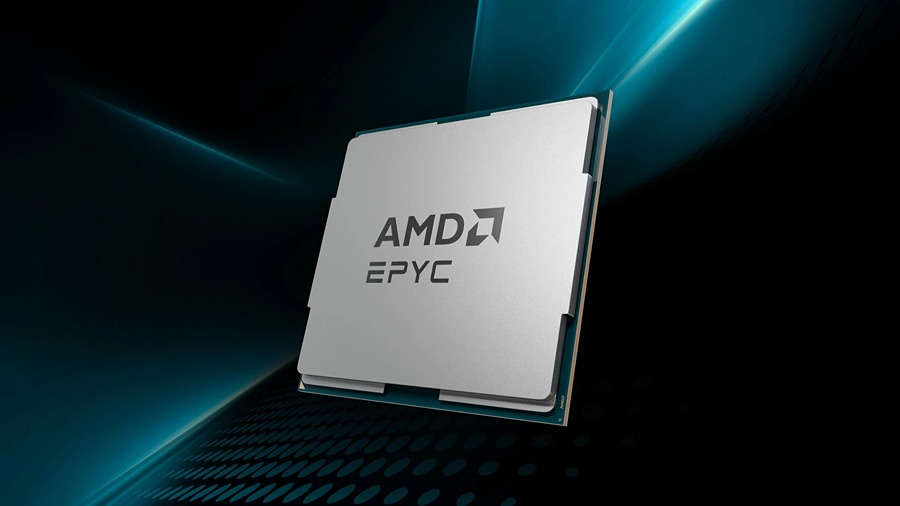
Google Cloud and AMD positioned TPU 8tx around protected inference, fine-tuning and reinforcement learning, with the host CPU carrying the security root.
Is confidential acceleration slow enough to change the answer?
Conclusion: for steady-state token generation, published hardware-TEE overhead is usually single-digit; the expensive part is startup and transfer-bound work. No independent TPU 8tx benchmark is public yet, so the figures below are a GPU-side proxy and any extrapolation to TPU should be labelled as analysis.
| Test configuration (TEE on vs off) | Token throughput overhead | Requests/sec overhead |
|---|---|---|
| H100 · Llama-3.1-8B | 6.85% | 3.22% |
| H100 · Phi3-14B-128k | 4.58% | 2.31% |
| H100 · Llama-3.1-70B | about 0% | about 0% |
| H200 · Llama-3.1-8B | 8.84% | 7.55% |
Source: the benchmark study archived as arXiv:2409.03992. Two caveats. First, reported spreads are wide — systems work published through ACM in 2025 (ccAI) cites studies in which Hopper confidential mode costs more than 20 percent on execution metrics, concentrated where CPU-to-device transfer dominates. Second, weight loading and cold start leak budget, because the encrypted copy path is traversed at job start. Practical rule: benchmark the first minute of a job, not the tenth.
Who has to sign off, and what evidence do they ask for?
Conclusion: remote attestation is the artefact your auditor wants, and it is a workflow with an owner, not a checkbox. Google Cloud Attestation returns verifiable claims aligned with the IETF Remote Attestation Procedures (RATS) Entity Attestation Token format, is documented as the default attestation service for Confidential Space, and can be supplemented by third-party verifiers — Intel reported an Intel Tiber Trust Authority integration with Confidential Space on 29 May 2025.
Organisational read: three questions must be answered before capacity is reserved. Which team owns the reference-value policy? Where are attestation tokens logged, and for how long? What fails closed when verification fails — job stops, or job silently degrades? The third question is where confidential AI programmes stall, because "silently degrades" quietly moves protected data back into a trust model that nobody approved.
How does TPU 8tx sit next to Google's existing confidential portfolio?
Conclusion: the accelerator is an extension of a portfolio you may already run, so the procurement conversation should be framed as coverage, not novelty. AMD EPYC processors underpin Confidential VMs, Confidential GKE, Confidential Space, Confidential Managed Service for Apache Spark and Confidential Dataflow, where AMD SEV technologies protect workloads; TPU 8tx brings the same root of trust to confidential AI acceleration.
| Job shape | Portfolio fit | What you still owe your auditor |
|---|---|---|
| Protected batch analytics on tabular data | Confidential Managed Service for Apache Spark, Confidential Dataflow | Data-minimisation policy per pipeline |
| Multi-party model collaboration | Confidential Space | Contribution-control rules and verifier choice |
| Containerised services and node pools | Confidential VMs, Confidential GKE | Image provenance and measurement baseline |
| Inference, fine-tuning, reinforcement learning on accelerators | Google Cloud TPU 8tx | Attested accelerator identity before memory access |
TPU 8tx, TPU 8i Max or a confidential GPU path: which one?
Conclusion: buy against your bottleneck. Google's own product page describes TPU 8tx as the third eighth-generation system, optimised for secure and confidential inference and also suited to small-scale training (cloud.google.com/tpu). The sibling, TPU 8i Max, is a memory-bandwidth play: a two-chip package reporting 768 MB of on-chip SRAM and 17.2 TB/s of high-bandwidth memory bandwidth (TechTarget, 10 November 2026). If your constraint is permission, you buy 8tx; if it is context length and decode bandwidth, you buy the other one.
| Decision dimension | Google Cloud TPU 8tx | Confidential GPU instance (Nvidia GPUs or AMD Instinct GPUs) | Self-hosted TEE cluster |
|---|---|---|---|
| Data-in-use protection scope | CPU memory plus connected accelerators, hardware-enforced | Varies by generation and hypervisor; verify per instance type | Full, but you own the root of trust |
| Software carry-over | x86 host, existing TPU tooling | Mature CUDA or ROCm stacks | Whatever your team already runs |
| Best-fit workload | Inference, fine-tuning, reinforcement learning under confidentiality | Training or serving with confidentiality as a layer | Regulated pilots with fixed capacity |
| Main hidden cost | Startup and attestation operations | Cross-vendor attestation tooling | Firmware review and key custody staffing |
Host-choice history is the least-hyped evidence in the release: for more than 10 leading hyperscalers and frontier AI labs, AMD EPYC processors are the host CPU of choice, across builds using AMD Instinct GPUs, Nvidia GPUs and custom silicon. The Google partnership runs through several EPYC generations and lands in today's Google Cloud Compute Engine C4D, N4D, H4D, Z4D and G4 instances, and includes years of corporate-level security work, with Google security experts performing deep reviews of AMD security processor firmware. That is a supply-chain argument, and risk teams understand it better than any benchmark table. Before you reserve capacity, it is worth reading where AI compute capital gets stuck in the wider TPU build.
Four misconceptions I keep seeing in planning documents
- "Confidential computing means end-to-end encryption." It protects data in use inside a verified hardware boundary. Data at rest and in transit still need their own controls; nobody inherits them automatically.
- "Overhead is a single number." Reported results split by phase: near-zero for some large-model decode paths, double-digit for transfer-bound and cold-start work.
- "The cloud provider attests on our behalf." The provider issues evidence; your policy decides whether to accept it. Ownership of that policy is the org chart decision.
- "A confidential host is a different data centre." It is still a rack neighbour. Mixed accelerator estates only become manageable once teams agree on shared power and thermal telemetry rather than arguing about interconnect specs first.
FAQ: the questions platform leads actually ask
Does TPU 8tx change what my model team has to rewrite?
Mostly no. The host is an x86 AMD EPYC platform, so the change sits in how you provision, measure and attest, not in your training or serving code.
Can I compare TPU 8tx directly against a confidential GPU quote?
Only on workload shape, not on the marketing claim. Fix one prompt-and-token distribution, run the same model weights through both, and record cold start, steady state and attestation wall-clock separately.
Is fine-tuning on protected data the strongest use case?
It is the cleanest business case: reinforcement learning and fine-tuning loops touch the most sensitive data over the longest sessions, and Google lists inference, fine-tuning and reinforcement learning as the target workloads for TPU 8tx.
What if our regulator does not accept hardware attestation?
Then treat attestation as one control among several and keep contractual and jurisdictional safeguards. Hardware evidence strengthens the file; it does not replace it.
A 90-day decision roadmap
- Days 1–15, name the owner. One accountable lead for the reference-value policy, one for key custody. If neither role exists, stop here; the project is an org problem.
- Days 16–35, measure the honest cost. Cold start, steady state and attestation latency on your own workload; document which numbers are vendor-published and which are yours.
- Days 36–60, map the portfolio. Decide per pipeline whether Confidential VMs, Confidential GKE, Confidential Space, Confidential Managed Service for Apache Spark, Confidential Dataflow or TPU 8tx is the correct layer.
- Days 61–90, run one protected job end to end. Third-party verifier in the loop, evidence archived, rollback path rehearsed for failed verification.
- Then, and only then, sign capacity. Reconcile it against the capital picture: TPU builds, packaging and power chains absorb money long before tokens are produced.
References
- AMD investor release, "AMD EPYC Expands Its Leadership at the Foundation of AI" — https://ir.amd.com/news-events/press-releases/detail/1304/amd-epyc-expands-its-leadership-at-the-foundation-of-ai
- Google blog, "Our newest TPUs: 8tx and 8i Max, built for the agentic era", 9 November 2026 — https://blog.google/innovation-and-ai/infrastructure-and-cloud/global-network/tpu-8i-max-and-8tx/
- ServeHome, "Google TPU 8tx Pairs AMD EPYC Turin Hosts with Confidential Computing" — https://www.servethehome.com/google-tpu-8tx-8i-max-amd-epyc-turin/
- arXiv:2409.03992, "Confidential Computing on NVIDIA Hopper GPUs: A Performance Benchmark Study" — https://arxiv.org/abs/2409.03992
- Google Cloud, TPU product page — https://cloud.google.com/tpu
- Google Cloud Attestation documentation — https://cloud.google.com/confidential-computing/docs/attestation
- TechTarget, "Google specializes TPUs for agentic, confidential computing" — https://www.techtarget.com/news/google-specializes-tpus-for-agentic-confidential-computing/874084/
- Intel Community blog, "Intel Tiber Trust Authority Integrates with Google Cloud Confidential Space", 29 May 2025 — https://community.intel.com/t5/Blogs/Products-and-Solutions/Security/Intel-Tiber-Trust-Authority-Integrates-with-Google-Cloud/post/1691578
- ACM, "ccAI: A Compatible and Confidential System for AI Computing" — https://dl.acm.org/doi/10.1145/3725843.3756104
Corrections and data-source requests go to the APACTechDigit AIFrontierTech desk at contact@apactechdigit.com.