
Claude Personal Finance Data Note: What Read-Only Bank Linking Actually Covers
By Lynn Zhou · APACTechDigit · AIFrontierTech · contact@apactechdigit.com
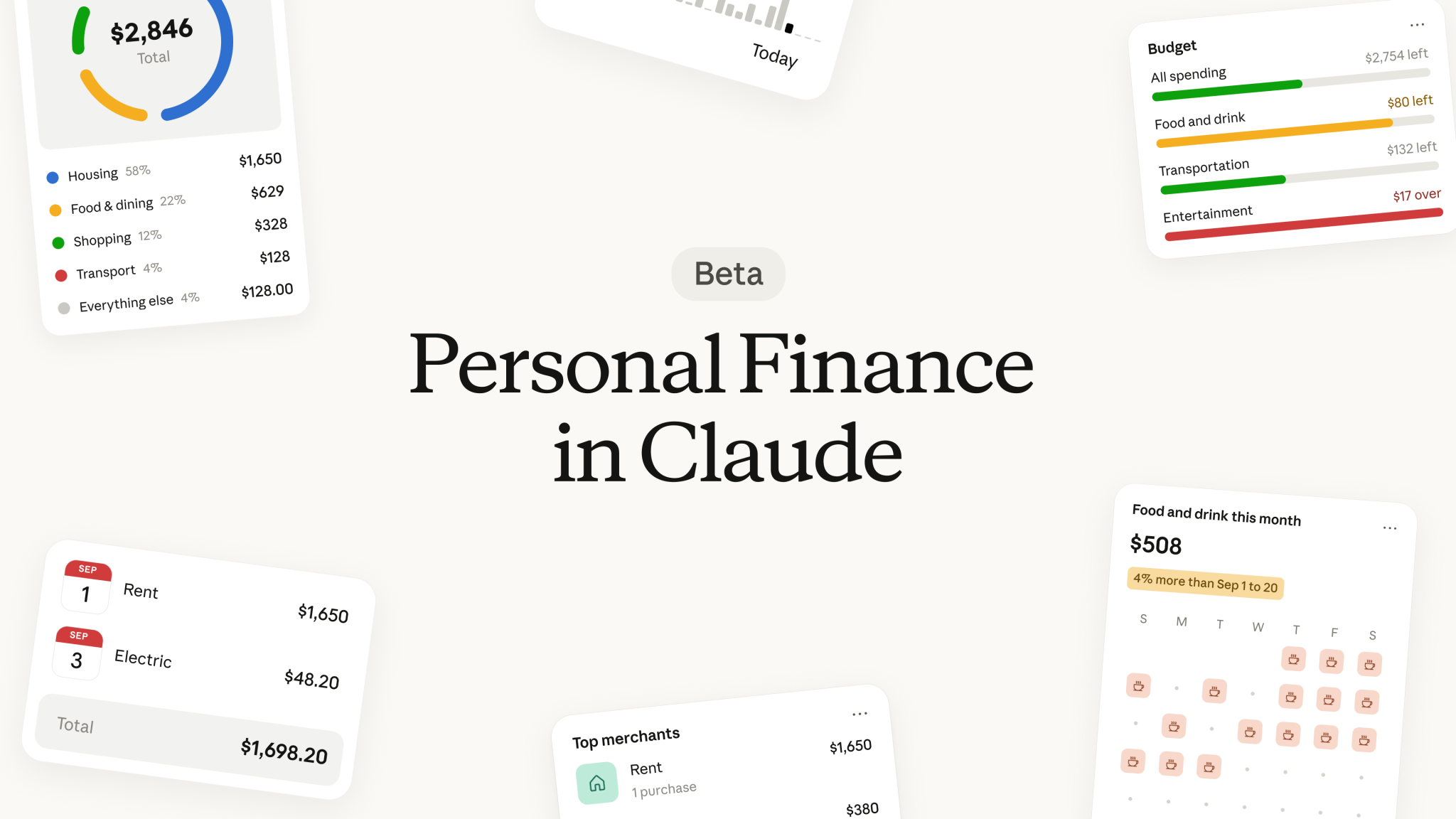
Anthropic has opened a read-only lane between Claude and live bank data. Personal Finance connects accounts through Plaid, reads balances, credit limits and up to two years of transactions, answers money questions in everyday language, and cannot move, manage or invest funds. For engineers and fintech decision-makers the signal is not the feature itself but the permission envelope around it: a capped account graph, a scoped data surface, and a training exclusion that applies only inside the hub.
What shipped, and on what timeline?
Conclusion first: a US-only, paid-tier beta that lands roughly six months after the category opened. Launch coverage dates the announcement to Thursday, November 5, 2026, with the beta beginning to roll out this week to Claude Pro, Max and Ultra subscribers in the US.
The calendar is the first data point that matters. OpenAI released a comparable personal finance experience inside ChatGPT in May of this year — May 15, 2026, per OpenAI's release notes — initially for US Pro users, then broadened to Plus and Pro subscribers on web, iOS and Android on June 25, 2026. Both vendors sit on the same plumbing: Plaid, which also underpins ChatGPT's connections to more than 12,000 financial institutions.
Anthropic's consumer move follows an enterprise one. On September 14, 2026 the company shipped Claude for Financial Advisors, bundling advisor workflows with connectors to Charles Schwab, BlackRock, Addepar and Orion, according to Schwab's press release. Personal Finance is the retail mirror of the same logic: differentiate the assistant on the data it is permitted to touch, not on the conversation layer.
What data does Claude see, and what stays out of reach?
Conclusion: the visible surface is an account identity plus a time-boxed ledger, not a complete financial life. Access is limited to bank name, account name and account type, the last four digits of the account, current balance and available balance, credit limit, and transaction history spanning at most two years. Full account numbers and Social Security numbers are excluded, and because sign-in happens on Plaid's own authorization surface, the model never handles a bank password.
| Field or capability | Status | Engineering consequence |
|---|---|---|
| Bank name, account name, account type | In scope | Enough to attribute a charge to a source without exposing institution-level records |
| Account number, last four digits only | In scope | Supports reconciliation; a leaked transcript cannot be turned into a usable payment instruction |
| Balance, available balance, credit limit | In scope | Enables solvency, runway and utilisation answers in one retrieval pass |
| Transaction history of up to two years | In scope | Long enough for seasonality and year-over-year comparison; short enough to bound token cost |
| Linked institutions | Capped at 16 | The Claude Help Center states a new bank can only be added after one is removed, which keeps the account graph small and auditable |
| Login credentials, full account numbers, SSN | Out of scope | Removes the highest-liability objects from the model's context entirely |
| Investment holdings, individual trades, loan rates and terms | Out of scope | Confines the product to spending analysis rather than portfolio or refinancing advice |
| Transfers, bill pay, trading, any write action | Not permitted | Read-only is enforced at the connector, not by prompt discipline |
How does the query loop work in practice?
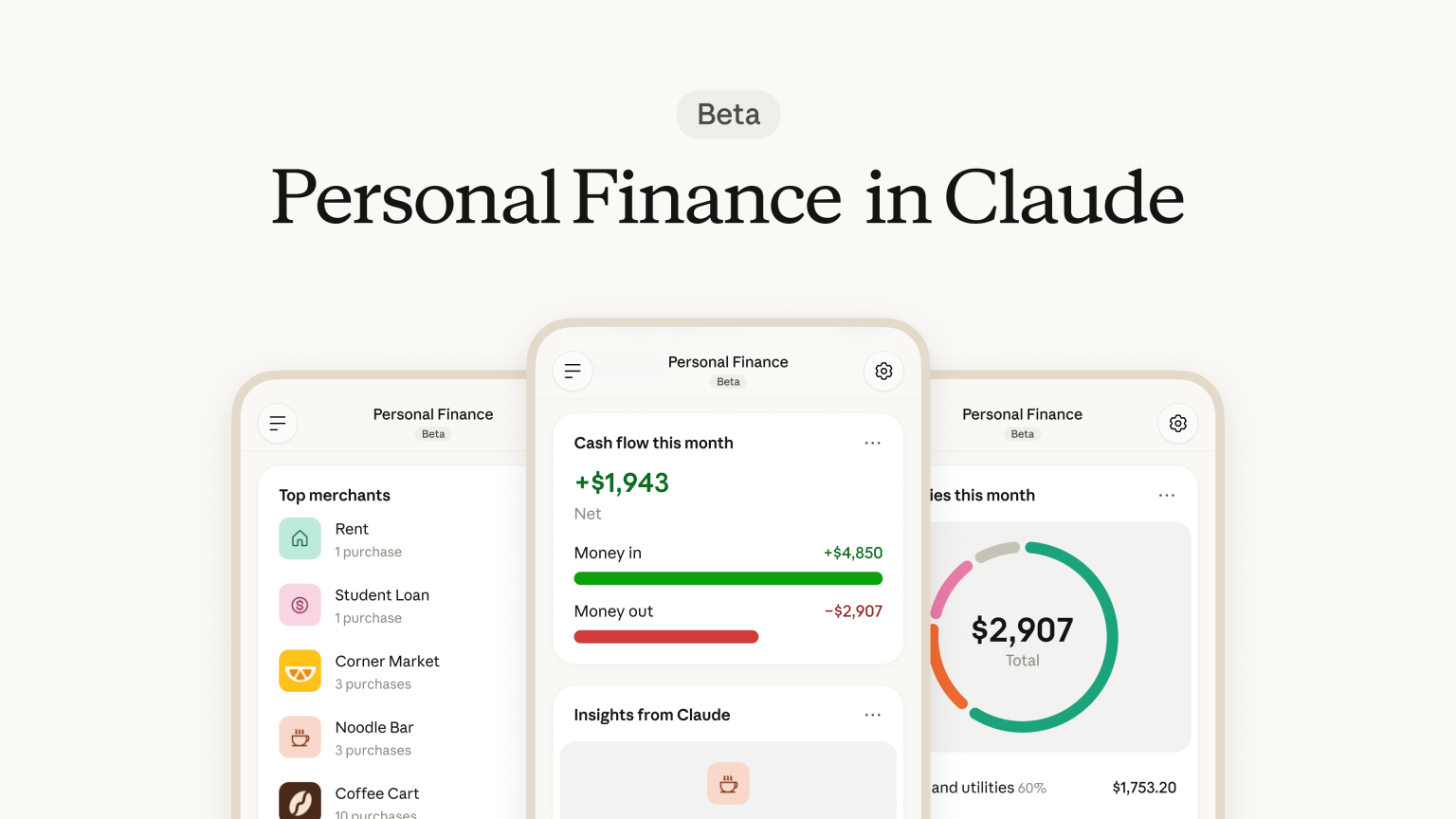
Conclusion: a single natural-language question triggers a multi-account join before a word of prose is generated. At month-end a user can ask "Where did my money go this month?"; Claude aggregates transactions across every connected account and rolls them into categories such as rent and utilities, dining and shopping. Follow-ups then run on the same snapshot — "Is this higher than my usual level?" and "What other expenses are worth watching?" — which is a retrieval-and-reasoning pattern, not a fresh model call per question.
- Proactive anomaly detection: multi-account transaction analysis flags duplicate charges, unexpected fees and steadily rising bills.
- Balance-sheet level questions: users can ask the macro question directly, such as whether my spending exceeds my income.
- Financial literacy layer: Claude explains jargon such as annual percentage rate (APR) in plain terms and then computes what the user actually paid in interest over the past year, turning a definition into a personal number.
Claude Personal Finance vs ChatGPT personal finance: where the two designs diverge
| Dimension | Claude Personal Finance | ChatGPT personal finance |
|---|---|---|
| First availability | Beta begins this week, announced November 5, 2026 | May 15, 2026 (US Pro), widened June 25, 2026 |
| Entitlements | Claude Pro, Max and Ultra, US only | Pro, then Plus and Pro, US only |
| Connector | Plaid, read-only consent | Plaid, spanning 12,000+ institutions |
| Primary surface | Conversational hub; category rollups and anomaly alerts | Dashboard view of portfolio performance, spending, subscriptions and upcoming payments |
| Reuse inside agent workflows | Linked accounts cannot be used in scheduled tasks, Cowork tasks or Claude Code | Not documented in OpenAI's launch note as an agent-workflow surface |
| Monetisation of answers | Anthropic states no ads or sponsored recommendations, and it does not offer cards, loans or deposit accounts | Not stated in the May 2026 launch note |
| Training use | Hub conversations are excluded from model training | Governed by OpenAI's own improvement controls |
Read as a comparison, the split is architectural: OpenAI front-loads a visual dashboard and treats the chat as an overlay, while Anthropic keeps the chat as the product and shrinks the data contract instead. For a household with several accounts and no analyst skills, the second pattern is usually the cheaper one to operate — an assessment, not a vendor claim.
Why the read-only boundary is the real design decision
Conclusion: the interesting part is not the model but the separation of three planes. Authentication stays with Plaid, so credentials never enter the inference plane; the data plane is a consented, field-level snapshot; and the inference plane is restricted to read operations with no tool that can move money.
That partition matches what banks currently tolerate. Legal analysis from Hunton's October 2026 review of bank restrictions describes the acceptable tier as "read-only data (e.g., balances) through open banking providers such as Plaid; no money movement or bill pay." Anthropic's own framing is narrower still: the feature cannot transfer, manage or invest funds, and the Personal Finance hub carries no ads or sponsored recommendations.
Two caveats are worth engineering attention. First, the training exclusion is hub-scoped: conversations in the Personal Finance section are not used to train AI models, while anything typed into a normal chat follows the account's standard privacy settings, and Anthropic's privacy documentation states deleted conversations leave back-end systems within 30 days. Second, the linked-account context is deliberately fenced off from autonomous execution — the Claude Help Center notes plainly that "Scheduled tasks can't use your linked accounts in Personal Finance," which means no unattended overnight agent run over live balances.
What the numbers say about demand — and about the headwind
Conclusion: appetite for read-only AI insight is broad; appetite for AI with hands on the money is not.
- A TD Bank U.S. survey published in early October 2026 found 69% of Americans would allow a bank-provided AI assistant to complete at least one financial task, with the same research noting roughly half of respondents had already used AI somewhere in their finances.
- Between October 13 and October 20, 2026, JPMorgan Chase, Charles Schwab, Citigroup and Wells Fargo each moved to block or contractually limit customer-directed AI agents, according to Hunton's summary of the announcements.
- Reuters and Axios reported on October 22, 2026 that major US banks had detected unauthorised third-party AI agents operating inside customer accounts and were restricting them.
Set against the launch, the sequence is legible: credential-based, agent-driven access is being shut, while consented read paths through aggregators remain open. Anthropic has built its consumer finance entry on the survivable side of that line. The risk is dependency: distribution is conditioned on Plaid's continued bank relationships, on a 16-institution cap, and on consent terms individual banks can rewrite — and there is still no comprehensive US open-banking mandate to arbitrate disputes.
Common misconceptions about Claude Personal Finance
- "It can pay my bills." No. Permissions are read-only; the feature cannot move, manage or invest money.
- "Claude has my bank login." It does not. Credentials are entered on Plaid's surface and never reach the model.
- "It will rebalance my portfolio." Balances on investment accounts are visible; holdings, trades and loan terms are not, so portfolio work is out of scope.
- "Everything I say is now training data." The hub's conversations are excluded from model training; normal chats follow your existing privacy settings.
- "I can schedule a weekly money report." Linked accounts do not carry into scheduled tasks, Cowork tasks or Claude Code, so recurring automation is not available today.
What builders and technical decision-makers should do next
- Treat the field-level list — bank name, account type, last four digits, balance, credit limit, up to two years of transactions — as a template for your own least-privilege connector design.
- Separate consent from inference in your architecture diagrams; if your agent can reach a password, you are building into the tier banks are closing.
- Bound the ledger window you feed the model. A two-year horizon buys seasonality analysis without unbounded context cost; anything longer should be summarised before it reaches inference.
- Write the retention promise as a number, not a phrase. "Deleted within 30 days" is auditable; "within a reasonable period" is not.
- Keep commercial neutrality explicit and testable if your answers touch product recommendations — that is the trust lever Anthropic is betting on.
FAQ
Is Claude Personal Finance available outside the US?
No. The beta rolling out this week is limited to paying subscribers in the US on Claude Pro, Max and Ultra, and only US banks can be linked.
How many accounts can one user connect?
Up to 16 linked banks. Once the ceiling is reached, an existing institution must be unlinked before another is added.
Can Claude accidentally spend money?
No. Access is read-only by design at the connector layer, so the feature cannot initiate transfers, pay bills or execute investments; it can only summarise and question what it is allowed to see.
Does linking a bank put transaction history into model training?
Conversations inside the Personal Finance hub are not used to train AI models. Data typed into ordinary chats, however, remains subject to the account's general privacy and retention settings.
What can it answer that a budgeting app cannot?
Grounded follow-ups. After an initial month-end rollup, users can ask "Is this higher than my usual level?" or "What other expenses are worth watching?" and, for example, get the interest actually paid over the past year rather than a generic APR definition.
References
- Claude Help Center — Use Personal Finance in Claude: https://support.claude.com/en/articles/18185620-use-personal-finance-in-claude
- OpenAI — A new personal finance experience in ChatGPT: https://openai.com/index/personal-finance-chatgpt/
- TechCrunch — Claude can now analyze your spending with its new personal finance tool: https://techcrunch.com/2026-11-05/claude-can-now-analyze-your-spending-with-its-new-personal-finance-tool/
- Hunton — Major Banks Move to Block or Limit Customer-Directed AI Agents: https://www.hunton.com/insights/legal/major-banks-move-to-block-or-limit-customer-directed-ai-agents
- Reuters — US banks detect unauthorized AI agents in customer accounts: https://www.reuters.com/legal/government/us-banks-detect-unauthorized-ai-agents-customer-accounts-axios-reports-2026-10-22/
- TD Bank survey coverage — Nearly 7 in 10 Americans Would Let AI Complete Certain Financial Tasks: https://stories.td.com/us/en/article/nearly-7-in-10-americans-would-let-ai-complete-certain-financial-tasks-td-survey-finds
- Charles Schwab — Schwab and Anthropic to Bring Claude to Independent Registered Investment Advisors: https://pressroom.aboutschwab.com/press-releases/press-release/2026/Charles-Schwab-and-Anthropic-to-Bring-Claude-to-Independent-Registered-Investment-Advisors/default.aspx