
Fixes, Not Findings: A Deep Dive on the GitHub–Microsoft Maintainer-First Security Pilot — APACTechDigit AIFrontierTech
AI has made finding potential vulnerabilities cheap. It has not made fixing them cheap. In a pilot run with maintainers rather than at them, GitHub and Microsoft turned thousands of possible issues into 99 private reports across six projects, and maintainers had fixed 55 of them by November 15. For APAC engineering teams, the sharpest finding is organizational: the bottleneck has moved from discovery to verification and merge, and that is where security budgets should follow.
The same dependency stack lands very differently across our region. A Tokyo bank meets Netty buried inside a vendor's messaging layer, patched on quarterly change windows. A Jakarta marketplace runs Express services whose upstream is a two-person team. A Shenzhen appliance maker ships Log4j inside firmware nobody audits. Identical packages, radically different fix capacity — and the GitHub–Microsoft pilot is worth a close read precisely because it engineers around that variable, treating the maintainer's merge queue, not the scanner, as the product.
Why unverified AI findings became a maintainer tax
Finding is no longer the constraint. Christian Grobmeier, a maintainer of Log4j, has framed the stakes: the AI defending open source has to be better than the AI attacking it. The attack side industrialized first, and low-quality AI-generated reports now reach maintainers every day. The cautionary case is curl: maintainer Daniel Stenberg documented how the project's bug-bounty queue filled with AI slop — invented code paths, hallucinated impact — in a widely cited post titled Death by a thousand slops. An unverified report is not free intelligence; it withdraws from the same capacity pool the fix needs. That is the market failure this pilot was built to reverse.
How does the maintainer-first pipeline work?
The pilot had two goals: only findings that matter should be sent, and no maintainer should receive an unverified finding. GitHub and Microsoft ran it on Codename MDASH, the multi-model agentic scanning harness from Microsoft Security, with a strict division of labor:
- Find. Codename MDASH scanned each project with Microsoft's MAI Cyber model and proposed fixes for what it found.
- Filter. An AI triage agent from the GitHub Security Lab, built on tailored Copilot skills, removed duplicates, checked validity, and concentrated on high-impact bugs.
- Verify. Researchers from Microsoft FORGE Lab hand-checked every remaining finding.
- Report privately. Maintainers received each report through GitHub private vulnerability reporting (PVR), with a proof of concept and a suggested fix.
- Fix. Maintainers decided what to fix, how, and when.
Across the six projects, the harness flagged thousands of possible issues. AI triage plus hand review by seven Microsoft FORGE Lab researchers narrowed that to 99 private reports. As of November 15, maintainers had fixed 55, and 14 of those fixes were already in a release.
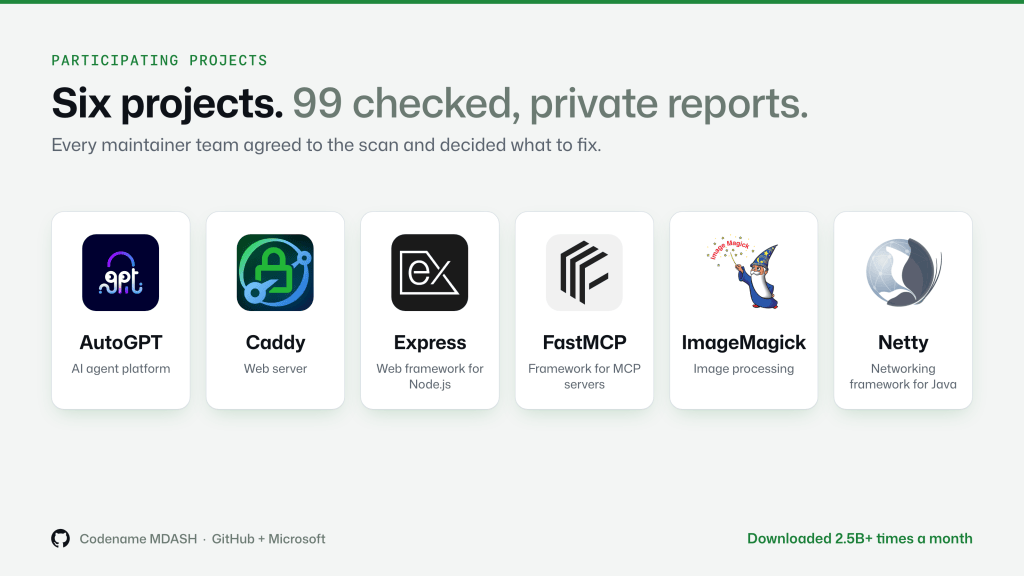
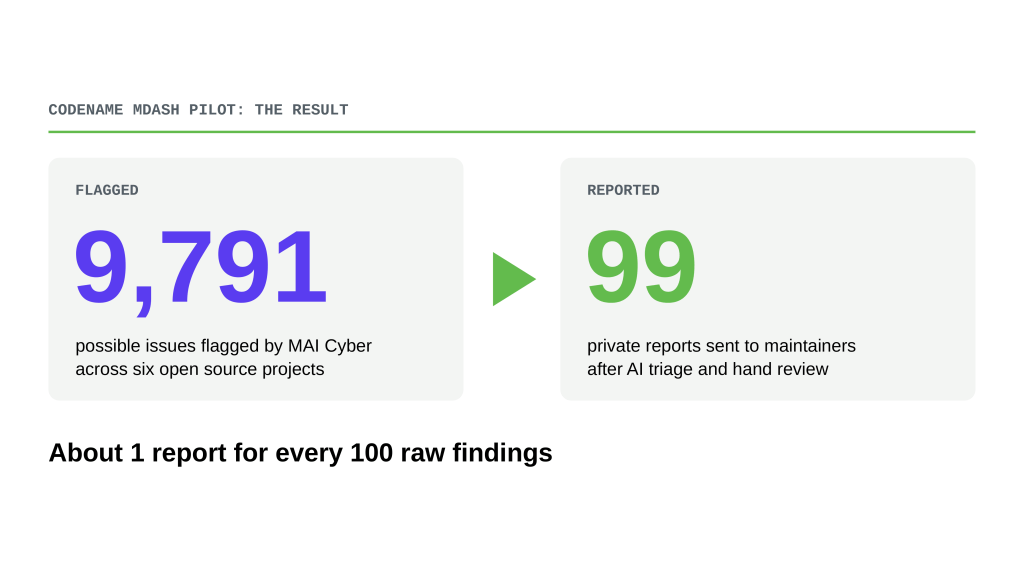
The contrast with the default behavior of AI security tooling is stark:
| Dimension | Unmediated AI scan dump | Maintainer-first pilot flow |
|---|---|---|
| Volume delivered | Everything the scanner flags | 99 private reports out of thousands of possible issues |
| Verification | The maintainer's problem | AI triage plus seven Microsoft FORGE Lab researchers |
| Fix attached | Rarely | Suggested fix with proof of concept |
| Channel | Public issues or bounty queues | GitHub private vulnerability reporting |
| Maintainer's first move | Triage from zero | Review a scoped patch |
What do the six cases prove about fix speed?
Six projects is a small sample, but the fix-speed data is the signal engineering leaders should read:
- Caddy. First fixes shipped about a week after the initial scan. Caddy's maintainers fixed 22 of the reports in a week or less, using the suggested fixes some as written and some with changes.
- AutoGPT. A newly shipped check was broken; the report landed three days later and pointed at the right line. Maintainers went beyond the suggested patch, wrote it within a day, and had it in production less than a week later.
- Netty. The bottleneck, in a maintainer's words: “Finding vulnerabilities is no longer our bottleneck. Fixing them is the hard part, and that depends on maintainers.”
- Express. Maintainers said the reports cut through the noise of vulnerability reports.
- FastMCP. “The Codename MDASH scan provided unique insights into the security of our project above and beyond what AI scanners have provided us in the past.”
- ImageMagick. Maintained by a two-person team, it received 22 reports. One looked at first like a familiar issue class; the summary showed it wasn't and pointed to exact lines, and the fix went out in 15 minutes. An ImageMagick maintainer: “Normally, a security advisory would take us around 30 minutes to 1 hour on average to read, understand, and make a fix. It is a huge difference.”
The pattern across all six: AI did the finding, researchers did the checking, maintainers stayed in charge.
Does it scale? The economics behind MAI Cyber 2
Seven researchers spent about two days per project verifying findings by hand. That is the honest cost of “no unverified findings”, and it does not scale yet. The commercial signal, though, points in the pipeline's favor: Today, Microsoft announced MAI Cyber 2, and trade press reported that MAI Cyber models already account for almost 40% of scans inside MDASH while MAI Cyber 2 Flash ships at a price 86% below its predecessor. Discovery cost keeps falling; human verification cost stays flat. The scarce asset is the verifying layer — which is why the pilot's design, not the model name, is the durable idea.
Nor is this an isolated experiment. Anthropic reported that Claude Opus 4.6 surfaced 22 vulnerabilities in Firefox in February 2026, more than in any single month of 2025, through a coordinated-disclosure partnership with Mozilla. The converging pattern across vendors: AI finds, a named party verifies, maintainers control the merge. When you evaluate any AI security pitch, ask who plays the verifying role. If the answer is “your maintainers”, keep walking.
Who pays for the safety net?
The economics are being subsidized upstream. Through the GitHub Secure Open Source Fund, each pilot project receives $10,000 via GitHub Sponsors, plus security training and Azure credits from Microsoft for Startups, sitting alongside Microsoft’s European Security Program and its Secure Future Initiative. Fund alumni also get GitHub Copilot Max as the program works to scale researcher review without cutting corners. The cumulative ledger: 216 projects, more than 300 maintainers, more than 4,000 vulnerabilities fixed in software downloaded more than 20 billion times a month. And when a maintainer publishes an advisory reviewed into the GitHub Advisory Database, Dependabot alerts every dependent repository — that is how one fix upstream becomes a fix downstream.
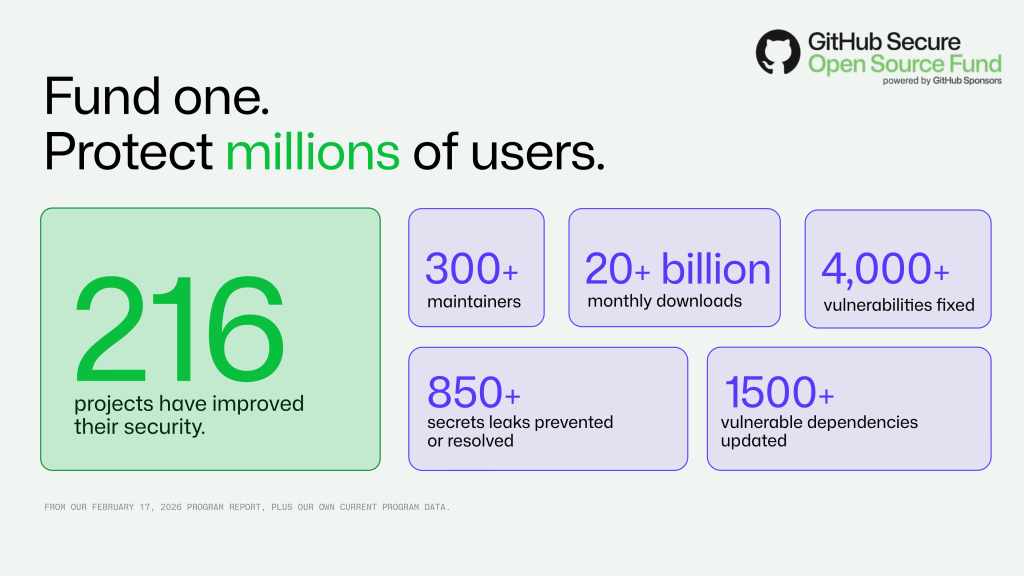
All alumni of the GitHub Secure Open Source Fund
AI, machine learning, and intelligent systems
- ACI.dev
- AlbumentationsX
- ArviZ
- AutoGPT/GravitasML
- CAMEL-AI
- Caracal
- CocoIndex
- Code-Graph-RAG
- CodeCarbon
- Cognee
- Deep Agents
- DIPY
- DocsGPT
- Jupyter
- LadybugDB
- LangChain
- Matplotlib
- n8n-MCP
- Nasiko
- NumPy
- Ollama
- ONNX
- OpenBB Platform
- OpenClaw
- OpenCV
- OpenMetadata
- OpenSearch
- PageIndex
- pandas
- Pydantic
- PyMC
- Ruby-OpenAI
- Scenic
- scikit-learn
- SciPy
- Serena
- TokenOps
- TraceRoot
- Zeus
Build systems, supply chain, and release tooling
- Apache Airflow
- Babel
- Bluefin
- bootc
- Browserslist
- Changesets
- Colima
- Concourse
- Cucumber
- CycloneDX Python Library
- Flux
- Foundry
- Gitoxide
- golangci-lint
- GoReleaser
- hardhat-deploy
- Jenkins
- JReleaser
- Jupyter Docker Stacks
- NixOS/Nixpkgs
- node-lru-cache
- oapi-codegen
- PostCSS
- PyPI/Warehouse
- rimraf
- Task
- Termux
- Terra
- Turborepo
- Warpgate
- webpack
- zizmor
Core programming languages, runtimes, and foundational libraries
- Apache Commons
- Apache Groovy
- Byte Buddy
- core-js
- CPython
- FS2
- Gleam
- Himmelblau
- htmx
- LLVM
- modernc.org/sqlite
- NAPI-RS
- Node.js
- Pkl
- Pyodide
- Rustls
- termcolor
- time-rs
Developer tools and productivity platforms
- AirQo
- API Dash
- ArduPilot
- AssertJ
- AsyncAPI Initiative
- Bevy
- Bootstrap
- calibre
- Charset Normalizer
- Cheerio
- Ciphey
- Cobra
- CodeRunner
- CSS Declaration Sorter
- DataJourney
- Diesel
- DIGIT
- Electron
- ERPNext
- fabric.js
- GitPython
- Hoppscotch
- jQuery
- js-yaml
- jsoup
- JUnit
- libyt
- LORIS
- MapStruct
- Mastodon
- Mathesar
- Mautic
- Mermaid
- MessageFormat
- Mockoon
- NativeScript
- Next.js
- Nuxt
- nvm
- Oh My Zsh
- p5.js
- Path-to-RegExp
- Pelias Geocoder
- Pest
- Pillow
- Polly
- Proyecto Respira
- PypeIt
- python-benedict
- qs
- React Starter Kit
- Readest
- Resolve
- Rocket.Chat
- Selenium
- shadcn/ui
- Sphinx
- Spyder
- ssh_config
- StackQL
- Stirling PDF
- Svelte
- Thunderbird for Android
- ToolJet
- Two.js
- Viper
- virtualenv
- Vuetify
- Wagmi
- WebdriverIO
- xyflow
- YAML
- Yii Framework
- Yjs
Web, networking, APIs, and infrastructure services
- actix-web
- aiohttp
- Apache APISIX
- Apache Shiro
- Apache Solr
- Apache ZooKeeper
- Arkime
- Caddy
- cmux
- Cryptomator
- curl
- CycloneDX .NET Library
- CycloneDX cdxgen
- Ente
- etcd
- evcc
- Express
- external-secrets
- FastAPI
- Fastify
- Haraka
- Helmet.js
- Home Assistant
- Hummingbird
- jose
- Keycloak
- Keyshade
- kgateway
- Log4j
- mimetype
- NetBird
- Netty
- Oauth2 (Ruby)
- OAuthlib
- openapi-stack
- OpenWISP
- PGPainless
- quic-go
- ScanAPI
- ScanCode
- Sniffnet
- Social Auth App Django
- Stalwart
- Starlette
- UAParser.js
- urllib3
- Vapor
- varlock
- Veramo
- WebAuthn (Go)
- ZITADEL
Which assumptions should you drop?
- More scanners mean more security. Discovery is the cheap part; unverified volume taxes the same people you are trying to protect.
- AI-generated reports are valid by default. The curl slop flood shows hallucinated reports arriving at scale — verification belongs on the sender's side.
- Enabling private reporting ends the work. Maintainers still need CI/CD tests on private forks to verify fixes, and access to cyber-capable models to check a proof of concept before and after the patch.
- Agents can fix without oversight. In this pilot, maintainers set the pace on every fix; autonomy without a verifying layer is how trust breaks.
FAQ: what readers ask first
What exactly is Codename MDASH?
A multi-model agentic scanning harness from Microsoft Security that discovers and proposes repairs for vulnerabilities in widely used open source. This pilot ran on the earlier MAI Cyber model.
How much did the pilot actually deliver?
Six projects, thousands of possible issues narrowed to 99 private reports, 55 fixed as of November 15, and 14 of those fixes already in a release.
Why private reporting instead of a public issue?
It removes the public exposure window attackers exploit, lets maintainers set the pace, and keeps reports and fixes on GitHub where maintainers already work.
What can a maintainer do this week?
Turn on private vulnerability reporting, run gh-secure to enable core security features in about two minutes, and — if you build on open source — turn on Dependabot alerts so dependency advisories reach you.
What APAC teams can do this quarter
For teams that consume open source — in practice every APAC bank, marketplace, and device maker — the core moves are short. Repositories using GitHub code security can put agentic autofix, powered by Copilot, on their alerts. When AI agents enter build and release tooling, hold them to the standard we applied when reviewing agentic EDA verification platforms: assistance earns sign-off roles only when its outputs are reproducible and versioned. Agent access itself deserves the same discipline — our earlier piece on why scoped tokens and platform isolation beat perimeter promises applies directly to AI security tooling.
A localization checklist before you copy the pattern
- Map who actually maintains your critical dependencies; flag two-person-team projects like ImageMagick and pre-book patch windows in your change control.
- Enable GitHub private vulnerability reporting on every repo you own; run gh-secure for core security features in about two minutes.
- Turn on Dependabot alerts downstream so a reviewed advisory reaches the owning team, not a shared inbox.
- Set a sender standard for any AI-generated vulnerability report you accept or forward: checked against the project's threat model, delivered privately, with a suggested fix.
- Scope credentials and isolate runtimes for every AI agent you deploy into engineering workflows.
The same package may sit in Tokyo core-banking middleware and a Jakarta storefront, but the discipline transfers across our markets: whoever verifies, owns the trust of the merge queue. Maintainers do the fixing — the pipeline's job is to make sure they never do it alone.
References
- GitHub Blog, “Maintainers don't need more AI bug reports. They need fixes.” — https://github.blog/open-source/maintainers/maintainers-dont-need-more-ai-bug-reports-they-need-fixes/
- Daniel Stenberg, “Death by a thousand slops” — https://daniel.haxx.se/blog/2025/07/14/death-by-a-thousand-slops/
- Anthropic, “Partnering with Mozilla to improve Firefox's security” — https://www.anthropic.com/news/mozilla-firefox-security
- TechMonitor, “Microsoft expands MAI portfolio with seven new models” — https://www.techmonitor.ai/news/microsoft-expands-mai-portfolio-with-seven-new-models