
Ginux vs. Linux, gVisor and Linuxulator: A Scorecard for 11 Days of Agentic Kernel Engineering
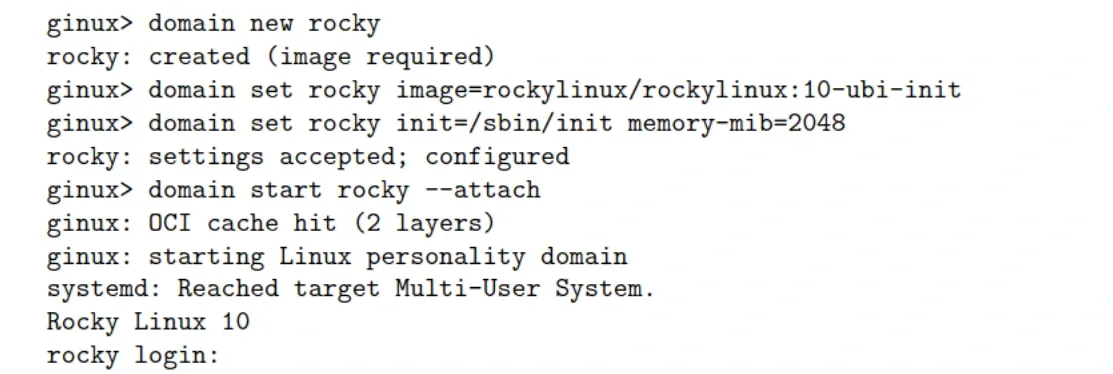
Score first, story second. Ginux did not beat Linux, and that was never the contest. What the experiment stress-tests is a working protocol — Human-Directed Agentic Engineering — graded against the harshest oracle systems software offers: an unmodified Rocky Linux 10 userland. Read that way, the run is genuinely impressive: roughly 139,000 lines of retained implementation and test code in 11 days, more than 1,000 commits, and a boot that carries the distribution as far as systemd's multi-user target. Read the same way, it is also visibly unfinished: of the 375 system calls that make up the Linux 6.12 x86-64 interface, only 82 are fully implemented. Those two figures belong in the same sentence. Everything a technical leader decides about agent-written systems code lives in the distance between them.
For teams choosing where generative agents should be deployed next, the useful question is not "can a model write an operating system?" but "which route to Linux compatibility are we buying, who verifies it, and what does verification cost?" This evaluation places Ginux alongside the three established answers to that question, then draws an explicit adopt / watch / skip line.
1. What is actually on the table
Kurtzer surfaced the project on X last week, with the source published on GitHub under an Apache 2.0 licence. The name stitches together Linux, GPT and Greg, and the project description jokes that the G is best read as GPT so the author does not come across as over-inflated.
- Not a fork. Memory management, scheduling, the process model, the file system and networking are all written from scratch, in Rust as the primary language, targeting x86-64 and booting directly through UEFI rather than sitting on a host kernel.
- One shared surface. The only thing Ginux and Linux have in common is the application binary interface. The framing used by the author is worth quoting in spirit: Linux is not merely one kernel implementation but a "personality" — the behaviour a kernel presents to applications. Only the Linux personality exists today; a BSD personality is not ruled out later.
- Isolation as a first-class object. Workloads run inside "Domains", each with its own processes, address space, file system, mounts and lifecycle. The project pitches this as a stronger boundary than namespace-based containers, while still assembling domain root filesystems from standard OCI images — the very mechanism that let it load Rocky Linux 10.
- Compatibility is partial by design. Against the Linux 6.12 x86-64 reference, 82 calls are complete, 245 work only partially, and 48 are deliberately left unavailable. Musl-based Alpine workloads and glibc-based Rocky Linux programs both run, which is the practical definition of "useful prototype".
2. Four routes to the same contract, side by side
The table below is the comparison that matters for architecture decisions. It is organised by who owns the syscall surface, because that single variable drives compatibility risk, performance overhead and audit burden.
| Route | What sits under the app | How the Linux contract is honoured | Blast-radius control | Coverage & assurance today | Where it wins |
|---|---|---|---|---|---|
| Native Linux kernel (6.12 as the reference point) | Monolithic kernel, decades of driver work | It is the contract | Namespaces, cgroups, SELinux/AppArmor; shared kernel across containers | Full syscall set; continuous public review and vendor security teams | Any production fleet, any hardware |
| Ginux | Independent Rust-first kernel | ABI reimplemented from scratch; partial coverage (82 complete of 375) | Domains with per-domain processes, address space, filesystem and mounts | No independent security audit; runs in QEMU only; bare metal, GPU and NVMe unsupported | Research, teaching, isolation experiments, agent-engineering case studies |
| FreeBSD Linuxulator | Mature FreeBSD kernel | Translates Linux system calls into FreeBSD equivalents; runs unmodified Linux binaries | FreeBSD jail + the host kernel's own guarantees | Long-documented upstream feature (FreeBSD Handbook); gaps appear as applications get newer | Running a Linux-only binary on a non-Linux kernel host |
| gVisor Sentry | User-space "application kernel" in Go above a host Linux kernel | Implements a Linux-compatible syscall surface in user space; deliberately a subset | Intercepts every syscall before the host kernel sees it | Production use in multi-tenant container platforms; documented architecture guide | Multitenant sandboxing of untrusted or agent-generated code |
| MicroVM (Firecracker-style) | A second real Linux kernel per workload in a lightweight VM | Hardware virtualisation; nothing emulated | Strongest boundary available in practice | Mature, widely operated; costs show up as cold start and density limits | Hard multi-tenancy where a kernel bug is unacceptable |
Two observations fall out of the grid. First, every Linux-compatibility strategy ever shipped is a bet on incomplete coverage: FreeBSD translates, gVisor re-implements in user space, Ginux re-implements in kernel space — and all three leave calls unimplemented. Compatibility percentage, not line count, is the metric to track. Second, Ginux is the only entry that combines a re-implementation with a novel isolation model, which makes it simultaneously the most interesting and the least verifiable option on the list.
3. The method under test: direction, gates, and a real distribution as oracle
The execution loop is what deserves the attention. Kurtzer fixed the architecture, the staged milestones, the constraints and the acceptance criteria; a continuously running OpenAI Codex task on the GPT-5.6 Sol model handled implementation, booting, testing and repair, then committed the result — more than 1,000 commits in 11 days, simple division puts retained output at roughly 12,600 lines a day.
The comparison case is Anthropic's own experiment, where Nicholas Carlini led a team of parallel agents through nearly 2,000 Claude Code sessions and about $20,000 of API spend to produce a 100,000-line Rust C compiler capable of building much of Linux 6.9 (anthropic.com/research/building-c-compiler). Two differences explain why Ginux is harder to accept than the compiler, even though both landed in a similar time frame:
- Oracle quality. A compiler inherits decades of test suites and reference toolchains; there is a canonical answer to check against. A kernel that must run someone else's untouched userland has no such harness — the distribution itself becomes the test.
- Topology of the agent work. Carlini's team sharded the job across parallel agents with narrow interfaces; Ginux ran as one long-lived task over 11 days, which puts pressure on architectural alignment rather than on parallel throughput. Public summaries of the Zenodo technical report (zenodo.org) describe exactly that pressure — the resulting code reads as something that grew until the tests passed, with heavy global state and no symmetric multiprocessing support.
The lesson for engineering organisations is uncomfortable but actionable: the scarce input shifted from keystrokes to specification quality and to the existence of executable gates. Kurtzer reports that booting a real Rocky Linux userland surfaced failures that hand-written synthetic tests had missed — which is the single most transferable finding in the whole exercise.
4. Numbers the report puts on the table
- Boot path. The build produces a single UEFI image, so kernel, embedded management controller and boot components ship together with no host Linux kernel underneath.
- Boot time. The project's own measurement brings a Rocky Linux 10 userland to a loginable state in 12.9 seconds versus 42.6 seconds on Linux, on a VM allocation of 1 vCPU and 2 GiB on an Apple Silicon machine. The write-up treats this as indicative rather than like-for-like: no kernel load step and a pre-cached filesystem flatter the number.
- Runtime benchmarks. Three-second sysbench runs, nine iterations, medians taken: Ginux sits marginally ahead on CPU and thread tests, marginally behind on memory, with gaps in the single-digit to mid-teens percentage range (36kr.com summary of the technical report).
- Spend. API cost for the 11-day build is reported at roughly $8,000 — about two-fifths of the compiler experiment's budget, for a far larger retained codebase.
5. Where the prototype stops, and what that costs you
No production framing here, and Kurtzer offers none. The prototype lives entirely inside QEMU: no physical boot, no GPU, no NVMe storage driver path. There is no independent security audit, so the safety claims are structurally unverifiable rather than merely unproven. Coverage gaps mean a workload that passes today can fail on the next dependency update. And the isolation story — Domains versus containers — is an architectural argument until somebody publishes an escape-resistance evaluation against it.
For anyone evaluating this as a platform bet, the risk profile is specific: a re-implemented syscall layer is simultaneously the compatibility surface and the attack surface. Partially implemented calls are the dangerous middle band — not rejected, not complete, and free to behave differently from Linux in the edge cases that only appear in production.
6. The bottleneck moved from writing code to verifying it
Assurance has always been the expensive half of kernel work. seL4 remains the reference point: a microkernel with machine-checked proofs of functional correctness, produced through years of formal-methods effort, and with proof maintenance flagged as an ongoing cost in the original SOSP paper (sel4.systems). Set that bar next to 12,600 lines a day and the asymmetry is obvious.
The Linux community's own handling of AI code makes the same point. Last month Linus Torvalds used Claude Code on an experimental set of page-cache patches; reviewers subsequently found a race condition, and the work is still under review. Around the same period kernel maintainers agreed they would no longer require contributors to disclose whether code was AI-assisted, winding back the "Assisted-by" tagging convention introduced earlier in the year (zdnet.com, reddit.com/r/linux). Provenance labelling is losing ground to review quality as the actual control — which is precisely the control that cannot be parallelised with more GPU spend.
Language choice does help, but only on one axis. Google's Rust-in-Android programme cut the share of memory-safety vulnerabilities from 76% of Android flaws in 2019 to 24% in 2024, and below 20% in the following year of reporting (security.googleblog.com, blog.google). Memory unsafety is a large slice of kernel defects and Rust suppresses much of it. Design correctness, ABI semantics, concurrency and threat model are not covered by the borrow checker.
7. Five misconceptions worth killing now
- "Ginux is a Linux distribution." It shares no Linux kernel code; only the ABI is emulated.
- "139,000 lines means it is nearly complete." Retained line count measures volume, not interface coverage — 82 of 375 calls complete is the honest measure.
- "The engineer was replaced." Architecture, milestones and acceptance criteria were human-set; the AI ran the implementation-test-repair loop. That is a role change, not a role removal.
- "Domains make containers obsolete." Containers have 15 years of adversarial hardening behind them; this isolation model has no published audit at all.
- "Rust plus AI equals a cheaper fleet OS." Today it cannot boot on hardware, drive an NVMe disk or run a GPU. The cost curve that matters sits in porting, hardware enablement and security review.
8. Scenario calls: adopt, watch, or skip
| Your situation | The real trade-off | Call |
|---|---|---|
| Platform team sandboxing agent-generated or untrusted code | Syscall-surface reduction versus operational maturity | Adopt the pattern, not the project: gVisor or microVM today; read Ginux as a design study on domain-level isolation |
| OS, driver or embedded team facing a rewrite | Bootstrapping speed versus long-term maintainability | Watch: use HDAE to generate scaffolding and test harnesses, keep humans on the architecture and review gates |
| Research, teaching or conference demo | Fidelity versus accessibility of a readable kernel | Adopt: an Apache 2.0 Rust kernel that boots a real userland is an unusually good lab artifact |
| Enterprise procurement assessing an OS supplier | Innovation story versus audit trail, hardware matrix, support window | Skip: no certification path, no security review, no bare-metal support |
| CTO deciding where to put agents first | Velocity gain versus review backlog | Adopt on well-instrumented code with executable gates; defer on security-critical, long-lived infrastructure |
9. FAQ
Is Ginux a Linux fork?
No. It is an independent x86-64 kernel that emulates the Linux ABI. Nothing from the Linux kernel tree is reused.
How complete is the compatibility layer?
Against Linux 6.12 x86-64: 82 of 375 system calls complete, 245 partial, 48 intentionally refused. Enough for musl/BusyBox Alpine binaries and glibc Rocky Linux programs, not enough for general-purpose workloads.
What did the AI do that a human could not?
Sustained implementation-test-repair iteration at machine tempo: about 139,000 retained lines and over 1,000 commits inside 11 days, driven by one continuously running OpenAI Codex task on GPT-5.6 Sol.
Why did a real distribution matter more than unit tests?
Synthetic tests check what the author thought of. Booting untouched Rocky Linux 10 to systemd's multi-user target checks what the ecosystem assumes — and found defects the harness had missed.
Is this a security risk to run?
As an unaudited, QEMU-only research prototype, it should be treated as the highest-risk class of software: no independent review, incomplete syscall semantics, no hardware support path. Community bug reports are the current safety mechanism, which is what the author expects and wants.
Can we reproduce this method on our own codebase?
The transferable parts are cheap: architecture documents, milestone constraints, acceptance criteria and an executable gate that fails loudly. The expensive part is finding an oracle as unforgiving as a real distribution.
10. Action checklist for the next 90 days
- Write the four documents before writing the prompt. Architecture, constraints, milestones, acceptance criteria. Agents degrade gracefully on fuzzy specs and shine on rigid ones.
- Build one unforgiving gate. Prefer a real artifact — production config, standard image, published test suite — over hand-written unit tests as the pass/fail signal.
- Track coverage, not output. Publish an interface-completion table the way Ginux publishes 82/245/48. Line counts are marketing; coverage is engineering.
- Price verification explicitly. Budget review hours and, for security-sensitive components, an external audit — seL4 and the Android Rust data both show assurance is where the money goes.
- Keep provenance discipline even where policy drops it. Kernel maintainers no longer require AI disclosure; your compliance obligations and your own incident forensics still do.
- Run a bounded experiment. Pick a self-contained, well-tested subsystem, give agents the loop, and measure defect escape rate at 30 and 90 days against your human baseline.
Three numbers will tell us whether this method is a inflection or a curiosity: whether the 82-of-375 completion curve steepens, whether the first bare-metal boot appears, and whether an independent security review ever gets published against it. Until then the honest reading is that AI has ended the argument about whether models can write deep systems code, and started a much more expensive argument about who will certify it. The interesting work is no longer producing the 139,000 lines — it is building the harness that can be trusted to judge them.