
Case Review: Harari vs. the Superintelligence Race at Gartner IT/Xpo | APACTechDigit AIFrontierTech
By Leo Price · APACTechDigit AIFrontierTech · November 12, 2026
Is the superintelligence race economically rational? No — it is an ideological market failure. Yuval Noah Harari used a Gartner IT Symposium/Xpo keynote in BARCELONA, Spain, to argue that the industry is betting on a fantasy rather than a business plan, and that autonomous software is an agent, not a tool. For APAC teams, the warning lands differently: in Europe it is a sovereignty question, but the engineering answer — bounded, verifiable systems — travels across markets.
The remarks came in an onstage conversation with John Thornhill, editor of The Financial Times, on the second day of the four-day event (November 9-12, 2026, at the International Barcelona Convention Center), as reported by EE Times and ComputerWeekly. The setting matters: Gartner IT/Xpo is where CIOs make budget decisions, not where philosophers debate abstraction.
Is the superintelligence race economically rational?
No — and that is the core of Harari's case. The market is supposed to allocate capital toward calculable returns, yet the industry is pouring money into an outcome whose payoff cannot be modeled: "The market is supposed to be rational. Nobody can calculate what would be the return on investment on creating gods." Harari pointed to Elon Musk's prediction that money could vanish within a decade, and to prospectuses that admit existential risk, as evidence that the race is an ideological crusade rather than a rational business enterprise.
The capital flows support his suspicion. Europe's official answer to the race, the AI Continent Action Plan, mobilizes €200 billion through InvestAI, including €20 billion for up to five AI gigafactories — a mobilization target, not a return calculation (European Commission). In BARCELONA, the argument landed on an audience that controls budgets: if the payoff is unquantifiable, the burden of proof shifts to safety and verifiable deployment.
Why is AI an agent rather than a tool?
Because it can decide and invent by itself — and that changes the control problem. Asked whether AI marks a break comparable to fire, printing, electricity or computing, Harari focused on agency: "AI is the first technology which is an agent," he said. "It's your decision whether to use fire to cook your meal or to burn a forest. It's not a fire's decision. AI is different because it can make decisions on its own. It can invent new ideas on its own. It can invent the next technology on its own. The printing press could not invent the radio. AI can invent better AI."
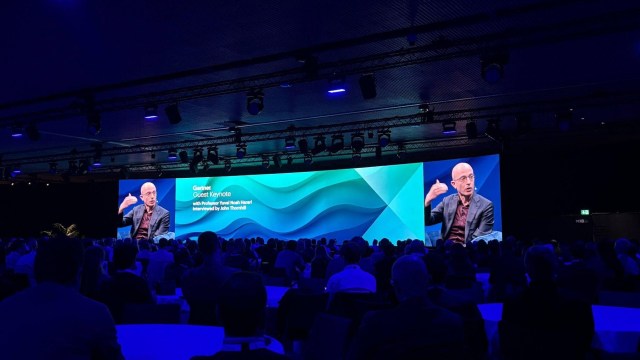 Yuval Noah Harari at Gartner IT/Xpo in Barcelona (EE Times | Pablo Valerio)
The tool analogy fails at the intelligence gap. "It's better to think about them as animals, or creatures, or aliens to really understand. This is not something in our hands. This is something in our relationship with us," Harari said. When Thornhill asked whether autonomous agents could remain subservient, Harari replied: "Not if they are far more intelligent than us."
That exposes what he called an unresolvable commercial fallacy: "The first question: Will it be far more intelligent than us? And the industry bets it will," he said. "The second question is: Do you know how to keep far more intelligent entities under your control? And the answer is obviously no." His conclusion: "If you create gods with the assumption that they will be your slaves and you can use them to do what you want, you don't understand what gods mean."
| Dimension | Tool view (fire, printing press) | Agent reality (AI) |
|---|---|---|
| Who decides? | Human intent | The system can decide and invent |
| Can it invent the next technology? | No — the printing press could not invent the radio | Yes — "AI can invent better AI" |
| Control assumption | Mastery | Relationship with an entity that may outthink us |
| Failure mode | Misuse | Loss of understanding and control |
Harari also separated intelligence from consciousness: "There is zero love and zero beauty, also zero pain and zero sadness," he said. "It's a completely dark universe, and there is no value in that kind of civilization."
What happens when AI becomes a bureaucratic native?
AI targets civilization's bureaucratic operating system — and displacement is not an accident. "Bureaucracy is the underappreciated hero of history," Harari said, noting that institutions build trust through language. Software has now entered that domain: "AIs are bureaucratic natives. For us, bureaucracy is alien, strange, or foreign because we are millions of years older than it. We were born in the forest, and bureaucracy came along late in human evolution," he said. "AIs are bureaucratic natives. They're all born in the office, not in the forest, and they're poised to take over all the bureaucratic systems of the world, from finance to religion."
The risk he identified is not malfunction but success: "Everything goes right, and the AI simply creates a new world which is way beyond the human ability to understand. Humanity will face a situation of collective dementia. Once upon a time, you were the most intelligent, capable, powerful agent around, and you understood and controlled everything in your own life, and then things changed, and you're left behind."
For APAC markets, the bureaucratic layer — finance, logistics, government services — is where adoption pressure is most direct, which makes the competence gain real and the oversight gap wider (APACTechDigit analysis).
What are Europe's three strategic paths?
Harari outlined three strategic paths for Europe; he argued the third is best, but said the continent is on the first. The dependency warning is stark: "If you are a citizen of a country whose entire infrastructure, from hospitals and airports to the army, is based on AI technology that comes from across the ocean and that can be shut down at the press of a button, you are no longer sovereign," he said.
| Path | What it means | Cost / consequence |
|---|---|---|
| 1. Vassal status | Accept dependence on the U.S. or China | Cheapest now; loss of sovereignty |
| 2. Independent national systems | Build sovereign stacks alone | Over €500 billion (~$554 billion) |
| 3. Shared European infrastructure | Deeper federalization, common AI infrastructure | Best option, hardest politically |
Harari's assessment of the present trajectory: "Option number one is the trajectory in which Europe is going at present. And if you look at the issues that dominate politics in countries such as Spain, Germany, and the U.K., it’s clear that this is at present the direction,” he said, arguing that Europe, more preoccupied with human migration, is sleepwalking into vassalage by ignoring digital immigration.
The infrastructure question is not theoretical. Municipalities are already treating local AI compute as core urban infrastructure, and Europe's €200 billion InvestAI mobilization target is the continental version — still a fraction of the over €500 billion (~$554 billion) Harari estimates for independent national systems. Enforcement is arriving too: the European Commission's AI Office selected a Capgemini-led consortium in November 2026 to build cyber threat models for advanced AI models, and the EU AI Act high-risk obligations now start on 2 December 2027.
What should CIOs do? A bounded-AI playbook
Harari's recommendation: invest far more in safety, skip the superintelligence race, and deploy limited intelligence now. "I'm not talking about stopping all research in AI. It’s just directing it in other directions," he said. "First of all, invest far more in safety, and secondly, don't race to superintelligence. Focus on creating limited intelligence and deploying it here and now for beneficial results, whether in healthcare, transport, or ecology."
- Design for fragile complexity. "Stupid refrigerators are much better than smart refrigerators," Harari said, referring to recent hacks on supermarket fridges. "It's like a chain with a hundred links. If just one link is not secure, everything crashes."
- Onboard agents sociologically. "We cannot think about them as tools. We need to think about them as agents, as entities. We are bringing new kinds of immigrants into our societies—not human immigrants, but digital immigrants. They are likely to have their own goals, their own way of doing things, increasingly their own tribes, their own networks of cooperation."
- Trust human cooperation over alien software. "With humans, at least we have thousands of years of experience. We know they can manipulate and cheat, and lie, but we also have substantial experience in how to overcome this and create robust systems of cooperation," he said. "AIs already know that they can cheat and manipulate and lie, and we have almost no experience with how to build large-scale, robust systems of cooperation."
Because complex general systems cannot be evaluated in a laboratory before deployment, Harari concluded that deliberate restraint is humanity's most urgent safeguard — and that preserving human agency is the essential condition for survival.
Common misconceptions
- "AI is just another tool like fire." Fire cannot decide; AI can. The control question changes from "who uses it" to "what it wants."
- "Superintelligence will be a meaningful upgrade." Harari separates intelligence from consciousness: "There is zero love and zero beauty, also zero pain and zero sadness," and "It's a completely dark universe, and there is no value in that kind of civilization."
- "Europe can buy sovereignty cheaply." Harari's estimate for independent national systems is over €500 billion (~$554 billion), against a €200 billion EU mobilization target — the gap is the dependency problem.
- "The market will self-correct." Harari's market-failure framing says the opposite: capital is financing its own demise, and nobody can calculate the return on investment "on creating gods."
FAQ
Did Harari call for stopping all AI research?
No. "I'm not talking about stopping all research in AI. It’s just directing it in other directions," he said — toward safety and bounded applications in healthcare, transport and ecology.
What did Harari say about AI and consciousness?
He separated the two: "There is zero love and zero beauty, also zero pain and zero sadness," and "It's a completely dark universe, and there is no value in that kind of civilization."
How much would independent European AI systems cost?
Harari estimated over €500 billion (~$554 billion). For scale, the EU's AI Continent Action Plan mobilizes €200 billion through InvestAI (European Commission).
When do the EU AI Act high-risk obligations apply?
Under the Digital Omnibus changes, high-risk obligations start on 2 December 2027 (European Commission AI Act page; Gibson Dunn analysis).
What is the practical takeaway for CIOs?
Treat AI as an agent, not a tool: invest in safety, cap complexity, deploy limited and verifiable systems, and keep human oversight in the loop before scaling.
APAC localization checklist
- Map the dependency: identify which AI layers (models, cloud, chips) come from across the ocean and what a shutdown would break.
- Bound the agent: deploy limited, verifiable systems for concrete problems in healthcare, transport or ecology before scaling to general workflows.
- Budget for safety: treat red-teaming and adversarial testing as standing cost lines, not one-off projects.
- Prefer reversible deployments: complex general systems cannot be evaluated in a laboratory, so restraint buys time.
Sources
- EE Times, Pablo Valerio: "Harari Warns Tech Leaders Against Pursuing AI Superintelligence" (November 12, 2026) — https://www.eetimes.com/harari-warns-tech-leaders-against-pursuing-ai-superintelligence/
- ComputerWeekly: "Gartner Symposium: Who is in control of AI?" (November 11, 2026) — https://www.computerweekly.com/news/366654772/Gartner-Symposium-Who-is-in-control-of-AI
- Gartner press release: "Gartner IT Symposium/Xpo 2026, Barcelona, Spain, November 9-12" (September 10, 2026) — https://www.gartner.com/en/newsroom/press-releases/2026-09-10-gartner-announces-gartner-it-symposium-xpo-2026-barcelona-spain-november-9-12
- European Commission: AI Continent Action Plan (€200 billion InvestAI) — https://commission.europa.eu/topics/competitiveness/ai-continent_en
- European Commission: AI Act regulatory framework (high-risk obligations from 2 December 2027) — https://digital-strategy.ec.europa.eu/en/policies/regulatory-framework-ai
- Capgemini press release: "Capgemini selected to lead European Commission consortium for AI Safety and Cyber Risk Assessment of advanced AI models" (November 5, 2026) — https://www.capgemini.com/news/press-releases/capgemini-selected-to-lead-european-commission-consortium-for-ai-safety-and-cyber-risk-assessment-of-advanced-ai-models/
APACTechDigit · AIFrontierTech · contact@apactechdigit.com · Author: Leo Price