
Jevons Meets Gartner: A Comparative Scorecard for Buying, Renting and Depreciating AI Compute
Three clocks run inside every AI compute decision, and they almost never agree. There is the accounting clock, the schedule a fleet is amortised against. There is the demand clock, how fast token consumption responds when intelligence gets cheaper. And there is the engineering clock, set by whatever the next silicon generation ships. Most public debate argues about one clock while quietly assuming the other two are aligned. This review lays the three side by side and reaches an unfashionable conclusion: two things can be true at once — usage keeps expanding, and the assets built to serve it finish their economic life well before their book life expires. What follows is a buyer-side comparison of who absorbs that gap, which sourcing model transfers it, and what an engineering or finance lead should verify before signing.
The two frameworks on the table
A couple of weeks ago, Gartner released a forecast that reads like a stress test for the whole AI infrastructure trade. It said AI providers will spend close to $1 trillion on infrastructure in 2026 and another $6 trillion between 2027 and 2030. To pay for that build, cover the cost of borrowing, and still earn a 12% return, AI data center owners would need about $8.5 trillion in revenue through 2030. Gartner expects the AI revenue that actually reaches those data centers to be $3.6 trillion at most. On that arithmetic, Gartner said more than $3.5 trillion of this spending could be exposed to write-downs by 2030, and more than 80% of neoclouds will no longer exist as independent companies. The firm's own release (Gartner newsroom, 14 October 2026) frames this as a risk estimate under its stated assumptions, not a prediction that the full amount will be written off.
That arithmetic, however, assumes AI keeps being deployed in roughly today's use and business models. The competing frame refuses that assumption. According to the Jevons paradox, the more a technology is available, the more people find new use models for it, so even if the technology price goes down, revenue from aggregated usage can go up. Cars make the mechanism intuitive: when cars become more fuel-efficient, each kilometre costs less, so people drive more, take longer trips, and may end up buying more fuel in total. Cheaper petrol works the same way, and when it rises, some drivers return to public transportation. The disagreement is therefore not about facts but about elasticity — and elasticity is the one variable a buyer can actually measure in their own stack.
| Dimension | Gartner base case | Jevons counter-case | Test a buyer can run before signing |
|---|---|---|---|
| Core assumption | Today's use cases and business models persist to 2030 | Lower unit price unlocks workloads that are uneconomical now | Share of your pipeline that only clears ROI below a given token price |
| Revenue arithmetic | about $8.5 trillion needed against $3.6 trillion at most | Aggregate spend can rise while unit price collapses | Revenue per GPU-hour trend, not token volume trend |
| Asset view | more than $3.5 trillion exposed to impairment; more than 80% of neoclouds absorbed or gone | Demand growth keeps utilisation high enough to rescue the fleet | Contract tenor versus chip generation; who carries residual value |
| Known weak point | Cannot price applications that do not exist yet | Only works if aggregate demand is more than unit-elastic | Internal elasticity read: cost per accepted task, not per token |
Where the Jevons case is measurable — and where it is not
On the price side, the evidence is strong. Epoch AI estimates that the price of reaching a given benchmark score has fallen by roughly 13 times a year since 2023, measured on the benchmarks it tracks, with the usual caveats about how those benchmarks are chosen. A different measurement base produces a different number for the same phenomenon: Stanford HAI's AI Index 2025 traces the cost of querying a GPT-3.5-equivalent model from $20.00 to $0.07 per million tokens between November 2022 and October 2024, a fall of more than 280-fold against a fixed capability bar. Both series support the same qualitative claim, and reading them together is the practical lesson — when a vendor quotes a cost-per-token decline, insist on fixed-capability comparison rather than model-version comparison, because the two can differ by an order of magnitude.
What price curves cannot settle is the threshold Jevons requires. Formal treatments of the mechanism (for example arXiv 2601.12339, on endogenous depreciation and the structural Jevons paradox) make the condition explicit: total expenditure on compute rises when unit price falls only if aggregate demand is highly elastic. The bear case argues observed AI elasticity is nowhere near that level; a widely circulated critique of the infrastructure trade, citing Anthropic's Economic Index, puts the response at roughly 3% more usage for a 10% cut in task cost, and highlights a widening gap between AI revenue growth and capital-expenditure growth. Those figures are contested interpretation rather than settled data — but they define the burden of proof. Jevons is a hypothesis about demand; depreciation is a certainty about assets.
Rental tape and resale tape are two different clocks
So far, the demand signal has favoured the bulls: "old chips" are keeping their value for longer than expected. a16z posted a chart built on Ornn rental data as of Oct. 19, comparing what each major Nvidia generation rents for today against a simple projection: take the first rent observed for each chip and let it fall in a straight line to zero over six years, roughly the way the hyperscalers write these servers off in their accounts. Because each line starts from its own first observed rent, the series begin at different points in each chip's life. Every generation now rents above that projection — the A100 by 9%, the H100 by 54%, the B200 by 111%, and the H200 by 143%.
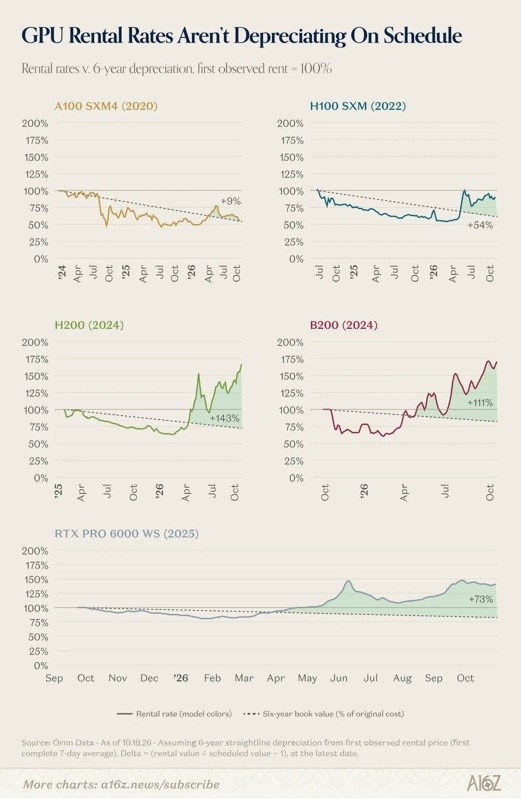
Two details matter for anyone defending a capex number. First, a16z notes that most of the gap opened after April, when token demand took off, consistent with the Jevons paradox at work, although the chart alone cannot prove the cause. Second, for most of their lives these chips rented below that line, and rent is not profit: a chip can rent well and still lose money for its owner once power, cooling, networking, facilities and the cost of borrowing are paid for.
There is a second market that tells a colder story, and it is the one lenders actually look at: resale. Through 2026, marketplace and analytics data put new H100 cards around $25,000–$40,000 while used, non-refurbished units trade near $15,000–$28,000 (compute.exchange; HashrateIndex). That spread is the collateral problem in miniature. An operator is repaid out of rental income, but a lender's downside is realised in the resale market, and the two price different things. Strong rents plus soft resale is the classic profile of an asset whose economic life is ending before its book life — which is exactly the mismatch a depreciation schedule has to absorb.
Why there is no single compute price
The Economist recently described compute as the new oil, and the comparison is useful. The token is the barrel, the "thing" the customer actually buys. Each GPU generation is an oil field: some wells pump cheaply and give better crude, so their cost per barrel is low; others are harder to work and yield lower-quality output, so each barrel costs more. For GPUs, the cost of producing a token is tied mainly to how much energy each generation needs and whether it can handle the work at all. When oil prices are high, every well pumps; when they fall, the costliest wells shut first. Chips behave the same way — when demand is very high, as it has been since April, even the A100 is needed. When a new generation arrives in volume it becomes the new cheap well, prices fall, and the oldest chips are switched off first. Microsoft, for instance, plans to scale its own Maia accelerators to multi-gigawatt deployments from 2027, claiming 40% more tokens per megawatt, a figure not yet independently verified.
The oil analogy still treats every barrel as identical, and that is where most analysis oversimplifies. Tokens — and the chips that generate them — are not all alike. Interactive and agentic work needs low latency and the newest, fastest memory. Bulk work, such as processing documents overnight, generating synthetic data or running evaluations, cares mostly about cost and barely notices latency. A fully paid-off chip whose remaining costs are power, cooling and upkeep can be the cheapest way to make those tokens. So there is not one oil market but several.
The twist is that the demand Jevons adds is price-sensitive by nature: uses that only become worthwhile once AI is cheap. Some are high-value, but many are bulk work, where older silicon competes best. A recent example is Jev, from TypeSafe AI, a model that returns structured decisions rather than text and that its makers claim is hundreds of times cheaper than a large language model. Models of this kind could move a lot of agentic decision-making off expensive LLMs and look well suited to older hardware, although TypeSafe does not say what it runs on.
At the other extreme, frontier models keep getting bigger and are increasingly sparse, activating only a small part of the model per token, as in Mixture of Experts architectures. For the largest of these, the bottleneck is less raw compute than memory capacity and fast connections between chips, which has made the rack, rather than the chip, the unit of frontier computing. An older GPU is not so much too slow for these models as too small and too isolated.
The result looks like a barbell. Giant models pull toward the newest rack-scale systems; small and specialised models live comfortably on older silicon. The squeeze falls on the middle — chips that are neither at the frontier nor already paid off, still carried on the books at a high value. A large share of the 2024 and 2025 spending sits exactly there.
Six ways to source AI compute, scored against the depreciation clock
A decade ago, a cloud data center ran different types of CPU, memory, storage and networking, and the job was matching workloads to a fairly predictable menu. Those servers aged gracefully: each new CPU generation was only modestly better, so an older server kept earning for years, a bit like a rental car where last year's model is nearly as good as this year's. Today, next to the CPUs sit GPUs, TPUs and other AI accelerators, and inference is increasingly split into stages that run best on different chips. Nvidia announced Rubin CPX, a dedicated chip for the prefill stage, in 2025, then put it on the back burner, possibly until a later generation, in favour of decode-focused racks based on technology licensed from Groq. Add HPC, which often still needs high-precision math that many AI chips deprioritise, and the matching job gets harder while each generation ages faster.
| Sourcing model | Whose clock sets obsolescence | Roadmap exposure | Best-fit workload | Main failure mode |
|---|---|---|---|---|
| Spot / on-demand general GPU | Provider's | High — repriced every generation | Spiky, uncapped experimentation | Peak-time capacity denial and budget blowout |
| Reserved cluster from a neocloud | Shared, by contract | Medium-high | Predictable training or inference blocks | Counterparty credit: the sector Gartner expects to consolidate |
| Hyperscaler AI capacity | Provider's | Medium | Mixed enterprise pipelines, burst overflow | Egress lock-in; unit economics move with the provider's model pricing |
| Self-owned general-purpose GPU fleet | Yours, on the supplier's roadmap | Highest | Multi-year base load with unknown task mix | Rental-to-resale gap hits the balance sheet |
| Vendor silicon you rent (TPU, Trainium, Maia) | Vendor's, but schedulable | Lower on own generation, higher on porting | Known, repeated, high-volume inference | Software portability and thin third-party resale |
| Dedicated on-prem for a fixed workload | Yours | Lowest | A small set of well-understood tasks; custom-model training | Specialised parts cannot start a second or third career as they age |
The scale rule behind that table is simple. The largest operators can afford variety: with enough volume they keep many kinds of hardware busy and route each job to the cheapest chip that can do it. Smaller data centers cannot, and for them the general-purpose GPU remains the safest bet, because it can step down from training to inference to batch work as it ages. Specialised parts are cheaper per task but more fragile as assets. A company running its own well-understood workloads can choose a configuration that fits closely and does not need to chase every new generation; there, state-of-the-art silicon matters mainly for training custom models and perhaps a few accelerated solvers.
Who owns the chips when the market turns
This is the core of the matter. Many of the big operators spread the cost of these servers over about six years in their accounts, but that is a bookkeeping convention; it says little about how long a chip actually earns more than it costs to run. That economic life is decided upstream, by the people who design the next chip. Nvidia's annual cadence, the token-per-watt gains each generation brings, new memory standards and number formats, and the software that keeps old chips useful together all set how long any GPU stays competitive. The silicon roadmap dictates the real depreciation timeline.
Seen this way, owning your own silicon gives you more say over your own clock. Microsoft with Maia, Google with TPU and Amazon with Trainium can shape when their own fleets become obsolete, even if demand and competitors still have a vote. A neocloud renting out Nvidia GPUs lives on a clock set by its supplier and its customers. And Nvidia sits on both sides of the table: it sets the pace that erodes the value of its customers' fleets and, according to a recent piece in The Economist, has also agreed to cover up to $300 billion of its customers' debt used to buy its chips should those customers be unable to repay. A faster cadence sells more new chips and weakens the chips securing those loans. When Jensen Huang posted in August that an A100 remains useful until 2029, he was making a technical point, but he also has a stake in the tradeoff.
Rental car companies are the closest precedent, and the precedent is grim. They buy fleets largely with borrowed money, pledge the vehicles against the loans, and make or lose money on resale. In early 2024, Hertz sold off about 20,000 electric vehicles and booked a loss of about $245 million. Hertz pointed mainly to high repair and collision costs, but weak resale values played a part too, and Tesla's price cuts on new cars had pushed down the value of used ones. A supplier's pricing decision eroded the value of its customer's fleet. GPUs carry the same risk in a stronger form: each new generation is a much bigger step than a new model year, the market for used chips is far thinner and more specialised than the market for used cars, and power, unlike parking space, is scarce.
Last week's earnings, read as depreciation evidence
Last week's earnings calls brought new signals. Meta, which reported a week earlier, narrowed its 2026 capital spending to $135–$145 billion and cited growing infrastructure costs and payments to third parties for AI tokens. Then Microsoft, Alphabet and Amazon reported. All three said demand for AI computing still runs ahead of the capacity they can bring online, and Microsoft and Google are even renting capacity from third parties to keep up. Between them, these three plan to spend close to $600 billion in 2026, and Alphabet and Amazon both said they will spend significantly more in 2027.
Three details on those calls are worth more than the headline numbers. Microsoft credited part of Azure's growth to "continued efficiency gains across our CPU and GPU fleet," a reminder that, as with a rental car company, getting more out of the fleet you already own is part of the business. Amazon said short-term capacity on its previous-generation Trainium chips now rents at a premium compared with the first half of the year, which supports the a16z chart's insight on Amazon's own silicon, and that inference is now well over half of AWS's AI revenue — exactly the varied, price-sensitive work where older and specialised chips compete. Google is now selling complete TPU systems for customers to run in their own data centers, with Amazon planning to sell Trainium outside AWS from late 2027. Owning a silicon roadmap is becoming a product hyperscalers can sell, and more of the market may end up living on their roadmaps rather than only on Nvidia's. Microsoft's own cadence has accelerated too: the company announced Maia 200, described on its official blog as an accelerator built for inference, on 26 January 2026.
Investors also got a reminder that more usage does not automatically mean more revenue. Alphabet lost about $500 billion of market value in a day after admitting that answers from AI Mode in Google search earn less than traditional search ads, according to The Economist. People are using AI more, and Google is earning less on each search, at least for now — and since advertising pays for much of this buildout, that matters to everyone buying chips. More of that money now has to be borrowed: Meta, Alphabet and Amazon all reported negative free cash flow, and even Microsoft, still cash-positive, announced $25 billion of new bonds the day after its earnings call.
The most instructive disclosure is the dullest one. Meta's own filings show that in January 2025 it completed an assessment raising the estimated useful life of most of its servers and network assets to 5.5 years effective January 1, 2025, cutting 2025 depreciation expense by roughly $2.9 billion (SEC Form 10-K; reporting by Yahoo Finance). One accounting line, several billion dollars of reported profit. For buyers benchmarking a provider's unit economics, useful-life assumptions belong in the same RFP scoring column as price per GPU-hour: two identical fleets can post very different margins purely because of the denominator.
Five misconceptions that cost real money
- Renting above the amortisation line means the asset is healthy. Rent is not profit. Power, cooling, networking, facilities and interest all sit between the rental rate and the margin, and for most of their lives these chips rented below the straight line.
- An about six year book life is a six year economic life. The schedule is a convention; the roadmap is the clock. Economic life is set by whoever designs the next generation, not by whoever files the depreciation.
- Cheaper tokens rescue every supplier in the chain. Elastic demand can accrue to application developers and model providers rather than to whoever sells raw capacity. Jevons can hold for AI as a technology and fail for AI infrastructure as a business model.
- A vendor backstop is a floor under resale value. Agreements covering up to $300 billion of customer debt are credit support, not a guarantee of what used GPUs fetch in the aftermarket — and the aftermarket is where collateral is marked.
- Older silicon is simply too slow for modern models. For large sparse models the binding constraints are memory capacity and interconnect, so an older GPU is too small and too isolated rather than too slow — which is precisely why it stays competitive on bulk, latency-insensitive work.
Action checklist for the next capex review
- Measure your own elasticity. Track cost per accepted task, including retries, and plot it against throughput. If usage barely moves when price falls, the bull case does not apply to your workload.
- Price the middle of the barbell. List assets by vintage. Chips that are neither frontier nor paid off — a large share of 2024 and 2025 spend — carry the most impairment risk, not the oldest ones.
- Split the catalogue into latency-critical and bulk. Move document pipelines, synthetic-data generation and evaluation runs to the cheapest tier that clears the SLA; that is where paid-off silicon wins.
- Score useful-life assumptions in the RFP. Compare each provider's disclosed server life against the vendor's release cadence, and ask what happens to your rate if their residual value is revised.
- Underwrite on resale, not on rent. Stress the collateral with used-market ranges, not with rental projections, and treat any guarantee as credit support rather than a value floor.
- Match contract tenor to generation cadence. A five-year commitment on hardware whose competitive life is three years converts a roadmap decision into your impairment.
FAQ
Is Gartner right, or is Jevons right?
Both, on different line items. Gartner's arithmetic is a revenue-coverage test against today's business models; Jevons describes what happens to aggregate demand when a technology deflates. The reconciliation is that demand growth and asset impairment can be produced by the same roadmap — one seen from the buyer's side, one from the owner's side.
Does the a16z and Ornn rental chart disprove the write-down thesis?
No. It shows current economic life is running ahead of the average schedule, which is real evidence — but it is a snapshot of rents, not of resale value or of operating margins, and for most of their lives these parts sat below the line. Treat it as a delay, not a refutation.
Should we buy older GPUs for bulk inference?
If the work is genuinely latency-insensitive, the answer is usually yes: fully depreciated parts with only power, cooling and upkeep left can produce the cheapest tokens. The exception is sparse frontier models, where memory capacity and rack-level interconnect, not clock speed, decide whether the job fits at all.
What single metric best predicts my impairment risk?
Tokens per megawatt per generation, compared with your contract tenor. It compresses the roadmap, the power constraint and the resale clock into one number, and it is the metric the self-designed accelerators are explicitly competing on.
Does owning custom silicon solve the problem?
It transfers the clock rather than removing it. Microsoft with Maia, Google with TPU and Amazon with Trainium can decide when their fleets go obsolete, but they also inherit the risk of the asset losing its ability to do a second career, and the porting cost of each new architecture.
Jevons' own ending
It is worth remembering where the paradox comes from. In 1865, in The Coal Question, the economist William Stanley Jevons observed that more efficient steam engines did not reduce Britain's coal consumption but increased it, because cheaper power found many more uses. The point held up: Britain's coal consumption kept growing as its engines improved, even if efficiency was not the only reason. It did not save every mine. The owners of the least efficient pits still went under while the industry grew. That is the most honest forecast available for AI infrastructure: demand will very likely keep surprising on the upside, and a good part of the money that built the first generations of this infrastructure will still have to be written down. The task for a technical buyer is not to pick a side in that argument, but to make sure the position they are holding is not the one in the middle of the barbell.