
APACTechDigit AIFrontierTech Data Watch: The gpt-6.2-astra Signal in Codex Telemetry, a 47% Benchmark Delta, and What the Numbers Cannot Yet Prove
Read as measurements rather than as rumours, the recent news around OpenAI produces three distinct datasets: a model identifier that newly appears inside user-side usage analytics, a percentage split between two identifiers within one account, and a paired score the vendor published itself in a technical blog post. Most coverage has fused the three into a single narrative — a next-generation flagship on the verge of shipping. Viewed as data, they justify a considerably narrower claim. The AIFrontierTech desk at APACTechDigit therefore separates recorded observation from inference, states what each number can carry, and lists the variables that are missing from every version of the story.
Signal inventory: four observations, four confidence levels
| Observation | Where it appeared | What it supports | What it does not support |
|---|---|---|---|
| gpt-6.2-astra as a separate record | Codex usage-analysis page, from October 31, per TestingCatalog | That a second model ID exists in the accounting path | Public availability, or any launch date |
| about 19.8% versus roughly 80% split | Screenshot published by blogger Token Gremlin on the X platform | Request-level routing of part of the traffic to a candidate model | Any quality ranking — the share measures bucket membership |
| Two transient IDs, rc-ada-or-vm and rc-ada-sh-vm | OpenAI API model list on November 3, reported by LuminaBench | Release-candidate-style naming activity | A verified link to GPT 6.2 Astra |
| 0.594 to 0.875 | OpenAI blog post published on November 3 | A large delta on one specific engineering benchmark | Transfer to shop-floor success rate or unit economics |
Observation 1: the interface and the telemetry disagree
TestingCatalog's report is precise about the mismatch. Starting on October 31, usage-analysis pages for some Codex accounts carried a standalone line for GPT 6.2 Astra, while the model picker in the very same product still displayed GPT 6 Astra. That discrepancy is the analytically useful part: the presentation layer and the routing layer are not aligned, which is what you expect when model selection has moved server-side and the front end has not been renamed.
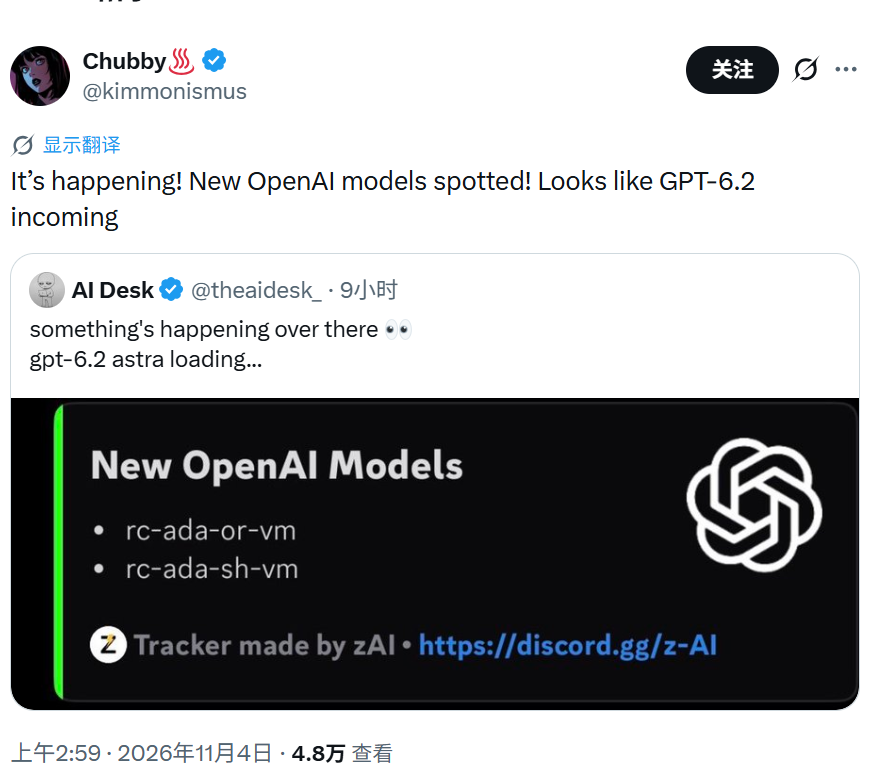
OpenAI has not confirmed anything here. There is no public announcement of GPT 6.2 Astra, no statement that a grey-release test is running, and no timeline. Demonstration videos circulating on social platforms remain contested on authenticity, so they cannot be used as evidence that the model's capabilities have been validated.
Observation 2: treat 19.8% as a routing metric, not a capability metric
The screenshot shared by Token Gremlin on the X platform attributes about 19.8% of one account's calls to GPT 6.2 Astra and roughly 80% to GPT 6 Astra. Screenshots from other accounts show noticeably different ratios, including shares in the low single digits. That variation is the signature that led developers to suspect background request routing — an A/B or canary slice — instead of an isolated display fault.
Percentage-rollout documentation from deployment platforms such as LaunchDarkly and Flagsmith describes precisely this shape: traffic is bucketed by a stable key, typically the account or user ID, so one tenant keeps seeing a persistent share while another sees none at all. Read through that lens, three engineering rules follow.
- A per-account percentage tells you about bucket size, never about model quality; two accounts with identical traffic can legitimately show different splits.
- A share that drifts upward across successive days indicates a ramp, not a release. Practitioner rollout guides usually open canaries at low single-digit levels, commonly 5–10%, and widen only while error and latency curves stay flat.
- If the split holds steady for weeks with no changelog entry, shadow evaluation — running the candidate in parallel and logging it without serving it — becomes a competing explanation.
The same caution applies to the identifiers that tracking account LuminaBench says appeared briefly in the OpenAI API model list on November 3 and then vanished: rc-ada-or-vm and rc-ada-sh-vm. Developer speculation ties them to release candidates, but nothing published confirms they map to GPT 6.2 Astra.
Observation 3: the BenchCAD 2.0 gap of 0.594 to 0.875
While the telemetry story spread, OpenAI published a technical blog post on November 3 titled "Accelerating engineering for the physical world", covering mechanical design, electronics and physical manufacturing. The single most-quoted line came from an unpublished model: on BenchCAD 2.0, the current GPT 6 Astra averages 0.594 at its highest reasoning setting, while what OpenAI calls a "newer internal model" averages 0.875 — a relative gain of about 47.3%, rounded to 47% in most headlines.
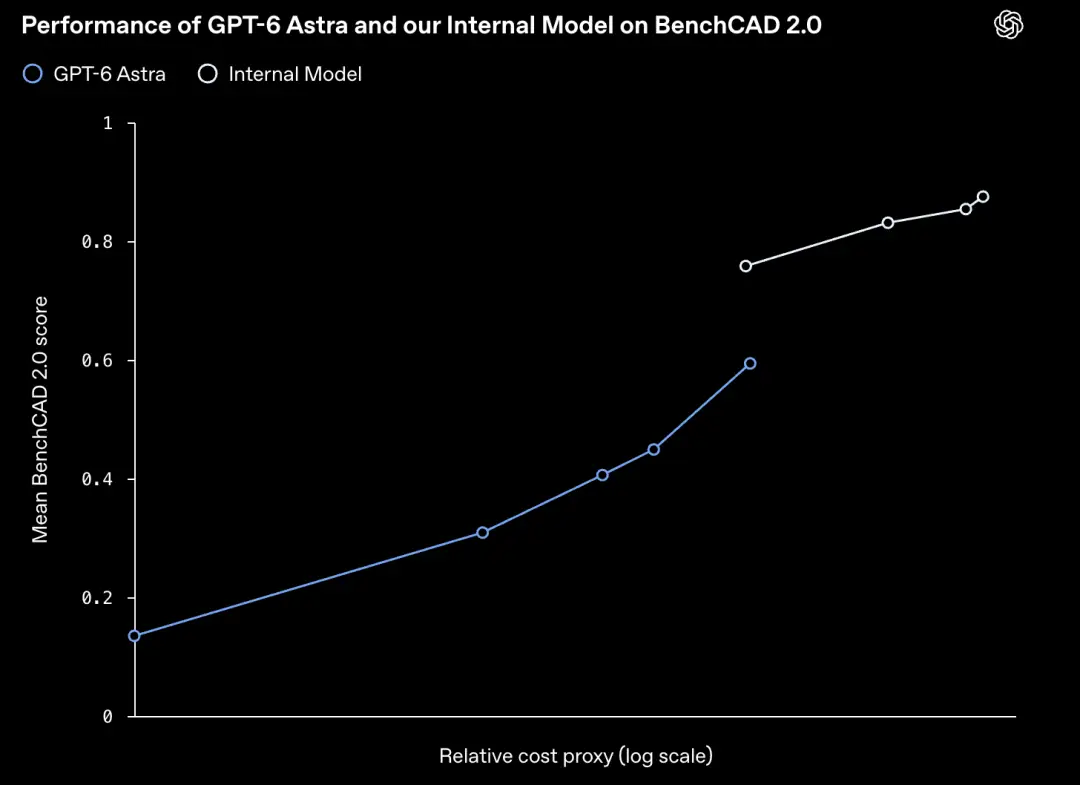
OpenAI did not name that internal model or say whether it is the same thing as the GPT 6.2 Astra appearing in Codex logs, and the vendor itself notes the scores are specific to an engineering benchmark rather than a proxy for overall manufacturing success.
What the vendor post omits is the denominator, and the benchmark's own public site supplies it. BenchCAD 2.0's Core set, as described on benchcad.com, consists of 100 held-out cases spanning six hardware-engineering tasks — reconstruction of 3D parts and assemblies from engineering drawings, and recovery of wiring relationships from board imagery — evaluated at maximum reasoning effort with up to 30 rounds per case, and scored against reference CAD outputs rather than graded by another LLM. Two implications deserve emphasis: the average compresses six quite different skills into one scalar, and a held-out design makes contamination less likely than on public-case sets, which makes the comparison meaningful but also narrow.
The two published rows, and the columns nobody published
| Dimension | GPT 6 Astra (highest reasoning) | Newer internal model | Source of the figure |
|---|---|---|---|
| BenchCAD 2.0 Core average score | 0.594 | 0.875 | OpenAI blog post, November 3 |
| Relative change | baseline | about 47.3% higher | OpenAI blog post |
| Disclosed model name | GPT 6 Astra | None | OpenAI |
| Cost per case | About $11 | Not published | Public BenchCAD leaderboard (benchcad.com) |
| Tokens and median wall clock per case | Roughly 135k tokens, about 62 minutes | Not published | Public BenchCAD leaderboard (benchcad.com) |
| Task-level breakdown | Aggregated average only | Aggregated average only | Both listings |
| Availability status | Released | Unannounced | OpenAI has confirmed neither the test nor a date |
The missing columns matter commercially. If the candidate reaches 0.875 by spending more reasoning rounds, the headline gain could be paid for in dollars and minutes rather than earned in efficiency; on a benchmark where the leading published score hovers near 0.59 and each case may run thirty rounds, that trade-off is the normal case, not the exception. Any migration decision needs the cost-per-accepted-case figure before it needs the score.
Case read: two engineers, less than a week of design, less than a month to prototype
OpenAI's engineering blog also carried a worked example, and it is more informative than the score table. Two engineers used GPT 6 Astra to complete the design of a portable AI device that interacts with Codex by voice in less than a week. The model touched the enclosure structure, internal mechanical components, the PCB, electronic components, the user interface and the firmware, and the engineers did not hand-edit the generated design during that window. A contract factory then delivered a small batch of physical prototypes in less than a month.
The company was equally explicit about where the workflow breaks: turning that design into a manufacturable product still requires multiple rounds of human review, because GPT 6 Astra does not consistently account for production-process limits, manufacturing tolerances or assembly details. OpenAI also disclosed that its hardware team's token consumption has grown 23 times since February of this year, with Codex and ChatGPT used for computer-aided design, manufacturing drawing generation, engineering simulation and design review.
Partner programmes show how the same capability is being pushed into regulated domains. OpenAI announced a research collaboration with Mazda, pairing its research and Forward Deployed Engineering teams with Mazda aerodynamics and crash-safety engineers; GPT 6 Astra generates variations of the vehicle front geometry and combines them with airflow simulation so engineers can weigh options. Mazda chief engineer Akihiro Nakata said that exploring and simulating dozens of design variants lets engineers see which styling features drive aerodynamic behaviour and where designers retain real freedom — a statement about design-space exploration, not about replacing simulation. OpenAI also expanded its work with IndyCar team Chip Ganassi Racing, converting 3D scans of existing parts into editable CAD models and 2D manufacturing drawings to cut repetitive reverse-modelling.
Five questions this dataset cannot answer
- Is the "newer internal model" the same artifact as gpt-6.2-astra? No published statement connects them.
- What did 0.875 cost? Reasoning tokens, wall clock and dollar price per case are unpublished for the candidate.
- Where did it fail? A single average hides whether the gain came from part reconstruction, assemblies or board-wiring recovery.
- Has anyone outside OpenAI reproduced it? The held-out Core set is not runnable by third parties in the same form, so independent numbers are not yet comparable.
- Does the split percentage reflect product intent? Rollout shares are operational levers that can be reversed instantly.
Common misreadings worth retiring
- "The model is basically launched." A telemetry ID plus a routing split is an internal-readiness signal, not a shipping event.
- "47% better engineering output." It is a 47.3% relative lift on one normalized benchmark average, on held-out cases with a specific harness.
- "A/B percentages are comparable across accounts." Bucketing by account ID makes cross-account comparison meaningless.
- "Demo videos prove capability." Authenticity is contested and unverified.
- "Benchmarks like BenchCAD predict factory yield." OpenAI's own case study shows tolerances and assembly detail still require human review.
FAQ for engineers and technical decision-makers
My Codex usage analytics show gpt-6.2-astra. Am I on the new model?
You are seeing an identifier in the accounting path. Whether a share of your requests was served by a candidate model cannot be confirmed from the client; only OpenAI can, and it has not.
Why does my colleague's percentage differ from mine?
Standard percentage-rollout design keys on a stable identifier such as account ID. Ratios describe routing distribution, so differing splits across accounts are expected behaviour rather than evidence of instability.
Should we hold CAD and PCB automation plans until the next model ships?
No. The published case shows the current generation already shortens design iteration while leaving tolerances and assembly review to humans. Build your own evaluation set now; a model swap later becomes a measurement rather than a gamble.
Is the BenchCAD 2.0 result trustworthy?
Its design is sound in principle — 100 held-out cases across six tasks, reference-based scoring without an LLM judge, up to 30 rounds per case. The weakness is disclosure: one unnamed model, one aggregate number, no cost or latency pairing.
How should we treat rc-ada-or-vm and rc-ada-sh-vm?
As transient list entries. They were observed by LuminaBench and removed; no source links them to GPT 6.2 Astra.
Action guidance
- Start logging model IDs today. Persist the model string returned in usage records for every call. Without history, the next identifier change is unanalyvable.
- Freeze an internal eval set. Pick 10–20 real tasks from your own backlog — part reconstruction, an assembly, a board-wiring recovery — and keep the references fixed so future models are compared on your data.
- Track cost per accepted case. Pair every score with tokens, wall clock and dollar cost; treat leaderboard averages without those columns as incomplete.
- Gate manufacturability explicitly. Route AI-generated geometry through design-for-manufacturing review for tolerances, process limits and assembly sequence before release.
- Assign someone to official channels only. Wait for OpenAI to name the internal model and confirm a release before changing contracts or capacity plans.
Aggregated, the evidence is a set of internal-readiness signals rather than a launch: one new identifier in Codex telemetry, one routing split whose percentages vary by account, one pair of transient API names, and one large, vendor-published benchmark delta whose cost and failure profile are still invisible. For teams building engineering workflows on top of these models, the useful response is procedural — instrument, benchmark on your own cases, and keep human review where tolerances live.
Written by Lynn Zhou, AIFrontierTech desk, APACTechDigit. Evidence corrections and additional telemetry data: contact@apactechdigit.com.