
When AI Stops Making Mistakes, Humans Stop Checking: A Verification Playbook Against Cognitive Surrender
APACTechDigit · AIFrontierTech desk · By Lynn Zhou
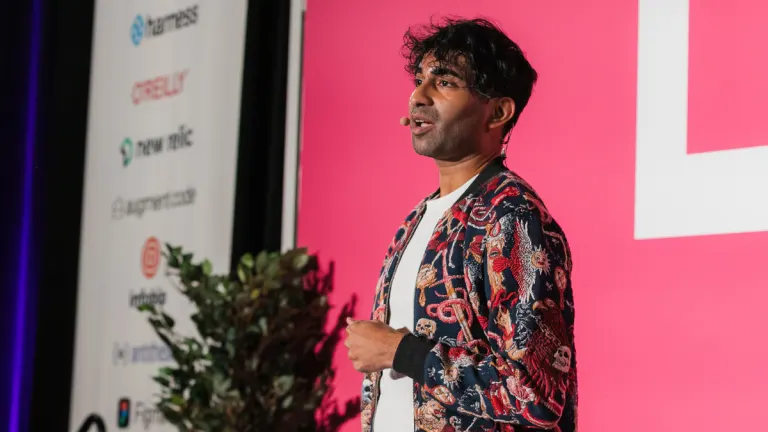
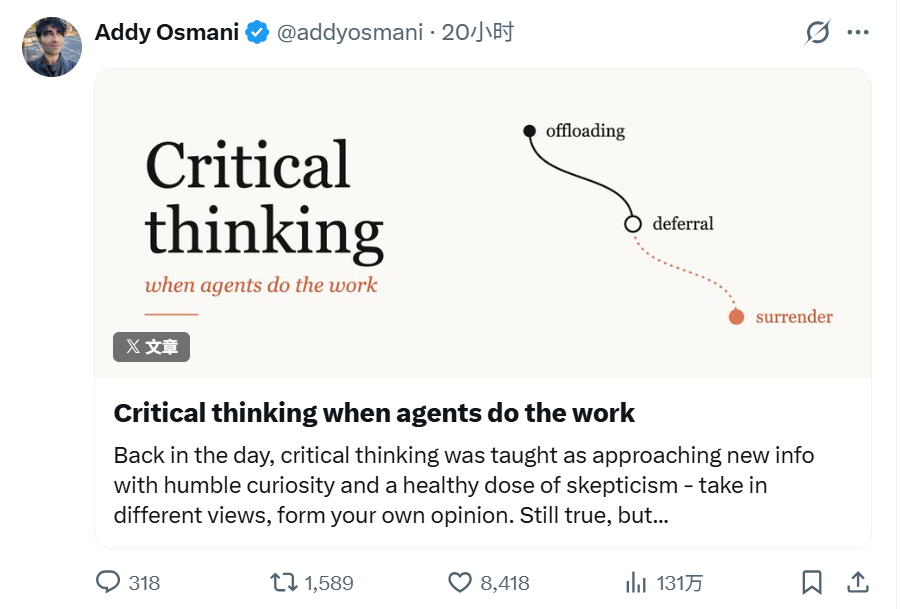
The most damaging agent failure of the current generation is not a hallucinated API, a red build, or an obviously wrong number. It is the clean artifact: a pull request that compiles, a design memo with perfect headings, a test suite that reports green — and no engineer on the team who can explain why any of it is correct. That is the territory Addy Osmani maps in his essay "Critical thinking when agents do the work", published on X in early November 2026. Osmani is an engineer on Anthropic's Claude Code team; before joining Anthropic he spent more than 14 years at Google, where he owned Chrome developer experience and later Google Cloud AI work. His background matters here, because the warning comes from someone who runs several agents in parallel every day rather than from a sceptic on the outside.
His claim is counter-intuitive and worth stating precisely: as models improve, obvious errors become rarer, and human vigilance becomes harder to sustain, not easier. Review discipline was historically trained by friction — the output was wrong often enough that checking paid for itself.
Why fewer visible errors erode oversight
Answering a question used to mean collecting information, analysing it, and then judging it. Today the same sequence can collapse into a few seconds. The output arrives structurally complete, fluently written, and mostly right, so the verification step looks like wasted latency. Skipping it feels efficient once, then becomes default behaviour.
Osmani describes the human side of that drift as three levels, a ladder that teams descend rather than climb:
- Cognitive Offloading: the task is handed to the model, but the human still treats the output as a claim to be checked and remains accountable for the result;
- Deferral: the output is no longer treated as a hypothesis needing validation; it becomes the input for the next step;
- Cognitive Surrender: the model's output quietly becomes the user's own judgement, and checking starts to feel unnecessary.
The term Cognitive Surrender itself was introduced earlier by Wharton School researchers Steven Shaw and Gideon Nave, and Osmani borrows it deliberately. That borrowing gives us access to something most platform commentary skips: experimental data rather than anecdote.
He also insists the descent is invisible while it is happening. Nobody decides to stop thinking; a reader works through the first AI report carefully, glances over the second one, and by the third only checks the outline. Weeks later, when a colleague asks what a specific conclusion actually rests on, the person who accepted it cannot reconstruct the reasoning. That sequence — close reading, fast skim, outline only — is the operational signature teams should look for in their own review history.
| Level | What the human still does | Observable failure signal | Control that fits |
|---|---|---|---|
| Cognitive Offloading | Requests work from the agent, then verifies against defined evidence | Review time per artifact falls but stays above a floor | Acceptance criteria fixed before generation |
| Deferral | Uses the output as the premise for the next decision | Downstream design built on unvalidated assumptions | Mark unverified claims in the artifact itself |
| Cognitive Surrender | Recites the model's conclusion as personal judgement | Owner cannot explain logic when challenged in review | Ownership rules; no merge without a human who can defend it |
The experimental evidence: availability alone was enough
Shaw and Nave's working paper, "Thinking — Fast, Slow, and Artificial: How AI is Reshaping Human Reasoning" (SSRN abstract 6097646), reports three experiments with 1,372 participants. The finding that matters for engineering managers is that overt persuasion was not required: simply having an AI available was enough for participants to lower scrutiny and adopt its answer, overriding their own intuition. Popular coverage — including a Forbes piece in March 2026 — framed the same result as people trusting the model over their own reasoning. Read together with Osmani's essay, the implication is uncomfortable: vigilance decay is not a character flaw of careless juniors, it is a predictable response to a fluent interface.
Osmani adds the organisational version of the same mechanism, which he calls Cognitive Debt. A team can ship large volumes of AI-generated code with every test passing while its shared understanding of architecture and implementation logic shrinks. The bill arrives on the day someone has to change the system and discovers that nobody actually knows how a given capability works.
He is equally clear about the limits of the remedy. Developers are not required to memorise a large codebase. The Claude Code team itself uses AI to rebuild understanding of a specific module when it needs it. The competency that must be preserved is narrower and more fragile: knowing what you do not know, and being able to re-learn it on demand.
Orchestration Tax: the arithmetic of a fixed review budget
As agents run more tasks simultaneously, Osmani identifies a second constraint, the Orchestration Tax: the gap between the rate at which AI produces work and the rate at which humans can genuinely review it and be willing to sign for it. This is measurable, and the numbers move fast. METR's time-horizon work (arXiv 2503.14499, metr.org) estimated that the 50% success time horizon of frontier coding agents roughly doubles every seven months — meaning the amount of finished, plausible work landing in a reviewer's queue per day keeps rising while the reviewer's hours do not.
Anthropic's own internal study of its people ("How AI is transforming work at Anthropic", anthropic.com/research, December 2025) shows the same slope from the inside: employees self-reported that a year earlier Claude appeared in 28% of their daily work, with a roughly 20% productivity gain attached. By September 2026 the company had published a prototype R&D Automation Index measuring how much of its AI research and development Claude carries out under human supervision; secondary reporting put that August 2026 reading at about 26% of weighted R&D work. In other words, even the lab best equipped to police its own output is now supervising a quarter of its research throughput.
Osmani's operational conclusion: when generated work piles up faster than people can audit it, adding more agents does not help. The fix is either better automated verification or deliberately lowering task generation speed.
| Signal to track | What it reveals | Response |
|---|---|---|
| Median review latency per agent-produced PR | Whether review time is collapsing under volume | Cap concurrent agent tasks (WIP limit) |
| Merge-queue depth and oldest waiting item | Backlog of work nobody has signed for | Throttle generation until queue drains |
| Share of artifacts closed with evidence vs summary | Ratio of verified to trusted output | Require logs, screenshots, test output as acceptance |
| Automated verification coverage of risky paths | Capacity that scales without humans | Invest in checks, not more agents |
Verification, not code generation, is the bottleneck
Agents can already write code, run tests, read the errors, patch, and iterate until the suite is green. The catch, as Osmani puts it, is that the tests may be written by the same model: if test logic and implementation share the same blind spot, an all-green run proves nothing about the absence of defects. This is no longer a thought experiment. IEEE Software (2026 issue 1) published a study titled "When AI-Generated Unit Tests Validate Bugs", examining LLM-based tools that infer expected behaviour from the very code they are meant to scrutinise — the circular-oracle problem in test form.
The practical mitigation the industry has converged on is fault injection rather than coverage. Meta's engineering team described using LLMs for mutation-guided test generation, where artificial faults are introduced and a suite earns trust only if it detects them (engineering.fb.com, September 2025). Branch coverage tells you lines were executed; a mutation score tells you the assertions can actually fail.
Two further rules come straight out of the essay and are easy to institutionalise:
- Acceptance evidence, not narrative: a deliverable from an agent is accepted on real test results, runtime logs and screenshots — never on an AI-generated summary that merely reads well.
- Forced disclosure: require the agent to list the decisions it made autonomously, the assumptions it adopted, and the conditions it ignored, because none of that appears in a final work summary.
Minimal decision-log template for an agent task
- Objective and definition of done, written before generation starts.
- Assumptions the agent inferred rather than received.
- Files, endpoints and edge cases it deliberately did not touch.
- Commands executed and their raw output, plus failing-test history.
- Open risks ranked by blast radius, with the human owner named.
Skill decay and the supervision paradox
Osmani's third warning concerns the atrophying of prior skill under heavy automation. He cites Anthropic's research on its own engineers and researchers, which surfaces what he calls a supervision paradox: supervising Claude requires programming ability, yet over-reliance on AI can degrade exactly that ability. His prescriptions are unusually concrete: write some code every week without AI, and revisit every month the skills you have stopped practising to decide which ones are still worth keeping.
Common misconceptions
- "This is an argument against using agents." It is not. Osmani states plainly that low-cost-of-error work can be handed to AI entirely.
- "More agents will absorb the review load." More agents raise generation speed, which is the numerator of the Orchestration Tax, not the denominator.
- "Green tests mean safe code." Only if the tests were validated independently — mutation testing or human-written assertions on risky paths.
- "The fix is remembering the codebase." The fix is knowing what you do not know and being able to rebuild understanding quickly.
- "Fluency indicates correctness." Fluency is the property that makes Cognitive Surrender persuasive in the first place.
Where the judgement stays human
The line Osmani draws is about stakes rather than difficulty. For decisions involving investment, career choices, product safety, or anything that affects other people, humans keep the final call. Future models may outperform people at spotting errors, and that still will not transfer accountability: what to build, why it is worth building, who it affects, and what cost you accept — those remain human choices.
FAQ
Is Cognitive Surrender the same as automation bias?
It overlaps with the older automation-bias literature, but Shaw and Nave position it more sharply: it is adopting the AI output in place of one's own reasoning, where intuition and deliberate analysis are both bypassed. The Wharton experiments' contribution was showing availability alone can trigger it.
How should a small team start applying this without hiring reviewers?
Sequence it: define evidence-based acceptance first (one page, reused), then add mutation or property-based checks on the highest-risk module only, then set a WIP limit on parallel agents. Each step costs staff-hours in hours, not weeks.
Can we measure whether our engineers have drifted into Deferral?
Two cheap proxies: run a design review where the presenter must explain a decision without the artifact open, and track what share of merged agent output was closed with logs or test evidence versus a summary. Both degrade before incidents do.
Does the weekly AI-free coding rule apply to non-engineers?
The underlying mechanism transfers: any role that consumes agent output should periodically reproduce the reasoning unaided — an analyst sketching the model by hand, a PM writing the risk section before prompting. It preserves the ability to detect a plausible-but-wrong answer.
What is the governance artefact worth keeping?
A named human owner per agent-produced change, plus the decision log above. Combined with immutable logs, that is what turns "the model did it" into an auditable statement of who accepted it.
Action checklist for the next two sprints
- Before prompting, write your own hypothesis on complex questions — even a wrong guess keeps an independent anchor in place.
- Ask for disconfirming evidence rather than a confidence score, and for contested questions put two models on opposite sides, then decide yourself.
- Publish acceptance criteria that demand test output, logs and screenshots as the definition of done.
- Mandate autonomous-decision disclosure in every agent task brief.
- Cap concurrent agents at what the team can review that day, and treat the merge queue as a hard signal.
- Add mutation or property-based testing to the two highest-blast-radius services before adding more agents.
- Hold one AI-free coding session weekly and run a monthly skill-retirement review.
- Name a human owner for every agent-delivered change in regulated or safety-relevant paths.
The through-line for anyone shipping with agents today is that the scarce resource has moved: generation is nearly free, and the expensive thing is a person who can say what a system actually does and why. Verification tooling buys time, decision logs buy traceability, and drill preserves the ability to notice when the fluent answer is the wrong one. Everything else in the workflow can be handed over — the closing line of Osmani's essay is the boundary he insists teams must not cross: you can hand the work and most of the review over to AI, but you cannot hand over responsibility. If your team has a verification playbook that works, write to contact@apactechdigit.com and we will feature it in this column.