
APACTechDigit AIFrontierTech Data Read: Perplexity Teammates, the $200 Per Month AI Coworker, and Enterprise Limits
Perplexity recently launched Teammates, a long-running AI coworker for enterprise workflows. Instead of answering one prompt, a Teammate keeps a persistent thread, remembers project context, coordinates multiple agents, and updates users through Slack. It is built on Perplexity's Computer platform and competes with OpenAI's Dots and Anthropic's Claude Duet. For technology teams, the issue is not novelty, but whether persistent agents can turn conversational AI into auditable work with measurable cost, clear permissions and human review.
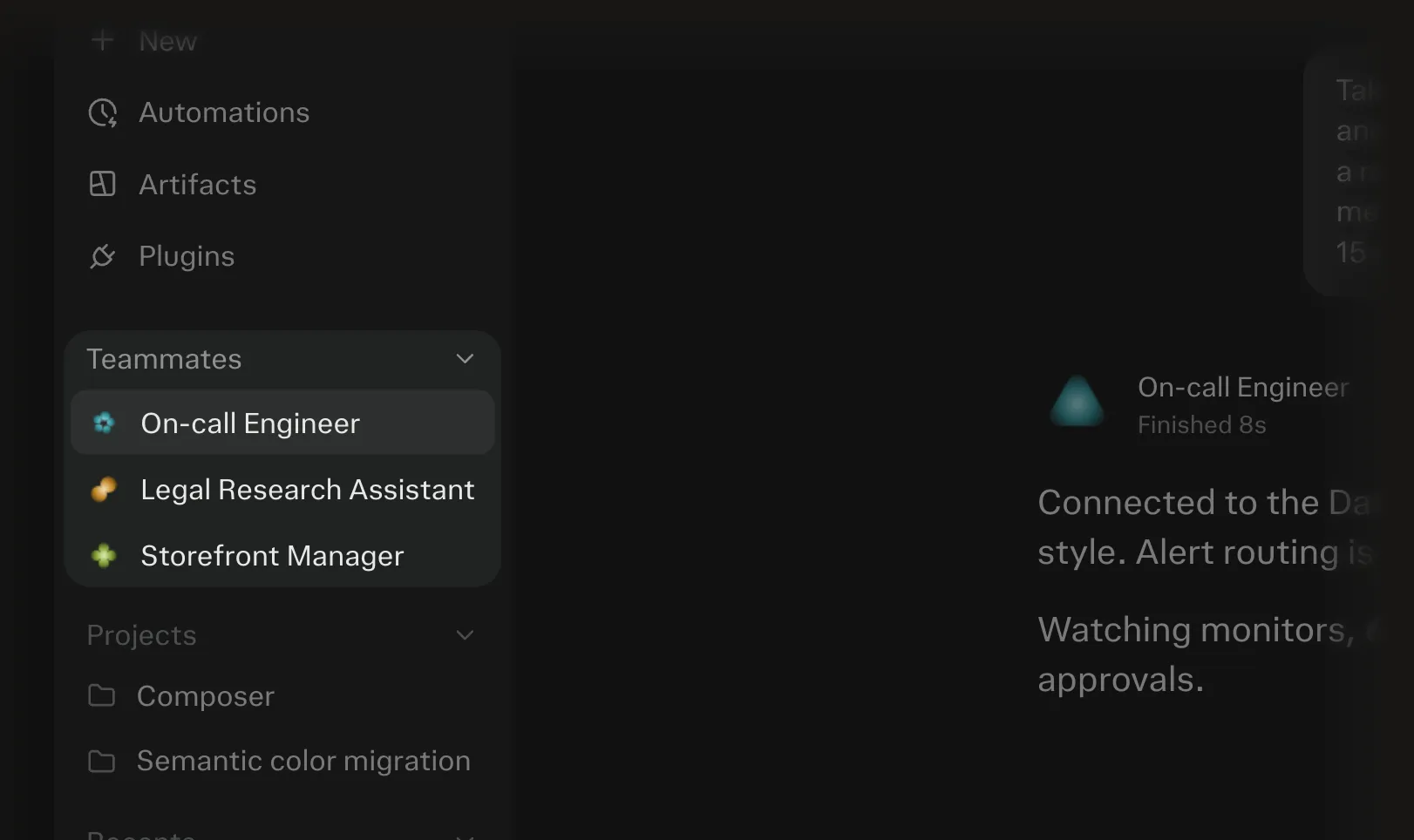
What changed: from prompt sessions to ongoing ownership
Teammates shifts the unit of work from a single query to a named, persistent responsibility. A Teammate can keep a project thread open, track earlier decisions, use shared files, and resume work when priorities change. That is the same capability pattern that makes an AI system useful in business: not only whether it can execute, but whether it can own a next step without being re-briefed every day.
Perplexity announced the feature days ago, with Teammates running as agents that coordinate multiple Computer sessions and other agents. Launch materials describe memory for project goals, execution history and shared files, while the company emphasizes that users can inspect and steer the work rather than treat the agent as an autopilot. This follows a broader rollout path: launch coverage connects Teammates with Perplexity's earlier Comet browser assistant and Computer system introduced in July 2025.
How does Teammates differ from Computer, Dots, and Claude Duet?
The practical difference is that Computer executes, while Teammates assigns, remembers, coordinates and hands off work. OpenAI's Dots and Anthropic's Claude Duet occupy the same competitive pattern, but the evaluation now centers on workflow integration, trust and control rather than raw model access alone.
| Product layer | Core function | Enterprise implication |
|---|---|---|
| Computer | Runs AI agents that execute tasks in a user environment | Useful for doing work, but planning still sits close to the human operator |
| Teammates | Long-running named agents that plan, coordinate, remember and hand off work | Adds continuity, parallelism and Slack-facing collaboration around existing project context |
| OpenAI Dots and Anthropic Claude Duet | Comparable multi-agent coworker patterns aimed at sustained business tasks | Makes persistent roles, approvals and cross-tool memory the main buying criteria |
Computer is the execution substrate; Teammates is the project owner above it. The difference matters because persistent agents can reduce repeated context handoffs, but they also make memory, permissions and action history part of the workflow.
Which numbers matter most to buyers?
Three data points frame the commercial and technical stakes of the launch: price, rollout surface and claimed long-term role density.
- $200 per month: Teammates is available through Perplexity Max, making it one of the higher-priced agent subscriptions currently aimed at work use. That shifts procurement away from trial curiosity toward cost-per-outcome analysis.
- Web first, broader clients later: Product materials and launch coverage indicate availability on the web for Max subscribers, with iOS, Android and desktop versions expected in a later rollout. For enterprises, the mobile and desktop path determines how far agents move beyond a browser tab.
- Hundreds of dedicated agents: Perplexity CEO Aravind Srinivas has described a future in which each organization may have hundreds of dedicated agents assisting individual employees. If that vision approaches reality, the scarce resource is not prompts, but governance: ownership, scope, logging and approval.
External research also supports why enterprises are watching. Gartner's 2026 Hype Cycle for Agentic AI places agent technology at a stage of high expectations and rising scrutiny. Gartner also predicts that by 2028, 80% of tangible ROI from agentic AI will come from specialized, domain-specific agents rather than generic assistants. That reframes Teammates less as a productivity gimmick and more as a candidate component in narrow workflows.
What does the sales example reveal?
A concrete example shows how value and risk appear in the same motion. If a long-standing customer stops ordering, a Teammate does not merely generate a reply. It can inspect order history and after-sales records, investigate causes, propose a remedy, draft an offer, or alert a human account team. The important part is not automation by itself; it is the chain of evidence behind the action.
For a workflow to become operational, each step must be traceable, and the final action must match the organization's approval policy. In the example above, the most defensible deployment is not "the agent fixed the account," but "the agent found the signal, assembled evidence, proposed a bounded action and routed the decision to a human owner."
What risks appear when agents remember and act?
The same features that create value also create risk. Persistent memory can reduce repeated explanations, but stale or wrong context can propagate across tasks. Slack integration can shorten coordination, but it can also let an agent move between tools, files and people. Multi-agent handoffs can parallelize work, but they can make accountability harder to assign.
Launch coverage notes isolated environments and access controls, which are necessary controls rather than guarantees. The NIST AI Risk Management Framework recommends governance, mapping, measurement and management as practical layers for AI deployment. Enterprises testing Teammates should treat those controls as pilot requirements, not optional compliance language.
What are the common mistakes?
The common mistakes come from buying access before defining control. Teams that skip measurement, permissions and ownership will find a persistent agent amplifying uncertainty rather than reducing manual work.
- Assuming a $200 per month plan makes the agent production-ready by itself. Access controls, logging, approval gates and owner assignments still need to be configured.
- Letting a Teammate manage broad goals instead of bounded workflows. Gartner's emphasis on domain-specific agents suggests narrow jobs are easier to measure and govern.
- Treating Slack as a dashboard rather than an action channel. If the agent can update, request or hand off tasks, the Slack channel must have clear human ownership.
- Counting task starts as savings. The meaningful metric is completed work after review, error rate and rework cost.
Who should pilot Teammates first?
APACTechDigit recommends a small pilot for teams with text-heavy, repeatable workflows and a measurable failure threshold. Suitable candidates include support triage, account research, ad campaign monitoring, document QA and code review. Unsuitable first uses include high-stakes financial decisions, HR judgments, security incident response or anything requiring irreversible action without human sign-off. The first success metric should be cycle time and auditability, not headline task completion.
For developers, the pilot should expose the agent to non-critical data first. For technical decision-makers, the question is whether the system can be stopped, audited and re-scoped without breaking the business process. For digital transformation teams, the workflow should be documented enough that an agent can follow it, but bounded enough that failure remains cheap.
FAQ: quick answers for engineering and IT teams
Is Teammates just a better version of Computer?
No. Computer executes tasks, while Teammates adds persistent roles, project memory, coordination across sessions and human review. In other words, Computer is the hands; Teammates is the role.
Can a Teammate replace existing enterprise agents?
Not automatically. It can compete with OpenAI Dots and Anthropic Claude Duet in concept, but replacement depends on data access, model performance, audit trails and whether the agent can follow internal policies.
Why does the $200 per month price matter?
Because it signals a high-end, work-oriented subscription rather than a mass-market feature. Teams must calculate whether one persistent agent can save enough human coordination time to justify the subscription across seats.
What should be reviewed before production use?
Permissions to files, Slack identity, memory scope, output logging, escalation rules and a rollback plan. If those are not visible, the agent should remain in a controlled pilot.
Action checklist before the first pilot
- Select one bounded workflow with an existing baseline, such as ticket triage or customer-order monitoring.
- Map data sources, file permissions and Slack channels the Teammate can access.
- Define human checkpoints for actions that create customer-visible or financial effects.
- Measure time saved, error rate and rework after each week; compare against current workflow.
- Decide after a fixed period whether to expand, keep the agent in read-only mode, or stop.
Teammates shows where AI search is going: from answer boxes to assigned workloads. The product's promise is real because persistent agents can carry context across days and tools, but its value will be decided by control systems, not launch messaging. For APACTechDigit's AIFrontierTech readers, the signal is simple: long-running agents are now a procurement and engineering question, not a chatbot demo.
Reference sources
- Perplexity Teammates product page: Perplexity Teammates product page
- Perplexity Help Center, "Get started with Perplexity teammates": Perplexity Help Center
- Gartner, 2026 Hype Cycle for Agentic AI: Gartner Hype Cycle for Agentic AI
- Gartner, Mastering Agentic AI: Multimillion-Dollar ROI Lessons: Gartner Agentic AI ROI
- NIST AI Risk Management Framework: NIST AI RMF
- Chinaz launch coverage on Teammates, isolated environments and web-first rollout: Chinaz article