
Agentic AI in CCStudio: A Migration Playbook for Embedded Teams at electronica 2026
By Ethan Rivera · APACTechDigit AIFrontierTech
Two teams, one silicon family, opposite results: one keeps SDKs, pin tables and errata in a versioned repo and gains immediately; the other carries that context in tribal memory and gets confident-sounding noise. The direct answer behind the gap: TI has pushed CCStudio past code completion by piping device-specific knowledge into industry-standard AI agents through Model Context Protocol (MCP) servers, so agents can generate code, configure peripherals, build, flash and debug inside CCStudio IDE or CCStudio for VS Code.
The capability is shipping rather than promised. Texas Instruments says agentic AI in CCStudio is available now across its general-purpose and real-time MCUs, wireless connectivity devices and radar SoCs, with the CCStudio development ecosystem offered as a free download on TI.com. The public debut of the expanded workflows is at electronica 2026, staged November 10–13, 2026 at Messe München, where live end-to-end demonstrations run at the company's booth in Hall C4. For Asia Pacific readers the timing lands twice over: Munich still draws roughly 80,000 trade visitors (U.S. International Trade Administration), while the regional edition, electronica Shanghai, ran July 1–3, 2026 with more than 1,900 exhibitors and 70,000 professional visitors, according to the organiser.
What actually changed in the toolchain — and what did not
Conclusion first: the model did not suddenly understand your silicon; the context did. Amichai Ron, senior VP for embedded processing and DLP products at TI, characterises embedded software development as an incredibly manual and time-consuming process, and credits recent agentic AI with changing that. Device migration, system configuration and debugging are now wired into frameworks built around embedded expertise rather than general coding style.
Design engineers have used generative AI tools for the past two years to write code faster, yet complex embedded tasks stall when hardware-specific context is missing: pin muxing, clock trees, peripheral errata, renamed SDK APIs. Agentic frameworks attack exactly that gap. SDKs, pin configurations and peripheral data reach the AI tool as structured context through MCP servers, which TI says improves accuracy, reduces hallucinations and yields implementation-ready output.
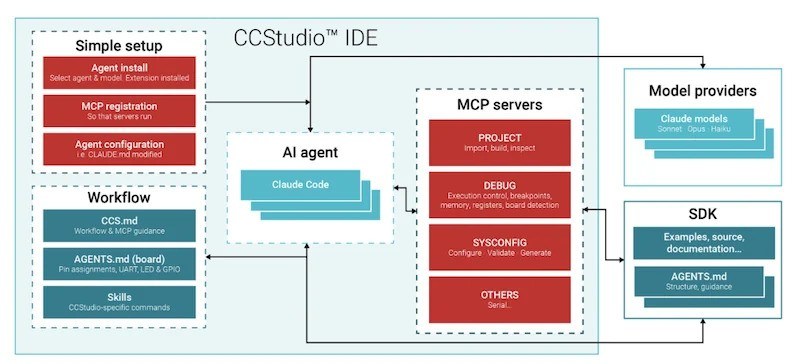
CCStudio strengthens agentic AI capabilities to streamline embedded software development across MCUs. Source: Texas Instruments
How the agentic migration loop runs, phase by phase
When an engineer asks a preferred AI tool to migrate code, the agentic model navigates the full migration sequence while preserving the developer's existing software investment. Specialised subagents own distinct phases, and each phase should leave you a reviewable artifact.
- Source analysis. A subagent parses the incoming project, its register writes and its peripheral usage, and produces a mapping you can inspect.
- Peripheral configuration. Clocks, pin muxing and interrupts are re-derived against target-device data instead of copied from the old vendor's assumptions.
- Code and API call updates. Driver calls are retargeted to the new SDK; renames and signature changes are applied mechanically.
- Build-error iteration. The loop compiles, reads diagnostics and repairs until resolution, which is where most of the manual hours used to sit.
- Flash and hardware verification. The agent builds, flashes to the device and debugs, so the claim is tested on silicon rather than on a diff viewer.
TI's framing is that these repetitive tasks are offloaded to a specialised skillset, moving complex design tasks from months to days and freeing engineers for system-level design. Its launch materials go one step further, describing the migration skill as taking porting work "from months to days, or even hours", and TI has published a whitepaper on accelerating embedded development with agentic AI in the IDE.
Manual port vs generic copilot vs agentic AI in CCStudio
| Dimension | Manual port | Generic code copilot | Agentic AI in CCStudio |
|---|---|---|---|
| Device context | Datasheets and tribal memory | Whatever you paste into the prompt | SDKs, pin configurations, peripheral data injected via MCP servers |
| Peripheral setup | Hand-edited, error-prone | Guessed from old code | Re-derived for the target device |
| Build–flash–debug loop | Human-driven | Human fixes agent output | Agent iterates build errors, flashes, debugs |
| Realistic cadence | Weeks to months | Unstable; rework heavy | Days, per TI's stated claim |
| Where your hours go | Typing register values | Reviewing plausible-looking code | Defining gates, verifying on hardware |
| Main failure mode | Schedule slip | Hallucinated API and wrong pin maps | Thin context repo, unreviewed autonomous writes |
Same toolchain, three very different rollouts
Conclusion first: capability is uniform, adoption speed is not, and localisation of context decides the difference. In Japan-style programmes, change control and distributor sign-off mean an agent-generated diff is an input to a formal review; the payoff is documentation quality rather than raw typing speed. In Pearl River Delta builds driven by availability and BOM cost, the target part is often chosen by procurement rather than by architecture, so a repeatable port beats an elegant one. In Indonesia and parts of Malaysia, coordination runs on chat threads, so pin tables and SDK versions live in unstructured history; until that materialises into a repo the agent can read, accuracy drops sharply. Treat this as APACTechDigit editorial analysis of regional practice, not survey data — but it is the variable most teams forget to budget for.
Case file: MSPM0 is the cleanest first port
Start where the reference material already exists. TI's migration guide for moving from Microchip 8-bit AVR MCUs to the Arm Cortex-M0+ MSPM0 family (application note SLAU929), plus TI training on moving from STM32 and MSP430 to MSPM0, give an agent a well-defined source and target. TI's own MSPM0 migration walkthrough describes a manual process that typically takes months becoming an agentic workflow finished in days or minutes. Cheap parts raise port volume: TI positioned MSPM0 entry devices at around 16 cents (EEJournal, April 2025). The context bet is not TI-only — STMicroelectronics is stretching STM32 into a platform story that includes agentic AI support in STM32Cube, which is worth reading before you standardise on one vendor's toolchain.
Five misconceptions that stall adoption
- "If it compiles, the agent can debug it." Debugger access is now a first-class MCP pattern — LLVM's LLDB MCP lets an agent set breakpoints, inspect memory and step code — which means autonomous writes to a live target, not just autonomous reads.
- "Months to days removes the test plan." It removes typing, not verification. Hardware-in-the-loop and certification effort do not shrink.
- "Migration means rewriting." TI's stated design goal is preserving the existing software investment while porting between compatible MCUs.
- "The model will infer the SDK from the datasheet." Without SDK, pin and peripheral context injected through MCP, you are back to hallucinated APIs — the same failure that limited code assistants for two years.
- "A free download means zero cost." Cost shifts to context preparation, review gates and the bench rigs that catch autonomous mistakes.
A seven-step rollout checklist before you switch agents on
- Freeze a baseline build and record SDK, compiler and device revision hashes.
- Inventory context: SDK versions, pin-mux tables, errata sheets, peripheral notes — in the repo, not in chat.
- Expose MCP servers read-only first; permit write and flash operations only after a pull-request path exists.
- Scope the first job to one driver or one peripheral, not the whole application.
- Run the port on a non-safety branch, then diff register-level behaviour, timing margins and interrupt load.
- Log every human rejection of agent output; override logs, not agent self-reports, are the honest autonomy metric.
- Measure against your last manual port in engineer-days, not in generated lines.
FAQ: what embedded leads ask first
Does agentic AI in CCStudio require a TI device?
The injected context is TI-specific: SDKs, pin configurations and peripheral data for TI general-purpose and real-time MCUs, wireless connectivity devices and radar SoCs. Source projects can come from other vendors, which is precisely what the migration skill is for.
Can I keep using VS Code instead of the full IDE?
Yes. TI exposes the workflow in CCStudio IDE and in CCStudio for VS Code, so engineers can move through configuration, build, flash and debug in natural language without switching tools or rebuilding context.
What is the realistic saving?
TI's stated claim is months to days for migration-heavy work, with launch material citing days or even hours where the source project is machine-readable. Your number depends on context quality, not model choice.
When should teams not adopt it?
Delay if your SDK and pin data are not versioned, if you have no automated bench verification, or if the port is safety-critical and your reviewers cannot inspect the agent's intermediate artifacts.
Sources
- Texas Instruments press release, "TI redefines embedded development with agentic AI in its CCStudio ecosystem", PR Newswire, November 11, 2026 — https://www.prnewswire.com/news-releases/ti-redefines-embedded-development-with-agentic-ai-in-its-ccstudio-ecosystem-empowering-engineers-to-accelerate-innovation-302933587.html
- EE World Online, "Agentic AI takes on embedded code migration" (free-download availability) — https://www.eeworldonline.com/agentic-ai-takes-on-embedded-code-migration/
- TI application note SLAU929, Migration Guide From Microchip to MSPM0 — https://www.ti.com/lit/pdf/slau929
- TI video, "Streamline migrating to MSPM0 with a powerful AI assistant" — https://www.ti.com/en-us/design-development/educational-resources/video/6408041471112
- electronica 2026 official site, November 10–13, 2026, Messe München — https://electronica.de/en/trade-fair/
- electronica Shanghai 2026 visitor registration (dates, exhibitors, visitor figures) — https://www.electronicachina.com.cn/en/important-exhibitions-for-the-industry/visitor-registration/
- LLVM LLDB Model Context Protocol documentation — https://lldb.llvm.org/use/mcp.html
- EEJournal, MSPM0 pricing coverage, April 21, 2025 — https://www.eejournal.com/article/ti-says-its-mspm0-is-the-worlds-most-teeny-tiny-32-bit-microcontroller-its-smaller-than-a-grain-of-white-rice-and-costs-16-cents/