
APACTechBriefing Case Review: How ABLIC Used Five Analog Niches to Grow over 10% in a Flat Market
APACTechDigit · APACTechBriefing · By Lynn Zhou
APACTechDigit’s brief: ABLIC’s case shows that analog semiconductor growth can come from disciplined portfolio focus rather than volume chasing. By organizing products around five key sectors, preserving a low-power design philosophy cultivated for more than half a century, and moving medical ultrasound plus battery-less water leak detection into regulated markets, the company maintained momentum while the analog market stayed flat from 2023 to 2025. ABLIC reported over 10% year-over-year sales growth in FY 2025, said Satoshi Hanazawa, Director, Senior Vice President, and CPO.
What did the ABLIC case prove about analog growth?
The conclusion: growth came from high-value-added analog functions, not from a broad market recovery. Hanazawa framed post-pandemic inventory correction as a market reset, leaving analog demand flat from 2023 to 2025. Against that backdrop, ABLIC kept sales rising by positioning products as the customer’s first choice. The five key sectors are lithium-ion battery protection, automotive power management ICs, medical and high-voltage applications, Hall effect ICs (magnetic sensor ICs), and battery-less water leak sensors using CLEAN-Boost TM technology. Hanazawa identified medical and high-voltage applications and battery-less water leak sensors as the highest-growth areas.
He also linked future demand to AI infrastructure, humanoid robots, commercial drones, and autonomous driving. These areas share one constraint: energy efficiency in compact systems. That makes ABLIC’s heritage, built over more than half a century from watch semiconductors, relevant to edge devices. It also explains why development efficiency and talent investment were treated as product-strategy matters, not overhead.

How did ABLIC turn a medical ultrasound acquisition into a product case?
First, the outcome: ABLIC expanded from a strength in ultrasound transmitter ICs into a more complete transmit-receive portfolio. The pivotal step was in December 2024, when ABLIC acquired Socionext’s medical business, gaining low-power, compact, lightweight receiver LSIs that deliver high diagnostic image quality. That moved the sales conversation from component supply to system-level ultrasound capability.
Second, the product path: ABLIC continues to evolve its viewphii handheld ultrasound solution. A third-generation model is under development and scheduled for mass production in 2027. The new model will raise transmission voltage to ±100V to improve deep-tissue diagnostic image quality. The company plans to present the expanding viewphii handheld series at RSNA 2026 in Chicago, Illinois, this November, and to share the transmitter IC and high-voltage switch IC roadmap for conventional cart-based systems.
A reusable detail: ABLIC’s long collaboration with medical device manufacturers lets them evaluate ICs early and move quickly to mass production after ICs are completed. Product materials cite viewphii-Gen 3, a digital pulser IC supporting a ±100V transmit voltage, which makes the handheld roadmap visible without requiring buyers to infer it from specifications alone.
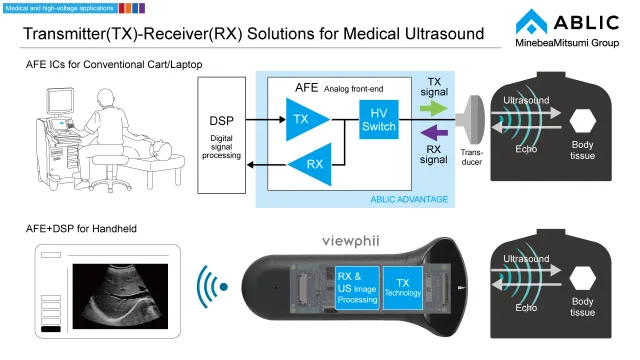
Transmitter(TX)-Receiver(RX) Solutions for Medical Ultrasound (Source: ABLIC)
Why did battery-less leak sensors become a cross-border case?
Short answer: the sensor solved an installation problem ordinary leak detection often does not. Battery-less water leak sensor uses CLEAN-Boost TM technology, a power storage and boost circuit technology, to obtain power from a tiny electrical charge generated when it contacts water. This enables detection of a few drops, reduces false alarms, and removes the need for battery replacement or power wiring. Many water leak sensors rely on resistance changes between electrodes; ABLIC’s design identifies leaks through the chemical reaction between water and metal, allowing detection even in pure water with low electrical conductivity.
Adoption followed a staged path. The sensors were first widely used in Japan, building a strong track record, with trial tests underway at several infrastructure facilities. For the US and EU markets, ABLIC obtained FCC certification, a communication and safety standard, and began sales last year. In June 2026, the company showcased the battery-less water leak sensor overseas for the first time at BOMA 2026, an international trade show in Los Angeles, California, generating strong interest. The no-power retrofit logic is especially useful in Europe, large data centers and smart city developments, where adding wiring can disrupt operations.
Two external data points strengthen the case. ABLIC’s JSCE Conference news entry says the experiment targeted repaired sections on an actual bridge that had been in service for approximately 38 years, providing infrastructure-field evidence beyond building deployments. Separately, EDN reported that ABLIC’s upgraded battery-less water leak detection sensor extends communication range by approximately two times that of its predecessor. For APAC buyers, longer wireless range can reduce the number of gateways needed across campuses, utility rooms and perimeter zones.
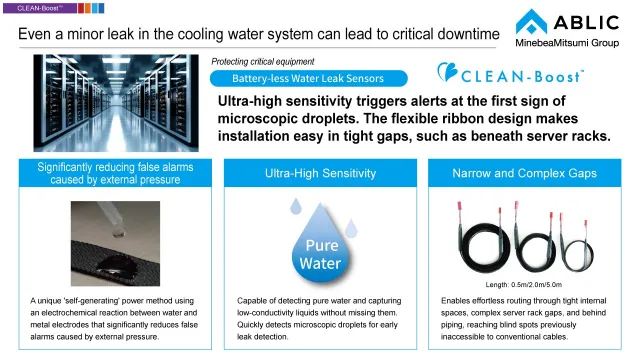
Characteristics and implementation overview of battery-less water leak sensors for data centers (Source: ABLIC)
What role did power management, AI and development systems play?
The case also includes adjacent AI-power infrastructure. ABLIC intends to propose lithium-ion battery protection solutions for industrial equipment, including energy storage systems (ESS) and battery backup units (BBUs) that guard against momentary power interruptions in AI servers. It will expand the lineup to include 48 V-compatible products so in-vehicle power supplies can serve a broad range of electric vehicles and related applications. That connects the battery-protection sector to AI and EV demand.
Internally, Hanazawa said ABLIC aims to raise the share of new products in total sales, and the effort is progressing as planned. The company will keep investing in technology and talent; M&A remains another route to high-value-added products. ABLIC is also using AI to improve development efficiency, intending to train AI to acquire design expertise so it can eventually handle more stages of the process. He emphasized that humans should make all final decisions, while security concerns require consultation with EDA vendors on how to proceed.
What can APAC digital and hardware leaders copy from ABLIC?
Read as a brief, ABLIC’s strategy uses a simple slogan with complex execution. The original case’s second framing was Small Smart Simple: focus, efficiency and deployability. Asked how ABLIC will use its strengths amid fierce global semiconductor competition, Hanazawa said the company is committed to inspiring customers with Small, Smart, Simple analog semiconductor solutions. The plan also includes developing new fields that could become the sixth and seven pillars of its business, while keeping low power consumption at the center.
Recheck checklist for APACTechDigit readers
- Portfolio discipline: ABLIC focused on five key sectors rather than spreading thinly across analog.
- Long-arc capability: low-power expertise from more than half a century was reused in AI, medical, automotive and leak sensing.
- Case proof: medical and leak-sensing products moved from specification stories to field evidence, including bridge verification and overseas market entry.
- Decision framing: the strategy is not only about technology but about reducing installation, maintenance, and integration risk for customers.
Action suggestions for APAC buyers
- Map leakage risk before wiring: if power drops are difficult, battery-less tags may be easier than wired sensors.
- Verify communication coverage: request on-site wireless range data, especially after EDN reported roughly double range versus predecessor.
- Check market certification: ABLIC’s FCC and US/EU sales status illustrates that regulatory readiness is part of the product.
- Test false-alarm tolerance: pure water detection is a meaningful differentiator in data-center or semiconductor-fab conditions.
- Track AI and vehicle power trends: 48 V systems and ESS/BBU backup are adjacent opportunities for APAC infrastructure buyers.
Asia-Pacific context and risks to watch
The regional case matters because leak-detection demand is no longer limited to factories and office buildings. Water-cooled AI servers can create localized leakage exposure near power distribution, plumbing and heat-reuse equipment. In the Asia-Pacific market, Data Bridge Market Research estimated the leak-detection sector at USD 437.46 million in 2025 and projected USD 757.27 million by 2033. That third-party estimate is useful for decision context, not as ABLIC company data.
Risk note: a battery-less sensor still needs wireless coverage, gateway integration, alarm workflow, and field validation. In pure-water environments, the chemical-reaction detection method can help, but buyers should test sensor-strip length, water chemistry, temperature range and placement geometry before scaling deployment.
Reference sources
- ABLIC, Battery-less Water Leak Sensor technical analysis: https://www.ablic.com/en/semicon/techanalye/part18/
- ABLIC, JSCE Conference verification news: https://www.ablic.com/en/semicon/news/2026/09/08/bl_waterleaksensor_jsce/
- EDN, ABLIC upgrades battery-less water leak detection sensor: https://www.edn.com/ablic-upgrades-battery-less-water-leak-detection-sensor/
- Data Bridge Market Research, Asia-Pacific Leak Detection market report: https://www.databridgemarketresearch.com/reports/asia-pacific-leak-detection-market
APACTechDigit editorial desk: contact@apactechdigit.com. Author: Lynn Zhou.