
K.C. Liu to Chairman, Miller Chang to CEO on January 1, 2027: Scoring Advantech's Split-Leadership Model Against APAC Peers
Advantech's disclosure published on November 5, 2026 splits two jobs that were held in one pair of hands: long-term direction, and the annual number. Effective January 1, 2027, founder K.C. Liu moves to full-time chairman while Miller Chang, president of Advantech’s Embedded Sector, becomes CEO, with group operations coordinated through the Worldwide Business Operations (WWBO) frame. For APAC buyers, integrators and channel owners, the decision-relevant question is not the title — it is whether escalation speed, roadmap continuity and regional authority improve or fragment.
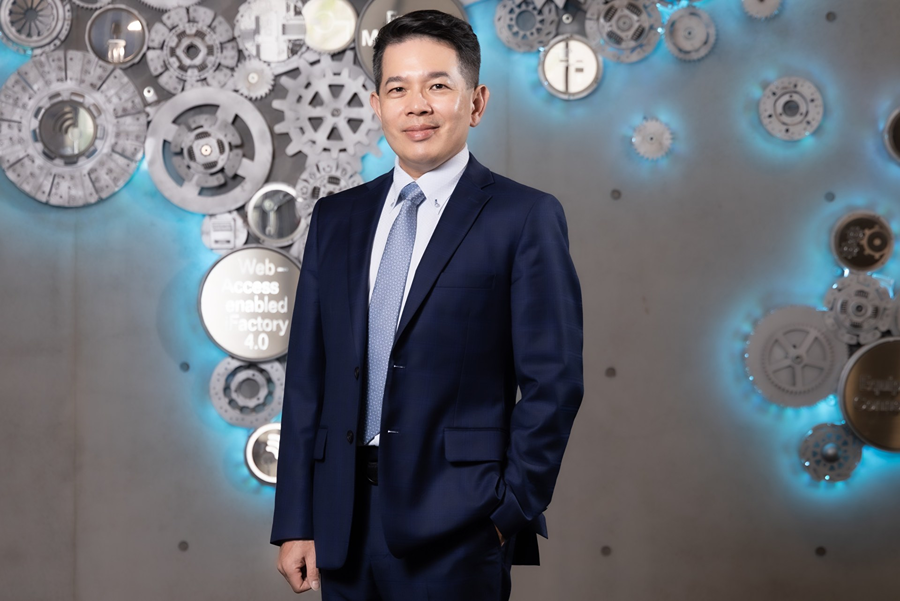
One detail most summaries skipped: the succession plan was published alongside strong momentum. Advantech's investor page reported accumulated nine-month 2026 revenue of US$2,485 million, up 46% year over year, in its October 29, 2026 earnings release. A handover written onto a rising curve is a governance consolidation, not a rescue appointment — and that distinction should shape how partners price the transition risk.
What actually changes on January 1, 2027 — and what does not
Short answer: the accountability map changes, the product catalogue does not. Advantech says it will further define strategic and operating responsibilities, putting corporate governance, long-term corporate development and new business investments with the chairman, while the CEO, together with the chief operating officer (COO) and chief financial officer (CFO), owns group operations, business integration, resource allocation and annual performance objectives.
| Role | Owns after January 1, 2027 | Not owned | What APAC customers must re-verify |
|---|---|---|---|
| K.C. Liu, full-time Chairman | Governance, long-term development, new business investments | Day-to-day group operations and annual targets | Whether multi-year co-development and investment-stage partnerships still route to the chairman |
| Miller Chang, CEO | Group operations, business integration, resource allocation, annual performance | Governance and new-investment mandate | Who signs off on allocation when two regions want the same capacity |
| COO and CFO | Operating and financial execution under the CEO | Strategic investments | Quarterly commitments, lead-time and price escalation paths |
| WWBO frame | Cross-business-group and cross-region cooperation and decision-making efficiency | — | Named decision owner per country, not a regional committee |
How does Advantech's model compare with other APAC hardware leadership structures?
Regional peers have tried at least three alternatives, and each trades something away. Advantech itself ran one of them: in 2017 the company announced three co-presidents — Eric Chen, Miller Chang and Linda Tsai — a sector-representative model that deepened vertical accountability but relied on a strong arbiter above it, which the founder then was.
| Model | Real example | Strength for customers | Failure mode for customers |
|---|---|---|---|
| Founder as chairman + single professional CEO | Advantech from January 1, 2027 | Continuity of vision plus one accountable operator | Arbitration between the chairman's investments and the CEO's annual number |
| Rotating CEO on a fixed term | Hon Hai Technology Group (Foxconn) named Michael Chiang rotating CEO for a one-year term effective April 1, 2026, succeeding Kathy Yang, with Young Liu as chairman | Power spread across business groups; reduces key-man risk | A 12-month horizon against 3–5 year industrial deployment cycles |
| Co-presidents by sector | Advantech's 2017 three co-president structure | Direct access to the executive who owns your vertical | Matrix deadlock without a decisive top layer |
| Founder-CEO combined | The configuration Advantech ran before the announced handover | Fastest single-point decisions | Concentrated key-man risk on strategy, capital and operations at once |
The takeaway for a buyer scoring suppliers: a split model with a defined operating frame is the most predictable for multi-year edge deployments, provided the company states who arbitrates across regions. A rotating or collective model is acceptable for commodity volume, but weak for roadmap bets that outlive the term.
Why does an embedded-hardware CEO matter to edge AI buyers?
Because the seat now sits above the sector that defines the architecture. Miller Chang has led Advantech's Embedded business and has argued publicly that the edge, not the cloud, is where physical AI becomes operational — and that platform work should create "repeatable, sustainable commercial value while extending industrial AI from Edge AI into Physical AI applications", as he put it at the company's August 5, 2026 investor conference on the Integrated WISE Solution & Station (IWS) platform strategy.
The market backdrop supports that bias, and it is concentrated in this region. Deloitte's 2026 State of AI in the Enterprise report (January 21, 2026) found 58% of companies already use physical AI to at least a limited degree, with adoption projected to reach 80% within two years, while only 25% of respondents said they had moved 40% or more of their AI experiments into production. Fortune Business Insights sizes the Asia-Pacific edge AI market at USD 13.24 billion in 2026 at a 36.7% forecast CAGR — the highest regional rate — while Mordor Intelligence puts the global industrial PC market at USD 5.87 billion in 2026, rising to USD 8.44 billion by 2031. Different firms count different scopes, so treat the levels as indicative and the direction as the signal: an embedded-first CEO aligns the top seat with the fastest-growing slice.
What is the Worldwide Business Operations (WWBO) frame actually worth in a deal?
It is worth exactly as much as the named approver inside it. Advantech's own description is that WWBO strengthens cooperation and decision-making efficiency across business groups and global regions, pairing long-term strategic vision with operational excellence. That is the mechanism that lets a split chairman/CEO model avoid the classic co-president stall.
The friction to watch: the operating layer is dual-hatted. Advantech's published executive team lists Linda Tsai as President of Intelligent System Sector and COO — meaning the executive who arbitrates cross-sector operations also runs one of the sectors being arbitrated. For APAC customers, that is manageable while volume is growing, and it becomes a bottleneck the moment two sectors compete for the same engineering capacity. Ask, in writing, who breaks a tie after January 1, 2027.
Regional read: should APAC, Europe and North America weigh this differently?
- APAC buyers: highest edge-AI growth rate and the densest deployment pipeline, so roadmap direction from the new CEO's sector matters more than governance optics.
- Europe and North America buyers: longer qualification cycles for industrial hardware; a 12-month notice period before January 1, 2027 is genuinely useful for re-papering supplier assessments and change-control clauses.
- Channel and system integrators: the chairman's new-investment mandate signals M&A or venture activity, which historically precedes portfolio reshuffling — build product end-of-life and succession clauses into renewals now.
- Investors and strategy teams: watch whether the WWBO cadence shows up as faster quote-to-lead-time conversion, not as another org chart.
Scorecard: green flag, yellow flag, or no signal?
Green flags. Twelve months of runway between announcement and effective date; a CEO promoted from the largest technical engine of the company rather than from finance; explicit definition of who owns annual performance objectives.
Yellow flags. Concentration of sector presidency and COO duties in one executive; an undefined escalation path between the chairman's investment agenda and the CEO's resource allocation; growth-led complacency while 9M26 revenue climbed 46% year over year and integration work is still unfinished.
No signal. Leadership titles alone. Read the handover as a governance signal rather than a procurement score, and let product roadmaps, firmware support windows and delivery performance do the talking.
Action checklist for APAC IT and procurement owners before January 1, 2027
- Freeze your supplier scorecard this quarter, then re-baseline after the handover; do not let a leadership change silently rewrite committed service levels.
- Request the post-January 1, 2027 named approver for your country and business group under the WWBO frame, in email form.
- Ask for the roadmap owner of every embedded platform in your bill of materials. The same question we applied to 16-bit microcontroller refresh decisions applies here: who signs the next five years of firmware support, not who signs the launch sheet.
- Add a governance-change clause to contracts renewing in 2027 covering roadmap continuity, product end-of-life notice and technical contact handover.
- Tie any edge AI pilot to a production KPI before committing volume: Deloitte's 25% pilot-to-production figure is the practical failure rate your business case must beat.
Frequently asked questions
Who becomes CEO of Advantech, and when?
Miller Chang, current president of Advantech’s Embedded Sector, takes over as chief executive officer on January 1, 2027, directing global operations and growth strategy. Founder K.C. Liu becomes full-time chairman on the same date.
Does the handover change products or prices immediately?
No. Nothing in the disclosed plan alters the catalogue or pricing structure. The visible change is internal: who signs annual performance objectives and who decides resource allocation across business groups and regions.
Is a founder becoming chairman a step back?
Not under this design. The chairman keeps corporate governance, long-term corporate development and new business investments — the three levers that matter most in a capital-intensive AI hardware cycle — while operating accountability moves to the CEO, COO and CFO line.
Should partners worry about decision speed?
Only if they cannot name the approver. The WWBO frame exists specifically to raise cross-region decision efficiency; the residual risk is tie-breaking between sectors, which the dual-hatted sector-president-and-COO arrangement leaves open.
Verified sources
- Advantech investor relations, leadership succession disclosure dated November 5, 2026 — https://www.advantech.com/en-us/investor
- Advantech, 3Q26 results (EPS NT$7.15; nine-month revenue US$2,485 million, +46% YoY), October 29, 2026 — https://www.advantech.com/en-us/resources/news/advantech-reports-3q26-eps-of-nt715
- Advantech executive team page (Miller Chang, President of Embedded Sector; Linda Tsai, President of Intelligent System Sector & COO) — https://www.advantech.com/en-us/about/executive-team
- Advantech investor conference on the IWS platform strategy, August 5, 2026 — https://www.advantech.com/en-us/resources/news/advantech-drives-industrial-ai-opportunities-with-integrated-wise-solution--station-iws-platform-strategy
- Advantech announces three co-presidents, 2017 release — https://news.cision.com/advantech-europe/r/advantech-announces-3--co-presidents--adopting--co-creation--and--holacracy--strategies-to-face-the-,c2336149
- Hon Hai Technology Group (Foxconn) names Michael Chiang rotating CEO, April 1, 2026 — https://www.prnewswire.com/news-releases/hon-hai-technology-group-foxconn-names-michael-chiang-rotating-ceo-boosting-leadership-governance-302732180.html
- Deloitte, 2026 State of AI in the Enterprise: The untapped edge — https://www.deloitte.com/us/en/about/press-room/state-of-ai-report-2026.html
- Fortune Business Insights, Edge AI — Asia-Pacific outlook — https://www.fortunebusinessinsights.com/edge-ai-market-107023
- Mordor Intelligence, Industrial PC (IPC) market — https://www.mordorintelligence.com/industry-reports/industrial-pc-ipc-market
Compiled by the APACTechBriefing desk. Author: Lynn Zhou, APACTechDigit. Corrections and partner briefings: contact@apactechdigit.com.