
Data Watch Briefing: September Chip Sales Rise in Every Region — Where the AI–Memory Cycle Bends for Asia-Pacific
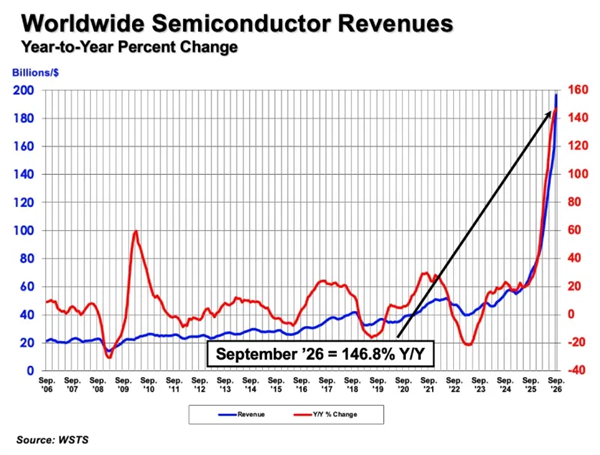
Short version: this is a supply-side event, not a demand recovery. In the single month of September, every major regional market printed steep year-on-year gains — Americas 191.7%, Asia Pacific and all other regions 141.4%, China 124.9%, Europe 102.5%, Japan 73.4% — because AI compute construction collided with a memory industry that cannot add bits fast enough. For Asia-Pacific technology leaders, the cycle lands first as a cost and allocation problem, and only second as a revenue opportunity.
What exactly did the September numbers show?
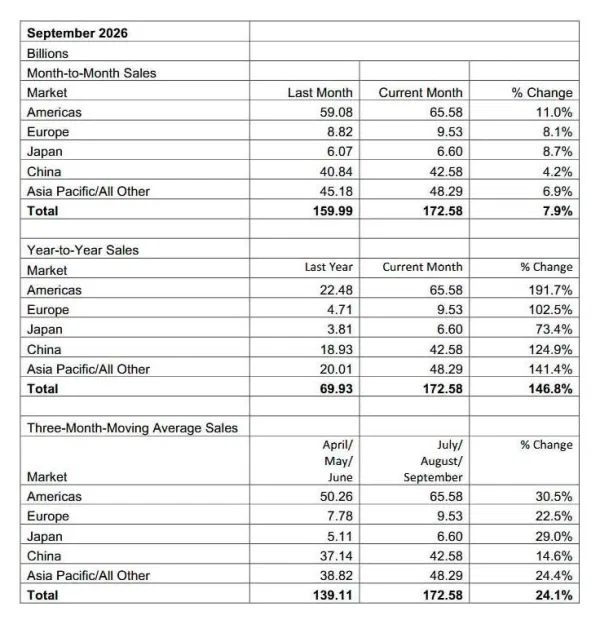
Conclusion first: the rally is universal, but its pace is no longer uniform. Data published by the Semiconductor Industry Association (SIA), compiled on the World Semiconductor Trade Statistics three-month moving-average basis, puts the third quarter of 2026 at about US$517.7 billion in worldwide sales — 24.1% above the preceding quarter — and September alone at roughly US$172.6 billion, up 146.8% year on year and 7.9% month on month.
| Region | September, year on year | September, month on month | September sales (US$ billion) |
|---|---|---|---|
| Americas | 191.7% | 11.0% | 65.58 |
| Asia Pacific and all other regions | 141.4% | 6.9% | 48.29 |
| China | 124.9% | 4.2% | 42.58 |
| Europe | 102.5% | 8.1% | 9.53 |
| Japan | 73.4% | 8.7% | 6.60 |
The year-on-year column is the headline; the sequential column is the signal. Month-on-month momentum is cooling fastest in China (4.2%) and in the Asia Pacific and all other regions bucket (6.9%), while the Americas is still compounding (11.0%). Because the sequential base is already inflated, the same percentage now buys far fewer incremental dollars — a mechanical reminder that headline growth can stay spectacular even as a cycle matures.
Why does Asia-Pacific carry the cost of this cycle?
Conclusion: the region sits between the demand and the price. The Asia Pacific and all other regions line is the second-largest on the map in dollar terms, with China's US$42.58 billion September total just behind it — and that is where most AI servers, memory modules and devices are assembled, so interconnect and memory inflation is absorbed here first.
- Demand anchor: J.P. Morgan Global Research sizes AI capital expenditure at roughly US$900 billion in 2026, heading toward US$5.5 trillion by 2030 — the spending pool that keeps HBM, DDR5 and optical components bid.
- Regional build-out: CBRE's 2026 Asia-Pacific data centre outlook describes hyperscale demand growing at a 14% CAGR, with technology companies lifting AI-related capital spending by 61% in 2026, concentrating new load in corridors such as Johor–Singapore, Thailand and Indonesia.
- Price transmission: TrendForce projected conventional DRAM contract prices to rise 10–15% quarter on quarter in the fourth quarter of 2026 and NAND flash 15–20%, later revising PC DRAM expectations to about 20% — evidence that cost pressure is already reaching buyers outside the AI supply chain.
What is actually driving the upcycle?
It is structural, not seasonal. AI servers consume HBM and DDR5 at rates that pull wafer, packaging and test capacity away from general-purpose memory, so a shortage in one category becomes a price rise in all of them.
Omdia previously forecast that global semiconductor revenue would break US$500 billion in the third quarter of 2026, and that cumulative sales in the first three quarters would already exceed the full-year 2025 total by more than 50%. The published third-quarter reading sits above that forecast line, which explains why suppliers' negotiating posture has hardened.
On the supply side, Goldman Sachs research puts the 2026 supply-demand gaps at 4.9% for DRAM, 4.2% for NAND and 5.1% for HBM — the widest reading for each category since 2011. SK hynix and Micron have publicly announced that their entire 2026 HBM capacity is sold out, with some customers already locking supply into 2027 to 2028.
How long can the cycle last?
Michael Robbins, President and CEO of SIA, said the global chip market grew sharply in the third quarter, with worldwide sales rising more than 20% sequentially for the third consecutive quarter and every major region holding strong year-on-year gains — underscoring, in his words, semiconductors' irreplaceable role in innovation, productivity and economic competitiveness. He added that AI infrastructure investment shows no sign of slowing, and that this compute-and-memory-led upswing will most likely extend into 2027.
The counterweight is physical: capacity approved today reaches volume output only after construction and qualification, typically around two years. That is why Samsung has told investors it expects shortages to deepen in 2027 and stay tight into 2028 — but the same lead time is also why a synchronised capex surge, if it meets even a pause in hyperscaler spending, remains the standard recipe for a price break.
Which risks should Asia-Pacific buyers price first?
- Cost pass-through to non-AI products. Servers, PCs, handsets and automotive memory compete for the same conventional DRAM and NAND bits, so contract-price gains of 10–20% per quarter squeeze margins in consumer and industrial hardware before any demand weakness appears.
- Allocation risk, not just price risk. With SK hynix and Micron's 2026 HBM output sold out and 2027 to 2028 slots being reserved, smaller Asia-Pacific buyers lose queue position first.
- Sequential deceleration. China's 4.2% month-on-month rise in September is the weakest in the table — a leading indicator for regional distributors carrying inventory struck at cycle-high prices.
- Capex concentration. The boom rests on a handful of hyperscalers; one budget review at a US cloud major transmits into Asia-Pacific order books with a two-quarter lag.
- Forecast drift. Quarterly contract-price calls have already been revised upward during the quarter, so budgeting to last quarter's assumption understates landed cost.
Four actions for the next two quarters
- Open supply negotiations for the second half of 2027 now, using volume corridors rather than fixed quantities, with price clauses indexed to published contract-price benchmarks.
- Separate AI and general IT budgets: assume conventional DRAM and NAND costs rise 10–20% per quarter, then re-forecast hardware total cost of ownership for servers, endpoints and edge devices.
- Re-qualify second-source suppliers and regional module vendors before remaining capacity is reserved by larger accounts.
- Track three indicators every month — SIA regional month-on-month sales, TrendForce contract-price calls and hyperscaler capex guidance. Treat a second consecutive month of slowing sequential growth in China and Asia-Pacific as the cycle's first genuine warning.
Quick briefing FAQ
Is this growth demand-led or supply-led?
Both, but asymmetrically: AI data-centre construction creates the demand, while sold-out HBM and constrained conventional memory set the price. That combination is why all major regions can rise in the same month.
Why does Japan sit at the bottom of the growth table?
Japan's 73.4% year-on-year gain still clears most industry benchmarks. Our reading is a mix effect: Japan's export base skews toward equipment, analog and discrete components rather than the memory and accelerator categories currently repricing fastest — this is analysis, not a company-specific statement.
When could prices stop rising?
Watch the capacity lag. Supply sanctioned in 2026 lands in volume during 2027–2028, broadly matching guidance from Samsung that shortages deepen in 2027 and stay tight into 2028. A price break is more likely to begin with an AI capex pause than with end-market fatigue.
What should an Asia-Pacific CTO budget for 2027?
Carry a 15–20% buffer on memory-linked hardware, extend lead times in procurement plans, and secure allocation before the fourth-quarter 2026 booking windows close.
Reference sources
- SIA global semiconductor sales releases — https://www.semiconductors.org/news-events/latest-news/
- TrendForce memory contract-price forecasts, 30 September and 20 October 2026 — https://www.trendforce.com/presscenter/news/20260930-13258.html and https://www.trendforce.com/news/2026-10-20/news-dram-prices-seen-rising-20-qoq-in-4q26-despite-slower-gains-ai-demand-tight-supply-support-outlook/
- Samsung guidance on shortage through 2027–2028 — https://www.tweaktown.com/news/112966/memory-shortages-will-get-only-worse-in-2027-and-2028-warns-samsung/index.html
- J.P. Morgan Global Research AI capex outlook — https://www.jpmorgan.com/insights/global-research/artificial-intelligence/ai-capex
- CBRE 2026 Asia-Pacific data centre trends and outlook — https://www.cbre.com/insights/reports/2026-asia-pacific-data-centre-trends-and-outlook
Briefing desk: Lynn Zhou · APACTechDigit · contact@apactechdigit.com