
APACTechBriefing Deep Read: Hyundai Home Shopping's AI-REAL Sales Show — What APAC Teams Must Verify First
In Seoul a home-shopping segment is a scheduled TV slot; in Jakarta or Manila, selling happens in live video. That difference decides how far this case travels. The direct answer for APAC buyers: Hyundai Home Shopping's AI-REAL can generate an entire sales broadcast, but the reported 80% supplier-cost cut and 120% target result are supplier-level, company-reported figures that need separate product-proof checks before anyone copies them.
By Nina Roberts — APACTechBriefing, APACTechDigit
What actually changes when an entire sales show is generated?
The conclusion first: the binding constraint moves from filming to verification. According to the retailer's November 15 announcement, AI-REAL generates voices and visuals without a live on-screen host or a camera shoot, pushing AI past a single virtual presenter into a complete program.
The first regular program sells Jeju Heart Gold kiwis on November 16 at 3:20 p.m. in South Korea, or 1:20 p.m. WIB (Western Indonesia Time — the clock that matters for any regional rebroadcast). AI-REAL runs on Hyundai Home Shopping's data shopping channel, known as PLUS# or Plus Shop.
Food is the practical test. Growing conditions, soil and distribution are expensive to show in a studio; Hyundai says generated visuals explain them without location filming or props. The still supplied by the company below shows an AI-REAL trial broadcast with generated visuals and a virtual presenter — the format, not a real on-screen host.
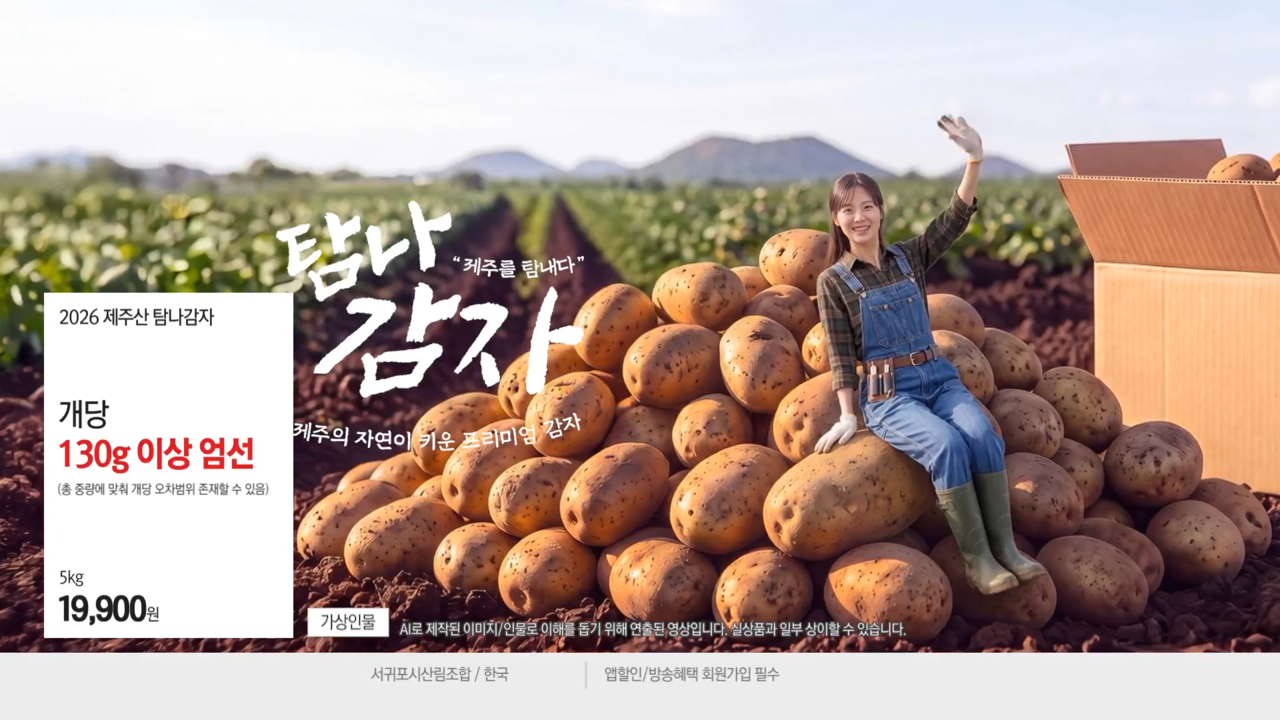
The rollout is deliberately narrow. Hyundai says it will start with agricultural products, meat and seafood, then move toward processed foods and household goods; Korean trade coverage adds that AI broadcasts are planned at least once a month (koreabizwire.com). That is a measured cadence, not a studio replacement. The human approval process stays undisclosed, and the announcement does not establish that other retailers can buy AI-REAL as a commercial service.
Is the 80% cost cut a real production saving?
Conclusion: no. It is a supplier-preparation figure, not a cut to the retailer's total production budget.
At least 80% lower specified supplier costs. In a trial, expenses for sample preparation, supplementary video production and related work fell by that amount, according to Hyundai Home Shopping. That boundary matters: it covers participating suppliers' preparation expenses, not software charges, internal labor, review time or the cost of correcting generated material. No total was disclosed.
Sales reached 120% of the target. This is a company-reported measure of target attainment, not a 120% rise in sales. Beating a target says little about AI's incremental effect without a comparable conventional program matching product, price, audience and airtime; neither that comparison nor the trial sample size was released. Lower cost in a demonstration and greater effectiveness in a demonstration are different results.
Lim Soo-jin, head of broadcast production at Hyundai Home Shopping, said viewer feedback indicated that "information such as growing conditions and cooking examples helped them decide whether to buy." That is the intended benefit, still company-reported rather than an independently measured conversion result.
The wider industry is applying the same skepticism. IAB's 2026 Outlook research found cost efficiency is now the top-cited benefit of AI among advertisers at 64%, up from fifth place in 2024 — a sign buyers want harder metrics (iab.com). That makes Hyundai's narrow, supplier-level framing more credible than a blanket savings claim, but it also raises the bar for what counts as proof.
Format decides the benchmark. Fresh Step's talking-cat films use generated characters to make a benefit memorable; the Hyundai AI-REAL case assigns AI a different job — explaining a product well enough to support a purchase inside a sales program.
| Example | Creative task | What it establishes |
|---|---|---|
| Fresh Step talking-cat ads | Make a benefit memorable through generated characters | A brand advertising production approach |
| Hyundai AI-REAL | Generate a full sales presentation and illustrate product information | A retailer broadcast production approach |
They are distinct formats with no shared cost benchmark. In comedy, an impossible character reads as a device; in a shopping demonstration, an image of growing conditions can read as product evidence. As the explanation grows more realistic, separating verified fact from illustrative reconstruction gets harder — and more important. Producing the scene is not the same as verifying the claim.
Why does APAC change the read on a host-free sales show?
Conclusion: Korea's scheduled TV-home-shopping logic does not port directly into Southeast Asia's live-video commerce, so the same AI format buys different things in different markets.
Hyundai Home Shopping is a teleshopping broadcaster — a fixed slot, a curated product, a scripted explanation. Across Southeast Asia, video commerce grew roughly fivefold in three years and now accounts for about 25% of e-commerce GMV (sourceofasia.com), with the region supplying the bulk of TikTok Shop's volume. Our briefing on the Shopee vs Taobao vs TikTok Shop 11.11 discount trade-off shows why: in these markets the discount and the live host are the entry ticket, not the background.
That changes the value of removing a presenter. In a curated Korean slot, a virtual host cuts preparation cost for a controlled message. In an Indonesian or Philippine live stream, the host's real-time response is often the trust mechanism; automation that removes it may save money and lose the reason viewers stayed. Terms worth noting: WIB is Western Indonesia Time; "home shopping" here means TV teleshopping, not generic e-commerce; a "KOS" (key opinion salesman) is the local name for a live-sales host in the regional playbooks SEA teams borrow.
There is a wider pattern: Korean consumer firms are already using "synthetic consumers" to test pricing, packaging and store layouts before launch, with around 50 firms adopting the method (retailnews.asia). AI-REAL is one piece of a broader Korean experiment in automating the commerce funnel — useful context, not proof the export version works everywhere.
What does disclosure research say about a virtual presenter?
Conclusion: disclosure, not generation cost, is the likeliest compliance tripwire for a synthetic host. IAB launched its first AI Transparency and Disclosure Framework in January 2026, built with Sonata Insights research showing Gen Z trust in AI ads fell 19 points; the framework flags synthetic humans and digital twins as cases needing disclosure (iab.com). That lands squarely on a presenter that looks like a person.
Meanwhile a 2026 scan of 37,768 Facebook and Instagram ad files found about one in eleven carried AI-generated media, yet only 0.06% disclosed it (resemble.ai). Practice is lagging policy. For APAC teams the immediate step is operational: label the synthetic presenter where platform rules require it, and keep a real product reference in frame. AI Academy HK's guidance for Hong Kong brands recommends retaining at least one genuine filmed shot and never letting AI generate prices, dates or terms. That is the same line between illustration and evidence — an environmental render can explain; a price or growing-condition claim must be substantiated.
Measurement has a parallel. Just as brands check whether assistants mention them accurately in purchase answers — what our briefing calls answer inclusion rather than a visibility score — commerce teams should check whether a generated scene actually represents the product, not merely that it looks persuasive.
FAQ
Did Hyundai Home Shopping actually cut production costs by 80%?
Not as a total. The 80% figure covers specified supplier preparation costs — samples, supplementary video and related work in a trial — not the retailer's full production budget. Software, labor, review and correction costs were not disclosed.
Does "120% of target" mean sales rose 120%?
No. It is the trial's target-attainment measure, reported by Hyundai Home Shopping. Without a comparable conventional program and a disclosed sample size, it cannot be read as AI-driven incremental lift or as a 120% increase.
Can other retailers buy AI-REAL?
The announcement does not say. It describes an internal system for Hyundai Home Shopping's PLUS# / Plus Shop channel, with category expansion at a measured monthly cadence; commercial availability was not established.
Why does this matter more in APAC than in one home market?
Because the format's value depends on local selling behavior. Korea's scheduled TV slot rewards cheaper, controlled explanations; Southeast Asia's live-video commerce rewards real-time host interaction. The same host-free show can save cost in one setting and remove trust in another.
Localization checklist: what APAC teams should verify first
Before treating a generated sales show as a template, work through this list:
- Define the savings unit. Separate supplier preparation cost from generation, review, correction and deployment cost; demand a baseline, not a single percentage.
- Keep illustration and evidence apart. Label generated environmental scenes; anchor origin, grade, price and date to verifiable data and a real filmed reference.
- Test the decision, not the target. Compare against a matched conventional program on the same product, price, audience and airtime before claiming conversion lift.
- Map the channel, not the format. Decide per market whether a host is a cost or a trust mechanism — scheduled TV and live social commerce answer differently.
- Check disclosure rules locally. Follow the IAB framework where adopted and each platform's labelling policy; synthetic presenters are the highest-risk category.
- Record the workflow. Log inputs, rejected takes and edits, as the Hong Kong guidance advises, so cost and quality can be audited later.
The takeaway for APAC teams is narrow but useful: generated broadcasts can make product explanation cheaper, yet advantage will come from tying each persuasive detail to something the seller can substantiate in the local channel that actually sells.
Reference sources
- The Korea Herald — Hyundai Home Shopping to debut fully AI-generated sales show
- Korea Bizwire — No hosts, no cameras: Hyundai Home Shopping launches AI-generated broadcasts
- IAB — The AI Ad Gap Widens (cost efficiency at 64%)
- IAB — AI Transparency and Disclosure Framework launch
- Resemble AI — 2026 AI in Advertising Report
- Source of Asia — Digital Commerce in SEA & South Korea 2026
- Retail News Asia — 50 Korean firms turn to synthetic AI shoppers