
APACTechBriefing: Alibaba's T-Head Hong Kong Spin-Off, Compared Against Ascend, Cambricon and a Shanghai Listing Route
By Nathan Hale, APACTechDigit
Alibaba said on November 10 that it intends to spin off wholly-owned T-Head (Shanghai) Technology Co., Ltd. for a standalone Main Board listing in Hong Kong, after the chip unit filed its A1 application confidentially to the HKEX on September 11, 2026. For Asia-Pacific technology leaders, the signal is not deal size but comparison set: a formerly captive Chinese accelerator supplier now has to be benchmarked openly against Huawei Ascend, Cambricon and Nvidia-supplied cloud capacity when regional AI budgets are allocated.
What did Alibaba actually confirm, and what is still unresolved?
The short answer: structure is fixed, economics are not. The Hong Kong Stock Exchange has confirmed Alibaba may proceed with the proposed spin-off, and T-Head's application covers H-share listing and trading on the HKEX Main Board. Alibaba has described T-Head as a leading full-stack data centre chip supplier in China, with silicon positioned as a system-level compute solution rather than a single accelerator SKU. After the separation, T-Head is expected to remain an Alibaba subsidiary.
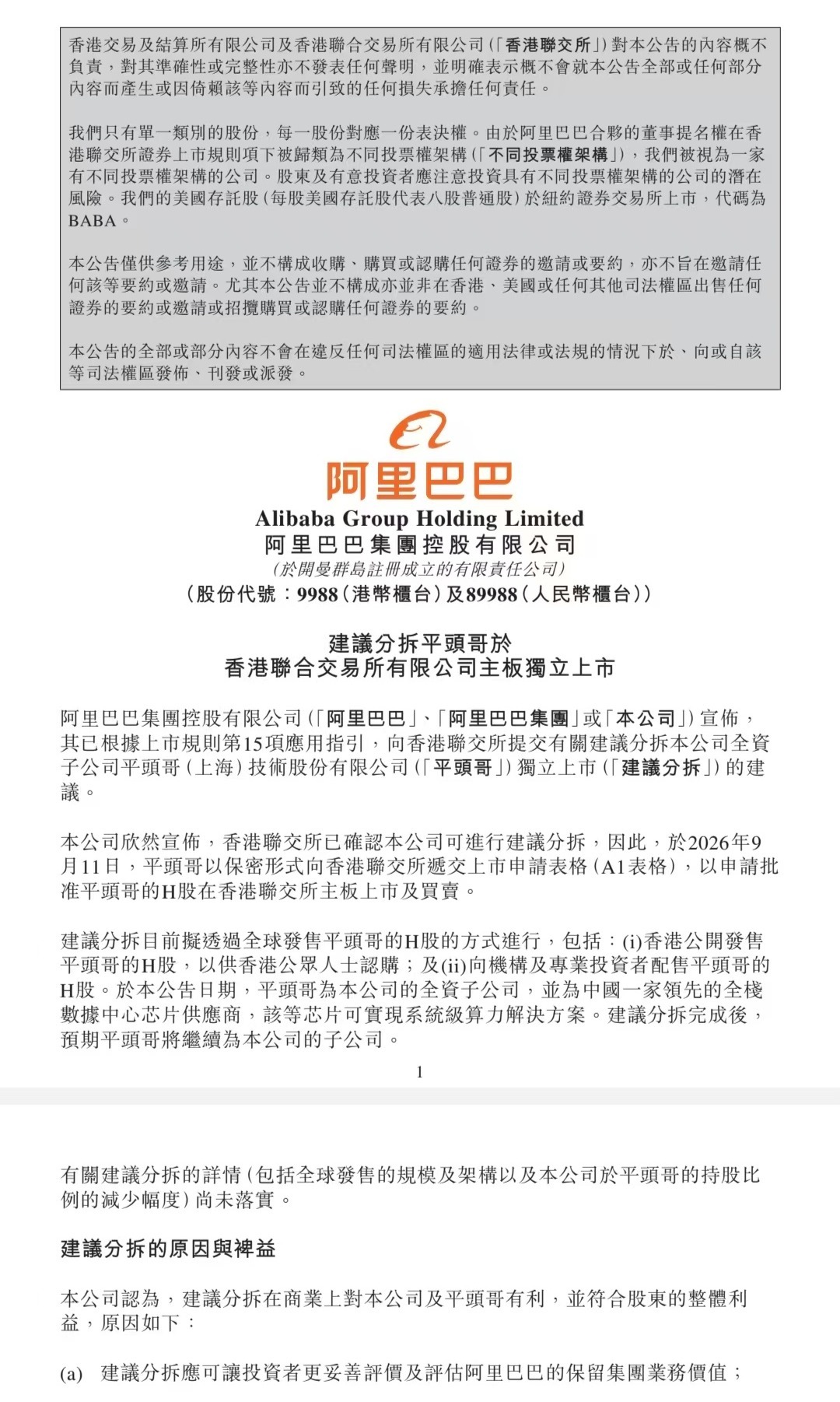
- Offering shape: a global H-share sale, combining a Hong Kong public offering with placings to institutional and professional investors.
- Still open: the size and structure of the global offering, and how far Alibaba's shareholding will be diluted.
- Still required: approval from the HKEX Listing Committee and completion of the record-filing procedures with China Securities Regulatory Commission (CSRC).
How does T-Head stack up against regional rivals on the numbers?
Conclusion first: T-Head is now a volume player with a credible flagship, but it trails the market leader by an order of magnitude in shipped units. In September 2026 the company unveiled its next-generation AI chip, Zhenwu V900. According to T-Head, single-chip performance reaches three times the previous-generation M890, a 3x step-up, and a single cluster can scale to as many as 500,000 chips for frontier large-model training; Alibaba expects volume production and market launch in the first quarter of 2027 (Q1 2027). Launch materials also disclose 216GB of on-board memory and 1,200GB/s of chip-to-chip interconnect bandwidth, with native FP8 and FP4 support, aimed mainly at cutting inference cost per token.
Set that against market tracking. IDC's first-half 2026 China AI accelerator data, as reported by OFweek and Tencent News, show roughly 2 million units shipped in the period, with Nvidia at 34% (678,000 units, down about 44% year on year), Huawei Ascend at 28% (572,000 units), T-Head at 7%, Cambricon at 5%, Baidu Kunlunxin at 4% and Hygon Information Technology at 3%. Morgan Stanley's projection of China's high-end AI chip self-sufficiency — 35% in 2025, 45% in 2026, 68% in 2027 — explains why buyers outside China are suddenly seeing these vendors in tenders.
| Vendor (H1 2026 share, IDC) | Route to an APAC buyer | Binding constraint |
|---|---|---|
| Huawei Ascend, 28% | Direct servers and regional partner channels | Pricing volatility; reported card price hikes of 20%-50% in two months in 2026 |
| Alibaba T-Head, 7% | Predominantly delivered through Alibaba Cloud capacity | Captive-supplier perception; few standalone on-premises SKUs |
| Cambricon, 5% | Domestic intelligent-computing centres, limited overseas presence | Software ecosystem maturity outside Chinese frameworks |
| Nvidia, 34% | Global cloud regions, strongest toolchain | Export-restricted China supply; reported state-funded data centre rules excluding foreign chips |
Why a Hong Kong spin-off rather than a Shanghai IPO?
Because it is the faster of two routes that both end at the same regulator. A wholly-owned subsidiary listing in Hong Kong must satisfy the exchange's spin-off framework, including independence from the parent in management, operations and finance — the principles set out in HKEX's Practice Note 15 guidance. Filing A1 in secret since September 11, 2026 also let T-Head run the vetting clock before market chatter forced a disclosure. The Shanghai path is heavier: it demands an onshore listing committee track, and it can stall, as the paused Shanghai STAR Market listing of China's YMTC parent illustrates for anyone sequencing domestic semiconductor capital raises.
Investors still lack a priced anchor. A January 2026 JPMorgan note, distributed via AASTOCKS, sized a standalone T-Head at US$25 billion-US$62 billion on comparable revenue multiples, roughly 6%-14% of Alibaba's market capitalisation at the time, and characterised the move as a sentiment catalyst rather than a near-term earnings driver. Bloomberg and Reuters both reported Alibaba's own rationale: separate listing lets investors value the chip business on its own merits and lets T-Head raise equity and debt directly.
Does "still an Alibaba subsidiary" change the buyer's calculus?
Yes, in two opposite directions. The commercial case for openness is improving: T-Head has moved from internal use — the company was formed in 2018 by merging the acquired C-Sky Microsystems with the DAMO Academy chip team to reduce Alibaba's dependence on external suppliers — to broad external delivery, with 560,000 Zhenwu-series units shipped cumulatively by April 2026 and more than 650 enterprise customers disclosed by the time of the September 2026 Apsara conference, spanning autonomous driving, finance, energy and manufacturing.
The counterweight is governance. T-Head's four-line portfolio — AI accelerators, general-purpose CPUs, SSD controllers and IoT chips — still sits under a group whose cloud arm competes with the same customers across Southeast Asia. Buyers should assume the allocation priority during capacity crunches follows the parent's infrastructure build-out, not the external purchase order. Regional read-through matters here: Alibaba Cloud stood up a new Johor public cloud region with two data centres in June 2026, bringing its Malaysian footprint to five facilities, its largest overseas base, which is the most realistic way for most APAC enterprises to consume this silicon — as in-region capacity, not as imported accelerators subject to localisation review. The sequencing question is familiar from regulatory filings that gate AI service launches in China.
What should APAC infrastructure teams do now?
- Tie GPU refresh decisions to the Q1 2027 volume-production milestone for Zhenwu V900; treat claims before that date as roadmap, not supply.
- Price a dual-vendor plan: benchmark Ascend, Cambricon and Nvidia-based cloud capacity side by side, since the reported 20%-50% card price moves of 2026 make single-vendor commitments the highest-variance line item.
- Model migration cost, not chip specs: measure FP8/FP4 inference economics on your own workloads before committing, and keep one cloud fallback for burst training runs.
- Decide the access mode: in-region cloud capacity in Malaysia, Indonesia or Japan versus on-premises purchase, and document which regulator constrains each option.
- Watch three disclosure gates for deal reality: the published offering size, the HKEX Listing Committee approval, and the CSRC record-filing receipt.
What could still delay or dilute the outcome?
Three risks stand out. First, procedural: the separation remains conditional on HKEX Listing Committee approval and CSRC filing, and neither has been granted. Second, supply-side: China's certified domestic designers are competing for the same limited advanced-node wafer slots, which historically converts demand into allocation queues. Third, market: if pricing is set on the back of self-sufficiency enthusiasm rather than audited margins, the aftermarket discount that hit previous Chinese semiconductor listings could compress the very value release Alibaba is seeking.
Frequently asked questions
Is T-Head still part of Alibaba after the listing?
Yes. Alibaba has stated that T-Head is expected to remain an Alibaba subsidiary once the spin-off completes; the adjustment range of Alibaba's shareholding has not yet been fixed.
When did the listing process formally start?
Confidentially on September 11, 2026, when T-Head submitted its A1 application to the HKEX; the plan was disclosed publicly on November 10.
How quickly can customers buy these chips?
Most APAC buyers will consume them through cloud capacity rather than standalone purchase. Alibaba expects Zhenwu V900 to enter volume production and launch in the first quarter of 2027, with clusters scaling to 500,000 chips.
Why does this matter outside China?
Because regional AI cost curves are set by accelerator supply. A listed, capital-accessible T-Head expands the credible vendor shortlist for Malaysia, Indonesia, Thailand and Japan deployments, and gives procurement teams a second benchmark against incumbent global suppliers.
References
- Reuters: "Alibaba AI chip unit T-Head files for Hong Kong IPO" (November 10, 2026)
- Bloomberg: "Alibaba's Chip Design Unit T-Head Files for Hong Kong Listing" (November 10, 2026)
- HKEX Listing Rules, Practice Note 15 on spin-offs (en-rules.hkex.com.hk)
- IDC first-half 2026 China AI accelerator shipment tracking, via OFweek and Tencent News
- JPMorgan research note on a potential T-Head valuation, via AASTOCKS (January 2026)
- Morgan Stanley China AI accelerator self-sufficiency forecast, via sgpjbg.com.cn industry report aggregator
- Alibaba Cloud press room: new Johor public cloud region in Malaysia (June 2026)
- TMTPost and China Market Star: T-Head shipment and enterprise-customer disclosures (2026)