
AMD Calls Itself a "Data Center-First" Company: Six Questions Asia-Pacific Tech Leaders Should Ask
AMD's Q3 2026 numbers settle the debate: record revenue of US$13.4 billion, up 97% year on year, with data center products now carrying roughly 63% of the total, while gaming slid 40% to US$773 million. This APACTechBriefing Q&A answers three practical things: what changed, why it changed, and what Asia-Pacific IT, procurement and product teams should do next.
What exactly did AMD report for the third quarter?
Short answer: the biggest quarter in the company's history, driven almost entirely by data center demand, while its consumer hardware business contracted in the same three months.
- Total revenue: a record US$13.4 billion in the third quarter, up 97% year on year.
- Revenue mix: data center products already account for about 63% of AMD's total revenue.
- Gaming: revenue fell to US$773 million, down 40% year on year.
- Near-term plan: chief executive Lisa Su said the data center business is expected to grow 50% quarter on quarter in the fourth quarter, and that she wants it to be more than double today's scale after 2027.
"We are a data center-first company; that is our positioning. People need more computing power to support all kinds of applications." — Lisa Su, speaking to Yahoo Finance after the earnings release
Where is that computing power actually coming from?
The answer is two product lines: Instinct AI accelerators, used for model training and inference, and EPYC server processors, which provide CPU capacity inside large data centers. Cloud providers and big technology companies are still building AI infrastructure, and that demand is what turned these two lines into AMD's growth engine. A decade of competing with Intel and Nvidia through Ryzen CPUs and Radeon graphics cards has not disappeared — it has simply stopped being the priority.
A product signal regional buyers should note: AMD has moved from selling boards to selling entire racks. Its Helios rackscale documentation describes a single design that integrates 72 Instinct MI455X GPUs with sixth-generation EPYC "Venice" CPUs and Pensando Vulcano AI network cards connected over UALink. For Asian operators, that reframes the buying decision from component sourcing to power, cooling and rack-load planning.
Su also addressed the AI investment-bubble argument directly. She said AMD invests with a long view, typically planning business capacity three to five years ahead, so today's supply-chain build is meant for demand that has not yet been ordered — and she positioned AMD as the partner of choice for the world's largest compute buyers. TechSpot has noted that this timing gap between spend and payback is precisely where short-term scepticism comes from.
Why did gaming revenue drop 40% — and is it an AMD-only problem?
Short answer: no. AI data centers are outbidding consumer hardware for the same memory, packaging and component supply.
TechSpot points to a supply squeeze: heavy AI data center purchasing of memory chips and other key components tightened consumer hardware availability and raised GPU production costs, while higher graphics card prices fed back into weaker PC gaming demand. AMD is not the only player feeling this; the entire consumer electronics chain is absorbing higher input costs on products with thinner margins.
Market data released around the same earnings window makes the demand side visible:
- Omdia reported global desktop, notebook and workstation shipments fell 21.2% year on year in the third quarter of 2026 to 58.1 million units, with desktops down 23.5% and notebooks down 20.6%. Omdia research director Ishan Dutt said the collapse was unsurprising after pull-forward buying supported the market through the first half, and the firm forecasts a further 24% decline in the fourth quarter of 2026 and another 7% in 2027.
- IDC Asia/Pacific recorded 11.6% growth in the regional traditional PC market for 2025, but now projects a 13.7% decline in 2026 to 92.0 million units. Maciek Gornicki, senior research manager for devices research at IDC Asia/Pacific, said strong AI infrastructure demand is creating significant constraints in global DRAM and NAND supply as memory makers shift capacity away from consumer electronics.
- J.P. Morgan Global Research estimates that DRAM prices will have risen more than 400% between the start of 2024 and the end of 2026 — a cost wave that lands hardest on consumer GPUs and mid-range laptops.
How far does the shift go? AMD and Nvidia side by side
The comparison shows two companies converging on the same identity, at different speeds.
| Indicator | AMD | Nvidia |
|---|---|---|
| Reporting period | Q3 2026 | Q2 of fiscal 2027 |
| Data center share of revenue | about 63% | 92.5% |
| Data center revenue | main growth engine behind the record US$13.4 billion quarter | US$8.902 billion |
| Consumer/gaming business | Still reported separately; gaming down 40% to US$773 million | No longer broken out as traditional gaming; folded into a broader edge-computing category |
| Stated positioning | "Data center-first" company | AI infrastructure-first company |
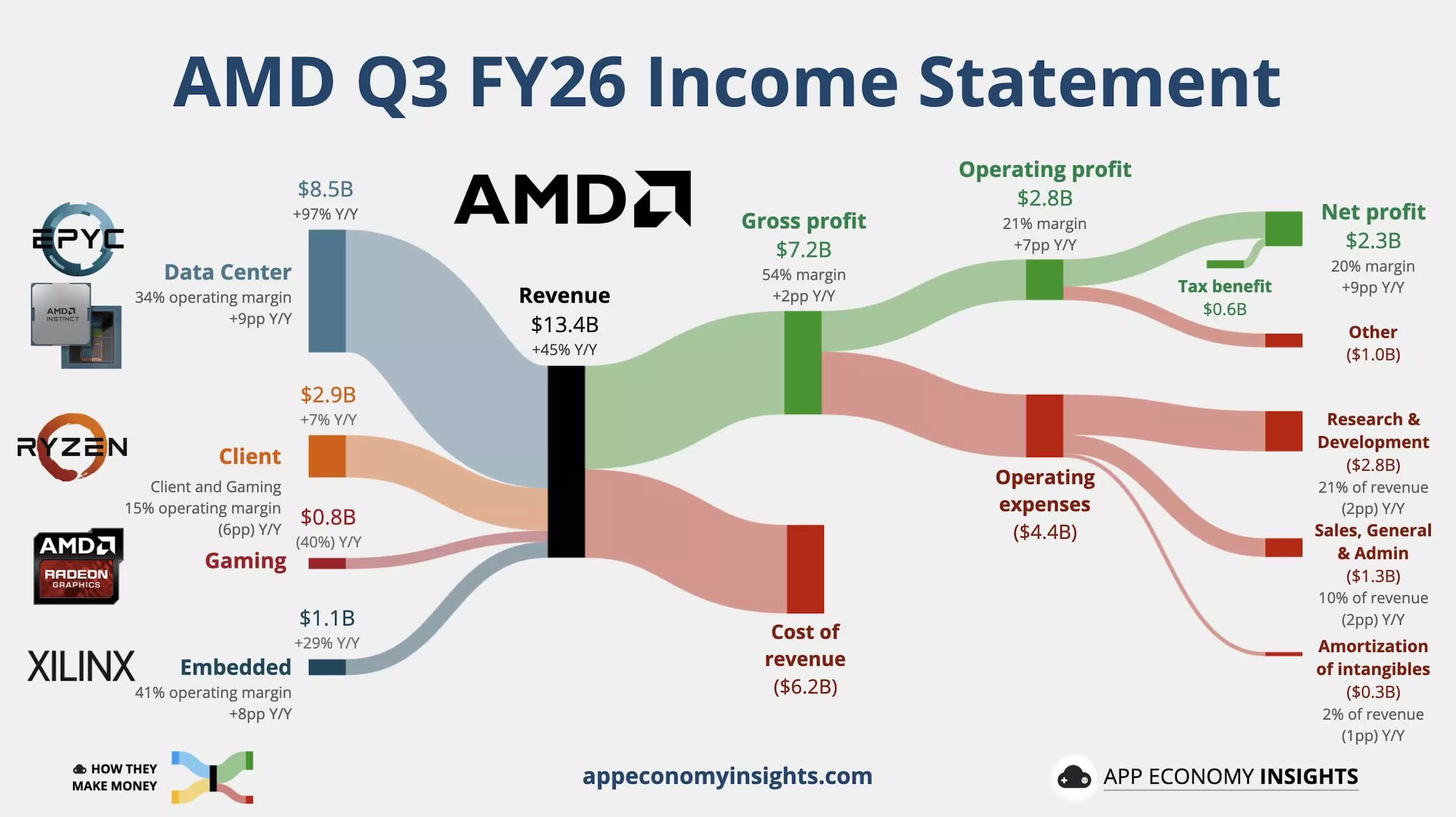
Nvidia has already completed the transition on paper, with 92.5% of revenue coming from data center in the second quarter of fiscal 2027. AMD still runs a comparatively complete gaming business, but at about 63% of total revenue the tilt is unmistakable. Nothing in Su's comments amounts to a Radeon exit: AMD has not announced abandoning the business or stopping consumer graphics cards. What has changed is priority — and priority decides research budgets, wafer and memory allocation, and refresh cadence.
What does this mean for Asia-Pacific IT and procurement teams?
Demand on the infrastructure side is not cooling. CBRE's 2026 Asia-Pacific data centre outlook puts global hyperscale demand growth at a 14% compound annual rate, with technology companies planning to lift AI-related capital spending by 61% in 2026. That is the same buying pressure that is inflating memory prices and draining supply from the consumer channel.
- Server refresh gets leverage first. Two vendors, a fast-growing EPYC installed base and rack-scale offerings give Asia-Pacific enterprises more negotiating room on server and accelerator contracts than they have had in years.
- Endpoint refresh gets more expensive. With Omdia expecting a 24% global shipment decline in the fourth quarter of 2026 and IDC projecting a 13.7% fall in Asia-Pacific volumes this year, expect longer lead times, thinner channel stock and higher notebook and desktop unit prices.
- Graphics-dependent teams should plan around volatility. Content, design, simulation and gaming-hardware teams should treat Radeon availability and pricing as a variable, not a constant, until AMD's consumer roadmap is clearer.
- Power and space become the constraint, not chips. Rack-scale AI systems shift the bottleneck to electricity and cooling — an argument for regional operators that matters more than list price.
Five moves to make in the next two quarters
- Lock memory and storage supply terms now, with price-adjustment clauses and volume floors, before another DRAM contract round passes.
- Split the 2027 budget conversation: evaluate server and accelerator capacity separately from endpoint replacement, because the two now face opposite price trends.
- Run a vendor-parity test on inference workloads — AMD's rack-scale stack and Intel's server roadmap are both credible bids; benchmark before renewing.
- Push procurement to check channel inventory health with shipment data, not vendor guidance, given the forecast decline in Q4 2026 volumes.
- Flag AI capex debates internally with a timeline: AMD itself plans three to five years ahead, so judging infrastructure spend on one-quarter payback will misprice the decision.
FAQ: short answers for fast decisions
Is AMD dropping gaming and Radeon?
No — AMD has made no such announcement, and gaming still generates US$773 million a quarter. But Su's "data center-first" framing means consumer GPUs now compete for resources against a business growing 50% quarter on quarter in the fourth quarter.
Why did AMD's gaming revenue fall so sharply?
Two forces: AI data center demand absorbing memory and components, which raised production costs and retail prices, and falling PC demand. TechSpot and Omdia data both point in the same direction.
How exposed is AMD to a slowdown in AI spending?
Increasingly. About 63% of revenue already comes from data center, and the plan is for that business to more than double after 2027. Su's counter-argument is that investors underestimate compute demand several years out, and AMD builds for that horizon.
Will PC and GPU prices in Asia-Pacific fall in 2027?
Nothing in the current forecasts suggests a quick relief. Omdia expects another 7% shipment decline in 2027, and IDC ties the constraint to memory capacity that is being redirected to AI infrastructure.
Does this change how enterprises should buy servers?
It strengthens the case for competitive bidding. With Nvidia at 92.5% data center revenue concentration and AMD still investing across CPUs, accelerators and rackscale designs, buyers in the region have more alternatives — and more pricing leverage — than at any point in the past decade.
Bottom line
For Asia-Pacific readers, the third quarter of 2026 marks a change in who AMD is selling to: hyperscale and AI infrastructure customers, not gamers. That does not kill the consumer roadmap, but it does reprice it. Treat data center product supply as the tight, well-funded side of the market and consumer silicon as the side that must wait for capacity — and set 2027 procurement plans accordingly.
References
- Omdia — Global PC shipments fall 21% in Q3 2026
- IDC — Asia/Pacific PC market grew 11.6% in 2025, supply constraints to hit 2026
- CBRE — 2026 Asia Pacific Data Centre Trends & Outlook
- J.P. Morgan Global Research — The AI-driven memory shortage
- AMD — Helios rackscale solutions (product documentation)
Compiled by Lynn Zhou for APACTechDigit · APACTechBriefing. AMD earnings figures are as reported by AMD and as cited by TechSpot and Yahoo Finance.