
Andes Parks the Cuzco RISC-V CPU Bet: What a Slowed Flagship Means for Asia-Pacific Silicon Roadmaps
TAIPEI, Taiwan — The most useful signal about RISC-V’s climb into the data center is not a new core announcement but a deliberate pause. In an interview with EE Times, Andes Technology CTO Charlie Su confirmed that development of Cuzco, the company’s flagship-class RISC-V CPU IP, has been slowed, with engineering capacity redirected to an AI business that now supplies half of revenue. For Asia-Pacific SoC teams and platform owners evaluating RISC-V at the high end, this is a timing story rather than a change of direction — and it arrives with a clearly documented plan for what gets funded in the meantime.
The decision in five lines
- Program status. Andes pulled the Condor technology back in-house earlier this year; Su says Cuzco is now moving “slowly, while looking for signs we should speed up,” and will still become a product, possibly under another name.
- Where the engineers went. The AI business accounts for half of Andes revenue, growing 30% last year and expected to grow 50% this year, absorbing internal resources that Cuzco would otherwise claim.
- Who is paying. Most AI income comes from AI chip companies that use Andes CPU cores for control, orchestration and data movement — Meta, d-Matrix, Fractile and Axelera among them — with many licences covering custom cores on demanding delivery schedules.
- The binding constraint. “The ecosystem needs to gradually go there before you have the hardware, otherwise you cannot catch the opportunity,” Su said.
- The competitive frame. SiFive’s $400M financing and Arm’s move into its own high-end silicon are resetting expectations at the top of the processor IP market.
Background: how a Hot Chips flagship became an in-house holding pattern
The route here began with a market call, not a technology gap. After identifying a future need for a high-end data center CPU based on RISC-V, Andes spun out Condor to develop Cuzco, then reclaimed the technology earlier this year. Unveiled at Hot Chips 2025, the Condor program generated many inquiries, but Su said those inquiries have been slow to convert to licenses. With no commercial take-off yet, the spinout was the obvious place to release capacity. “We could have put more effort into finishing Cuzco and maybe get one or two customers, but it’s not enough—we need to wait for bigger momentum,” Su said. “So we decided to scale it back and move a little bit slower.”
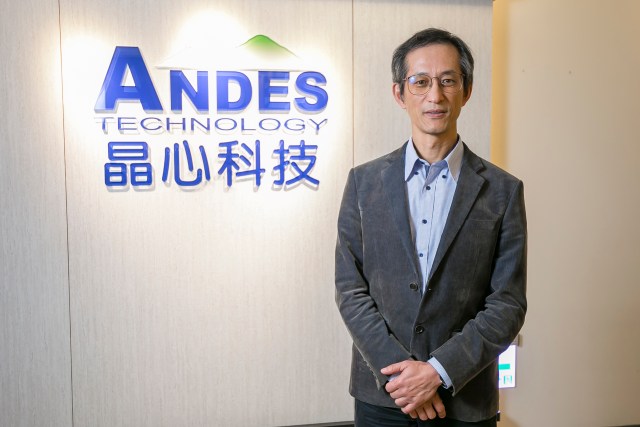 Andes Technology CTO Charlie Su (Source: Andes)
Why the pause: the revenue arithmetic inside an IP vendor
Andes is not short of an accelerator story — the company has a small deep learning processor with its own compiler, rated up to around 4 TOPS at 1 GHz — but that is not where its growth is concentrated. “We started, but as time went on, we found the AI part of our business continued to grow very strongly,” Su said. The baseline those percentages sit on is on the public record: Andes reported record annual revenue of about $42 million for 2024, with license revenue up 38.4% year on year and royalty revenue up 25.0%, according to its results release (andestech.com). Measured against a program with no customers yet, the trade looks simple: “We decided to consolidate and slow down [Cuzco], so we could put more resources on the immediate revenue generation part,” Su said.
Ecosystem timing: the actual bottleneck for high-end RISC-V
Flagship-class RISC-V is software-limited before it is silicon-limited. The RVA23 profile, ratified by RISC-V International in late 2024, set an application-processor baseline for Linux-class systems and for the vector features AI designs depend on, while a server SoC specification addressing data center-specific requirements is still being defined (riscv.org). Shipping cores into that gap risks a familiar pattern: silicon gets designed in, software never quite arrives, and volume slips. The demand curve also points elsewhere first. The SHD Group’s 2026 RISC-V market analysis forecasts RISC-V-based SoC shipments of 35.9 billion units by 2031, carrying roughly $318B in revenue, with most of that volume landing in edge, consumer, storage and automotive parts rather than general-purpose server CPUs (theshdgroup.com).
The monetisation model reinforces the sequencing. SHD analyst Richard Wawrzyniak has projected that royalty-driven revenue will overtake licence-driven revenue around 2027, and sooner if data center penetration accelerates (EE Times) — a model that rewards cores designed for very long production lives rather than for headline first-mover status. Andes’ own numbers make the point: “The core that brings us the most revenue today is one we designed more than 10 years ago,” Su said, adding that “We want to do it right, make it reusable, instead of getting to market first.” Winning in IP, in his framing, is not necessarily about arriving first.
Agentic AI, headcount and the spring consolidation
The Condor decision was also part of an internal productivity reset. The rise of agentic AI in the early part of 2026, Su said, is a key driver for improving productivity and reducing headcount across the business this spring. Andes has its whole engineering team using AI agents to accelerate progress, with humans reviewing everything, and consolidating Condor was linked to that strategy. Two read-across points matter for regional peers: AI agents are now a real lever on IP development cost, and small, pre-revenue high-end teams are the first candidates for absorption when a program is not yet paying for itself.
Arm’s pivot into silicon reshapes the trust equation
Su reads recent changes in Arm’s business model following its launch of high-end CPU silicon as a positive for competitors of the IP giant, Andes included. “Arm changed its business model, and that has certainly affected customer trust, especially at the high end,” he said, noting that “[Embedded] customers also don’t know when it will hit their market.” The backdrop is fresh: in March 2026 Arm announced its first in-house data-center chip, the AGI CPU, with Meta named as initial customer (newsroom.arm.com; cnbc.com) — a step that turns a licensor into a supplier alongside its own licensees. For APAC fabless teams that need a credible second source and no channel conflict, a neutral RISC-V supplier gains value even when its flagship core lands later than planned.
Where the funding goes instead: storage, automotive, robotics
Read the roadmap as a sequence, not a retreat. A main processor core for the storage market is high on Andes’ priority list at present; the company already has 10 customers in production with smaller controller cores, and it is also focusing on automotive and robotics. The storage bet has visible evidence in the supply chain: Phison selected Andes N45 and N25F RISC-V cores for its first aiDAPTIV+ AI solution, announced in February 2026 (andestech.com), while Marvell expects its Bravera SC6 PCIe 6.0 SSD controller to begin sampling in Q4 2026 — a segment where host-interface performance and local inference data movement are converging. Embedded economics underline why these cores matter: Andes’ embedded customers may use the same cores for 10 years or more, albeit on different process nodes. Cuzco experience is being leveraged inside the company in the meantime, and the target stays in view: “The bottom line is that the market Cuzco tried to address is still there and will continue, so that’s where we want to hit next in terms of our performance level,” Su said.
Three RISC-V strategies, side by side
| Vendor / program | Stance on high-end RISC-V | Resource signal | Implication for APAC buyers |
|---|---|---|---|
| Andes / Cuzco | Slowed, brought back in-house; product still planned | AI is half of revenue, growing 30% last year | Do not anchor a 2027 server design to a paused flagship core |
| SiFive | Doubling down on data center performance | $400M round, reported at a $3.65B valuation | More choice and faster spec pressure at the top end |
| Arm | Extending from IP licensing into its own silicon | AGI CPU with Meta as initial customer | Neutrality becomes a purchasable feature |
Action recommendations for Asia-Pacific decision-makers
- Re-baseline high-end RISC-V CPU assumptions by two to three quarters. Treat flagship-class RISC-V cores as a 2028-class option for volume server designs, and keep current-generation Arm or x86 CPU paths in the architecture plan as a fallback.
- Buy the control plane now, the data plane later. RISC-V cores doing orchestration, data movement and management inside AI and storage SoCs are shipping and proven; that is where design wins convert to silicon today.
- Make ecosystem readiness a gate in your IP scorecard. Ask vendors specifically about RVA23 compliance, Linux and hypervisor enablement, compiler support and the pending server SoC specification — not just peak core performance.
- Price licences for decade-long reuse. With embedded designs lasting 10 years or more across shifting nodes, negotiate extension terms and custom-instruction flexibility up front rather than re-licensing later.
- Use the Arm silicon pivot as negotiating leverage. Where a licensor now competes with its licensees, request stronger neutrality commitments, or qualify a second RISC-V source for the same slot.
- Track conversion, not inquiries. The Cuzco case shows interest does not equal revenue; for any RISC-V high-end roadmap, ask for named production customers before committing an SoC generation.
Risks and watch items
- Ecosystem slippage: if server software and OS support for RISC-V matures more slowly than expected, high-end programs across the sector get pushed further right.
- Capital asymmetry: a well-funded rival can keep a data center roadmap alive far longer than a royalty-funded IP house, which may compress Andes’ window if it waits too long.
- Renamed or re-scoped delivery: Su himself flags that Cuzco may emerge under another name and in a different form — regional teams should avoid pinning roadmaps to a marketing label.
- Efficiency-driven capacity risk: headcount reductions tied to agentic AI tooling could thin the bench available for performance-first cores if momentum suddenly arrives.
A paused flagship is not a lost one. The Asia-Pacific takeaway from Su’s account is that the high-end RISC-V prize is acknowledged, the sequencing problem is openly diagnosed, and the near-term money is being spent where royalties actually accrue — storage controllers, automotive compute, robotics and the AI control plane. Teams that read the pause as an ecosystem signal, rather than as doubt about RISC-V’s direction, will be the ones positioned to adopt Cuzco-class cores on the schedule Andes is now describing.