
APACTechBriefing Case File: Inside Apple's Record FY2026 Fourth Quarter — What It Won, What It Missed, and What APAC Teams Can Reuse
Apple (NASDAQ:AAPL) today published the numbers behind what management calls the best year in its history. The fiscal fourth quarter and full-year fiscal 2026 report, covering the period ended 26 September, reached investors after the Monday close on the Nasdaq exchange — early morning on 3 November for most of Asia-Pacific. Read as a case file rather than a headline, the quarter is unusually teachable: a record September quarter, a first earnings test for CEO John Ternus, and a Greater China line that grew 21% year on year and still fell short of the market's bar.
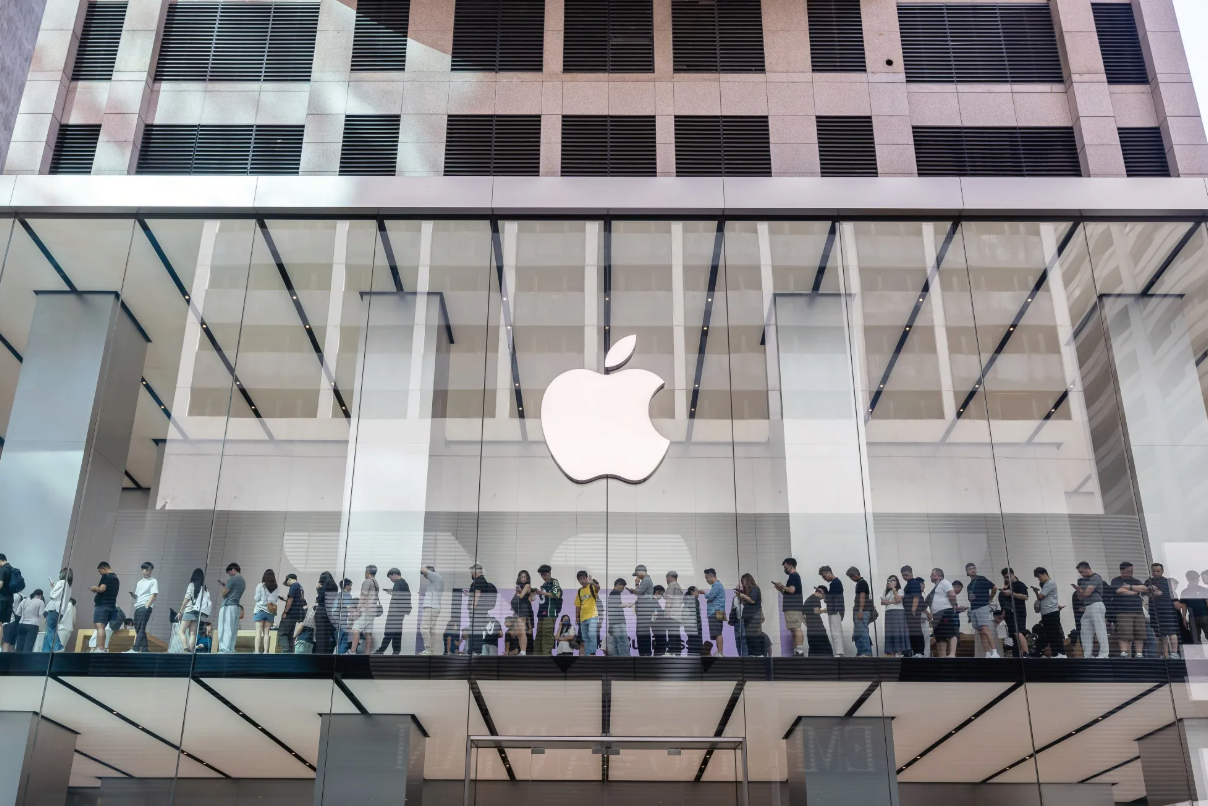
Case setup: the record was banked before the new hardware shipped
Two framing details matter for any APAC team that treats this print as a demand signal for the coming holiday season.
- Guidance versus delivery. When it reported the June quarter, Apple had guided fiscal Q4 revenue growth of 9% to 11% year on year. Delivered growth of 12% cleared the top of its own range and beat the Street model of roughly $113,390 million in revenue and $1.99 diluted EPS cited by 36Kr.
- The calendar window. Because the quarter closed on 26 September, it captured only about nine days of iPhone 18 Pro sales and none of iPhone Duo, which reached stores on 23 October — a boundary Channel NewsAsia flagged before the print. The record was set by the previous product cycle plus Services, not by the new lineup.
- The leadership window. This was the first report since John Ternus took over as CEO on 1 September 2026, so the market was pricing a transition as much as a quarter.
Scoreboard: the reported lines, in Apple's own units
All figures below follow Apple's press-release convention and are stated in millions of US dollars.
| Line item (US$M unless noted) | Q4 FY2026 | Q4 FY2025 | Change |
|---|---|---|---|
| Total net sales | 114,477 | 102,466 | up 12% |
| Products | 82,904 | 73,716 | up 12% |
| Services | 31,573 | 28,750 | up 10% |
| Gross profit (margin 48%) | 54,820 | 48,341 | up 13% |
| Total operating expenses | 19,189 | 15,914 | up 21% |
| Operating income | 35,631 | 32,427 | up 10% |
| Net income | 30,711 | 27,466 | up 12% |
| Diluted EPS (US$) | 2.10 | 1.85 | up 14% |
By product line
- iPhone: $57,583 million versus $49,025 million, up 17% — a September-quarter record.
- Mac: $10,792 million versus $8,726 million, up 24%, the fastest-growing hardware line and the first touch-enabled Mac.
- iPad: $6,229 million versus $6,952 million, down 10%, reflecting a refresh gap.
- Wearables, home and accessories: $8,300 million versus $9,013 million, down 8%, still in a downcycle.
- Services: $31,573 million versus $28,750 million, up 10%, an all-time high.
By region: Asia-Pacific told three different stories
| Region | Q4 FY2026 (US$M) | Q4 FY2025 (US$M) | Change |
|---|---|---|---|
| Americas | 48,680 | 44,192 | up 10% |
| Europe | 32,008 | 28,703 | up 12% |
| Greater China (mainland China, Hong Kong, Macau and Taiwan region) | 17,539 | 14,493 | up 21% |
| Japan | 6,540 | 6,636 | down 1% |
| Rest of Asia-Pacific | 9,710 | 8,442 | up 15% |
The regional split is the most under-read part of the release. Greater China was the fastest-growing region on a like-for-like basis, yet the China region still disappointed, while the rest of Asia-Pacific compounded at 15% and Japan went slightly negative. Full-year Greater China net sales reached $82,378 million, up roughly 28% according to IT Home, after three consecutive down years that had dragged the business from $74,200 million in fiscal 2022 to $64,400 million in fiscal 2025, per 9to5Mac's tally. The same shape appeared in the June quarter, when $18.82 billion of Greater China revenue beat the prior year but missed the $19.67 billion consensus compiled by Visible Alpha, as Reuters reported.
Market reaction: a beat that moved the stock less than 1%
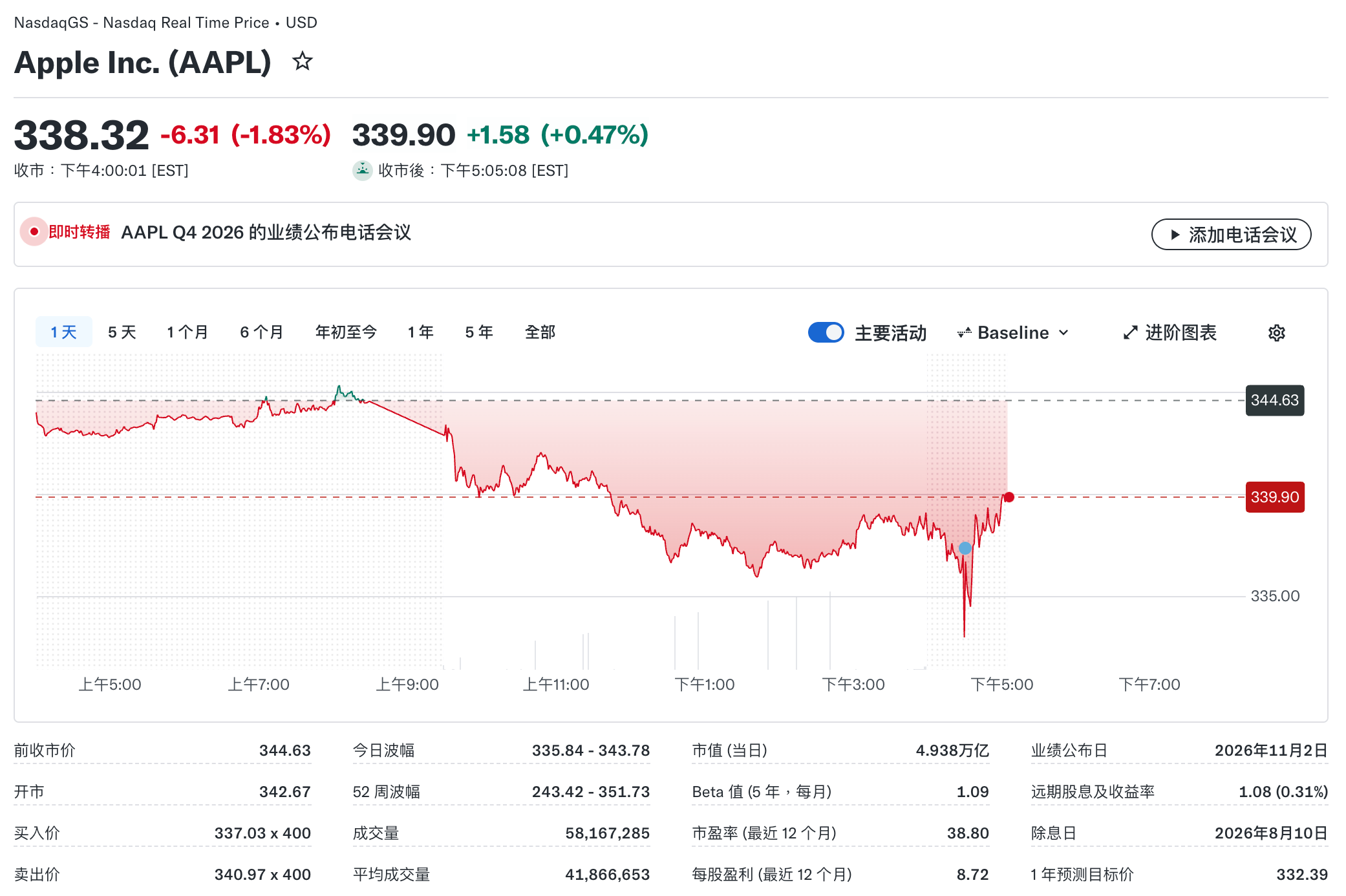
Apple shares rose 0.47% in after-hours trading.
Apple stock opened at $342.67 on the Nasdaq exchange on Monday. It closed down $6.31 at $338.32, a fall of 1.83%, then added $1.58 to $339.90 in after-hours trading for a gain of 0.47%. Over the past 52 weeks the stock has traded between a high of $351.73 and a low of $243.42 — a narrow band that says the market had already discounted much of this result before the release.
Full year and shareholder returns
- Fiscal 2026 revenue: $478,834 million, versus $416,161 million in fiscal 2025, up 15%.
- Fiscal 2026 net income: $132,175 million, versus $112,010 million, up 18%.
- Dividend: Apple's board declared a cash dividend of $0.27 per share to holders registered at the close on November 12, 2026, payable November 16, 2026.
Management read-out
John Ternus, Apple's CEO, said: "Today, Apple is proud to report that September quarter revenue reached a record $114.5 billion, up 12% year over year, with iPhone setting a September-quarter record and Services an all-time high, capping our best fiscal year ever. We closed the year with our most ambitious product lineup to date, including the most transformative iPhone since the original, iPhone Duo, and our most powerful iPhone 18 Pro and iPhone 18 Pro Max ever. We also just launched a new generation of hardware for the home and brought touch to Mac for the first time. Together with the all-new Siri AI, this is a stunning lineup that will carry us into the holiday season."
Kevan Parekh, Apple's CFO, said: "Apple delivered September-quarter records in net income and diluted EPS. Our record September quarter caps a strong fiscal 2026, with full-year revenue reaching a record $479 billion and double-digit growth in earnings per share. We generated $28 billion of operating cash flow this quarter, allowing us to return $28 billion to shareholders. Thanks to our very high customer satisfaction and loyalty, our active installed base of devices set a new record across all major product categories and geographic regions."
Root-cause notes: four things the release did not print
- Cost growth outran revenue growth. Operating expenses rose 21% against 12% revenue growth. 36Kr's read of the filing puts quarterly research and development at $11,730 million, up roughly 32%, and full-year R&D at $45,765 million versus $34,550 million a year earlier — an AI-era spending curve that APAC platform teams are now competing with for the same engineering talent.
- Part of the margin quality was a one-off. The same 36Kr analysis estimates about one percentage point of the quarter's gross margin came from tariff refunds, adding roughly $0.05 to EPS — a reminder to strip one-offs before benchmarking.
- Share gain happened in a shrinking market. Counterpoint Research estimated Apple shipped 22% of all smartphones in the July–September period, up from 18% a year earlier, while global shipments fell 20% year on year to their weakest third quarter in 14 years. Volume leadership here is partly an artefact of rivals contracting faster.
- Next quarter is supply-gated, not demand-gated. Digitimes reported that Apple raised its iPhone Duo shipment target by 44% on strong preorders, while Channel NewsAsia pointed to surging memory costs. Backlogged foldable units may simply shift revenue from the December quarter into the March quarter.
Action brief for APAC product, IT and go-to-market teams
- Re-baseline channel plans on the fiscal window, not the launch calendar. With the quarter ending 26 September and the foldable launching 23 October, the headline hides a two-quarter revenue hand-off. Align regional inventory, carrier financing and trade-in budgets accordingly.
- Treat Greater China as recovery, not re-acceleration. A 21% jump off a three-year decline is a low-base effect; recurring expectation misses on top of strong growth suggest setting regional targets off sell-through data rather than year-on-year optics.
- Read the 15% rest-of-Asia-Pacific line as the region's real swing factor. India, Southeast Asia and Korea are where incremental installed-base growth sits; price ladders, financing and trade-in depth should be planned there first.
- Budget for the component cycle. Rising memory and advanced-node costs compress margins for every device maker in the region; lock supply agreements ahead of the mid-year refresh window.
- Benchmark against the services line, not the hardware line. Services grew 10% to an all-time high of $31,573 million on a record installed base; for APAC digital teams this is the clearest proxy for monetising an existing user base.
Risk register for the December quarter
- iPhone 18 Pro and iPhone 18 Pro Max holiday sell-through, plus the first full quarter of iPhone Duo supply.
- Siri AI rollout quality and its effect on upgrade motivation.
- Whether China region supply recovers enough to return Greater China to an above-expectations path.
- Memory and advanced-node input costs against a 48% gross margin base.
The case-file verdict is narrow but useful: Apple proved that a mature hardware-plus-services platform can still print records in a contracting device market, yet also proved that records can leave a region unsatisfied and a share price almost unmoved. For APAC operators, the transferable lesson is the sequence — protect the installed base, keep the services attach rate climbing, plan inventory around the fiscal calendar rather than the keynote, and never count a launch as revenue until the supply chain has cleared it.