
Apple Weather Minus 32°C Misfire: An APACTechDigit Briefing on Forecast Data-Pipeline Risk Across Asia-Pacific
By Lynn Zhou · APACTechBriefing desk · corrections and tips: contact@apactechdigit.com
A cold snap that never existed moved faster than any correction could. On November 4, in the early hours of the day, the built-in Weather app on Apple phones (iPhone) surfaced an impossible outlook to a mass audience: minimum temperatures of around minus 30°C for November 13 in Beijing, Shanghai and Xiamen, with some locations pinned at minus 32°C. For Asia-Pacific operations teams that schedule freight, outdoor maintenance, energy load and staff shifts around one pre-installed icon, the episode should be read as an engineering and governance incident rather than a weather story — a data-path failure that briefly outranked the state forecaster in public attention.
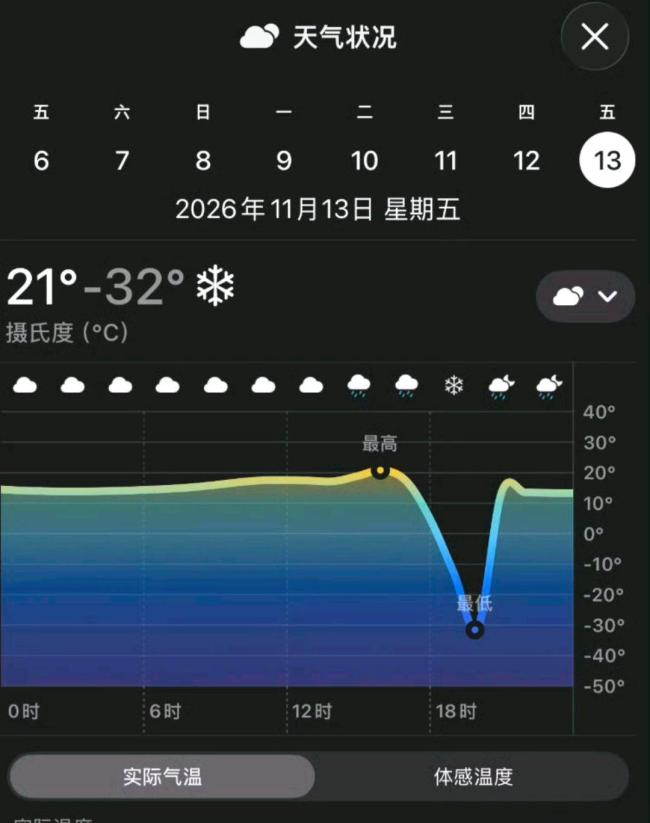
Four facts that anchor the incident
- Reported window: November 4, in the early hours, when Apple Weather returned minimum temperatures of around minus 30°C for November 13 across several Chinese cities, with outliers down to minus 32°C.
- Vendor diagnosis: as relayed by China News Jingwei, Apple's official customer service said preliminary checks attributed the fault to a system port anomaly, not to hardware failure, and that the technical team had completed an emergency repair.
- Official rebuttal: The Beijing News reported that the China Meteorological Administration said that if weather that extreme were actually coming, the meteorological departments would have notified the public in advance, and that up to now the China Meteorological Administration had never issued such an extreme low-temperature forecast.
- Public reassurance and status: the Public Meteorological Service Center of the China Meteorological Administration, speaking through its "China Weather" account, responded that "there is simply no such temperature difference"; currently the temperature figures for the affected dates in the Apple Weather app have returned to normal.
What the anomaly did — and did not — do
Apple customer service pushed back on the most widely shared user theory, that a positioning error had matched the data to some other part of the world. The reasoning it offered is the part engineers should note. If location had drifted, the forecasts for the neighbouring days would have degraded at the same time; instead the bad values clustered on one specific date, which argues against a persistent positioning error. Apple customer service added that a large volume of users had reported the abnormal weather data, apologised for the trouble caused, and said it would keep working on the data service experience.
Why a professional reader could falsify the numbers in seconds
There is a codified reason the official denial is decisive rather than merely reassuring. China's cold-wave warning system runs on four tiers — blue, yellow, orange and red — set out in the national rules on issuing and disseminating meteorological disaster warning signals. Even the lowest tier carries hard numeric triggers: a blue signal requires the minimum temperature to fall by 8°C or more within 48 hours to 4°C or below, normally with land winds of grade 5 or stronger, as documented in the guidance published by weather.com.cn and restated by the Beijing municipal government on beijing.gov.cn; individual provinces may adjust parameters for local climate. A minimum temperature near minus 30°C in Shanghai or in the subtropical coastal city of Xiamen would have overwhelmed every published threshold and produced a national-level warning long before screenshots began circulating.
| Dimension | What a real cold surge looks like | What the app displayed |
|---|---|---|
| Signal source | Meteorological departments issue tiered warnings against numeric criteria | Apple Weather showed extreme values with no matching official warning |
| Shape across time | Cooling unfolds over consecutive days and moves north to south | The anomaly sat on a single date, November 13, while surrounding days looked ordinary |
| Spatial pattern | A coherent region is affected, tracked from the cold-air mass | Multiple cities showed the same impossible floor simultaneously, pointing to server-side distribution |
| Lifecycle | Warnings are upgraded or lifted on a published cadence | Emergency repair the same day, followed by data returning to normal |
Inside the supply chain: a built-in app with many upstream hands
Apple's own support document "Feature availability and data sources in the Weather app" (support.apple.com, document 105038) makes the architecture explicit: unless otherwise specified, 10-day forecast, temperature and precipitation map data come from Apple Weather, air-quality maps are supplied by BreezoMeter and QWeather, and the listed partners span Asia-Pacific public agencies — including the Japan Meteorological Agency, the Hong Kong Observatory, the Australian Bureau of Meteorology, the India Meteorological Department and the Thai Meteorological Department. Legacy paths still matter in the field: on iOS 15.2 and earlier versions, some temperature and precipitation figures were provided by The Weather Channel. The longer arc is vertical integration — Apple acquired the hyperlocal forecaster Dark Sky in 2020, folded its technology into the system app, and replaced the developer-facing Dark Sky API with its own WeatherKit service.
Every additional hop is another opportunity for a value to be mis-tagged. Independent analysis published on the same day localises the fault that way: science communicator Fengyun Mengyuan, cited by Chutian Metropolis Daily (ctdsb.net), inferred that the abnormal cold was confined to around 20:00 on November 13, that 20:00 Beijing time — 12:00 in coordinated universal time — is an important run node for numerical weather prediction, and that a severe deviation at that node was probably stretched by interpolation into an abrupt dip and rebound. Forecast analysts posting via sina.cn added a second check: day ten already sits at the outer edge of deterministic forecast skill, and neither conventional nor machine-learning models were signalling an extreme, abrupt cooling on November 13 — if anything, a warmer-than-normal pattern. Taken together with Apple's rejection of a positioning fault, the most defensible reading is a pipeline defect: one mis-parsed field, fanned out across many cities.
A pattern worth pricing in: built-in data services fail quietly
This is not the service's first scare this year. According to Apple's system status page, as reported by IT Home (ithome.com) and republished by Sina Finance, Apple Weather stalled from 22:45 on April 28 to 02:30 on April 29 Beijing time — about 3 hours and 45 minutes of slow or failed data loads, resolved with no published technical root cause. Two incidents, two failure modes (a stall, then wrong-but-confident numbers), one shared gap: no public post-incident report. Cross-vendor comparisons circulated by Chinese tech media also describe domestic Android brands as connecting more directly to national-agency feeds or aggregating several local providers, whereas Apple layers its own model under third-party data — a structural difference that changes which vendor is exposed to which class of error.
Five actions for APAC digital and operations teams
- Treat the pre-installed weather icon as one vendor feed, not ground truth; bind weather-sensitive decisions to the national meteorological authority of each market in your footprint.
- Add a plausibility gate to any automation that consumes forecasts: reject values outside a historical extreme envelope, or any day-to-day swing beyond a stated delta.
- Compare across dates, not within one cell — a single anomalous day inside an otherwise normal 10-day series is exactly the signature this incident produced.
- Capture screenshots with timestamps when a feed misbehaves; with no published root-cause analysis, user-side evidence is the only practical audit trail.
- Pre-agree a correction channel: publish the all-clear in the same group and format that carried the false signal, so the fix travels as far as the error did.
Trend read for the region
The briefing takeaway is not about a bad forecast but about trust architecture. Vendors are pulling meteorological modelling in-house while still stitching in third-party feeds, and there is as yet no common regional obligation for device makers to disclose data-quality incidents rather than mere uptime. Expect three shifts over the next cycle: incident pages extended from availability to accuracy reporting, procurement questions about third-party feed error notification in device contracts, and a continued re-ranking of which source counts as authoritative market by market — national agencies holding that position in China, Japan and Australia, aggregation models dominating consumer apps elsewhere in Southeast Asia. Teams that map their own exposure to the vendor's published data-source list will not be surprised twice.