
APACTechDigit APACTechBriefing: Arduino Nano XL Link Brings CAN FD, RS485 and Ethernet to Nano — A 2026 APAC Buyer Read
By Nina Garcia, SaaS product lead and transformation adviser, APACTechDigit · APACTechBriefing
For APAC industrial and building-automation buyers, the Arduino Nano XL Link is a Nano-format controller that puts CAN FD, RS485 and 10/100Mbps Ethernet on one board; it was unveiled at electronica 2026, but Arduino has not published a price or ship date. The decisive question is not the pinout. It is who owns the fieldbus once three gateway modules collapse into a single board.
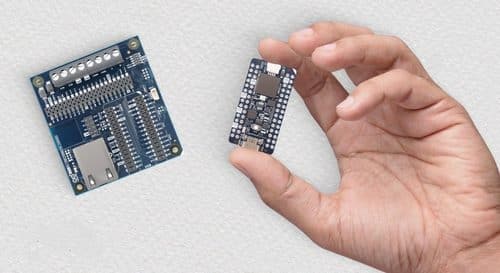
That ownership question is where automation upgrades stall. A facilities team in Singapore may hold the budget for smart lighting while the controls contractor owns the HVAC specification, and neither has an incentive to redraw the cabinet. Arduino's own documentation describes the Nano XL Link as "a compact microcontroller board designed for industrial and building automation applications" (Nano XL Link User Manual, 2026). The wording is a category claim, not a hobby-board refresh.
What changed on the board, exactly?
The interfaces changed, not the footprint. Nano XL Link keeps the compact Nano shape but adds three wired links that used to arrive as separate modules, so the board can talk to industrial networks, motors, sensors and building control systems without extra hardware.
The controller is the Microchip PIC32CK2051SG01144, built on a 32-bit Arm Cortex-M33 core running at 120MHz, with 2MB of flash and 512KB of RAM. Transceivers come from Texas Instruments — the TCAN3414 for CAN FD and the THVD2410 for RS485 — alongside Microchip's KSZ8081 Ethernet PHY. CAN FD runs up to 8Mbps; Ethernet stays at 10/100Mbps.
Arduino names real-time machine control, fieldbus gateways, smart lighting, HVAC and energy management systems as target applications — a spread that crosses OT and facilities ownership lines.
| Interface | On-board device | Rate |
|---|---|---|
| CAN FD | TCAN3414 (Texas Instruments) | up to 8Mbps |
| RS485 | THVD2410 | not stated |
| Ethernet | KSZ8081 Ethernet PHY (Microchip) | 10/100Mbps |
Why the carrier, not the chip, decides retrofit fit
The Nano XL Link Connector Carrier is the gating item for panel integration. Bench compatibility is simple; cabinet compatibility is where projects lose weeks.
Expansion runs through two 30-pin dual-row connectors for digital and analogue I/O, PWM, UART, SPI and I2C, with a Qwiic connector for sensors and peripherals. The carrier adds screw terminals for CAN FD and RS485, an RJ45 Ethernet port, and a DIN-rail mount intended for industrial cabinets no larger than 4U. On APAC retrofit sites, where panel space is already committed, 4U decides whether this is a drop-in or a redesign.
Which software route lowers the integration bill?
For a pilot, Arduino IDE and Arduino Cloud are the quickest way in; for a product that has to survive three years of maintenance, the Arduino Zephyr core is the option to watch.
Nano XL Link can be programmed through Arduino IDE and Arduino Cloud, and the platform also supports the Arduino Zephyr core. On 4 September 2026, Electronics Foru reported that Arduino's Zephyr core reached 1.0 across 11 boards, noting that Zephyr adds a preemptive RTOS beneath the familiar Arduino application programming interface. Threads and a regular release cycle matter to an industrial buyer more than another block of flash: they are what keep a pilot codebase alive after its author moves on.
What this launch does not solve
Two blanks remain, and both are commercial rather than technical. Arduino has announced neither pricing nor availability for either board; coverage dated 10 November 2026 likewise reports no price or release date and tells buyers to watch for updates.
No BOM number means no FY27 budget line, and no final board spec means no confirmed certificate set. Some third-party write-ups mention a hardware security module on the PIC32CK family; the brief we reviewed does not list one, so treat that as a verification item rather than a specification.
Compliance does not move with the schematic either. A previous APACTechBriefing note argued that reusable cellular IoT IP speeds baseband and protocol bring-up but not RF certification. On-board CAN FD and RS485 shorten the parts list; they do not sign off the cabinet.
Frequently asked questions
Can I order the Arduino Nano XL Link today?
Not on the published record. It was unveiled at electronica 2026 and, as of November 2026 coverage, no price or ship date had been released. Plan a pilot slot, not a purchase order.
Does it replace a fieldbus gateway?
Arduino positions Nano XL Link as a real-time machine controller and fieldbus gateway, with CAN FD, RS485 and Ethernet on board. Whether it replaces a certified gateway in your plant depends on the approvals that ship with the production board.
Will it fit our existing cabinet?
The Carrier is specified for DIN-rail mounting in cabinets up to 4U. Confirm clearances and terminal access against your own panel drawing before committing.
Which toolchain should a production team pick?
Prototype in Arduino IDE or Arduino Cloud, then evaluate the Arduino Zephyr core for the maintained build. The RTOS route buys scheduling and long-term support, at the cost of a steeper handover.
A four-step roadmap for APAC teams
- Name one owner. Put a single accountable lead across facilities and controls; split ownership is the usual reason a fieldbus upgrade stalls.
- Scope one panel. Pick a lighting or HVAC cabinet under 4U and list what the two 30-pin connectors and Qwiic port actually need to drive.
- Pilot the interfaces. Exercise CAN FD at 8Mbps, RS485 and 10/100Mbps Ethernet through the Carrier's screw terminals and RJ45 port before writing any production code.
- Gate on the boring things. Revisit the decision when price, availability and certification are published. Budget training and sign-off lines alongside the board, because the organization, not the silicon, is the constraint.
Reference sources
- Arduino, Nano XL Link User Manual — https://docs.arduino.cc/tutorials/nano-xl-link/user-manual
- Electronics Foru, "Arduino Core on Zephyr Reaches 1.0 Across 11 Boards", 4 September 2026 — https://www.electronicsforu.com/news/arduino-core-on-zephyr-reaches-1-0-across-11-boards
- Hackster.io, "Arduino's Nano Goes Big, Though Not in Size", 10 November 2026 — https://www.hackster.io/news/arduino-s-nano-goes-big-though-not-in-size-as-the-arduino-nano-xl-link-industrial-dev-board-4e6e1cc180b8
- Ma-no.org, "Arduino Nano XL Link: Cortex-M33 and Integrated Industrial Buses", 10 November 2026 — https://www.ma-no.org/en/programming/microcontrollers/arduino-nano-xl-link-cortex-m33-and-integrated-industrial-buses
- Arduino Core based on Zephyr, GitHub repository — https://github.com/arduino/ArduinoCore-zephyr