
APACTechBriefing Case File: How Kimi K3.1 Pro Turned a +5.1% Arena Net Improvement into an Open-Model Lead
Answer first: Arena's agent leaderboard now places Kimi K3.1 Pro (Max) at the head of the open-weight field, with a net improvement rate of +5.1% measured across more than 17,500 real, long-horizon agent task sessions — 4.2 percentage points above the +0.9% posted by the previous generation, Kimi K3 (Max). For Asia-Pacific technology teams, the value of this case is not the headline number; it is the repeatable route that produced it.
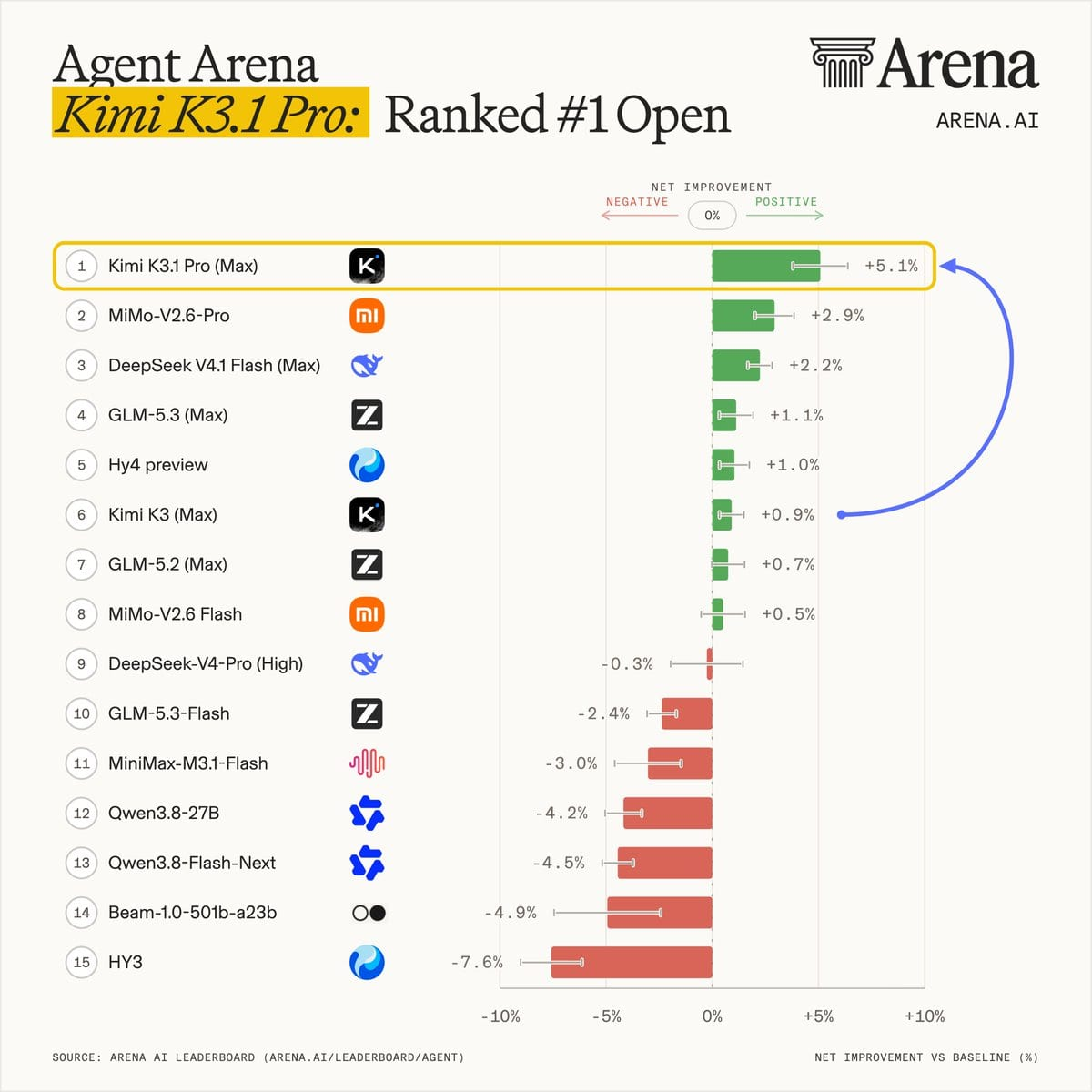
What actually changed in this case, metric by metric?
Conclusion: the gain is concentrated in execution reliability and controllability, not in a uniform lift across the board. Arena scores live sessions on signals such as task success, user satisfaction and steerability, which makes the breakdown below the useful part of the record rather than the single ranking line.
| Arena agent signal | Kimi K3 (Max) | Kimi K3.1 Pro (Max) | Open-model position for K3.1 Pro |
|---|---|---|---|
| Net improvement rate | +0.9% | +5.1% | Top of the open field |
| Bash Reliability (shell command execution) | -4.5%, 13th | +7.9% | Ranked first among open models |
| Praise vs Complaint (user satisfaction) | +1.3% | +7.7% | Improvement, no separate open-model rank published |
| Steerability (course-correction from user feedback) | Not published in this cut | +6.5% | First among open models |
| Confirmed Success (user explicitly confirms completion) | +3.8% | +3.9% | Ranked fourth among open models |
Read as a case, the pattern is legible: a model that was previously negative on command execution (K3 at -4.5%, 13th) turned positive at +7.9%, while the metric that depends on explicit human sign-off barely moved (+3.8% to +3.9%). Moonshot AI improved how reliably the agent does things, more than how often users declare the job finished.
How did Moonshot AI produce the delta?
Conclusion: post-training on an already-large open base, then narrowing the target set to long-running work. Per Moonshot AI's published model material, Kimi K3.1 Pro is the first model of the K3.1 line and uses a Mixture-of-Experts architecture with 2.8 trillion total parameters, roughly 104 billion parameters activated per inference pass, and a context window of about 1 million tokens. It is natively multimodal, with deliberate emphasis on coding, 3D creation, financial research, factual accuracy and complex agent-task execution. The weights are available for download on Hugging Face.
Independent measurements fill in the mechanism. Artificial Analysis reported that the model's AA-Omniscience factuality score rose to 30 from 20, while output tokens per Intelligence Index task climbed about 14% versus K3 (roughly 55K against 48K). That combination — more generated reasoning per task, better factuality — is consistent with the Arena record, where reliability and steerability moved most and confirmation lagged.
Why the net improvement rate is the number APAC buyers should read first
Conclusion: it is outcome-based, not exam-based. Arena derives its agent ranking from randomly matched live sessions contributed by users worldwide — here more than 17,500 of them, spanning long-horizon tasks rather than single-turn prompts. Static benchmarks cannot capture recovery after a bad tool call; Arena's signals can, which is why Steerability and Bash Reliability behave as leading indicators for production agent work.
Arena has also layered its leaderboard with category cuts and a median-cost-per-task view that plots net improvement against cost, flagging models on or near the Pareto frontier. In its own commentary on this release, Arena noted that Kimi K3.1 Pro (Max) carried a median cost per task of $1.03 — efficient, but described as just off the frontier. Analysts and APAC procurement teams should treat the leaderboard as directional: independent academic work on agent leaderboards argues that rank transfers poorly to a specific workload, toolchain and prompt style.
What the win costs: price, tokens and the fine print
Conclusion: per-token price and per-task price diverge, and "open weights" is not "unrestricted commercial use". Three operational checks emerge from this case.
- List price is roughly half the closed frontier. Developer-platform coverage from Bito and R&D World puts Kimi K3.1 Pro at $2 per million input tokens and $10 per million output tokens, against $4 and $20 for Claude Opus 5.5. The 14% token inflation measured by Artificial Analysis means the saving does not translate one-to-one; Arena's own $1.03 median task cost is the better planning figure.
- Licence review is a gate, not a footnote. The K3 weight family ships under a bespoke Kimi licence that several reviewers, including VentureBeat and Zentor, describe as MIT-inspired but not OSI-approved, with attribution obligations at large user scale and a separate agreement required to resell capacity as model-as-a-service. APAC system integrators packaging agent products should confirm the terms attached to K3.1 Pro specifically before embedding.
- Self-hosting is a cluster decision. Hosting guides published around the release size the full-precision weight footprint near 2.8 TB and point to multi-node clusters with 2 TB or more of aggregate GPU memory; quantised builds are reported closer to 594 GB. Anything below a serious data-centre budget belongs on an API, not in a private server room.
Why the same result lands differently across Asia-Pacific
Conclusion: the region is past pilots, so leaderboard deltas now enter procurement shortlists. A 2026 regional survey circulated by PR Newswire Asia, citing McKinsey, Singapore's Economic Development Board and Tech in Asia, reported that 81% of Southeast Asian companies had moved beyond AI experimentation, while the EDB's own regional report put company-level adoption in Singapore at 56%.
That maturity splits the region into two buying logics. Markets where data-residency and sovereign-cloud rules constrain foreign-hosted inference gain most from downloadable weights — an open 2.8 trillion-parameter model with a roughly 1 million-token context is an option they can legalise and host locally. Markets with cheap, mature API access care more about median cost per task and whether the reliability gain justifies switching a working pipeline. This distinction is our analysis, not a vendor claim.
Which lessons are reusable? A five-step playbook
- Re-baseline your own agent workload before and after the swap, using long-horizon tasks with tool calls; a four-point net-improvement swing on Arena does not guarantee the same gap on your prompt set.
- Budget per completed task, not per token: track output-token inflation the way Artificial Analysis did, because agentic models buy accuracy with length.
- Instrument the weak link. Confirmed Success ranking fourth among open models says the failure mode is closure, not execution — keep human checkpoints at the acceptance step.
- Run a licence and data-flow review in parallel with the technical trial, so commercial terms are cleared before a model becomes product infrastructure.
- Watch category-level Arena cuts and cost-per-task charts, not just the overall row; that is where a model sitting near the Pareto frontier becomes visible to your CFO.
FAQ on the Kimi K3.1 Pro Arena case
Is Kimi K3.1 Pro the strongest open agent model right now?
On this Arena snapshot it leads the open field on net improvement (+5.1%) and ranks first among open models on Bash Reliability (+7.9%) and Steerability (+6.5%), while placing fourth on Confirmed Success (+3.9%). "Strongest" depends on which signal your workload rewards.
What is net improvement rate?
A relative measure of how much better a model performs than the session average, inferred from live user interactions across more than 17,500 long-horizon agent sessions, instead of a fixed test set.
Can our team download the weights and run it?
The weights are published on Hugging Face, but running them is a multi-node, terabyte-class GPU exercise; cost-per-token API access or a hosted provider is the realistic entry point for most mid-size APAC teams.
Does the model beat closed frontier systems?
The published Arena record positions it at the top of the open-model cohort and Arena's cost commentary places it near, but not on, the efficiency frontier. Head-to-head superiority over closed flagships is workload-dependent and not established by the figures here.
Briefing take: the case is a template for how open-weight models now close gaps — post-train a very large MoE base on agentic execution, publish the weights, and let live-user data do the marketing. For APAC teams the actionable signal is narrow and testable: reliability up, closure still human-owned.
Sources and further reading
- Arena agent leaderboard — arena.ai/leaderboard/agent
- Arena on category cuts and task cost — arena.ai/blog/agent-categories-and-cost
- Moonshot AI model card on Hugging Face — huggingface.co/moonshotai/Kimi-K3.1-Pro
- Artificial Analysis model metrics — artificialanalysis.ai/models/kimi-k3-1-pro
- Regional adoption figures — PR Newswire Asia release citing McKinsey, EDB and Tech in Asia; EDB, AI in Southeast Asia: An Era of Opportunity (2026) — edb.gov.sg
- Third-party pricing and licence coverage — bito.ai, rdworldonline.com, venturebeat.com, zentor.ai, unsloth.ai