
ASUS ProArt P16 vs ProArt P14 in India: Which NVIDIA RTX Spark N1X Creator Laptop Fits Your Workflow?
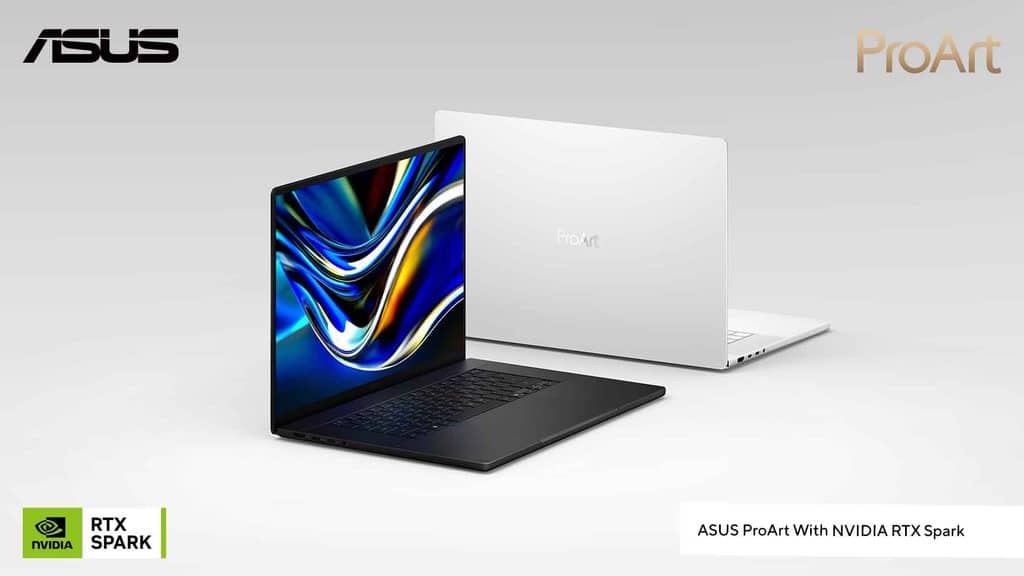
Short answer: pick the ProArt P16 when model size, not body weight, is your bottleneck; pick the ProArt P14 when the bottleneck is the commute. ASUS opened India sales for both machines on 3 November 2026, weeks after the same platform reached other markets. Because each is built on the NVIDIA RTX Spark N1X computing platform for local AI work, the decision rests on memory ceiling, display, battery and budget rather than on a generational gap in silicon.
For APAC buyers this reads as a budget-cycle story as much as a product story. IDC logged 4.4 million units in India's PC market for Q1 2026, up 31.1% year on year, while Omdia reported AI-capable notebooks climbing from 28% to 44% of Indian notebook shipments in Q2 2026, yet forecast a 22% market decline in the second half of 2026 on front-loaded purchasing and rising component costs. A premium device entering that curve needs a defensible reason to be bought now, not just a spec sheet.
What does NVIDIA RTX Spark N1X actually bring to creative work?
The platform's contribution is headroom that stays on the desk instead of the tenant. ProArt P16 (H7607BA) pairs it with a 20-core central processing unit (CPU), a 6,144-core graphics processing unit (GPU) and up to 128GB unified memory, and both models are positioned to run more than 1,000 AI-accelerated applications, with Adobe, Blender and ComfyUI named as reference workloads. NVIDIA's RTX Spark specification page frames the silicon around a Blackwell GPU, a Grace CPU and up to 980 AI TOPS, and independent hardware listings put the LPDDR5X interface near 300 GB/s. That number is the practical limit of the story: model capacity is abundant, memory bandwidth is not infinite.
How do ProArt P16 and ProArt P14 compare line by line?
| Decision dimension | ProArt P16 (H7607BA) | ProArt P14 (H7407BA) | Buying consequence |
|---|---|---|---|
| Compute | 20-core central processing unit (CPU), 6,144-core graphics processing unit (GPU) | 18-core processor, 5,120-core graphics card | Roughly a 17% core delta; enough for render pacing, not enough to change which tools run |
| Memory | up to 128GB unified memory (64GB in the India entry build) | 24GB in the India entry build | The only dimension that can force a re-buy within 24 months |
| Display | 16-inch 4K ASUS Lumina Pro OLED touchscreen, 120Hz refresh rate, Pantone validated | 14-inch 3K ASUS Lumina Pro OLED touchscreen, 120Hz refresh rate, Pantone validated | Colour sign-off work is covered on either panel; timeline width is not |
| Power | 99.9Wh battery | 90Wh battery | The 16-inch machine holds about 11% more capacity at higher panel draw |
| Mobility | approximate 1.77kg chassis | approximately 1.48 kg | 290 grams matters on a shoot day, not in a studio bag |
| Input and software | ASUS HapticPad, ProArt Creator Hub | HapticPad, ProArt Creator Hub | Workflow control layer is identical across the range |
| India price | starts from ₹4,99,990 | starts from ₹3,29,990 | A ₹1,70,000 gap that memory, not CPU, mostly explains |
Which entries in the official feature list change daily work?
- up to 128GB unified memory in the larger chassis — the single reason a developer or 3D generalist chooses this line over a mainstream creator laptop.
- NVIDIA RTX Spark N1X architecture with up to 6,144 GPU cores — accelerates diffusion and rendering passes more than chat-style token generation.
- 4K and 3K OLED touchscreen display options, each at a 120Hz refresh rate with Pantone validation — client-side review without a reference monitor attached.
- ASUS HapticPad for precision touch control, used with ProArt Creator Hub to keep colour, fan and performance profiles consistent across projects.
- Support for more than 1,000 AI-accelerated applications, covering image generation, 3D design, content editing and local experimentation with AI models.
What does the India pricing ladder say about value?
Headline pricing is only the entry rung. Indian retail listings, summarised by Gizmochina and Digit, put the ₹4,99,990 ProArt P16 build at 64GB of memory with a 1TB drive, while the 128GB configuration is quoted at ₹6,49,990 — about 30% more for the feature that defines the platform. The ₹3,29,990 ProArt P14 build ships with 24GB, which is adequate for editing and light model testing but not for resident large-model work. Accessories stay cheap by comparison: ProArt Mouse MD301 costs ₹8,499 and ProArt Keyboard KD300 costs ₹14,999. Launch offers were tracked through 30 November 2026 and reportedly included no-cost EMI from ₹13,750 a month, a two-year warranty extension and three years of damage protection for ₹99.
The procurement read: if a studio's argument is workflow, wait and benchmark. If the argument is component-cost inflation, which Omdia explicitly flags for the Indian market, placing the order inside the offer window is the cheaper option.
Where does local AI win, and where does it stall?
Wins are concentrated where data cannot leave the room: confidential client material under NDA, medical or legal case work, on-set dailies, and offline iteration while travelling. The 99.9Wh battery and 90Wh battery make those unpowered sessions realistic without a wall socket. Stalls appear where bandwidth, not capacity, governs speed. A shared LPDDR5X pool near 300 GB/s must serve graphics and inference simultaneously, so running a render while a local model answers prompts is the scenario to test before purchase, not after. Studios whose day-to-day AI is a hosted assistant gain little from the hardware: our read of India's ChatGPT lead turns distribution into a constraint on model competition explains why access and pricing, not device specs, shape usage in this market.
Which risks sit outside the spec sheet?
- Arm software coverage. Microsoft's Windows on Arm FAQ states that apps and hardware drivers work only when designed for Arm-based Windows 11, and kernel-level components are the usual failure point. Audio plug-ins, capture-card drivers and print pipeline utilities should be validated on a demo unit before fleet rollout.
- Memory is not upgradeable. The LPDDR5X pool is fixed at order time; a team that under-specs the 24GB build cannot recover it later.
- Air-travel margin is thin. A 99.9Wh battery sits just under the 100 Wh threshold that IATA treats as generally permitted in carry-on without airline approval, so field crews should confirm individual carrier rules rather than assume headroom.
- Compliance framing. India's DPDP Act does not impose blanket data localisation, as the DLA Piper country profile notes; on-device inference reduces transfer exposure and vendor dependency, but it is not a substitute for a documented transfer map.
- Service depth for halo SKUs. Low-volume creator platforms in India depend on brand stores and a handful of national electronics chains for spares and calibration-level panel service.
How should APAC teams read the staggered rollout?
This platform arrived market by market, not all at once. Trade coverage recorded the China launch of the RTX Spark-equipped ProArt 16-inch machine on 8 October 2026, US availability from 16 October, and India sales on 3 November. For regional buyers that sequence is an advantage: the earlier markets generate four weeks of independent reviews, thermals data and compatibility reports before an Indian purchase order is signed. It also exposes price dispersion across markets, which complicates standardised fleet budgets. Teams weighing regional hardware against regional infrastructure can compare this device-level approach with our guide to Korea's NVIDIA, Rebellions and SK Telecom sovereign AI stack, where the same AI-adoption pressure is being answered at data-centre level.
What about the peripherals — are they worth the line item?
ProArt Mouse MD301 brings an 8,000 DPI sensor, glass tracking, six programmable buttons and multi-device connectivity; ProArt Keyboard KD300 uses a small 65% layout with low-profile optical switches and a touchpanel for shortcuts. For editors the value is desk space reclaimed on a 14-inch setup; for studios the value is consistency of key bindings across a shared HapticPad and ProArt Creator Hub configuration profile. At ₹8,499 and ₹14,999 respectively, they are a rounding error against the laptop budget and should be standardised in the same order.
Decision checklist: buy, wait, or route elsewhere
- Buy the 128GB build if you load multi-billion-parameter models locally, work with unreleased client assets, or render and generate in parallel.
- Buy the ₹3,29,990 ProArt P14 if the job is 4K timeline editing, colour review and occasional model testing, and you carry the machine daily.
- Hold and pilot if you are IT procurement standardising a fleet: test Arm plug-in and driver coverage on one unit before committing budget.
- Route to desktop if the workload is continuous 24/7 inference or shared team serving — a mobile creator platform is the wrong form factor for that duty cycle.
Frequently asked questions
Is the ₹1,70,000 gap between the two models justified?
Only if memory capacity is the constraint. The ProArt P16's advantages beyond the larger pool are a bigger panel, a heavier GPU configuration and a 99.9Wh battery; none of those change what a 24GB workload can do.
Does up to 128GB unified memory behave like 128GB of graphics memory?
Partly. It is one pool shared between CPU and GPU rather than a dedicated frame buffer, so the buying case is resident model capacity, not VRAM equivalence.
Can these machines work offline?
Yes, and that is the platform's stated purpose: local AI compute for image generation, 3D design, content editing and model experimentation, with support for more than 1,000 AI-accelerated applications.
Should a buyer wait for the next revision?
Our assessment, not a vendor claim: the second half of 2026 carries a rising component-cost outlook for Indian PCs, so waiting is likely to be more expensive rather than better. Revisit only if Arm compatibility testing blocks your toolchain.
Sources and further reading
- NVIDIA RTX Spark N1X product specifications — https://www.nvidia.com/en-us/products/rtx-spark/specifications/
- IDC, 'Why India's PC Market Surged 31.1% in Q1 2026' — https://www.idc.com/resource-center/blog/india-pc-market-q1-2026/
- Omdia, 'India's PC market growth set to reverse with 22% decline forecast in 2H26' — https://omdia.tech.informa.com/pr/2026/sep/indias-pc-market-growth-set-to-reverse-with-22percent-decline-forecast-in-2h26
- Microsoft, Windows Arm-based PCs FAQ — https://support.microsoft.com/en-us/windows/experience/platform-variants/windows-arm-based-pcs-faq
- IATA, safe travel with lithium batteries — https://www.iata.org/en/youandiata/travelers/batteries/
- DLA Piper Data Protection Laws of the World, India — https://www.dlapiperdataprotection.com/?t=law&c=IN
- Gizmochina India launch and offers coverage — https://www.gizmochina.com/2026-11-03/creator-focused-asus-proart-p16-p14-launched-india-oled-rtx-spark/
- Digit India availability and pricing — https://www.digit.in/news/laptops/asus-proart-p14-and-p16-with-nvidia-rtx-spark-launched-in-india-specs-price-and-availability.html
Prepared for APACTechBriefing by Nathan Hale, enterprise technology analyst, APACTechDigit.