
APACTechDigit | APACTechBriefing: BIWIN's 122.88 TB SSDs Read the electronica 2026 Signal for APAC Infrastructure
For APAC technology managers, the more useful reading of electronica 2026 is not "which SSD was launched" but "which storage constraint is being addressed first." BIWIN's November 10-13 show plan at Trade Fair Center Messe München in Germany places 122.88 TB-class U.2 drives, AI-facing PCIe 5.0 parts, always-on industrial recording and automotive embedded storage on the same stage. That gives regional buyers a compact way to compare data-center capacity pressure, Industry 5.0 plant workloads, and vehicle architecture needs in one exhibition cycle.
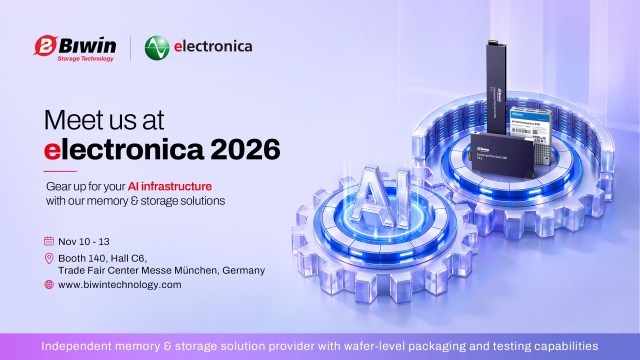
The company positions its portfolio around systems that pull in different directions: data centers running AI workloads, small devices limited by PCB area, and industrial platforms that operate 24/7. In-house capabilities across hardware, firmware, storage algorithms, packaging, testing and manufacturing let it tailor NAND systems to those constraints rather than offering one enterprise SSD shape for every job.
Why Munich 2026 matters as an Asia-Pacific infrastructure checkpoint
Two market signals sharpen the APAC relevance. TrendForce's enterprise SSD coverage expects PCIe 5.0 to become the mainstream enterprise SSD interface in 2026, which turns BIWIN's PCIe 5.0 family from an early-adopter option into a mainstream procurement question. Mordor Intelligence also forecasts Asia-Pacific as the fastest-growing AI-infrastructure geography at a 16.85% CAGR over 2027-2032, while MarketsandMarkets sizes Asia-Pacific smart manufacturing growth from USD 122.9 billion in 2026 to USD 332.7 billion by 2031. Those numbers point to the same pressure: more compute, more data, and more heat and power constraints at the edge and in metro racks.
Enterprise SSD matrix: density, endurance and standards compatibility
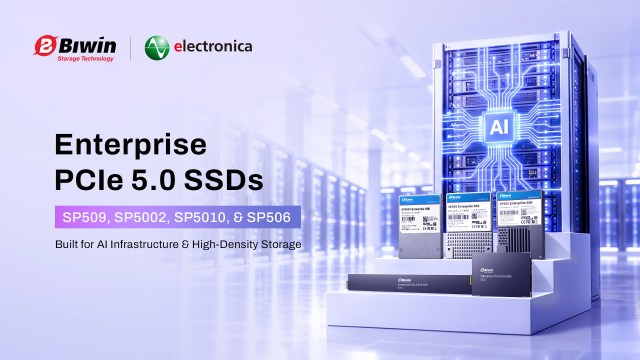
BIWIN's enterprise SSD line for PCIe 5.0 can be read as a workload map:
| Model | Hard specification anchor | What APAC buyers should infer |
|---|---|---|
| SP509/SP519 | PCIe Gen5 x4; up to 14,700/9,000 MB/s sequential read/write and 4K random read/write up to 3,200K/800K IOPS | For AI training and inference, queue depth, host thermal design and storage software matter as much as peak throughput. |
| SP5002 | QLC NAND; up to 61.44 TB in EDSFF form factors | Data lakes and cloud infrastructure gain capacity density when floor space and power distribution are constrained. |
| SP5010 | 2.5-inch U.2 PCIe Gen5 x4; up to 122.88 TB per drive | Tower and rack projects can trade multiple lower-capacity drives for one higher-density drive, reducing power, footprint and TCO discussion. |
| SP506/SP516 | 2.5-inch U.2 PCIe Gen5 x4; OCP 2.0; high performance-per-watt focus | Hyperscale and regional CSP buyers should check OCP 2.0 compatibility before assuming drop-in portability. |
The company's own framing is that endurance, density, power efficiency, interoperability and latency differ by deployment; the line is not a single drive in four labels.
BIWIN ePoP5X addresses the opposite end of the spectrum. It combines LPDDR5X memory and eMMC storage in a Package-on-Package form factor, freeing PCB space for next-generation industrial devices, AI glasses and compact PCs. In this design, ePoP5X is not only a size play; it is a route to more memory and storage inside a device whose board area cannot grow.
Industrial edge storage: Win-REC and the always-on video problem
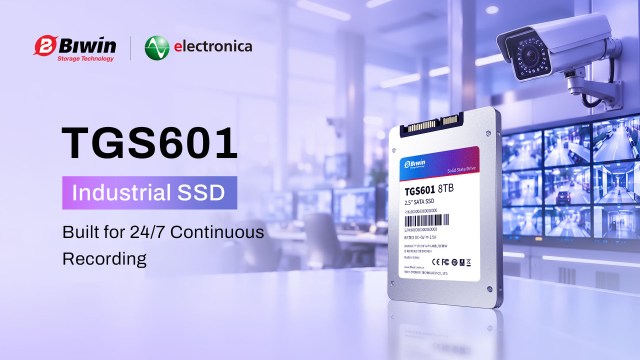
BIWIN TGS601 Industrial SSD targets continuous video workloads, where storage fails not because of peak speed but because of sustained writes. At its core is Win-REC, BIWIN's intelligent write algorithm for continuous recording. A single TGS601 can support recording from up to 24 simultaneous video streams while keeping write behavior consistent, reducing frame drops and interrupted footage in surveillance and video-heavy edge deployments.
The product also leans on wide-temperature operation from -40°C to 85°C, full-capacity onboard DRAM, hardware-based power-loss protection and multi-layer data protection. That makes it relevant to autonomous security systems, intelligent transportation, in-vehicle surveillance, edge computing and industrial servers - environments where an edge AI perception engine needs a durable buffer and a Physical AI control loop needs a fail-safe record layer.
Automotive storage: sleep-state power savings become a system lever
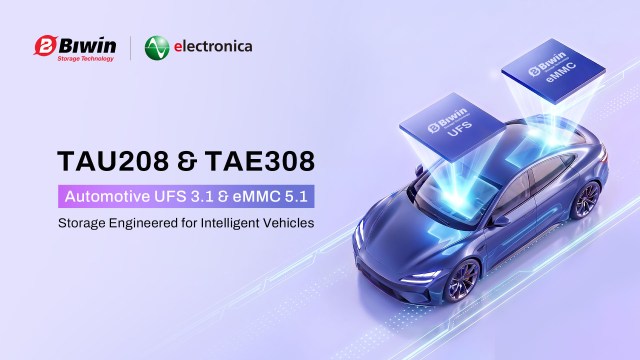
BIWIN's automotive portfolio spans smart cockpits, infotainment, navigation, digital instrument clusters, T-BOX modules and domain controllers. TAU208 UFS 3.1 is positioned as the higher-performance branch, with Deep Sleep reducing sleep-mode power consumption by up to 95%, plus Performance Throttling Notification and Error History logging. TAE308 eMMC 5.1 extends embedded coverage with a self-developed controller, AEC-Q100 Grade 2 qualification and operation from -40°C to 105°C.
The APAC implication is that software-defined vehicle architectures are becoming storage-heavy systems, not only compute-heavy ones. 360iResearch projects the automotive embedded storage eMMC & UFS market to grow by USD 7.93 billion at a 7.62% CAGR by 2032, supported by cockpit, logging and domain-controller data growth. TAU208 and TAE308 therefore give platform teams different points on the performance versus integration curve.
Miniaturization: removable PCIe storage and package-level integration
BIWIN BL130 Mini SSD brings PCIe Gen4 storage into a removable ultra-compact envelope with sequential read speeds up to 3,700 MB/s and capacities up to 2 TB. BL130 can support handheld gaming devices, compact PCs, smart cameras and edge AI platforms where internal space is scarce. The practical risk for OEMs is thermal: thinner designs can make a high-performance drive thermally constrained earlier than a standard M.2 bay, so enclosure validation remains necessary.
Together with ePoP5X, the compact portfolio shows BIWIN approaching miniaturization from two directions: shrink removable storage without losing SSD-class interface speed, or merge memory and storage into one package. The first preserves field serviceability; the second maximizes board density.
Action checklist for APAC readers ahead of electronica 2026
- Visit Hall C6, Booth 140 during November 10-13, 2026 at Trade Fair Center Messe München, Germany if the company's enterprise, embedded, industrial, automotive and PC OEM storage roadmap needs to be evaluated directly.
- For AI data-center planning, test SP509/SP519 under the workload profile you expect, not only with benchmark scripts; compare the published 14,700/9,000 MB/s and 3,200K/800K IOPS numbers against queue depth, temperature and storage software.
- For capacity-dense racks, model SP5002 and SP5010 side by side: 61.44 TB in EDSFF versus 122.88 TB in 2.5-inch U.2 can shift the bottleneck from drive slots to power, cooling and network aggregation; also ask SP506/SP516 about OCP 2.0 compatibility.
- For industrial edge programs, ask for Win-REC validation with 24 streams, -40°C to 85°C behavior and power-loss protection scenarios before assuming TGS601 can replace conventional surveillance storage.
- For automotive programs, check TAU208 UFS 3.1 sleep-state power savings against the vehicle's power budget, and confirm TAE308 eMMC 5.1's AEC-Q100 Grade 2 status within the target temperature range -40°C to 105°C.
- For compact-device OEMs, evaluate BL130 and ePoP5X as separate integration paths: one keeps removable capacity and faster interface flexibility, the other collapses memory plus storage into a single package.
Why this product map is relevant beyond the booth
BIWIN Storage Technology Co., Ltd. (SSE STAR Market, Stock Symbol: 688525) remains a supplier whose relevance to APAC buyers comes from breadth: enterprise, data-center, automotive, industrial and consumer storage under one semiconductor packaging and testing capability. Its portfolio includes PCIe NVMe SSDs, SATA SSDs, enterprise SSDs, DRAM modules, embedded storage such as ePoP, eMMC and UFS, automotive and industrial storage, plus portable storage categories. For regional readers, electronica 2026 is useful because it compresses those categories into a few decisions: where density reduces rack pressure, where sustained writes reduce edge failures, and where power-state savings reduce vehicle software risk.
APACTechBriefing's takeaway is less about a single flagship and more about workload fit: 122.88 TB SSDs answer capacity, Win-REC answers always-on recording, TAU208 and ePoP5X answer power and board-area constraints, while OCP 2.0 and AEC-Q100 Grade 2 signal the standards environment that APAC buyers must test before procurement.