
Case Brief: Reading DeepSeek’s November 3 Partial Outage as an Asia-Pacific Reliability Playbook
A single status-page flag raised at 16:58 would normally disappear into an operations log. This one is worth five minutes, because the way it played out — a public chat surface refusing requests, three named services degrading at once, a fix pushed while monitoring was still running — is a compact case study in what happens when a whole region builds products on top of shared model capacity.
This briefing reconstructs the incident, reads the year-to-date fault record behind it, and converts the lessons into a checklist that platform and product teams in Asia-Pacific can apply this quarter.
The case, move by move
| Signal point | What happened | What an on-call team could act on |
|---|---|---|
| Afternoon of November 3 | Chat requests stopped completing; the interface returned “Server busy, please try again later”. | First visible symptom was user-facing, not API-facing — support desks heard it before dashboards did. |
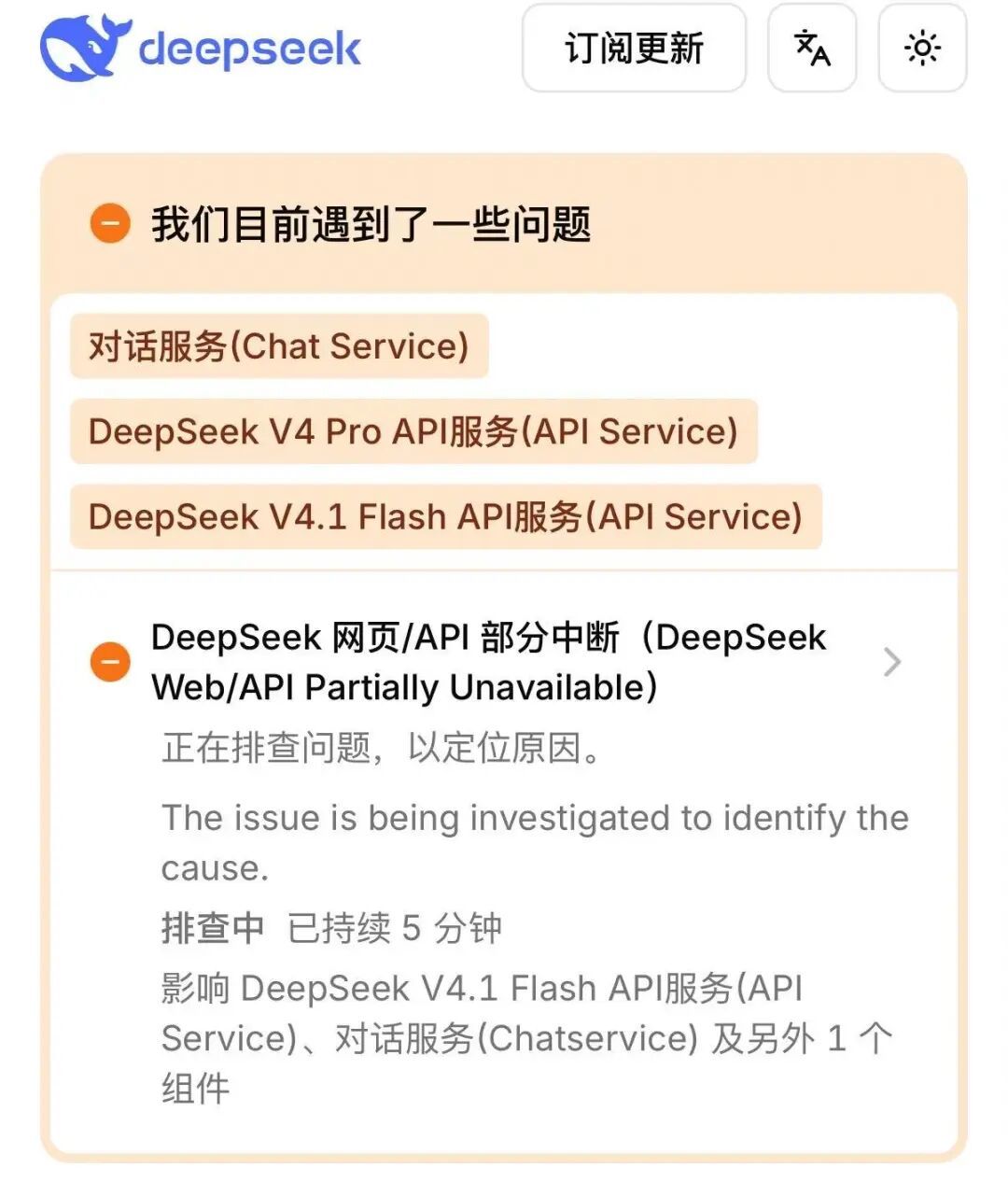
| 16:58 | DeepSeek’s official status page recorded a partial interruption of its web and API services and said engineers were investigating to locate the cause. | Time-anchored declaration: everything before it is anecdote, everything after is a tracked incident. |
| Declared scope | Affected services were Chat Service, the DeepSeek V4 Pro API service and the DeepSeek V4.1 Flash API service. | Both a “heavy” model tier and a “fast” model tier were hit, so a same-vendor swap was not an escape route. |
| Repair step | DeepSeek’s official website later stated that the earlier partial interruption of web and API services had been fixed and that the fix was still being monitored. | “Fixed” and “safe to resume full traffic” were two different moments. |
| Residual state | Degraded performance persisted on the DeepSeek V4 Pro and DeepSeek V4.1 Flash API services and on the chat service. | Latency budgets and timeouts needed to stay widened after the all-clear. |
The record underneath the incident
Read alone, November 3 looks like bad luck. Read against DeepSeek’s official service-status records, it looks like a recurring operating condition: the company has logged at least 10 large-scale fault entries since the start of this year, including reports categorised as “service unavailable” and “service abnormal”, while “performance degradation” entries appear far more frequently than either.
The recent sequence makes the cadence concrete. On the morning of October 15, web and app access broke down and message boxes returned “Server temporarily unavailable”; that outage ran close to 5 hours. On October 12, partial interruption of the web service was recorded, alongside periods of degraded web and API performance. Through September, the official log shows multiple abnormal-service entries, one of them a partial web and API interruption on September 14 that lasted about 3 hours. Longer interruptions sit earlier in the record as well.
Lesson one: “busy” and “down” are different failure classes
The most actionable finding from this case is a triage one. DeepSeek’s own API documentation describes its traffic controls as concurrency-based rather than as a published quota: requests that exceed the account-level concurrency ceiling for a given model are rejected with an HTTP 429 “Rate Limit Reached”, and the limits are tightened dynamically when servers are under load. That means some “Server busy, please try again later” moments are load-shedding on a service that is still alive — and during a declared performance-degradation window, 429 volume can spike on healthy-looking infrastructure.
Teams that collapse both patterns into one “provider is down” alert make two mistakes at once: they page engineers when pacing and queue depth were the fix, and they stand down while a partial outage is still quietly burning latency budgets.
Lesson two: external fault counts are not an SLO baseline
Second finding: the public record and the measured record do not line up. Independent trackers applied their own definitions and reached different tallies — one outage-monitoring site listed 7 incidents across a trailing 30-day window for DeepSeek, while another reconstructed the October 15 event as a 4-hour-52-minute interruption from its own probe timestamps. Neither number contradicts the vendor’s log, but they count different things, and status pages only capture what the operator chose to flag.
For anyone writing availability into customer commitments, the practical rule is that third-party incident counts make useful colour and unusable contracts. Request-level telemetry inside your own gateway is the only defensible source of truth.
Lesson three: regional cost advantage concentrates regional risk
Why this matters more in Asia-Pacific than elsewhere: coverage of model adoption in the region, including reporting by the South China Morning Post, has pointed to low-cost Chinese frontier models pulling small and medium-sized Southeast Asian businesses into generative AI use. Adoption driven by unit economics tends to come with thin redundancy budgets — one API key, one vendor, no gateway layer, and no tested fallback. A partial interruption that a large platform absorbs as a latency bump lands on those teams as a hard stop, and traffic curves in the region overlap with the operator’s own peak hours.
Reusable playbook for the next 16:58
- Track the operator log, timestamp your own. Follow DeepSeek’s official status history, but record internal first-detection and first-mitigation times; that gap is your real exposure.
- Split the error taxonomy. Alert differently on HTTP 429 concurrency rejection, HTTP 5xx and timeouts, and on declared performance degradation — three different runbooks, not one ticket queue.
- Put a fallback chain in front of the model, not in a wiki page. Route through an AI gateway with a secondary provider or a locally hosted model, and pre-check output quality on your own evaluation set before you need it.
- Cap retries. Exponential backoff with jitter plus a circuit breaker prevents a retry storm from converting a 30-minute degradation into an hour of self-inflicted congestion.
- Design a degraded answer. Cached responses, shorter context windows, queued batch jobs and a visible banner on your own product beat a silent spinner.
- Rewrite what you promise customers. If your upstream vendor publishes status entries rather than contractual availability commitments, your external SLA must carry buffers and carve-outs.
- Drill the outage quarterly. Simulate a full-day loss of the primary provider and measure time-to-second-source; the November 3 case shows residual degradation can outlast the headline fix.
Decision line
The takeaway is uncomfortable but simple: with at least 10 major fault entries year to date and partial interruptions as the recurring unit of failure, model availability is now a planning assumption rather than a contingency. Cheap frontier-model access is a genuine competitive gift to Asia-Pacific builders — the brief on November 3 shows that the winners will be the teams that keep shipping answers while the upstream line still reads “monitoring”.