
DeepX DX-M2 Tape-Out Turns LPDDR5x-PIM Into a Sub-5 W Edge AI Shortcut: An APACTechBriefing Deep Read
DeepX, a South Korean edge-AI chip startup, has completed tape-out of DX-M2 and is pairing it with Samsung LPDDR5x-PIM to target large-model inference in a 5 W envelope. The bet matters for APAC buyers because it turns memory-side compute into a practical path for robots, drones, AI PCs and industrial devices, while pushing AI workloads away from constrained data centers.
Quick brief: DX-M2 succeeds DX-M1, aims at 20 billion to 100 billion parameters — approximately 3 billion to 20 billion active parameters — and 10 to 30 tokens per second. DeepX cites 50 to 150 GB/s memory bandwidth, 80 TOPS on a 2-nm node, and 6.7× tokens per second for Llama3.1-8B when GEMV work moves into memory. Samples are expected in March 2027, mass production in fall 2027; DX-M3 follows in 2028.
 DeepX’s Tim Park (left) and Lokwon Kim (Source: DeepX)
What changed when DX-M1 moved to DX-M2?
The M1 is now in mass production for vision applications, while the M2 is built for generative AI at the edge. The company says its NPU doubled power efficiency through design improvements, and the move to a 2-nm process doubled that again, allowing 80 TOPS. Memory bandwidth moves from 50 to 150 GB/s.
“The most important change [between M1 and M2] is the memory bandwidth,” DeepX founder and CEO Lokwon Kim told EE Times.
The M2 targets models with 20 billion to 100 billion parameters, or approximately 3 billion to 20 billion active parameters, at 10 to 30 tokens per second, depending on model, within the same 5 W budget as M1. Large mixture-of-experts LLMs are in scope, along with speculative decoding and TurboQuant.
“This is important because with 5 W power consumption we can go everywhere, drones or any other battery-powered device,” Kim said. “Our goal is to enable deployment of sophisticated AI in all devices.”
Why is LPDDR5x-PIM central to the DX-M2 architecture?
DeepX and other accelerator vendors face the same constraint: moving weights between memory and compute slows inference, especially GEMV operations. PIM shifts part of that work into DRAM banks, reducing data movement and lifting effective bandwidth. That is the architecture choice behind LPDDR5x-PIM.
At Hot Chips 2026, Samsung’s PIM presentation reported a separate memory-side result: 3.01× faster inference than ordinary LPDDR5x, with an 8× bandwidth view. The number is not a substitute for DeepX’s system simulation, but it shows why a memory supplier, rather than only a logic vendor, now anchors part of the edge-AI roadmap. See ServeTheHome’s Hot Chips 2026 coverage and JEDEC’s LPDDR6 roadmap preview.
A JEDEC standard for LPDDR6 is set to cover PIM, and JEDEC says LPDDR6 PIM is nearing completion. Before that, DeepX has been working with Samsung to integrate DX-M2 with LPDDR5x-PIM.
“We have spent one and a half years on this technology, collaborating with Samsung Memory, as they already have their custom PIM for LPDDR5x,” Kim said. “We already received LPDDR5x PIM samples and we are testing the operations and performance in-house.”
DeepX’s own simulation says offloading GEMV operations from DX-M2 into LPDDR5x-PIM produces 6.7× the tokens per second for Llama3.1-8B versus DX-M2 alone. “DX-M2 with LPDDR5x-PIM is close to optimal,” Kim said. “But our next generation, the DX-M3, will support official LPDDR6 PIM technology; then we can get the full theoretical performance advancement, which is 5× to 8× higher performance.”
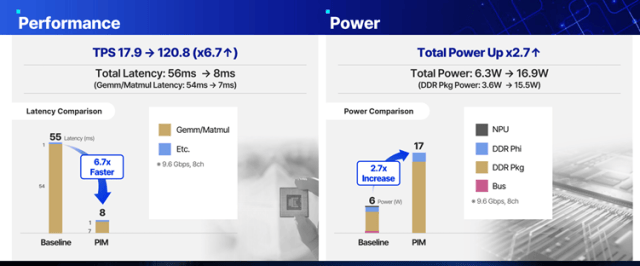 Offloading GEMV operations into memory will improve tokens per second by 6.7× (based on Llama3.1-8B), according to DeepX, at the expense of power consumption. (Source: DeepX)
The tradeoff is not free: 6.7× performance requires 2.7× total power consumption, while DeepX believes it can still get a 2× performance uplift within the same non-PIM power envelope.
“Substantial manual effort” is required in the compiler. Kim said DeepX has a prototype compiler based on simulation of the PIM-enabled LPDDR5x. “We are now making the hardware modules so that we can test that in the physical environment, so we couldn’t finish the compiler yet, but we are actively working on it.”
Which APAC and global markets are moving first?
Tim Park, director of strategic marketing at DeepX, said DX-M2 will target AI PCs, robotics, automotive and IoT. The company is working with Taiwanese OEMs on laptops and workstations, while robotics teams prototyping on Nvidia Thor want lower power and more on-device compute. For automotive, customers want a low-power chip that can run agents in-vehicle.
For IoT, DeepX is working with Samsung on a next-generation smart hub, and it is joining the AWS IoT ecosystem to use Greengrass for remote model updates.
Park said many robotics customers begin on GPUs but must move because of thermal and power limits. DeepX is trying to let teams shift from Nvidia Isaac to its in-house equivalent, Newton.
“Robotics customers ask us about our hardware, but also about how they can migrate from Nvidia to DeepX,” Park said. “This is the answer—customers change their APIs to call Newton instead of Isaac and then they can run the exact same pipeline on the DeepX system.”
The company says it now has 17 compatible libraries running. DeepX demonstrated M1-based robots using the same source code as an Nvidia Jetson-based robot while calling DeepX libraries. “The actual outcome for the customer is they can enjoy 20 times longer battery life and [lower cost] when they switch from Nvidia to DeepX,” Kim said. “At the same time, the switching time can be under a second. They just need to change the API name from Isaac to Newton. That’s it.”
DeepX is building a full robotics stack under the name DX-Newton.
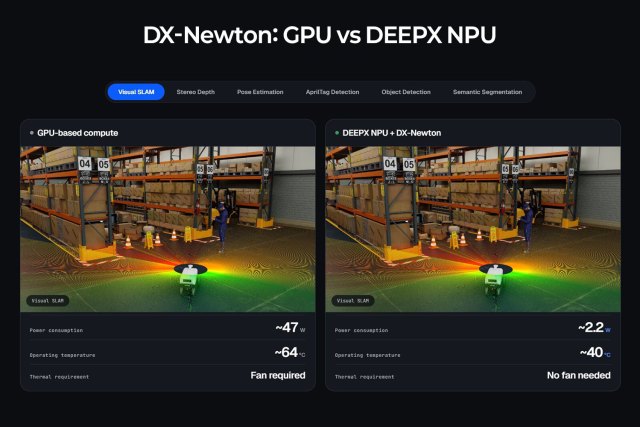 DeepX has developed software libraries for robotics under the name DX-Newton. (Source: DeepX)
Robotics customers in the U.S., China, Vietnam and Korea are engaging with DeepX, and Hyundai Motor Group Robotics Lab already uses DX-M1 in its robotics platform.
The company is adding Taiwanese OEMs, vertical champions and an Intel collaboration. To reach Intel’s x86 base, DeepX is integrating OpenVINO with the DeepX SDK; DX-M1 can complement NPUs in Intel Core Ultra CPUs and enable AI on Intel edge CPUs without NPUs by offloading workloads.
Kim said DeepX recently met with AMD to discuss a robotics platform built on DeepX accelerators and AMD’s Kria reference board, especially for the Korean ecosystem. The company is also pursuing heterogeneous ecosystems, including Raspberry Pi and Baidu’s PaddlePaddle.
What commercial signals should decision makers track?
Kim said DeepX has more than 100 purchase orders for DX-M1 across global markets and physical-AI industries, including drones, robots, smart factory, surveillance camera, aerospace and defense, healthcare, and IoT. The M1 is now in mass production.
Kim said the most active physical-AI market was previously China, but Japan has emerged this year as a major market for humanoid robots. “All the large Japanese companies are evaluating our chips, more than 10 leading companies in Japan right now, and their feedback is very encouraging,” he said. “At the same time, the U.S. market [is strong]; we have several big names there, and their feedback is really good.”
Smart city projects in South Korea, Vietnam and Singapore also involve DeepX.
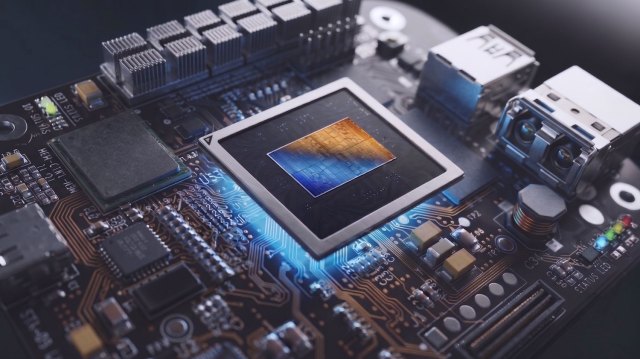 An artist’s rendering of the final DX-M2 chip, which has just taped out. (Source: DeepX)
Park framed edge AI as a distribution opportunity, not a niche. “Our long-term view is that AI compute will become more distributed as efficiency improves,” he said. “The PC and smartphone eras showed how computing can spread into many products. AI will follow its own path, but local inference has clear value when an application needs immediate access to sensor data or operation without continuous connectivity.”
DeepX also argues that the AI capacity problem cannot be solved by data-center investment alone, especially when power constraints slow new facilities. Kim said only a quarter of the CPU market is in the data center today, while AI processor demand could shift to the edge in five to 10 years.
“If we deploy models up to 100 billion parameters in devices, we can reduce AI data center traffic by more than 80%,” Kim said. “That means we could have five times larger infrastructure without adding any AI servers. This is our vision.”
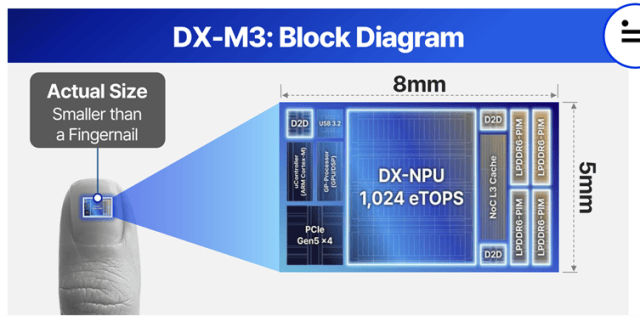 DeepX’s third-generation will be chiplet-based. (Source: DeepX)
DeepX’s roadmap points to DX-M3 in 2028. The M3 will be chiplet-based and will target 1 ePOPS (INT8) using LPDDR6-PIM. Its main targets are automotive OEMs and humanoid robotics companies that need multi-chiplet designs. In the meantime, M2 samples are expected in March 2027, with mass production targeted for fall 2027.
How should APAC buyers act on the DeepX DX-M2 signal?
For APAC technology and product leaders, the DX-M2 announcement is less a chip launch than a supply-chain and architecture signal: memory vendors can now place inference economics under the power envelope that edge devices actually tolerate.
| Option | Where it helps | Decision caveat |
|---|---|---|
| LPDDR5x-PIM | Edge AI PCs, robots, drones and compact devices that need local LLM inference near 5 W | Still a supplier-custom path; compiler support and board-level validation are immature |
| LPDDR6 PIM | Later-generation edge systems that can wait for JEDEC standardization | DX-M3 support is promised for 2028, not a 2027 procurement path |
| GPU or NPU plus LPDDR5x | Known robotics pipelines and high-volume vision workloads | Thermal budgets can force redesign when models grow to 20 billion to 100 billion parameters |
Action checklist
- Test end-to-end, not bank-level PIM. Samsung’s Hot Chips result, DeepX’s Llama3.1-8B simulation and a customer token-per-second target can move in different directions.
- Track AI memory supply chains for status gaps. AI memory supply chains show why sample timelines and standard windows matter more than peak TOPS.
- Compare migration cost before claiming Nvidia displacement. The Newton API path is attractive only when 17 compatible libraries cover the target workload and the device still fits under a second context-switch expectations.
- Plan around 5 W thermal limits. For drones, robots and industrial cameras, the 2.7× power penalty of 6.7× gains is the practical procurement gate.
FAQ: What APAC readers ask about LPDDR5x-PIM edge AI
Is LPDDR5x-PIM a replacement for Nvidia accelerators?
No. For many robotics teams, DeepX’s pitch is an alternative after GPU prototyping, especially when thermal and battery budgets tighten. The M2 aims to make local inference feasible where Nvidia Thor, Nvidia Jetson or discrete GPUs are too power-hungry.
Why does the compiler matter more than the chip tape-out?
Tape-out proves silicon can be made; compiler support proves it can be programmed. DeepX said substantial manual effort is required, so buyers should ask for PIM-enabled inference latency, power curves and toolchain compatibility before committing.
Which timeline is most important for APAC OEMs?
The sample-to-production window: DX-M2 samples in March 2027 and mass production in fall 2027, while DX-M3 points to 2028 with LPDDR6-PIM. Buyers can use these dates to decide whether to prototype now or wait for standard PIM.
Reference sources
- DeepX DX-M2 and physical-AI roadmap details: DeepX CES 2026 media briefing.
- JEDEC LPDDR6 and LPDDR6 PIM roadmap: JEDEC LPDDR6 roadmap preview.
- Samsung LPDDR5x-PIM at Hot Chips 2026: ServeTheHome and Tom’s Hardware.
- Edge-AI memory-wall context: Synopsys Physical AI and memory wall blog.