
APACTechBriefing Case Recap: DK-NFLNK Battery Sampling Turns Wiring Risk Into Data Readiness
For APAC battery-system teams evaluating a multi-country rollout, the DK-NFLNK sampling case is less about wireless novelty and more about removing connector risk, tightening cell-level data, and preparing for traceability rules. The core lesson is that safer packs start with synchronous measurement, but legacy modules, thermal warnings and compliance data must be planned as one system.
What happened in the DK-NFLNK sampling case?
At the Pretzl Connect 2026 press event, Dukosi, based in Edinburgh and quoted with the BUDAPEST, Hungary dateline, said commercial sampling has started for DK-NFLNK, a contactless intra-battery communication solution. The dispatch from Budapest describes a single bus antenna carrying near-field RF links for voltage and temperature data, replacing wiring harnesses. The compliance anchor is Regulation (EU) 2023/1542 of the European Parliament and of the Council, which requires an electronic record for certain packs from a fixed date: “From 18 February 2027 each LMT battery, each industrial battery with a capacity greater than 2 kWh, and each electric vehicle battery placed on the market or put into service shall have an electronic record (‘battery passport’).”
For APAC exporters, preparation timing now has two official markers. The European Commission published guidance on 21 August 2026 to support preparations for the digital battery passport alongside Regulation (EU) 2023/1542. Separately, Chinese government reporting published in January 2026 says interim measures will assign a digital identity to each new energy vehicle power battery from 1 April 2026. The case therefore shows a regional pattern: EU Battery Passport rules set an external market deadline, while China is building domestic traceability pressure.
Why connector risk became the first design problem
Joseph Notaro, president of Dukosi in Budapest, framed the issue as quality risk rather than convenience. He stated: “Connector failure rates in a conventional wiring harness are around 10 parts per million,” followed by “In the automotive and industrial arenas where you’re looking at parts-per-billion-level reliability, that failure rate is simply too high and an unacceptable risk of failure.”
Notaro also argued that wired networks can create galvanic coupling between high-voltage circuits and low-voltage controls, while adding labor and weight. “With contactless technology, we decouple the high-voltage circuits and get rid of the physical connectors, which makes the system safer, higher quality, and more reliable over its entire operating life,” he said.
| Case variable | Legacy wiring evidence | DK-NFLNK lesson |
|---|---|---|
| Failure surface | Connector failure rates in a conventional wiring harness are around 10 parts per million, | Remove the physical connector layer and re-test at pack level |
| Electrical separation | Galvanic coupling between high-voltage and low-voltage domains | Decouple high-voltage circuits for safer assembly |
| APAC deployment | Assembly labor and weight vary by market cost structure | Measure total system value, not only bill-of-material cost |
 Joseph Notaro (Source: Dukosi)
How cell-level synchronization changes battery decisions
The technical core is C-SynQ, a protocol that sends near-field radio signals along one bus antenna wire. Dukosi said those signals work at the cell level, remain inside the enclosure and provide noise immunity without requiring line of sight. Joseph Notaro said: “Smarter battery management starts with better data, and better data starts at the individual cell,” adding: “When you’re deciding available power or charge limits, you want every cell being measured at the same time under the same conditions. That’s the technical equivalent of taking a high-speed photo of every cell at the same time.”
He continued: “The weakest cell dictates the state of charge and the overall performance of the pack. If you don’t measure the cells in synchronization, then measurement errors creep in, and you’re forced to add in design margins, which in turn limit performance.” For product managers, the practical takeaway is that asynchronous sampling converts data uncertainty into locked-away energy.
What thermal warning windows reveal
For lithium-ion safety, the goal is preventing thermal runaway. A short circuit in one cell can start heat that spreads to neighbors. Older pack designs used only two or three temperature sensors across the module, so they did not monitor individual cells. Notaro said: “In the traditional layouts with very sparse temperature sensing, the heat from a failing cell can take 10 to 15 minutes to get to an external sensor,” and “With sensing capability on every cell, temperature excursions are detected almost immediately, well before the heat has a chance to propagate to the adjacent cells.”
That time gap is the design boundary. Cell-level data allows outlier-detection software to compare thermal profiles and flag small deviations early. Notaro warned against assuming uniformity: “Some manufacturers try to cut costs by getting rid of the sensors and just assuming the cells are all the same,” and “Every chemical manufacturing process has variation. You can’t have a battery pack that’s that uniform and then ignore the cell-level monitoring without increasing your operating risk.”
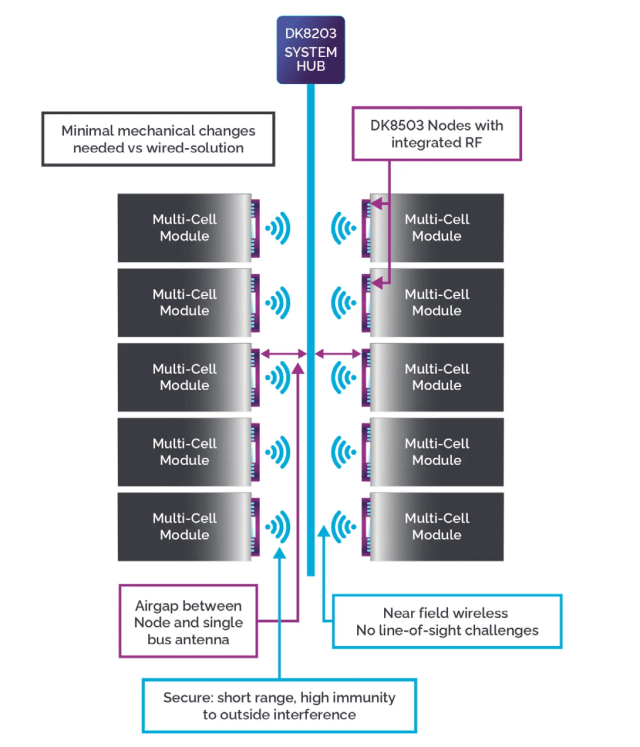 DK-NFLNK System Diagram (Source: Dukosi)
What does China mean in the monitoring discussion?
During the briefing, EE Times asked whether battery manufacturers in China approach monitoring and safety differently from companies in other regions, particularly whether their strategies are mainly cost-driven. Notaro replied that China has two distinct tiers of customers: one that prioritizes safety and total system value, and another strictly focused on short-term component costs. He stressed the split is not unique to China because carmakers worldwide divide between safety-conscious and cost-driven mindsets. He added that the massive volume of EVs in China gives domestic manufacturers extensive operational data, accelerating their ability to refine battery quality over time.
How usable energy and passport data connect
The Dukosi Cell Monitoring System, known as DKCMS and built around the DK8102 Cell Monitor chip and DK8202 System Hub, targets system measurement errors that traditionally degrade usable battery capacity. Notaro said: “By providing consistent cell-level data, operators can reduce safety buffers and increase usable energy by 6% to 12%,” and “You are not altering cell chemistry or adding weight; you are simply extracting energy previously locked away by measurement margins.”
For utility-scale energy storage, the master data gives a finance team a clear unit economics test: in a 200-MW installation, additional revenue of $8 million can be generated from the extra capacity, or capex can be reduced by $2 million by needing fewer cells.
Traceability is the second half of the story. From Feb. 18, 2027, batteries covered by the EU Batteries Regulation will require an electronic record containing information about identification, composition, performance, and health. The DKCMS chips include onboard non-volatile memory and a unique silicon identifier attached to each cell. Notaro said: “Every cell has its own digital passport on chip, which records the maximum temperature it’s ever seen, its voltage history, and total charge cycles,” adding: “When the battery has finished its life in the car, the recyclers and integrators simply read the chip to determine the health of the cell, which allows them to sort it efficiently for either grid use or recycling.”
Why legacy module teams can still act
Chip-on-cell is the endpoint, but DK-NFLNK is positioned as an upgrade path for manufacturers using traditional module design. The system connects the node chip to analog front ends through a serial interface, adding wireless capability without changing the module hardware structure. Notaro concluded: “DK-NFLNK and our full cell monitoring system are built on the same C-SynQ communication platform, giving battery manufacturers a real migration path,” and “The engineers can upgrade their architecture today and move to full chip-on-cell monitoring in future product cycles.”
Which real deployments matter beyond the press release
The case also points to commercial testing across sectors. Nordic Marine Power received DNV maritime approval for its PowerStack system using Dukosi monitoring, while Yichuan Intelligent Technology incorporated the system into marine vessels in China. For APAC buyers, those references matter because marine platforms stress vibration, maintenance access, crew safety and long certification cycles.
What APAC teams should do now
- Map every connector in the pack architecture and benchmark its failure exposure against parts-per-billion-level expectations.
- Set a thermal monitoring floor: if legacy designs rely on two or three temperature sensors, treat sparse sensing as a safety risk, not only a cost choice.
- Plan cross-border data compliance as a product feature. Track EU Battery Passport readiness for 18 February 2027, and for China-facing programs test cell identity, voltage history and charge-cycle records now.
- Model energy value before choosing a migration path. The reported 6% to 12% usable-energy gain should be translated into pack-level capacity, warranty margin and resale value.
- Use C-SynQ-compatible architecture decisions as the bridge: DK-NFLNK can preserve legacy modules, while DKCMS, DK8102 and DK8202 support deeper cell intelligence later.
FAQ
Does DK-NFLNK eliminate all battery wiring?
No. The sampling case shows replacement of harness wiring for intra-battery communication, while power circuits, balancing logic and enclosure design remain system decisions.
Why should a ppm-level connector issue matter in APAC factories?
Because warranty exposure, line automation and cross-border compliance documentation often scale failure costs. A defect described as 10 parts per million may be unacceptable when pack programs aim for parts-per-billion-level reliability.
What is the reusable lesson for enterprise channel teams?
For enterprise tech buyers, safety data is marketing data. Cell-level measurement and traceability can support product claims only when the evidence chain is auditable.
Is the EU Battery Passport deadline enough to trigger redesign?
Not by itself. The stronger trigger is the combination of connector risk, thermal warning windows and usable-energy margins, with passport data as the compliance layer.
Sources
- European Commission, “Guidance to support preparations for the Digital Batteries Passport”, 21 August 2026. https://single-market-economy.ec.europa.eu/news/guidance-support-preparations-digital-batteries-passport-2026-08-21_en
- English-language Chinese government reporting, “China to strengthen recycling management of used power batteries”, 16 January 2026. https://english.www.gov.cn/news/202601/16/content_WS6969df0cc6d00ca5f9a089c0.html
- Dukosi, DK-NFLNK solution brief. https://www.dukosi.com/app/uploads/2026/09/Dukosi_Solution_Brief_DK_NFLNK_for_Battery_Systems_A4_August_2026.pdf