
APACTechBriefing | Farsoon FS722M: Eight-Laser Metal PBF for Series Production
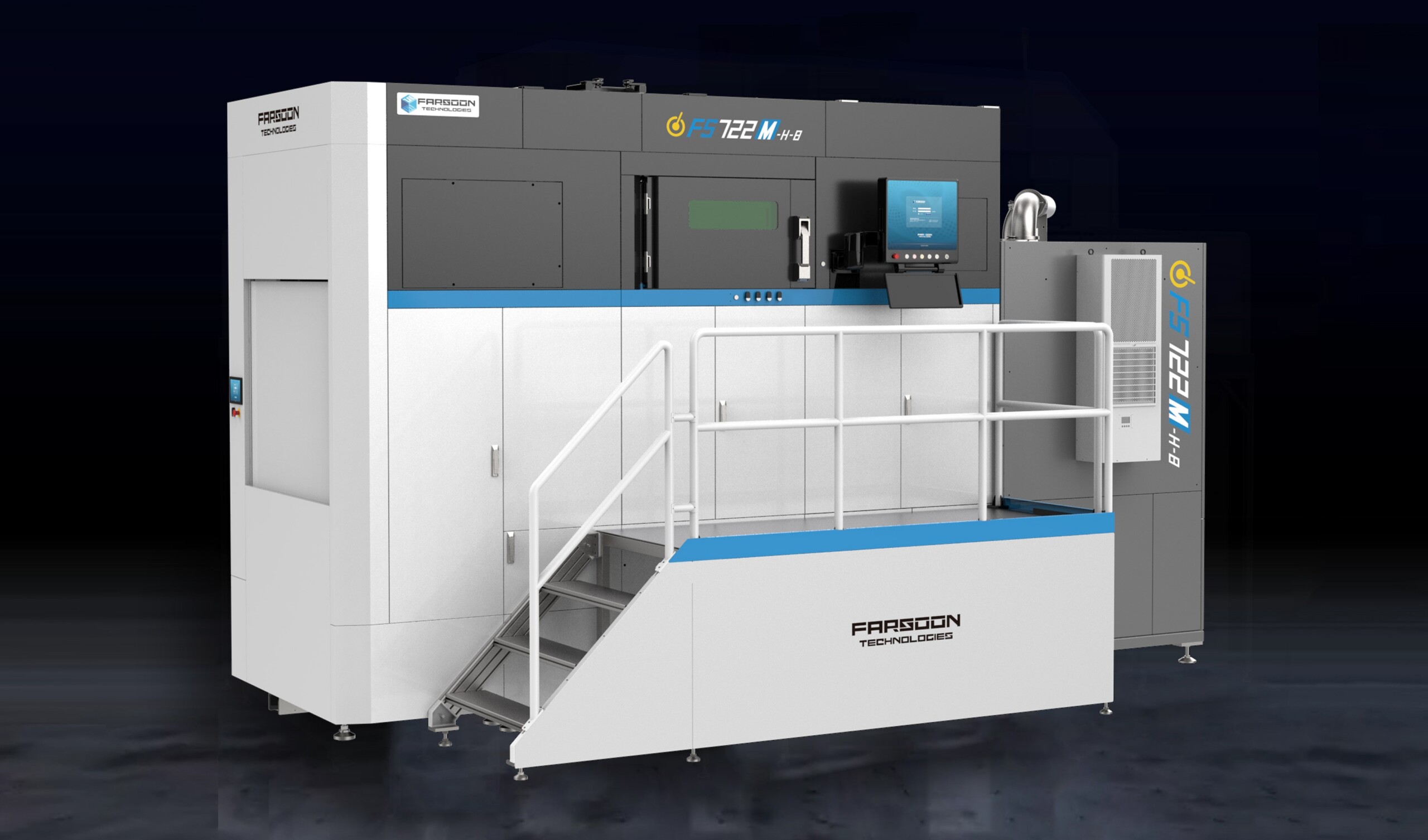
Direct answer: Farsoon Technologies frames FS722M as a metal powder-bed-fusion capacity step: eight 1,000 W lasers sit inside a 720 × 420 × 650 mm envelope, the 650 mm height supports vertical nesting, and the company cites up to 1,000 cm³/h under qualified conditions, while CAMS and FS722M-CAMS target uptime, traceability and operator consistency.
For APAC decision-makers, the more important change is that this is not a standalone machine announcement. The platform extends the FS721M and FS721M-H line, so teams already familiar with large-format laser powder bed fusion workflows can evaluate FS722M against existing process windows, powder handling rules and part-removal routines rather than starting from scratch.
Why the launch matters for APAC production planning
Conclusion first: the FS722M is most relevant when a factory needs repeatable output, stable cycle planning and clearer part cost, not simply a faster headline build rate.
Industry benchmarks show that additive manufacturing is moving from prototyping toward production. The Wohlers Report 2025, published by Wohlers Associates, states that the global AM industry grew by 9.1% to $21.8 billion in 2024 (wohlersassociates.com). For APAC factories, that growth is most actionable when equipment can connect large-format capability with qualified, repeatable production routines.
There is also a regional channel signal worth noting. Coverage of a 2026 Australia and New Zealand partnership referred to more than 1,500 Farsoon systems installed across over 30 countries, which supports the argument that large-format PBF platforms are being evaluated as part of broader industrial supply chains, not as isolated pilot assets.
What the platform numbers translate into on the shop floor
| Platform element | Production implication for APAC manufacturers |
|---|---|
| eight 1,000 W lasers | Higher laser count can compress cycle time when parameters, nesting and part quality are validated. |
| 720 × 420 × 650 mm build envelope | The rectangular format supports automotive components, tooling inserts and large machine parts with different orientation needs. |
| 650 mm height | Enables taller parts and vertical nesting, reducing fixture compromises for elongated or layered geometries. |
| up to 1,000 cm³/h | Throughput remains material-, parameter- and condition-dependent; it should not be treated as a guaranteed production rate. |
| beam-shaping option | Can improve energy input and melt-pool control, but application-specific trials are still required. |
| CAMS and FS722M-CAMS | Shifts the discussion from print speed alone to uptime, cartridge exchange and post-build logistics. |
Process consistency is the real qualification test
The FS722M package highlights digital optics, customizable scanning strategies, an updated multi-layer gas flow design and an upgraded recoater blade. In practical terms, these features are aimed at one outcome: stable powder spreading and predictable layer formation across a wide platform.
That is where APAC buyers should focus their evaluation. A platform can be attractive because it fills a build envelope, but series production begins when a machine can deliver the same qualified part family repeatedly, with defensible variation controls.
- Map your top five candidate parts against the 720 × 420 × 650 mm envelope and the 650 mm height.
- Re-run existing FS721M and FS721M-H process logic where possible, rather than assuming a clean-sheet approach is better.
- Quantify powder reuse, sieving loss and fresh-powder replenishment before assuming stable material cost.
- Require traceability on laser power, chamber temperature and gas flow for every qualified build.
- Treat the 1,000 cm³/h figure as a capacity ceiling, not a planning number, until material-specific data are collected.
CAMS changes the bottleneck from printing to workflow
The platform's CAMS concept uses exchangeable build cartridges to move part removal and preparation outside the printing cycle. A conveyor transfers cartridges between the machine and an external loading dock, while a finished cartridge moves to an inerted breakout station for downstream handling.
The FS722M-CAMS configuration also integrates closed-loop powder management: recycling, sieving, storage and fresh-powder feeding are kept within a protected inert environment. The filtration module is positioned for lower routine maintenance, with dust-bin emptying as a central service task. The strategic point is that CAMS does not just add automation; it reorganizes the production sequence so the build station stays productive while part handling occurs elsewhere.
Case signal: why production pilots matter more than specs
The FS722M arrives after large-format Farsoon workflows had already been tested in series-production pilots. Industry reporting from 2024 described a premium electric-motorcycle component partnership using an FS721M-H-8-CAMS configuration, and Farsoon Technologies has positioned FS722M for industrial series production on its own launch page (farsoon-gl.com).
APACTechDigit analysis suggests the more useful takeaway for regional buyers is that the next constraint is often qualification discipline and production logistics, not the number of lasers on paper. A machine that can support high deposition can still disappoint if cartridge cadence, powder recovery or part inspection cannot scale with it.
Decision checklist for APAC technology and operations leaders
- Start with part mix, not machine specs: prioritize products that genuinely need the rectangular envelope and the 650 mm height.
- Model cost per qualified part, including powder, gas, downtime, post-processing and scrap.
- Use a two-trial approach: one trial for print speed, one for repeatability across multiple builds.
- Assess local support, service response and spare-part availability before committing to production-scale automation.
- If adopting FS722M-CAMS, verify cartridge exchange intervals and breakout station throughput before promising plant-level utilization.
FAQ
Is FS722M simply a replacement for FS721M?
No. The more accurate framing is platform extension. FS722M adds production-oriented features while building on the large-format lineage that includes FS721M and FS721M-H.
What does FS722M-CAMS add for a production plant?
It targets non-print downtime by separating printing from part handling, using exchangeable cartridges, an inerted breakout workflow and closed-loop powder handling.
Should buyers treat 1,000 cm³/h as guaranteed output?
No. The company states the figure depends on material, process parameters and build conditions, so factories should use it as an upper bound until their own qualification data are in place.
Why is this relevant beyond the machine itself?
Because APAC manufacturers are moving from trial cells to repeatable production. The value of FS722M is not only capacity, but how uptime, monitoring and workflow design combine to support qualified part output.
By Lynn Zhou for APACTechDigit APACTechBriefing. Contact: contact@apactechdigit.com.