
APACTechBriefing: Videostrong and the XCPE Backdoor — Comparing Android TV, Google TV and Uncertified Boxes for APAC Buyers
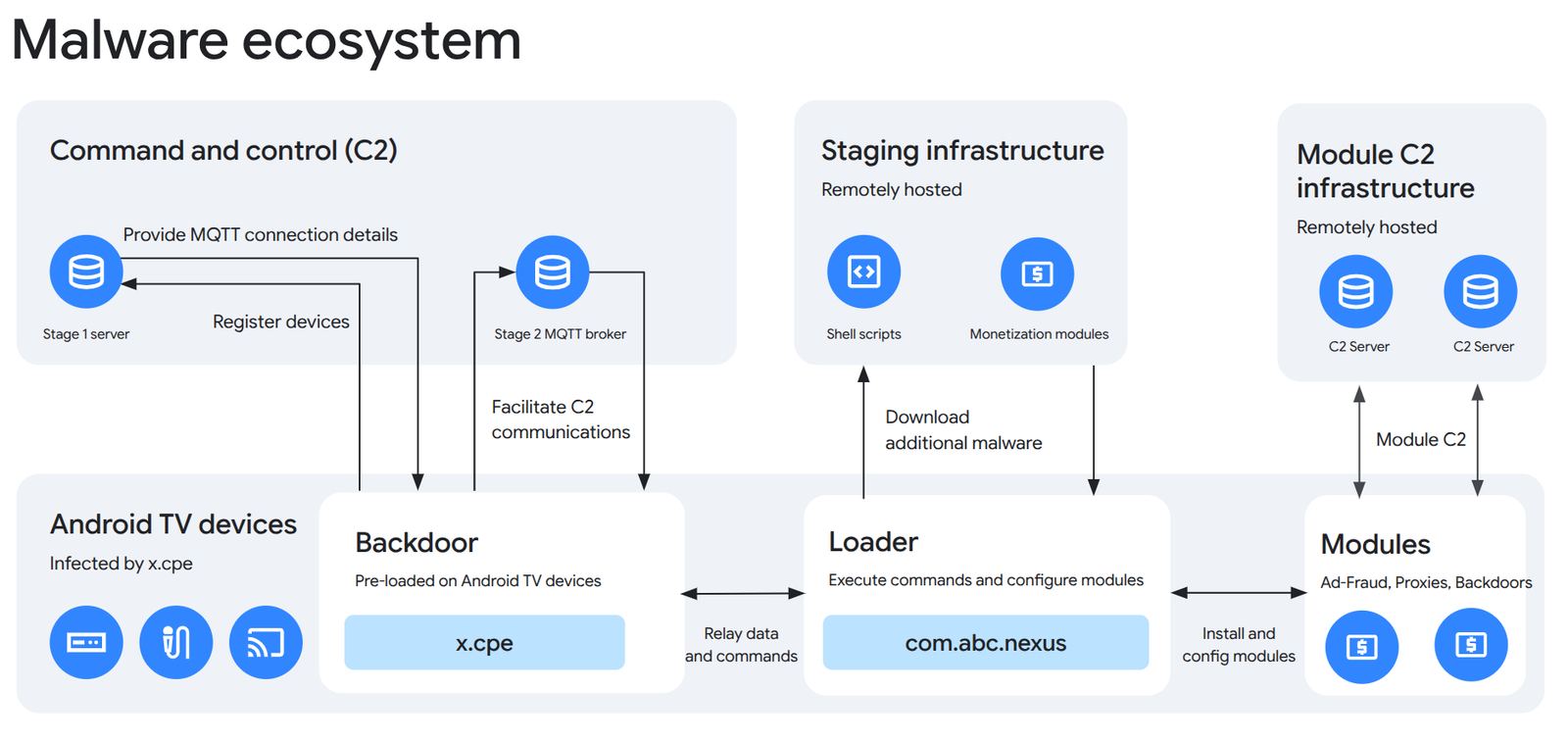
For procurement teams sourcing living-room and signage hardware in Asia-Pacific, the lesson here is procedural, not technical: a certification badge is no longer a substitute for supply-chain verification. Google has confirmed that Videostrong, a Shenzhen-based China-origin manufacturer of officially certified Android TV set-top boxes, built a remotely controllable backdoor into firmware — reported as the XCPE infrastructure — and sold access to criminal affiliates. Google recently terminated all cooperation with the vendor, took legal action against the control servers, and estimates that its action cut communication channels to at least 10 million further devices. What follows is a briefing-format comparison of the five procurement lanes APAC buyers actually weigh, plus a 72-hour checklist you can run against your existing device estate.
60-second fact base
- Who: Videostrong, a China/Shenzhen manufacturer of Google-certified Android TV hardware, now a former partner.
- What: a preinstalled firmware backdoor plus a purpose-built server network used to manage devices and distribute malicious code.
- Named platform: XCPE; affected ecosystems: Android TV and Google TV set-top boxes.
- Brand called out by researchers as a key exposure point: Mecool.
- Scale stated by Google: at least 10 million additional devices had their attacker communication path severed; confirmed infections run into the millions of units.
- Google position: this was deliberate, multi-year engineering, not a rogue employee or an accident.
Why certified hardware failed its own trust model
The investigation describes a system that was mature enough to survive audits. Google says the malicious code shipped across multiple models and multiple brands, ran on dedicated infrastructure, and was repeatedly reconfigured to evade detection while still letting the operator manage downstream partners and malicious modules. That rules out the two explanations procurement teams usually accept from suppliers — a bad batch, or an individual developer's shortcut.
The evasion method matters for your incoming-inspection design. Rather than placing executable malware in the image tested by Google, the vendor reportedly pre-set hidden code and relied on obfuscation to clear compatibility and security testing, then downloaded or activated the malicious modules only after a user's first boot. Public threat-intelligence write-ups describe the components running with Android system-level privileges and using a messaging-broker style command channel to receive instructions and pull further modules. The practical consequence: a device can be genuinely certified at test time and genuinely compromised at run time.
Google has acknowledged a gap in its certification scheme — vendors exploiting whitespace in the review flow by deferring code loading to the user's device — and says it is upgrading certification and review mechanisms, with stronger verification of device firmware and later software behaviour. The enforcement package announced alongside the disclosure goes wider than one factory: Google has banned Videostrong and any affiliated entities from producing Google-app-preloaded certified Android devices in the future, and from providing software services to other certified Android device vendors.
Blast radius: categories, models and geography
Security firms tracking the campaign place the exposure mainly in Android TV and Google TV set-top boxes, with Mecool products singled out as one of the most affected brands. Google's estimate that at least 10 million extra devices were disconnected from attacker control servers is the number to use when sizing the tail of the incident: takedowns suppress current control, they do not prove the estate is clean.
Category spread is what turns this from a consumer story into an APAC enterprise story. The same malicious components were found beyond TV boxes — in digital-signage players, karaoke equipment and telehealth terminals. Those are exactly the device classes that regional system integrators deploy in hotels, retail chains, F&B venues and clinics, often in unattended, always-on network segments with static credentials and no MDM.
Reported intended uses of the backdoor line up with the economics of grey-zone network capacity: installing additional malware, executing ad fraud, building proxy networks and other cybercrime activity. Coverage of the takedown by research partners adds bandwidth resale, delivery of video content and mass content scraping for AI projects to that monetisation list. And because public reporting places affected devices across more than 200 countries, an APAC importer cannot treat this as a China-domestic problem.
Cross-comparison: five procurement lanes and their failure modes
Read this as a trade-off matrix, not a ranking. Certification status, update control and the cost of switching are the variables that decide the risk you actually carry.
| Option | What certification buys you | Failure mode to test for | Best fit | Cost of switching |
|---|---|---|---|---|
| Branded Android TV / Google TV boxes from tier-1 OEMs | Google-app licensing plus compatibility testing; a named counterparty to hold accountable | Run-time firmware deviation after first boot — the Videostrong pattern | Hospitality, premium retail, long-life deployments | Low: same app catalogue, similar install workflow |
| White-label ODM project boxes (regional resale) | Certification is claimed via NDA'd GTVS builds; verification is on you | Shared firmware lineage across many brand skins; no firmware provenance record | Price-sensitive consumer resale, short refresh cycles | Medium: distributor stock and co-branding |
| Uncertified AOSP TV boxes | Nothing. Google support guidance warns uncertified devices may not be secure, may miss system or app updates, and ship unlicensed Google apps | Preloaded SDKs from ad, proxy or scraping vendors | Closed-loop IPTV with your own apps only, kiosk islands | Low, but scope of supported services shrinks |
| Closed walled-garden streamers (non-Android TV platforms) | One vendor owns the OS, app review and OTA cadence | App and integration gaps; no Android tooling continuity | Consumer-facing bundles, simple signage, low-touch estates | Medium to high: app re-platforming |
| Operator or carrier-managed STB / smart TV with Tizen or webOS | Update pipeline sits with the operator or panel maker, not an ODM | Firmware release notes are rarely exposed for audit | Telecom bundles, hotel IPTV, estate-wide standardisation | High: contract and CAPEX cycles |
One comparison dimension deserves special attention in the hospitality and content-delivery lanes: hardware-backed DRM. Streaming services commonly gate HD and UHD tiers on hardware-level Widevine security rather than software-only implementations, so uncertified boxes frequently degrade to lower resolutions. That is a service-quality risk as much as a security risk — and in many APAC tender documents it is written as an SLA.
Scenario picks for APAC deployments
- Hotel and karaoke systems: prefer tier-1 certified Android TV or Google TV hardware, or a managed platform, and require the vendor to state which ODM/firmware lineage the SKU uses. Karaoke terminals were named among affected device classes, so treat inherited stock as suspect until model-checked.
- Retail digital signage: signage players were explicitly in scope of the research. Consolidate on devices you can attest and segment signage VLANs so they cannot reach the open internet; unsigned content channels are the real exposure.
- Telehealth kiosks: highest consequence, because the device is physically public and handling personal data. Choose an update-controlled platform, disable sideloading, and set an expectation that firmware cannot be patched by the site team.
- ISP and operator bundles: the certification ban blocks Videostrong from supplying software services to other certified Android makers, so audit the dependency map of any Android-based STB roadmap item before you commit volumes.
- Consumer resale and grey-market distribution: this is where the Mecool-named exposure and unbranded variants overlap. Reclassify margin on uncertified SKUs against recall and support cost, not just unit price.
Numbers to quote in your next vendor review
- Android TV held about 47.83 per cent of set-top-box software-stack revenue in 2025 and is the fastest-growing stack in the category through 2031, per Mordor Intelligence's set-top box research — the commercial reason a firmware flaw becomes a regional procurement issue.
- Asia-Pacific was the largest region for Android TV boxes in 2025 according to Research and Markets' category coverage, and a separate Asia-Pacific set-top box estimate puts the regional market near USD 15.1 billion in 2025 (Market Data Forecast).
- The living-room device class has been hunted before: the Kimwolf botnet was reported on roughly 1.8 million devices including Android TVs and set-top boxes, and Google's earlier disruption of the NetNut residential-proxy operation covered more than 2 million hijacked consumer devices including smart TVs. XCPE is a pattern, not a one-off.
- Google's own figure remains the anchor for this incident: communication channels to at least 10 million devices were cut, with confirmed infections in the millions.
Action list: first 72 hours
- Verify certification, don't assume it. Use Google's Play Protect certification check on the device itself (Settings, then About in the Play Store profile menu) and cross-reference the certified-device listing before approving any new SKU.
- Model sweep across the estate. Pull the inventory for Android TV, Google TV, signage players, karaoke and telehealth terminals, flagging Mecool-named models and any units traceable to the Shenzhen vendor or its affiliates.
- Contain, then replace. The C2 servers are gone, but the backdoor itself was written into firmware and cannot be removed by the end user, which is why replacing affected units with better-sourced devices is still the recommended posture for high-risk sites. Quarantine on the network segment first.
- Detect the residual behaviours. Alert on first-boot outbound fetches, system-level services with unusual package names, messaging-broker traffic from TV/VLAN segments, and ad-request or scraping-like egress patterns.
- Change the contract, not just the box. Require firmware provenance and signing attestations, a right-to-audit on ODM firmware lineage, defined security-update SLAs, and disclosure of embedded SDKs for advertising, proxy or analytics.
- Track the certification upgrade. Google says its review of firmware and post-certification behaviour is being strengthened; re-baseline your approved-vendor list when those changes land.
Bottom line for APAC decision-makers
The headline number is reassuring — a botnet was dismantled and at least 10 million devices were pulled back under attacker control — but the residual risk sits where it always does for regional buyers: in firmware you cannot inspect and in a distribution chain that changes brand names but not boards. Certification is now a minimum entry condition rather than a warranty, and the practical response is a shift of due diligence leftward, onto model provenance, update pipelines and egress behaviour. Treat the Videostrong case as a procurement-policy trigger: expect certification regimes to tighten, expect grey-market suppliers to absorb displaced capacity, and expect the next such disclosure to name devices already sitting in your signage, hospitality and kiosk fleets.