
Google Maps Goes Edge-to-Edge on iPhone Duo: A Dual-Screen Reality Check for APAC Teams
By Lynn Zhou · APACTechBriefing, APACTechDigit
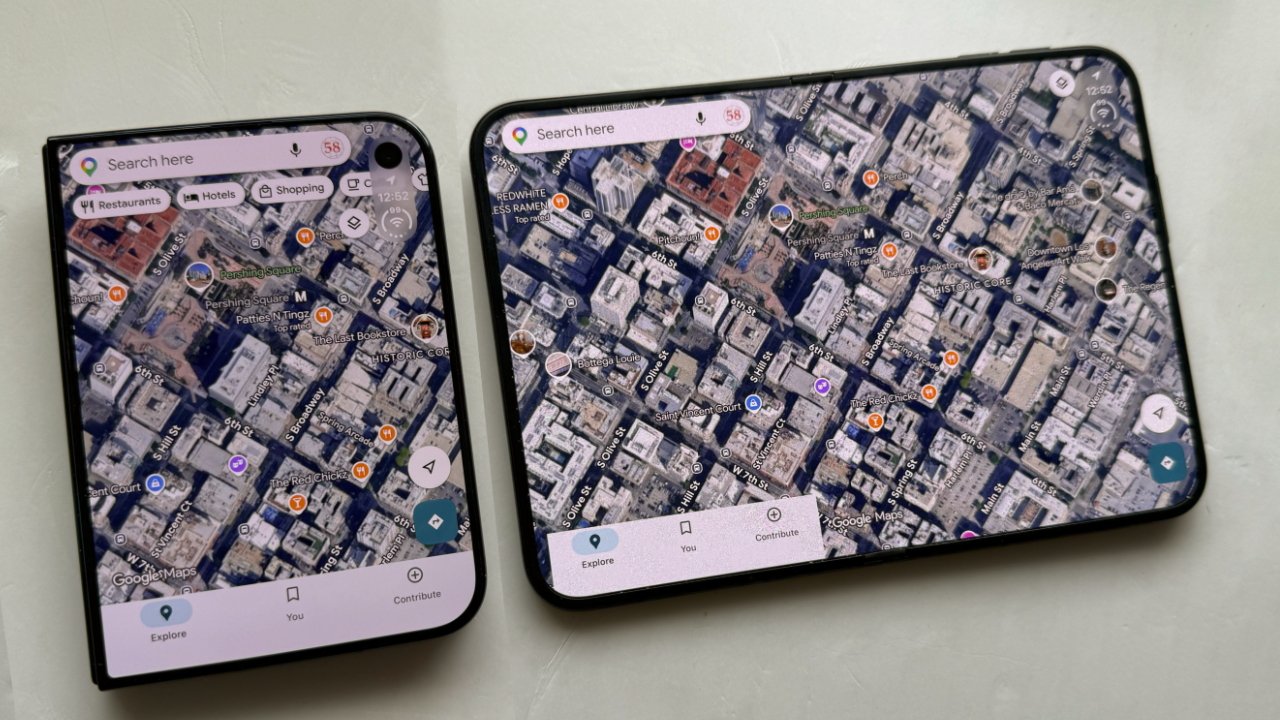
Google recently shipped version 26.44.4 of Google Maps for iPhone, and the build finally lets the app display on both screens of Apple's foldable iPhone Duo. The practical gain is layout, not capability: the outer panel is no longer pushed off-centre, and the inner panel now carries a landscape-first interface with the map stretching edge to edge. Street View still cannot fill the whole inner display.
Since iPhone Duo entered the market, the queue of developers reworking interfaces for the book-style hinge has grown week by week. Google Maps is the latest mainstream app to close the gap, and it did so quietly — the App Store release note for the new build mentions only "Bug fixes", as coverage by MacRumors and AppleInsider on 4 November 2026 pointed out. For Asia-Pacific readers who judge platform readiness, the more interesting signal is the distance between "display-adapted" and "feature-complete".
What actually changes on each screen?
Conclusion first: 26.44.4 converts Google Maps from a scaled-up phone window into a tablet-like app. The control layer moves to a left rail, and the map claims the remaining width.
| Display or mode | Before 26.44.4 | After 26.44.4 |
|---|---|---|
| Outer display | Interface offset slightly to the left to leave room for the bottom Dock bar of the new iOS | Filling, better-aligned layout; a modest but visible improvement |
| Inner display (open) | Basically the traditional iPhone interface inside a window that could slide sideways, with most of the panel idle | Menu and search box docked on the left, map or satellite imagery running from edge to edge — an experience much closer to the iPad version of Google Maps |
| Street View | Not designed for the widened canvas | Panorama placed on the left half, full map view on the right half, so position and surroundings are visible at once |
| Closing the device in Street View | n/a | The panorama moves automatically to the outer display and keeps playing; the on-screen close button returns the user to the normal map |
Two limitations survive the update. Users cannot swap the Street View and map panes left for right, and there is still no counterpart to "Look Around" in Apple Maps, which expands the panorama across the entire inner screen for immersive viewing.
Why a layout fix now and features later?
The sparse release note is the tell. Google Maps has a long habit of disguising substantive interface work as routine maintenance, and the absence of any Duo wording in the App Store description suggests a staged rollout rather than a coordinated product launch.
APACTechBriefing analysis (not a statement by Google) sees three drivers behind the sequencing:
- Platform pressure. Apple's adaptation track for the device makes a baseline dual-display build close to mandatory for large apps; relaying out existing screens is the fastest way to clear that bar.
- Engineering order. Layout work ships in weeks; a genuine dual-pane product surface — swappable panes, immersive Street View, navigation split across both halves — requires new state management and testing across hinge poses.
- Competitive sequencing. With map apps in mainland China already demonstrating split-screen navigation, Google's move reads as catch-up on display parity before differentiation on features.
How quickly can the rest of the iOS ecosystem catch up?
Conclusion: the tooling is already in place; the bottleneck is design effort, not developer access. The evidence sits in the platform's own documentation and release cadence.
- Apple's human interface guidance for the device states that apps designed for iPhone Duo should adapt seamlessly to the two displays and stay continuous as the device opens and closes, and notes that each display carries its own front camera (Apple Developer, "Designing for iPhone Duo").
- Hardware maths explain the letterboxing problem: reporting on the device describes a 5.4-inch outer panel and a 7.6-inch inner panel built to the same aspect ratio, so apps that do not opt into the wider canvas simply sit in a phone-shaped window.
- Toolchain: the first Xcode 27.1 beta, released on 18 September 2026, added an iPhone Duo device type and pose simulation; iPhone Duo itself runs iOS 27.1, per coverage on 19 September 2026.
- Compatibility tiers: apps built with the iOS 26 SDK or earlier run in a legacy mode with visible borders; builds against the 27.0 SDK reclaim part of the panel; only builds against iOS 27.1 fill the inner screen.
- Deadline pressure: Chinese tech media reported on 7 October 2026 that Apple opened Duo adaptation submissions on 6 October and will require iPhone Duo screenshots for new or updated app submissions from April 2027.
Evaluation caveat: an adaptation badge on an App Store product page records a rebuild against the current SDK, not a redesigned interface. Treat it as the floor of quality, not the ceiling — which is exactly the gap the pre-26.44.4 version of Google Maps illustrated.
What does the map-app race say about Asia-Pacific markets?
The region is not moving in lockstep. On 22 October 2026, Amap announced full adaptation to iPhone Duo and previewed what it described as the world-first split-screen navigation for a foldable iPhone: lane-level guidance on the left, wider route overview and traffic conditions on the right, with the interface re-laying out automatically as users switch between the inner and outer screens or change orientation. Coverage of the announcement also noted map content running alongside other apps.
Google's first step on the same hardware is narrower — both displays usable, one map surface. The two approaches mirror their home markets: China's super-apps treat the wider canvas as a multitasking surface, while Google optimises the primary task before adding a second one.
Demand context. IDC forecast in December 2025 that the worldwide foldable smartphone market would grow roughly 30% year on year in 2026, attributing the acceleration to the arrival of the first Apple foldable. The region's largest foldable market cooled before that arrival: IDC's quarterly tracker, reported on 27 October 2026, put mainland China foldable shipments at 1.77 million units in the third quarter of 2026, down 32.7% year on year and a fourth consecutive quarterly decline, with Huawei holding more than 70% share and Samsung 8.9%; IDC expected a return to growth from the December quarter as Apple enters the category.
What should APAC product, IT and strategy teams do now?
- Audit build targets. List which of your iOS apps are compiled against the current SDK; anything older is running in compatibility mode on the inner panel and will show borders in screenshots, demos and app review.
- Test three poses, not two. Cover outer-screen use, open flat layout and half-folded postures in the simulator, then re-test on a real hinge — Street View handoff to the outer display on Google Maps shows that state transfer between panels is where bugs live.
- Move controls to a rail. The left-docked menu and search pattern is what makes the 26.44.4 layout legible; hard-coded screen dimensions and bottom-anchored tab bars are the first things to retire.
- Benchmark against split navigation. Mobility, logistics, ride-hailing and field-service teams should treat dual-pane guidance as the emerging reference pattern for the device, not merely a China feature.
- Don't trust release notes. Verify interface changes on device; a "Bug fixes" line can hide a substantive rebuild.
- Reserve one QA cycle before April 2027. Screenshot and submission requirements land on the update cycle, so budget the adaptation work into the first half of 2027 rather than the deadline quarter.
Frequently asked questions
Do I need to update to see the dual-display layout?
Yes. The fullscreen behaviour on both screens arrives with Google Maps for iPhone 26.44.4, available as a free download on the App Store, where Google's description still reads only "Bug fixes".
Does anything change for ordinary iPhone users?
Nothing has been announced for single-screen devices. The visible differences are on the foldable: a tidier outer-screen layout and a wider, iPad-like map view when the device is open.
Can Street View take over the whole inner screen?
No. In the current version the panorama occupies the left half while the map fills the right, and the two cannot be swapped. Apple Maps remains the reference for an immersive, full-panel panorama through its Look Around feature.
Is this the end of iPhone Duo adaptation for Google Maps?
Unlikely. Display parity is the easier half; pane control, immersive viewing and navigation-specific dual-screen modes are the parts that still separate it from the most advanced map apps in Asia-Pacific.
Google Maps crossing over to both displays matters less for the map itself than for what it reveals: in the first weeks after a new device form factor reaches the market, the gap between apps that merely run and apps that are redesigned becomes the sharpest competitive variable in Asia-Pacific. Track adaptation status, not download counts — that is where the foldable battle is being decided.
Sources
- Apple Developer — Human Interface Guidelines: Designing for iPhone Duo
- MacRumors — Google Maps Updated to Fully Support iPhone Duo Displays (4 November 2026)
- AppleInsider — What Google Maps looks like on both iPhone Duo displays (4 November 2026)
- IDC — Worldwide Foldable Smartphone Market to Grow 30% YoY in 2026, Boosted by the First Apple Foldable iPhone (9 December 2025)
- Beijing Daily — IDC China smartphone and foldable quarterly tracker, Q3 2026 (27 October 2026)
- Economic Observer — Amap adapts to iPhone Duo with split-screen navigation (22 October 2026)
- Sina Finance — Xcode 27.1 beta adds iPhone Duo simulator support (19 September 2026)