
iPhone Duo Mainland vs U.S. Specs: Compliance Limits, Not Cost Cutting, Shape the Debate
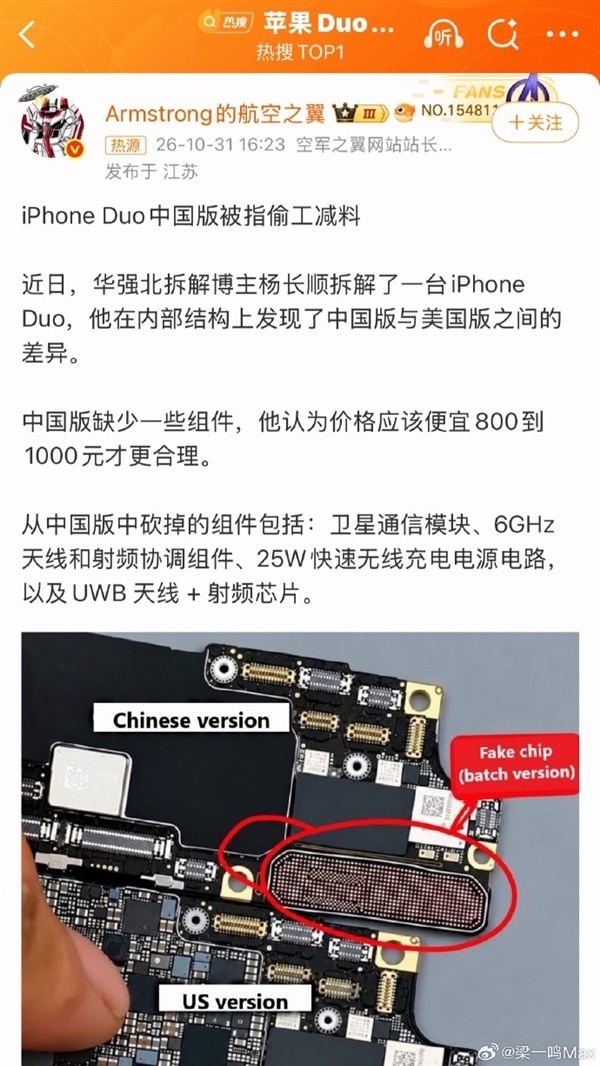
Recently, a teardown video published by Huaqiangbei-based creator Yang Changshun reopened the discussion over the Chinese mainland and U.S. versions of Apple's iPhone Duo. For APAC technology managers, the more useful question is not simply whether a missing shielded part exists, but why feature availability is market-dependent. As reported by Jiemian News, Apple-related technical personnel said they currently cannot directly verify the third-party teardown claims. They added that parts procurement and manufacturing stages may produce individual market-specific differences, while no detailed component-difference list has been released. That response keeps the factual anchor narrow: regulation and certification shape the public spec sheet, and the 800 to 1,000 yuan gap is a user-side estimate rather than a verified cost-down.
Previously, early online posts described the Chinese mainland model as lacking satellite communication, a 6GHz Wi-Fi antenna, a 25W wireless-charging circuit and associated radio components. Some users interpreted the list as hardware deletion and concluded that domestic buyers should have received a thousand-yuan price reduction. The official specification trail complicates that arithmetic. The Apple China official website already contradicts the most circulated UWB removal claim: the Chinese mainland iPhone Duo is listed with a second-generation ultra-wideband chip, and Apple official website regional feature pages can be used to confirm that the ranging and spatial-awareness function family is not the disputed item. The core difference is therefore between "disabled service or noncompliant frequency band" and "removed hardware."
Key facts to carry into the briefing
- Unverified teardown list: the claim of a missing satellite communication module, 6GHz Wi-Fi antenna, 25W wireless-charging circuit and related RF components comes from a third-party disassembly video, not an Apple parts manifest.
- Already disproved UWB claim: the "Chinese mainland model cut UWB" narrative does not match Apple China official website specifications, which identify a second-generation ultra-wideband chip in the domestic device.
- Netizen price math: the 800 to 1,000 yuan estimate reflects a rough BOM-style reaction to visible feature gaps; it should not be treated as official evidence of a thousand-yuan reduction.
- Regulatory explanation: satellite messaging, 6GHz Wi-Fi and high-power wireless charging are all subject to market-specific radio, telecom and equipment certification rules.
- APAC lesson: flagship smartphone specs are now regional compliance documents, not universal feature guarantees.
Specification comparison
| Specification | Chinese mainland model | U.S. model | Editorial interpretation |
|---|---|---|---|
| Ultra-wideband | Listed with a second-generation ultra-wideband chip | Same functional category | Apple China official website specs refute the claim that UWB was removed. |
| Satellite SOS | Teardown interpretation says hardware is present but service is not enabled | Can provide emergency messaging and location sharing where supported | Domestic communication licensing and service rules may keep the feature unavailable. |
| Wi-Fi 7 | 2.4GHz and 5GHz bands open; 6GHz not available | 6GHz can be used in supported market settings | Spectrum allocation, not a confirmed antenna deletion, explains lower tested throughput. |
| MagSafe | Up to 15W | Up to 25W | Wireless-charging frequency and power compliance can cap the public charging rate. |
| Cost debate | Users estimate an 800 to 1,000 yuan component gap | Used as comparison baseline | The price inference is unverified because feature restrictions may be regulatory rather than economic. |
Why 6GHz and 25W become compliance questions
6GHz Wi-Fi is the clearest example of regional spectrum policy becoming a consumer-visible feature. Wi-Fi 7 gains much of its headline throughput from wider channels and multi-link operation, and 6GHz is often the band that enables the fullest implementation. The Wi-Fi Alliance regulatory tracker shows that 6GHz Wi-Fi enablement is market by market. In domestic Chinese radio-frequency policy, reporting from IEEE Spectrum and other technology sources indicates that the upper portion of 6GHz is directed toward cellular IMT use, so domestic devices open 2.4GHz and 5GHz but not 6GHz. That means the measured wireless transfer speed of the mainland model can be lower than the U.S. model even when the antenna architecture has not been intentionally stripped as a cost cut.
The wireless charging gap is similar. The public specification difference is clear: the Chinese mainland version lists MagSafe at up to 15W, while the U.S. version supports up to 25W. South China Morning Post has reported that China's newer radio-frequency rules can block the sale of some wireless-charger categories, including certain Apple charging products, and 36Kr's English coverage has linked the absence of 25W wireless charging to frequency allocation issues. Those external data points do not replace Apple's official numbers, but they strengthen a practical reading: the charging gap is best interpreted as a regulatory ceiling imposed on market-specific certification, not as proof that Apple intentionally reduced hardware for domestic consumers.
Impact on APAC digital operations
For buyers in APAC, the iPhone Duo debate is a reminder that flagship devices are increasingly sold as regionally constrained platforms. A corporate procurement team cannot treat "Wi-Fi 7" or "satellite SOS" as uniform capabilities across markets. In high-density offices, factories, logistics centers and remote support environments, the relevant question is whether the device can meet local network, safety and warranty requirements. If the mainland model is used in a network that does not permit 6GHz operation, the lower speed is a policy boundary, not a defective unit. If a field team depends on satellite SOS, the capability must be validated by country and carrier availability before rollout. Device standardization therefore has to be built around compliance matrices, not model names.
Action list for buyers and reviewers
- Check Apple China official website and Apple official website regional specification pages before publishing any feature-difference chart.
- Treat teardown videos as engineering observations, not procurement evidence; missing components may be unenabled, certified differently or regionally locked.
- For enterprise fleets, compare supported bands, charging certifications, cellular service restrictions and warranty coverage instead of relying on social-media cost-gap estimates.
- For consumer buyers, do not assume a U.S. device will provide a better domestic experience; imported hardware may face network, warranty and regulatory constraints.
- For APAC market analysts, map each "cut feature" to its regulatory layer: spectrum allocation, telecom service licensing, charging frequency rules or local data and safety requirements.
Bottom line
The most defensible interpretation of the iPhone Duo controversy is that the visible Chinese mainland and U.S. feature gap is mostly a compliance artifact, not a confirmed thousand-yuan discount on hidden hardware. Apple's current public position is that third-party claims cannot be verified and detailed component differences have not been disclosed. In the absence of that disclosure, the safe editorial conclusion is practical: the second-generation UWB listing, domestic 2.4GHz and 5GHz Wi-Fi 7 operation, capped MagSafe power and disabled satellite service all point to a market-specific product profile. For APAC readers, that profile should be evaluated by use case, network environment and legal constraints, not by simplified cost-cutting narratives.