
Asia Tech Briefing: Kioxia's Flat December Guide Splits the Memory Trade
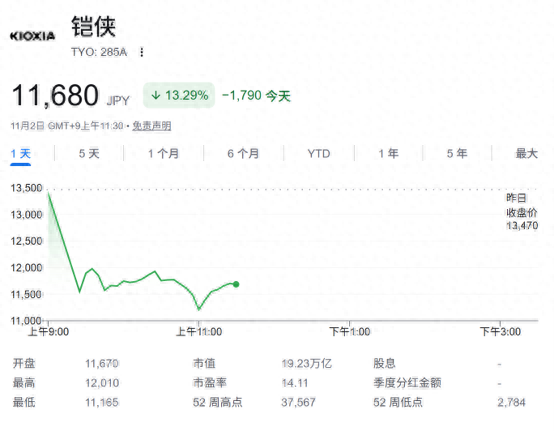
Nothing in the results Kioxia published last Friday was weak. The quarter through the end of September was the largest revenue period in the company's history, and management still says next year's output is spoken for. Monday's damage came entirely from the forward line: a December-quarter profit guide that landed short of what analysts had modelled. For APAC decision-makers the lesson is not about one stock, but about how fast pricing momentum in AI-era storage can decelerate while underlying demand is still intact.
Six facts that anchor the story
- Second fiscal quarter of FY2026, the quarter ended at the end of September: revenue of 2.48 trillion yen, up 453.20% year on year; adjusted operating profit up 2181.10% year on year.
- That single quarter out-earned the entire previous fiscal year, which produced about 2.34 trillion yen of revenue.
- December quarter guidance: operating profit of 2 trillion yen, roughly US$12.7 billion, versus a consensus estimate of 2.35 trillion yen.
- Measured against the 1.99 trillion yen of operating profit logged in the September quarter, the implied sequential growth is almost nil.
- NAND average selling price trajectory: gains of about 70% quarter on quarter in the second quarter of 2026, narrowing to about 20% by the third quarter.
- Regional contagion proved temporary — Samsung Electronics and SK hynix both erased their morning losses.
Print versus guide: where the gap opened
| Reference point | Figure | Why it mattered on Monday |
|---|---|---|
| Revenue, quarter ended September (second fiscal quarter of FY2026) | 2.48 trillion yen, up 453.20% year on year | Record performance, yet not the driver of the sell-off |
| Adjusted operating profit, same quarter | up 2181.10% year on year | Confirms the AI storage cycle is still generating cash |
| Benchmark: previous fiscal year in full | about 2.34 trillion yen of revenue | Now exceeded by one quarter, raising the bar for what counts as growth |
| Operating profit booked in the September quarter | 1.99 trillion yen | The base the new guide failed to lift meaningfully |
| December quarter operating profit guide | 2 trillion yen (about US$12.7 billion) | Below the 2.35 trillion yen consensus — the trigger for the drop |
Management's defence: shipment calendar, not demand
Over the past several quarters Kioxia's operating profit climbed in an almost unbroken line, which is precisely why a flat guide read as a break in trend. The company's explanation is timing. At the request of customers, some orders originally scheduled for delivery in the current quarter were pulled forward into the September quarter. Other orders slid into the March quarter of the following year, because enterprise storage products carry a longer production lead time as their share of the mix rises.
CFO Yoshihiko Kawamura told analysts on a call last week that demand from AI data centre operators remains robust and that the company expects to be back on a steep growth path in the March quarter next year. His capacity datapoints were blunt: next year's planned output is already sold out, and more than half of the capacity for the year after next has been allocated, with some large customers already opening negotiations on contracts for 2029 and beyond. It was the same narrative that, in June this year, briefly made Kioxia the most valuable listed company in Japan.
The real signal is the slope of price, not the level
Investor unease has two layers. The first is tone: once executives begin framing the outlook cautiously, the growth story they have been selling gets repriced. The second is structural. Kioxia is exposed almost purely to NAND, while competitors in South Korea also sell DRAM — the other critical component in AI compute builds — and their two-pronged product set leaves them with stronger bargaining power across a customer's total memory bill.
The pricing data make the point cleanly. In the second quarter of 2026, Kioxia's NAND average selling prices rose about 70% quarter on quarter. By the third quarter the increase had collapsed to about 20%. Memory equities are usually priced off the rate of change in price rather than the absolute level, so a decelerating curve is read as a possible inflection in the up-cycle even before volumes disappoint. Third-party supply-chain research adds a counterweight rather than a contradiction: analysts at TrendForce have projected NAND flash contract prices to rise about 15% to 20% quarter on quarter in the fourth quarter of 2026, with AI server demand sustaining enterprise SSD orders while consumer-side demand lags. The market is still rising, but more slowly — a condition in which guidance risk becomes asymmetric.
Regional read-across and the leverage overlay
The scare did not travel. In Monday's early session Samsung Electronics dropped more than 3% and SK hynix fell more than 1%, but both reversed into positive territory; as of publication Samsung was up 0.44% and hynix up 2.75%, evidence that the market treated the move as name-specific rather than sector-wide.
What amplified the drop was shareholder plumbing rather than fundamentals. Kioxia carries the highest concentration of leveraged long positions of any company listed on the Tokyo Stock Exchange. When a negative catalyst lands, margin-funded holders can be forced to sell regardless of their view on the business — turning a guidance miss into a disorderly tape.
Action lines for APAC technology and procurement teams
- Re-date your delivery assumptions. If the supplier's own story is pulled-forward and pushed-back shipments, treat the March quarter next year as the true test of the cycle rather than the December quarter guide.
- Track quarter-on-quarter ASP slope, not price level. A second consecutive step-down in NAND pricing momentum is the earliest warning that enterprise SSD negotiations have swung back to buyers.
- Convert capacity certainty into contract terms. With next year's planned output sold out and more than half of the year after next's capacity already allocated, long-dated agreements are where buyers should push for priority, index-linked pricing and flexible ship windows.
- Diversify by component, not just by vendor. Suppliers in South Korea and elsewhere with both DRAM and NAND exposure bring more leverage to AI infrastructure negotiations; balance single-product specialists accordingly.
- Expect volatility that has nothing to do with your roadmap. Crowded leveraged positioning in Japanese memory names means news-flow can move procurement and budget conversations faster than fundamentals do.
- Watch the peer tape for confirmation. When Samsung Electronics and SK hynix recover within the same session, read it as idiosyncratic de-rating, not a demand shock across APAC storage.
Bottom line
Monday's sell-off was an argument about valuation versus momentum, not about demand. The AI storage cycle that lifted Kioxia to the top of Japan's market-cap ranking in June this year is still intact on the order book; what has changed is the pace at which pricing and shipping schedules convert into reported profit. For Asia-Pacific technology buyers and portfolio strategists, the actionable takeaway is simple: the next two earnings updates from memory suppliers will be judged on the rate of price change, and on whether backlog timing shifts resolve cleanly into the March quarter, rather than on headline revenue records.