
APACTechDigit | APACTechBriefing Q&A: Is China's 8-Meter Qingqi Solar Drone Worth Deploying for APAC Inspection?
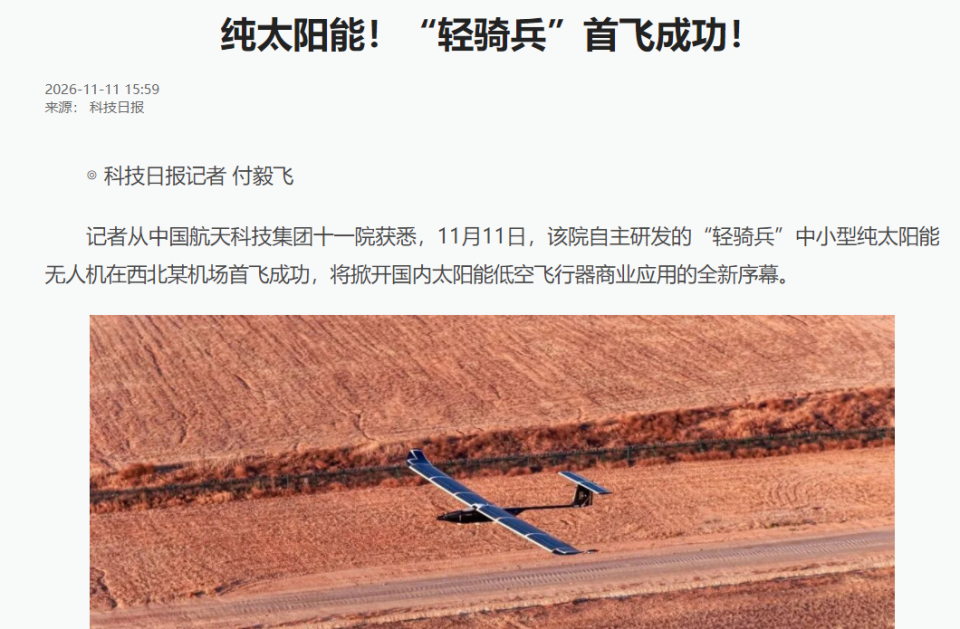
Short answer: Yes—for linear, daylight-heavy jobs such as pipelines, dykes and forest-fire watch, the 8-meter Qingqi solar drone is worth deploying where a 30-hour endurance window and a 7,000-meter ceiling match the mission. Built by China Aerospace Science and Technology Corporation's 11th Academy, it trades near-space record-chasing for a pickup-transportable tool. For cost-sensitive APAC field teams, the real test is not whether it can fly but whether it is worth using, and the answer hinges on mission fit and local rules.
That distinction matters because the global solar-powered UAV market was estimated near US$1.2 billion in 2025 and is projected to reach US$2.2 billion by 2032, according to a recent industry forecast. Spending is shifting from high-altitude science toward the practical watching of infrastructure—a trend directly relevant to APAC Market buyers.
What is the Qingqi, and why does an 8-meter wingspan matter?
Conclusion: The Qingqi ('Light Cavalry') is a commercial-grade small-to-medium pure solar UAV whose modest size is deliberate. The 11th Academy of China Aerospace Science and Technology Corporation—the same 11th Academy behind the Caihong ('Rainbow') series—flew it on 11 November 2026 at an airport in northwest China. It spans 8 meters, measures 3.2 meters long, weighs 45 kilograms at take-off, offers 30 hours of maximum design endurance and reaches 7,000 meters.
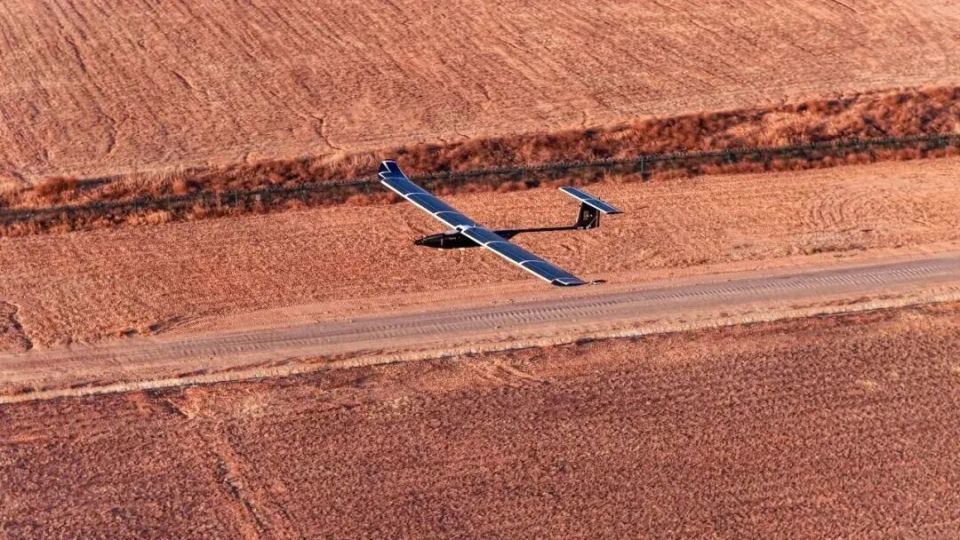
Its wings carry domestic flexible thin-film photovoltaic cells, the fuselage holds a lightweight storage battery, and carbon-fiber composites withstand catapult launch. Per Xinhua, a modular design lets operators swap in communications-relay or remote-sensing payloads, including sensing work such as solar-asset monitoring. Setup from parking to launch takes 20 minutes; crews report about twenty minutes of ground preparation and no dedicated runway.
Why did the big solar drones keep failing?
Conclusion: The largest programs hit a structural wall: more solar cells meant bigger wings, bigger wings became fragile, and fragility killed the operational case. U.S. NASA's Helios had a wingspan wider than a Boeing 747 yet shattered in low-altitude turbulence. Google and Meta each poured hundreds of millions of dollars into solar flight; one aircraft's wing snapped after four minutes aloft, another lost its right wing in a light breeze on landing, and both programs were eventually cut.
Airbus's Zephyr still holds the record at 25 meters of wingspan, 67 days of flight and a ceiling above 20,000 meters; the UK's BAE PHASA-35 stretches to 35 meters on a near-space experimental path. Impressive, but far from a ground crew's needs—you cannot task a pipeline patrol with an asset needing a dozens-strong support team and a long runway. The 11th Academy had already flown a 45-meter solar UAV above 20,000 meters in 2017. Knowing where that road ends—strong parameters, awkward field reality—is why it cut the wing to 8 meters and the weight to 45 kilograms.
How does it escape the battery 'dead loop'?
Conclusion: It does not solve battery energy density; it designs around it. Daytime power falls short at night, more storage adds weight, weight demands a larger wing, and larger wings turn fragile and costly. Research in MDPI's Energies confirms an energy buffer is essential when solar input drops at night or under cloud. The Qingqi changes the question: it does not chase two months of loiter or a 20,000-meter ceiling. Thirty hours covers one full day-night cycle, and 7,000 meters lets an electro-optical gimbal resolve vehicle shapes while field staff link up on lightweight radio.
Is China's solar-drone ecosystem a real advantage?
Conclusion: It is industrial, not a single breakthrough. Northwestern Polytechnical University's Zhou Zhou and the Meiying ('Phantom') team set a national low-altitude civil solar record of 27.6 hours back in 2019. Zhu Shengli, technical lead for the Qimingxing-50 at AVIC's First Aircraft Institute, pursues the high-altitude, long-endurance path. Parallel routes mean China is weaving a technology net across need levels rather than betting on one point.
On cost, the supply chain is decisive. Bespoke aerospace-grade parts made Western solar aircraft unaffordable; China's full photovoltaic, lithium-battery, carbon-fiber and UAV chains, hardened in mass civilian markets, deliver a price benchmark imported systems cannot match. Field economics agree: industry estimates put drone linear inspection at roughly US$200–300 per mile versus over US$1,200 for helicopters, with 30–40% operating-cost savings. A pickup, one aircraft, twenty minutes of setup and thirty hours of watch push the cost into a single crew's班组能够承受的区间。
What are the APAC deployment risks and compliance points?
Conclusion: The limits are knowable but must be priced in. Endurance is daylight-dependent—monsoon cloud and high-latitude winter shrink the window, and storage sets the night-time floor. At 45 kilograms the airframe sits below many heavy-payload thresholds, yet each market applies its own beyond-visual-line-of-sight, airspace and Localization rules. Imagery collected near borders or critical infrastructure can trigger Cross-border Data Compliance duties that differ by jurisdiction. Treat 30 hours as a design ceiling, not a promised mission profile.
Decision checklist: a 30-day path
- Map linear, daylight-rich missions—pipelines, dykes, coastlines, fire watch—where 30 hours and 7,000 meters add value.
- Benchmark US$200–300 per mile against your current helicopter or ground-crew spend before committing.
- Confirm payload options and Localization of ground-control data storage in each target market.
- Run one 20-minute deployment drill covering pickup transport, catapult launch and field radio links.
FAQ: quick answers
Prototype or product? Positioned as commercial-grade with modular payloads and a first flight on 11 November 2026; treat early units as pilots.
Replace a helicopter? For sub-45-kilogram, linear tasks the cost data favors drones; for heavy lift or crewed response, no.
Does 30 hours mean 30 hours of usable data? Only with adequate sunlight and storage—plan one day-night cycle, not two months.
Night or monsoon cloud? Expect shorter windows; an energy buffer constrains flight when solar input falls.
Bottom line
The Qingqi's value is a category shift: it moves solar UAVs from 'whether it can fly' into 'whether it is worth using.' For APAC operators, the choice turns on mission fit and compliance, not wingspan. As spending heads toward US$2.2 billion by 2032, platforms one crew can truck to a site and fly through a full day-night cycle will set the practical edge of low-altitude work. Watch how the 11th Academy prices and localizes the platform for overseas buyers—that decides whether the cost edge travels beyond its home market.
Author: Nathan Hale, enterprise technology analyst and technology news writer, APACTechDigit.
References
- Xinhua, 'China's first commercial small/medium pure solar UAV completes first flight,' 12 Nov 2026 — https://www.news.cn/tech/20261112/77c685a298064a24b2003512577564f2/c.html
- GlobeNewswire, 'Global solar-powered UAV market forecast to reach US$2.2 billion by 2032,' 28 Oct 2026 — https://www.globenewswire.com/news-release/2026/10/28/3390433/28124/en/global-solar-powered-uavs-market-forecast-to-reach-2-2-billion-by-2032-airbus-aerovironment-bae-systems-lockheed-martin-and-skydweller-dominate.html
- Phoenix Drone Pros, 'Drone vs Manned Aircraft for Pipeline Inspection,' 4 Nov 2026 — https://blog.phoenixdronepros.com/drone-vs-manned-aircraft-pipeline-inspection
- MDPI Energies, 'Flight Capability Analysis Among Different Latitudes for Solar UAVs,' 2025 — https://www.mdpi.com/1996-1073/18/6/1331