
Logitech's Two Dog-Ad Offenses in Half a Year: An APAC Briefing on Marketing-Governance Risk
APACTechBriefing — treat this as a controls failure rather than a copywriting accident. Recently, a promotional clip for the GPW4 gaming mouse, published on Douyin by the official account of the Logitech G audio-visual flagship store, opened with a cartoon dog waving away a discount — "Not interested, thanks." The same dog then lit up in front of an offer priced 40 percent off after coupon, a ticket starting with the digit 3, under the caption "You really know how to read people!"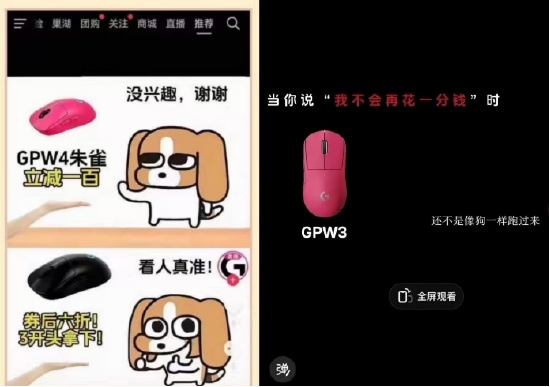
Within hours, the hashtags "Logitech is picking a fight with its users" and "Logitech ad again accused of insulting users" were trending, and the comments were blunt: "Is their promotion ever going to get over the dog?" and "Their whole strategy assumes male users are dogs who come running the moment there is a discount." On November 2 the brand's flagship stores were still livestreaming on social platforms, while the clip had already been pulled from the Logitech G audio-visual flagship store Douyin account. Under another product video on that same account, one shopper wrote: "After-coupon price? Only a dog would buy that."
The store answered with a line that has now been heard twice in one year: "We have already launched an investigation. Thank you for your oversight and understanding. Logitech China always respects every player."
Fast briefing: the six facts that carry decision value
- Repeat pattern: two offenses inside half a year, and the second time the GPW series is involved. Both campaigns built the punchline on price cuts plus "dog" imagery.
- Regulatory history: the March campaign ended in a fine of RMB 200,000 imposed by the Shanghai Jing'an District Administration for Market Regulation on the operating agency, Shanghai Baishide Electronics Co., Ltd.
- Second legal front: the dog itself belongs to somebody else. The unlicensed sticker IP is now being pursued by its rights holder in Xiamen.
- Time gap: the new clip went online just over seven months after the first scandal broke.
- Financial backdrop: revenue and profit grew in the first half of fiscal 2027, but operating cash flow fell about 6.6 percent year on year, and a supplier accident is expected to cost USD 70 to 80 million in the third fiscal quarter.
- Structural cause: both ads ran on brand-name "authorized accounts" operated by external sales agencies, which is why the same mistake could reappear under a different operator.
Case file: two campaigns, one script
| Dimension | March this year | Late October this year |
|---|---|---|
| Account | Logitech G official flagship store, on Douyin | Logitech G audio-visual flagship store official account, on Douyin |
| Product | GPW3 mouse | GPW4 mouse |
| Creative | Subtitle reads "When you say 'I won't spend another cent'", then shows a red mouse with the line "Really, the moment I cut the price, you came running like a dog." | Cartoon dog refuses an instant cut of RMB 100, then reacts to a 40 percent after-coupon price beginning with 3: "You really know how to read people!" |
| Brand response | Apology issued that same evening, blame placed on an employee who skipped review | Investigation announced; clip removed; hashtags trended on November 2 |
| Formal outcome | Fine of RMB 200,000 in July this year | Copyright claim from the IP owner, plus renewed public backlash |
The March case is on the record in detail. On March 26 this year, a GPW3 promo video published on the Douyin account "Logitech G official flagship store" began with the subtitle "When you say 'I won't spend another cent'", showed a red mouse, and closed with the line "Really, the moment I cut the price, you came running like a dog." Facing a wave of complaints, Logitech China apologised that same evening, stating: "For the extremely inappropriate content published by the Logitech G official flagship store, Logitech China feels genuinely shocked and pained. We fully understand and share every player's disappointment and anger, and we offer our most sincere apology to all users."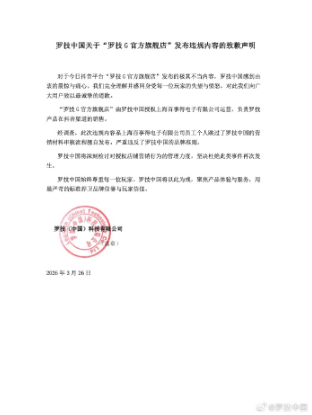
On causation, Logitech China said its investigation found the content was posted personally by an employee of Shanghai Baishide Electronics Co., Ltd., skipping Logitech China's marketing-material review process and seriously breaching brand rules, and promised a thorough self-examination of how authorised stores are managed. At the time, Logitech China had authorised Baishide Electronics to run the Logitech G official flagship store and handle sales of Logitech products on the Douyin channel.
The BUG column found that Baishide Electronics is a micro-enterprise founded in 2001 whose business is wholesale, with two natural persons as its only shareholders. The Shanghai Jing'an District Administration for Market Regulation fined the company RMB 200,000 in July this year. Just over seven months later, Logitech made the same mistake in the same place, and whether this second round is again a supplier's fault remains unclear.
Why the repeat stings: shoppers draw the line at being defined
Public anger is less about discount mechanics than about who gets to frame the buyer. "It is fine when I call myself greedy about bargains; it is not fine when Logitech says it," one consumer told the BUG column. "I pay for your product. You may learn my preferences, study my buying habits, even know the moment I am most vulnerable to price. But that knowledge does not give you the right to define me. I can say I am someone who cannot resist a good deal. You cannot master my psychology and then stand off to the side laughing at me." The same shopper offered a compact comparison: "A friend teasing me about buying another mouse and a mouse seller teasing me about taking the bait do not taste the same."
Root cause: the brand voice sits outside the brand
For Asia-Pacific digital and e-commerce teams, the instructive part is the account architecture rather than the slogan. Douyin's own merchant rulebook classifies an "authorised store account" as a separate legal entity's account that carries the brand's verified badge, requires corporate verification and a brand-authorisation letter, and must have no serious violation history — but it does not require the brand to pre-approve every edit. Reporting by Jiemian News, republished by China National Radio Online, says the store behind the November clip is linked to Hebei-registered Daiju (Hebei) Technology Co., Ltd., a distinct authorised-dealer operator whose Logitech authorisation runs to December 31, 2026, and is not the same firm as Shanghai Baishide. Sina Finance, citing business-registration data, adds that this operator was founded in 2021 with registered capital of RMB 3 million and a single individual shareholder.
Chinese media reading of the earlier penalty documents reported that account login credentials and management rights were handed to the operating team as far back as March 2021. Put those facts together and the recurrence becomes predictable rather than paradoxical: one authorised operator patched its review flow, a different authorised operator ran the same creative template into the same wall. A brand whose promo content is produced by multiple agency-run storefronts, working from a shared discount script, has effectively outsourced its tone of voice without outsourcing accountability.
The other lawsuit nobody forecast: the dog is copyrighted
Alongside the insult controversy, Logitech has a second exposure. The dog used in the Logitech G audio-visual flagship store clip is "Beagle Duodong", a character from Siam Lipu, a Chinese original IP that started as a sticker pack in 2022 and later expanded into comics and short video.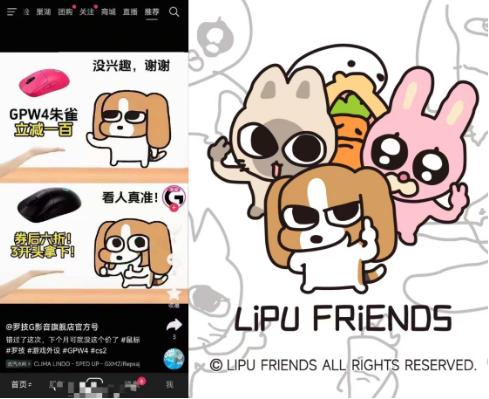
The BUG column reached the copyright holder, Xiamen Quzhengji Culture Media Co., Ltd., whose staff said the company never licensed Beagle Duodong to Logitech or its affiliated stores for sales videos and that its legal team is pursuing the matter. Attorney Liu Yabo of Beijing notes that the character is an artwork protected under Article 3, item 4 of the Copyright Law, and that editing and uploading it in a commerce video touches the reproduction right, the right of information-network dissemination and the right to preserve the integrity of the work, all of which require explicit permission under Article 10. Because the rights holder has confirmed no authorisation was given, the use may constitute infringement.
On who pays, Liu argues that such videos are typically produced by brand, studio and agency together, so unlicensed use can be treated as joint infringement carrying joint and several liability under Article 1168 of the Civil Code — with the brand's review authority over scripts and materials, any instruction to produce, participation in the campaign plan, and whether it captured the commercial benefit all weighing in favour of joint liability. Damages, he adds, follow Article 54 of the Copyright Law: actual loss or illegal gain, and where those are hard to compute, reference to a royalty rate.
That last clause matters more than it looks for risk sizing. This is not an obscure meme: IP-licensing materials and the encyclopedic entry for Siam Lipu put its WeChat sticker usage at over 900 million sends with downloads above 16 million, and Chinese media have documented large collaboration runs, including a 2025 beauty tie-up reported to have moved more than 900,000 units in two weeks. Where a character has visible market rates, the "reference royalty" path to damages stops being theoretical, and the agency model described above is exactly where those licensing checks get skipped.
Deterrence math: why a RMB 200,000 fine changed nothing
Read the enforcement outcome as a price signal. Under Article 57 of the Advertising Law, advertising that disturbs public order or offends good social custom draws an order to stop publishing plus a fine for the advertiser of not less than RMB 200,000 and not more than RMB 1,000,000, with licence revocation reserved for serious cases; the published penalty for the March video landed exactly on the statutory floor. Against the first-half figures below, RMB 200,000 is roughly one one-hundredth of one percent of net profit — a rounding error in the income statement, and a far smaller number than the reach the campaign bought.
Cost asymmetry explains repetition better than intent does. When the fine sits at the minimum, the operating agency keeps the traffic upside while the brand absorbs a reputational cost that its own reporting does not yet show. The unresolved question for Logitech China is whether this second incident triggers anything the first did not: a change of the operator relationship, contractual content-veto rights, or a genuine escalation clause. The BUG column's own framing — the same error again after only a little more than seven months — is the audit trail that regulators and rights holders will read next.
Financials: strong margins, one cash-flow wrinkle, and a supply warning
Logitech recently published results for the first half of fiscal 2027, covering April 1, 2026 to September 30, 2026:
| Metric | H1 fiscal 2027 | Change year on year |
|---|---|---|
| Revenue | USD 2.446 billion (about CNY 16.349 billion) | up 5 percent |
| Gross profit | USD 1.155 billion (about CNY 7.72 billion) | up 16.26 percent |
| Gross margin | 47.2 percent | expanded |
| Net profit attributable to shareholders | USD 416 million (about CNY 2.779 billion) | up 31.28 percent |
| Operating cash flow | USD 330 million (about CNY 2.207 billion) | down 6.6 percent — precisely 6.67 percent |
The same release carried a supply-chain warning: a factory accident at one semiconductor supplier is expected to reduce third-fiscal-quarter net sales by roughly USD 70 million to USD 80 million, an impact management expects to be largely cleared by the fourth fiscal quarter. Logitech's chief executive has publicly said AI infrastructure demand is crowding out chip capacity and that the company is seeking alternative suppliers. Market summaries of the quarter add that second-quarter net sales came in near USD 1.22 billion, up 3 percent in US dollars and 2 percent at constant currency — the eleventh consecutive quarter of growth — while a guidance range of USD 1.36 billion to USD 1.43 billion implies a swing of minus 4 percent to plus 1 percent in the holiday quarter.
Analyst view: category anxiety behind the edginess
Industry commentator Zhang Shule frames the episodes as a peripheral giant hunting for attention. "In the mobile-internet era, the frequency and duration of mouse usage have been greatly diluted. The gaming-mouse consumer circle is small, so even a heavyweight like Logitech, which covers the high, mid and low ends, struggles to reverse the downtrend. At the same time, the mouse is such a mature category that ordinary consumers can barely feel a difference in experience, which means quality problems get amplified further." In his reading, marketing outré enough to force its way into the mainstream conversation looks like Logitech China's chosen remedy for its own "mouse anxiety".
He adds that the November episode and the March one are almost identical in rhetoric: users cast as "dogs", and the pull of "price cuts" and "discounts" turned into a discriminatory joke about a dog nobody can interest. That, he argues, signals a brand's arrogance and prejudice towards Chinese consumers, and shows no deep reflection in public-opinion handling or crisis communication. A regional counterpoint worth noting for planning: third-party estimates still place Asia-Pacific at roughly a third of global gaming-peripheral demand, with the market projected to grow from about USD 7.79 billion in 2026 to USD 18.17 billion by 2034 — the category ceiling is not the binding constraint; permission to compete is.
Action list: what APAC marketing, product and IT leaders should do now
- Inventory every account that carries your brand but not your payroll. List flagship stores, authorised reseller accounts and agency-run short-video handles; record operating entity, authorisation expiry and who holds the login credentials.
- Make discount creative a controlled content class. Require dual sign-off for any promotion that implies a buyer's motivation, plus a written pre-publication review right in the agency contract, with retained review logs as evidence.
- Prove image provenance before publishing. Stickers, meme characters and stock mascots need a written licence naming the scope — reproduction, information-network dissemination and adaptation — with the licence file attached to the campaign record. Check expiry dates, not merely the existence of an authorisation.
- Price non-compliance above the statutory floor. Insert escalation and termination triggers for repeat breaches so a minimum fine cannot be absorbed as a cost of doing business by the operator.
- Pre-agree one crisis voice. Divergent answers from brand and storefront are what turned a takedown into a two-day news cycle; a single holding statement should be drafted before any campaign goes live.
- Watch marketing incidents and supply risk together. With chip capacity tight and guidance implying a possible decline in the third fiscal quarter, brand-safety noise is a poor companion to channel uncertainty — track both on one dashboard.
Trend call
The read-through for Asia-Pacific is uncomfortable but useful. Short-video commerce has moved brand voice out of headquarters and into agency content factories optimised for reach; where governance amounts to an apology letter and a performance deduction, a minimum-sentence fine functions as a licence plate rather than a brake. Expect three developments next: rights holders monetising unlicensed meme characters faster than regulators open cases; platforms tightening the distinction between brand-run and authorised accounts; and, in mature hardware categories where product differentiation is thin, brand permission becoming the actual moat. Logitech's own numbers show reputational damage that has not yet reached the income statement. Its next campaign will decide whether it ever does.