
Logitech's Second "Dog Meme" Promo in China: Governance Lessons for APAC Brand Teams
For brand and digital-commerce teams across Asia-Pacific, the Logitech China saga has moved past the question of taste. What it now exposes is a question of control: how many storefront accounts a single global brand authorises, what each of them can publish without approval, and what a regulator is willing to fine when the joke lands on the wrong side of the counter. The latest chapter arrived this week in the form of a discount meme — again featuring a dog.
The clip at issue: a two-frame discount joke
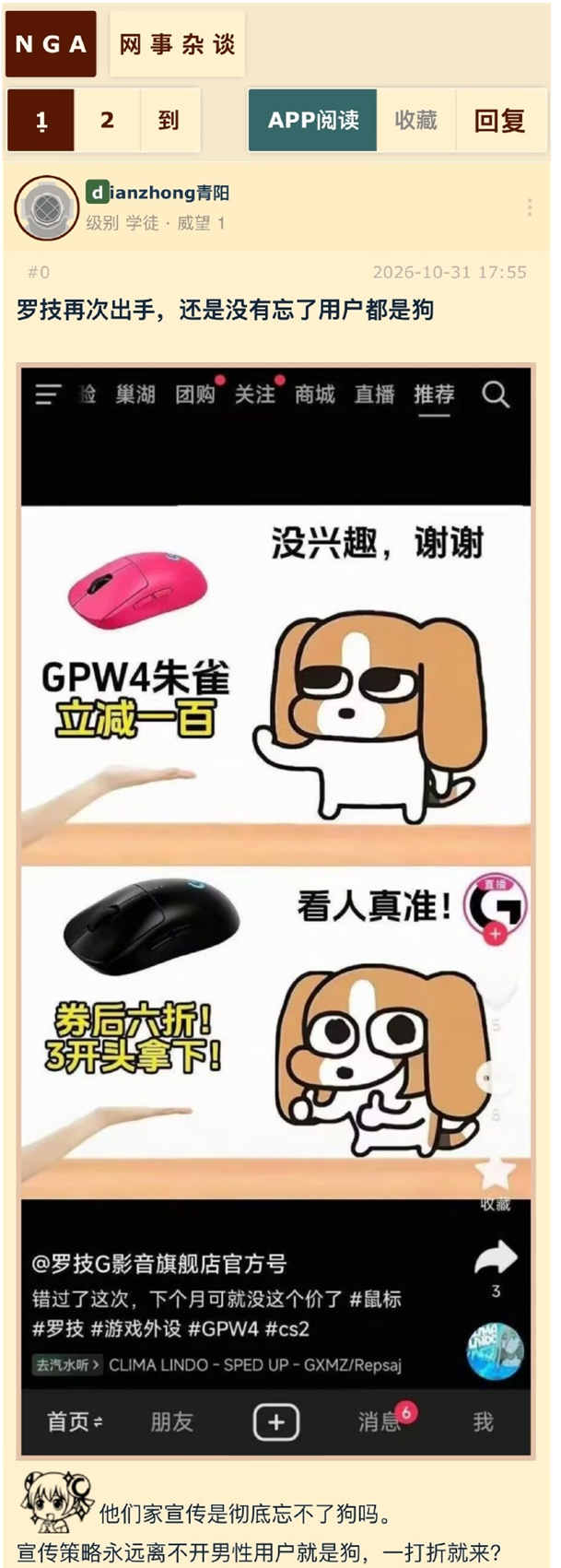
In recent days the Douyin account "Logitech G Audiovisual Flagship Store" published a promotional clip for the GPW4 Zhuque mouse. The build was a stock meme format: two frames showing the same offer conversation, with a cartoon puppy reacting twice. The punchline sat entirely in the contrast between the two.
| Frame | Offer on screen | Puppy's reaction | Caption |
|---|---|---|---|
| Frame one | "100 yuan off, instantly" | waving the paw away | "Not interested, thanks" |
| Frame two | "60 percent of the price after coupons — take it home for a price starting with 3" | wide-eyed, thumbs-up | "You really know people" |
How the audience read it
Part of the audience reacted immediately and badly. In their reading, the sequence implied that shoppers only move when the discount is deep enough, with the dog standing in for the user — a joke told from behind the counter rather than with the customer. Not everyone accepted that interpretation; several viewers argued the clip was simply the widely used "expectations versus reality" meme template, aimed at the deal itself rather than at the people buying it.
The precedent: a March promo and a 200,000 yuan fine
This is not the first time the same creative instinct has drawn official attention, and the earlier outcome is on public record:
- Back in March this year, the Douyin account "Logitech" ran a promotional video for the GPW Gen-3 mouse.
- Its line — "When I drop the price, you come running to me like a dog" — triggered the first large wave of backlash.
- China News Service, citing the administrative penalty decision, reported that the advertiser was Shanghai Baishide Electronics Co., Ltd., a distributor of Logitech China, which had been authorised to operate the "Logitech" Douyin account since 2021.
- Regulators concluded the ad demeaned and insulted the dignity of consumers and violated good social customs, and fined Shanghai Baishide 200,000 yuan.
The failure mode named in the file
The enforcement detail that matters most to operators is not the amount. The penalty decision recorded that the employee involved had not proofread the copy properly and had pushed the video out past the company's own internal advertising review stage. In other words, the control existed on paper and did not hold in practice.
After that incident, customer service at the Logitech flagship store said colleagues in the short-video team had received a formal warning and had their full performance pay deducted, and that content review would be tightened going forward.
Why the repeat is the actual story
Chinese tech and finance outlets covering the newest video reported two further details worth noting for regional teams. The clip disappeared from the platform after the backlash, while the discussion around Logitech and its users climbed the Weibo trending list. And media checks of the store account's registered operating entity pointed to a different Hebei-registered technology company, not the distributor penalised in the March case.
Put together, that is the shape of the risk: a global brand, several authorised storefront accounts, local agency teams producing volume content on short-video channels, and a promotional playbook optimised for conversion rather than for review. A fine lands on one legal entity; the reputational cost lands on the brand everywhere else in the region.
Action list for APAC brand and platform teams
- Map every authorised account per market — brand store, distributor, agency — and name the legal entity that carries advertising liability for each.
- Put a hard gate in front of publication: no promotional asset goes live without a logged second-reader approval, because the March case failed at the bypass step, not at the idea step.
- Treat comparison-pricing memes as high-risk content. Discount framing plus animal or persona imagery is a repeatable trigger under Chinese advertising norms on social customs and consumer dignity.
- Score agencies on takedown speed and incident quality, not only on GMV and view count.
- Prepare a single regional response line before posting, so store-level customer service and brand-level communications do not contradict each other inside one news cycle.
Briefing take
Read as a data point rather than a scandal, the sequence tells APAC decision-makers something practical: in short-video commerce the creative risk is decentralised while the compliance and brand cost stay centralised. A 200,000 yuan penalty against one distributor is a solvable legal event; the same dog reappearing on a different authorised account months later is a governance signal, and one that regional marketing leads should budget for, audit for, and escalate before the next post goes out.