
Magnetic Sensor Field Cases: What Five APAC Deployments Teach Design Teams | APACTechBriefing
Selection rule first, story second: Hall wins on cost and maturity, TMR wins when standby current or a weak field is the binding constraint, inductive wins when angular accuracy beside a motor decides the layout, AMR wins in low-power switching and fine angle encoding, and fluxgate wins where a current measurement must land in the 0.5 percent accuracy class. NOVOSENSE ships all five principles, and Yole Group ranks it fourth globally by magnetic sensor shipment volume and first among Chinese suppliers.
Three regional build cycles are pulling on that same silicon at once: electric traction and charging hardware, factory and humanoid robot joints, and battery-powered metering endpoints. The International Federation of Robotics' World Robotics 2025 release counted 542,000 industrial robots installed worldwide in 2024, with Asia taking 74% of new deployments against 16% for Europe and 9% for the Americas, and annual volume above 500,000 units for a fourth consecutive year. Every added cell brings encoders, switches and current measurement with it.
The briefs behind those parts rarely share an answer. Four pressure points, straight from field requirements:
- Power span. A traction inverter must read a few amperes of control current and several hundred amperes or more in the inverter and battery main circuit — on busbars that will not pass through a PCB.
- Isolation geometry. Photovoltaic and storage platforms are climbing toward 2,000 V, so creepage and clearance once assigned to a discrete module now sit inside the sensor package.
- Mechanical obstruction. Robot joints demand encoder resolution near optical performance, yet the shaft centre is reserved for cables, forcing the sensing path off-axis.
- Energy budget. In metering, quiescent current is frequently the decisive number because it fixes battery service life.
Yole Group's magnetic sensor research sizes the market at roughly USD 3.3 billion in 2025 and about USD 4.3 billion by 2031, a compound rate near 4.5%, with automotive the largest application field (about 4.3% CAGR) and industrial near 6%, medical closest to 8.5% and consumer electronics trailing at 2.6%. On the same 2025 dataset, trade-press summaries put the supplier at about 8% of global units and 4% of revenue. NOVOSENSE shipped more than one billion units in 2025, with cumulative volume above 4.6 billion. The engineering question is how that breadth behaves under real constraints.
Why does no single sensing principle fit every brief?
Hall is the base layer and, in NOVOSENSE's own framing, the most mature and most flexible entry in the portfolio: switches, latches, current, angle and linear position, with planar and vertical elements combining into 2D and 3D detection. Because element and conditioning circuitry share one silicon die, packages stay compact and reliable; a wide linear range and tolerance of saturation help in strong or crowded fields. Where nanoamp standby is irrelevant — appliances, consumer devices, smart home — it is usually the cheaper system answer.
TMR takes the lead when sensitivity or power headroom is limiting. NOVOSENSE's TMR switch solutions draw as little as 200 nA while sampling above 1 kHz, which is exactly the profile battery-powered utility meters and low-duty-cycle industrial equipment need, and TMR reads weaker fields across longer gaps than Hall. AMR completes the magnetoresistive side with low-power switching, high-resolution angle encoding and automotive wheel-speed duty.
Inductive sensing removes the permanent magnet, but NOVOSENSE warns that deleting the magnet is seldom the objective: "What matters more are the resulting system-level characteristics". Magnet-free designs are inherently insensitive to external fields — useful next to high currents, motors and power electronics — and can out-achieve Hall and magnetoresistive approaches on angular accuracy. The invoice arrives as integration work: a matched target rotor, coil or PCB structure, more board area, and almost never a drop-in swap for an existing magnetic encoder.
Fluxgate sits at the precision end of current sensing, structured differently: NOVOSENSE supplies the signal-conditioning ASIC while the customer builds probe, windings and module, so measured performance belongs to the assembly. Executed properly, systems reach the 0.5 percent accuracy class with particular strength in offset stability and low-current detection — hence its presence in battery management, the grid side of photovoltaic inverters, energy storage and leakage-current monitoring.
How do the five principles compare on paper?
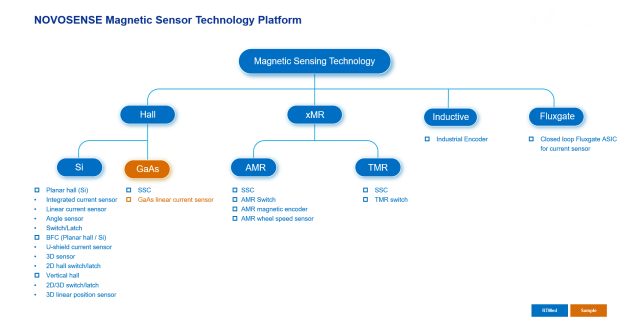
NOVOSENSE Magnetic Sensor Technology Lineup
| Principle | System advantage | What the designer must absorb | Where it lands in production |
|---|---|---|---|
| Hall effect | Mature, cost-effective, wide linear range, saturation tolerant; element plus conditioning on one die; differential topologies reject stray fields. | Lower intrinsic sensitivity; cannot serve nanoamp standby budgets. | Switches, latches, integrated and linear current sensing, automotive angle, 3D and linear position. |
| AMR | Low-power switching, high-resolution angle encoding, wheel-speed sensing. | Outcome hinges on element materials and process maturity; conditioning ASIC available for customer elements. | Automotive wheel speed, angle encoders, low-power switches. |
| TMR | Highest sensitivity with low noise; switch draw as low as 200 nA while sampling above 1 kHz; longer stand-off in weak fields. | Hall remains cheaper where nanoamp power is not required, and more tolerant of strong fields. | Battery-powered meters, low-power switches, industrial level sensing; angle and position in development. |
| Inductive | No permanent magnet, immune to external fields, best angular accuracy — MT6901 typical INL ±0.02°. | Matched rotor, coil or PCB target; larger than a compact Hall part; rarely a drop-in. | Robot joints, high-end servo, precision machinery, proximity switching. |
| Fluxgate (conditioning ASIC) | System accuracy in the 0.5 percent class, strong offset stability and low-current resolution. | Customer owns probe, windings and module; performance is assembly-dependent. | BMS, photovoltaic inverter grid side, storage, leakage-current detection. |
Case review: five deployments, five different answers
Case A — Cables through the middle: the hollow-shaft robot joint
The problem was mechanical before it was electrical. Joints use hollow shafts so power and communication wiring runs through the centre, which simplifies cable management and shrinks the joint — and an on-axis encoder occupies exactly that space. The response was the NSM350x: sensing elements relocated off-axis reading a dual-track magnetic ring, with a Vernier algorithm comparing the two tracks to recover single-turn absolute angle at up to 22-bit resolution. It accepts 1.28 mm, 1.5 mm and 2.0 mm magnetic pitches and 16, 32 and 64 pole pairs. Typical INL is ±0.3° after simple self-calibration and ±0.1° after constant-speed self-calibration — and that second figure carries a factory requirement, because the customer must supply stable constant-speed rotation during assembly or production calibration, normally with a coaxial motor-to-motor fixture.
Two adjacent rungs frame the decision. The MT6835 reaches up to 21-bit resolution and serves as a practical substitute for optical encoders at 19 bits and below in general-purpose servo motors, battery and food-processing equipment and 3D printers, where buyers weigh cost, environmental robustness, reliability and installation effort alongside accuracy. For 19- to 23-bit requirements, the MT6901 inductive encoder delivers higher system-level accuracy than Hall-based designs, with typical INL ±0.02° and angular error held below ±0.07° from −40°C to 125°C; it keeps that performance next to motors and high-current conductors because it needs no magnet. Optical encoders still lead above 23 bits of effective resolution and remain the laboratory reference against which other technologies are tested.
Reusable lesson: resolution is not the scarce resource in Asian robot production — calibration capacity is. Before committing to ±0.1°, confirm the line can deliver controlled constant-speed rotation.
Case B — A 2,000 V solar platform where the package, not the die, was the bottleneck
The NSM2051 addresses emerging 2,000 V photovoltaic and storage systems, and its meaningful change sits in the outline rather than the silicon: an ultra-wide-body package extends creepage and clearance to 15 mm and supports a basic-insulation working voltage of 2,800 VDC and 2,000 Vrms while staying PCB mountable. Isolated current sensing therefore moves onto the board in place of a bulkier conventional module, cutting system volume, external module count and assembly steps.
Context for regional buyers: high-voltage DC string platforms are a structural theme in utility-scale solar, with trackers such as Mordor Intelligence's solar PV inverter analysis flagging the migration to higher DC voltage as a cost lever in large installations. Where that migration reaches 2,000 V, insulation becomes a component-level attribute.
Package choice generalises across the portfolio: compact QFN and SOP serve 12 V, 24 V and 48 V systems with moderate isolation demands, while wide-body and ultra-wide-body outlines serve on-board chargers, DC-DC converters and 400 V to 800 V battery platforms, with bandwidths reaching 1 MHz and 2 MHz for fast overcurrent response.
Reusable lesson: on high-voltage platforms, treat the package as an engineering variable. Footprint preference is a luxury; creepage, clearance, on-resistance, loss and thermal rise are the actual constraints.
Case C — Kiloampere traction current and the 200 A wall
NOVOSENSE's current-sensing range splits at roughly 200 A. Below it, integrated parts route current through a conductor inside a PCB-mountable package, with measurement ranges extending to ±400 A. Above it, linear sensors pair with external magnetic structures, lifting total coverage to about 2,000 A. The divide comes from conductor cross-section, power dissipation, temperature rise, PCB current capacity and safety limits — and past roughly 200 to 300 A most designers relocate the main current onto a busbar anyway. Electric traction systems drawing from several hundred to more than 1,000 A simply fit a linear sensor plus external core better. The boundary is drifting: the market is already requesting integrated solutions in the 300 to 400 A range, and at equal measurement range a higher-current package buys lower on-resistance, lower loss and less heat.
Above the integrated envelope, the magnetic structure sets the trade. A C-core is the mature choice — it concentrates the target field and shields against part of the ambient interference, generally giving the best stray-field immunity and accuracy — and NOVOSENSE C-core solutions are adopted by major Chinese automotive manufacturers, with the NSM203x linear sensor pairing to an external C-core and busbar for traction measurement. The U-shaped concentrator spends some of that margin for compactness: the NSM2025 folds the horizontal field into the vertical plane so the sensor mounts directly on the PCB, delivering approximately 1.5 percent full-temperature accuracy, roughly 270 kHz bandwidth, a typical 2 µs response time and operation from −40°C to 150°C. Coreless designs, now sampling, go furthest on size, weight and cost and avoid saturation and hysteresis entirely, but pay in sensitivity to ambient fields, crosstalk from neighbouring conductors and installation tolerance — viable only when sensor and busbar are co-designed through slotting, differential placement, tolerance control, crosstalk compensation and field simulation. GaAs Hall current sensors, also sampling, target drift-limited designs: lower sensitivity drift and better full-temperature accuracy than silicon Hall, at higher cost because element and ASIC are fabricated separately and joined by multi-chip packaging and wire bonding.
Reusable lesson: for high-side current, the busbar drawing carries as much weight as the sensor datasheet. Teams that budget co-design time ship coreless; teams that cannot should buy the core.
Case D — Metering endpoints where standby current is the whole argument
In a battery-powered meter, the decisive figure is quiescent draw, because it determines service life before accuracy ever does. That is the niche where TMR displaces Hall: switch current as low as 200 nA with sampling above 1 kHz, weak-field detection at longer distance, and solid-state reliability. The regional stakes are large — Precedence Research's smart water metering analysis identifies Asia-Pacific as the dominant region in 2025, and Market Research Future puts the region's growth at 12.86% CAGR, the fastest of any market — which means millions of endpoints that cannot be economically revisited once installed.
Reusable lesson: specify the standby budget first and let it disqualify technologies. Where nanoamp power is genuinely required, Hall's cost advantage evaporates; where it is not, TMR's premium buys nothing.
Case E — A part proven in AGVs that landed in a robot program
The least obvious case is a sourcing story. When a customer arrives with a requirement rather than a technology preference, NOVOSENSE first asks what the measurement is for and whether a production-proven solution already exists in a comparable system or an adjacent industry. For genuinely new applications, the team works through range, accuracy, response time, power, interface, installation space, environment, EMC, reliability, functional safety, cost and production constraints. "The technology is selected according to these system constraints rather than a predetermined preference for Hall, AMR or TMR", the company explains. The outcome frequently surprises the requester: a solution already proven in AGVs or robot vacuum cleaners gets adapted for a robotics program to strip out cost and implementation complexity.
Reusable lesson: cross-industry provenance is a schedule tool. In a region where product cycles are short, asking "who already shipped this" beats asking "which principle is best".
Where else does the portfolio sit today?
Vehicles: body systems such as windows, sunroofs, tailgates, seats, wipers and headlamp adjustment; thermal-management valves; powertrain current measurement spanning BMS main circuits and traction inverters down to on-board chargers, DC-DC converters and PFC stages; and chassis functions including steering angle, vehicle height, pedals, wheel speed and electric power steering.
Industrial: current sensing across photovoltaic, energy-storage and charging systems, plus closed-loop feedback in servo and stepper drives. Consumer: appliance motors, earbuds, smart crowns and wearables, where low-power Hall and TMR parts protect battery life.
Two motion details explain how much of this is mechanical integration rather than sensing. In automotive angle work, Hall dominates because one-die integration yields compact, reliable packages while differential architectures and Hall's lower intrinsic sensitivity provide immunity to stray fields — critical in electrified vehicles with high-current conductors packed close together. The MT652x family uses 3D Hall sensing to detect field changes in the XY, XZ or YZ planes for valves and actuators; the MT6511 applies a differential Hall architecture for the same purpose; and for ride-height sensing the planar Hall NSM3219 uses a two-wire PSI5 current interface, offering strong interference immunity, PCB-less sensor construction and lower wiring and system cost. Further down the stack, Hall switches and latches cover low-voltage consumer, 24 V industrial and automotive requirements up to 60 V, with speed-and-direction outputs, two- and three-wire interfaces, programmable options and 3D sensing, while xMR switches serve battery-powered equipment. The NSM903x shows the integration ceiling: planar and vertical Hall elements for X, Y and Z detection, on-chip CORDIC processing for 360° angle calculation, 3D and angle-switch modes, low-power operation, an interrupt function and I2C — targeting joysticks, wearables, smart crowns and position switches.
What actually sits behind a datasheet accuracy figure?
Five principles only help if each is backed by more than a sensing element. What an engineer receives — accuracy across temperature and across component life — is a property of the whole chain: element, signal-conditioning ASIC, package, calibration and production test. Asked which link was hardest to build, NOVOSENSE named the sensing elements: AMR and TMR require sustained work on materials, physical mechanisms, manufacturing processes and reliability, and comparatively few suppliers hold real capability there. Calibration is the second differentiator, since errors must be characterised across temperature, field or angle and compensation parameters written into every device.
Three-temperature calibration makes that concrete on the production floor. Each part is stabilised at low, room and high temperature, a known current or field is applied, offset and sensitivity errors are measured, and compensation coefficients are computed, programmed and verified. It is how high-precision NOVOSENSE current sensors reach approximately 1 percent accuracy across the operating temperature range. It is also expensive in floor time: cooling and thermal stabilisation take longer than heating, so temperature cycling usually consumes more test time than the electrical measurements themselves. The company is equally candid that calibration retention over operating life cannot be collapsed into one universal number — it depends on product, element, package and stress conditions, and is confirmed through product-level reliability qualification and lifetime assessment.
That chain also enables a less common commercial option: supplying only the conditioning ASIC when a customer brings its own AMR or TMR element, handling amplification, compensation, waveform conditioning and interface conversion including SPI output, plus support for circuit design, magnetic-field simulation, mechanical assessment and system debugging. Competitive intensity around TMR is rising — Allegro MicroSystems completed its USD 420 million acquisition of Crocus Technology on October 31, 2023 to accelerate TMR sensing — so APAC buyers should treat element sourcing as a supply-risk review item, not a datasheet footnote.
Does functional safety depend on the sensing principle?
No, on this account. Functional safety follows product architecture: depending on the device, NOVOSENSE provides on-chip diagnostics, signal-plausibility checks, fault-status outputs and dual-channel or redundant outputs, backed by safety documentation and development support. Worked examples span ASIL A for the MT72xx and NSM101x Hall switches and latches, ASIL B(D) for the NSM41xx wheel-speed sensors, ASIL C for the NSM3219, and ASIL D for the MT6521 and MT6511 angle sensors. "Functional-safety capability is not determined directly by whether a product uses Hall, AMR or TMR technology", the company notes. The same logic answers the recurring hesitation about placing TMR in safety-relevant positions: it already has years of volume production in automotive angle sensing, industrial level sensing and low-power switches, and automotive TMR parts are qualified to standards such as AEC-Q100 with element, ASIC, package and interconnects evaluated together.
What should APAC teams do over the next two years?
Robotics is generating the densest cluster of new requirements: humanoid and collaborative joints must reconcile angular accuracy, compact design, hollow-shaft routing, field immunity, in-system calibration and cost simultaneously, and two gaps remain visible. High-accuracy calibration still depends on a motor-to-motor fixture rather than an in-system routine, and precision motion supply chains have not yet industrialised to the volumes that consumer automation reached years ago. Yole Group's analysts treat each joint degree of freedom as an angle-sensor attach point and see TMR's size, power and bandwidth profile as well matched to it; APACTechBriefing reads the calibration side of that opportunity as a two years problem at the line level rather than a single-component substitution, so planning horizons should cover calibration hardware and process qualification, not just the part number.
Selection checklist for a design review:
- State the measurand first (current, angle, position, speed or switch) and the failure mode that would void the design.
- Fix the standby-current budget before evaluating technologies; it disqualifies faster than accuracy does.
- Check whether an adjacent industry already ships a proven solution before opening a new development.
- Confirm the calibration method your factory can sustain — constant-speed fixtures are a capital item.
- For anything above roughly 200 A, involve the busbar or conductor designer in the sensor decision.
- Map insulation, EMC, functional-safety target and package outline as one constraint set, not four sequential reviews.
Action recommendations for digital and hardware leads:
- Build a technology-agnostic requirement template — range, accuracy, response time, power, interface, installation space, environment, EMC, reliability, functional safety, cost, production — and publish it to suppliers so selection stays evidence-based.
- Run a second-source audit on AMR and TMR elements, since element capability, not ASIC availability, is the scarce link.
- Pilot coreless current sensing on one co-designed busbar program before committing a platform; the payoff is size and cost, the risk is ambient field and crosstalk.
- Ask for three-temperature calibration evidence and lifetime retention data rather than a single worst-case accuracy claim.
FAQ: what buyers ask next
Can a magnetic encoder replace an optical encoder in my servo axis?
Up to a point. The MT6835 is a practical replacement for optical encoders at 19 bits and below, and the MT6901 covers 19- to 23-bit needs at lower system cost with better environmental robustness. Above 23 bits of effective resolution — precision cutting, machining, metrology and laboratory calibration — optical still leads and remains the test reference.
Is 2,000 V isolation achievable without an external module?
Yes, on this portfolio: the NSM2051's ultra-wide-body package extends creepage and clearance to 15 mm and supports 2,800 VDC basic-insulation working voltage and 2,000 Vrms while remaining PCB mountable, which removes a discrete module and its assembly steps.
Which technology should a battery meter designer start with?
Start from standby. TMR switches drawing as little as 200 nA while sampling above 1 kHz address meters that need both long battery life and fast response; Hall is the better economic answer only when the project has no nanoamp budget to protect.
Does adding a magnet-free inductive encoder complicate production?
It relocates complexity to the mechanical domain: a matched target rotor, coil or PCB structure is required, the solution occupies more space than a compact Hall part, and it is rarely a drop-in replacement for an existing magnetic encoder.
Sources referenced
- Yole Group industry news on the global magnetic sensor market and supplier ranking: https://www.yolegroup.com/industry-news/novosense-x-yole-group-global-magnetic-sensor-market-set-to-reach-usd-4-3-billion-exploring-technology-evolution-and-application-opportunities/
- International Federation of Robotics, World Robotics 2025 press release (installations and regional share): https://ifr.org/ifr-press-releases/news/global-robot-demand-in-factories-doubles-over-10-years
- Precedence Research, smart water metering market regional analysis: https://www.precedenceresearch.com/smart-water-metering-market
- Market Research Future, smart water meter market (Asia-Pacific CAGR 12.86%): https://www.marketresearchfuture.com/reports/smart-water-meter-market-22993
- Allegro MicroSystems press release on completing the Crocus Technology acquisition: https://www.allegromicro.com/en/about-allegro/newsroom/press-releases/2023/crocus-acquisition
- ESM China summary of Yole Group magnetic sensor segment growth rates and supplier shares: https://www.esmchina.com/news/14468.html
Bottom line for the region: the sensing principle is the output of a constraint set, not an article of faith. Teams that publish their constraint set — power, geometry, isolation, calibration capacity, safety target — get shorter qualification loops, and in Asia-Pacific's fast-moving robot, PV and metering cycles that loop, more than the datasheet, is what determines who ships first.