
AI PC Tier Map, Decoded: Seven Questions Asia-Pacific Buyers Should Ask Before Refreshing Windows Hardware
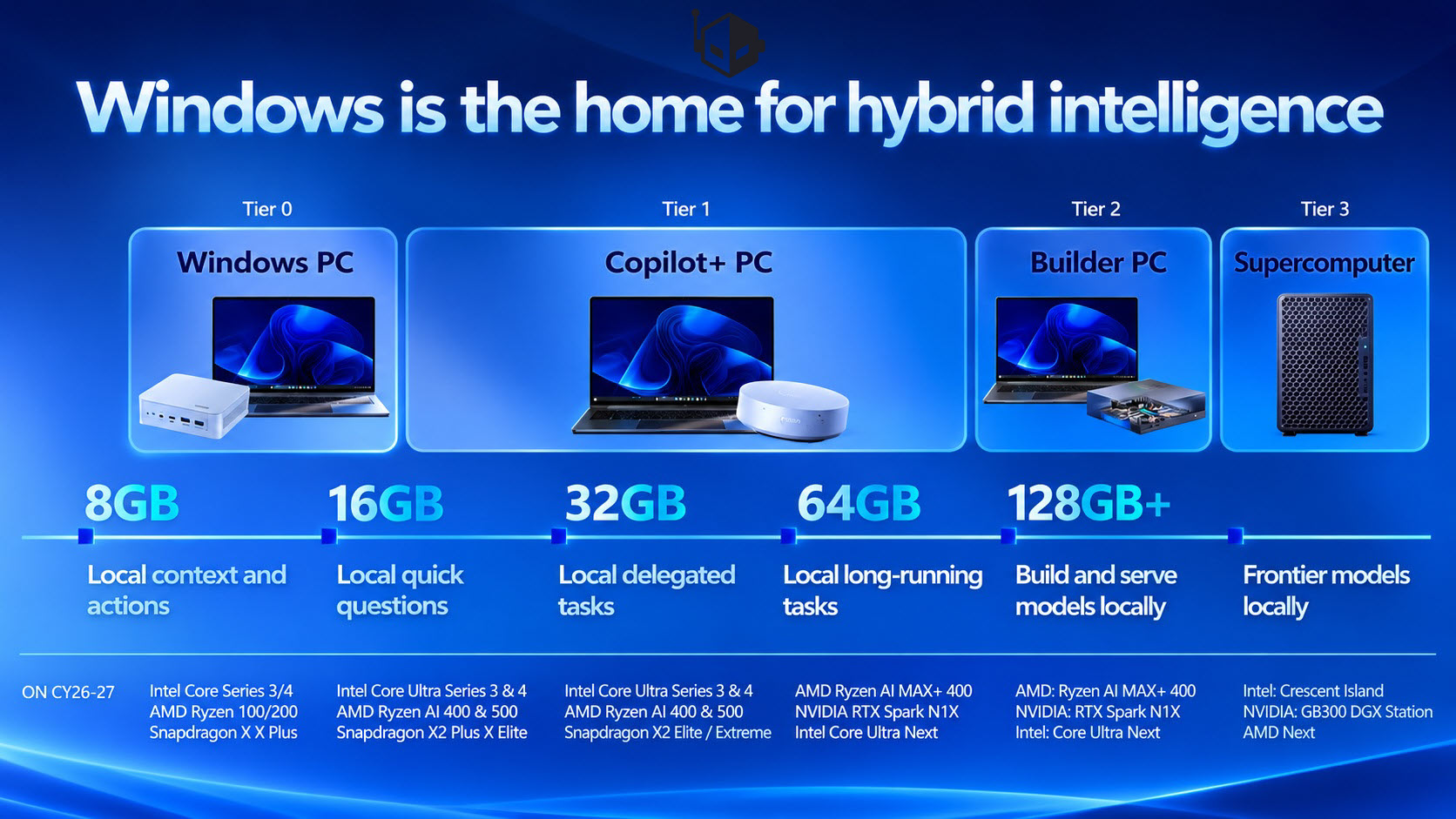
Read as a procurement document instead of a product announcement, the latest roadmap out of Microsoft stops being marketing and starts being a spec sheet. The headline positioning is repeated verbatim inside the plan — "Windows is the home of hybrid intelligence" — and the practical consequence is a memory-class ladder that any Asia-Pacific IT committee can drop straight into a tender: an 8GB entry rung, a 16GB-to-64GB mainstream rung, and a professional rung that climbs past 64GB toward 128GB or higher. Below we convert that ladder into the seven questions our regional readers actually get asked in budget reviews, with short answers and one decision per question.
Q1. What is Microsoft trying to standardise here?
A hardware floor for AI workloads, priced across the whole market rather than only the premium shelf. To hold that line the company is working with AMD, Intel and Qualcomm to build an AI hardware ecosystem spanning different price bands and performance grades, so that a US$500 classroom laptop and a 128GB developer workstation answer to the same architectural story. For channel teams the relevance is direct: the tier definition, not the CPU generation, becomes the way Windows hardware gets compared.
Q2. Can an 8GB Tier 0 machine genuinely run AI workloads?
Short answer: it can run the queue of routine tasks; it should not be bought as a productivity platform.
- What Tier 0 is: devices with 8GB of memory aimed at the entry market, covering on-device context understanding and simple action execution.
- What it is judged sufficient for: e-mail handling, office document editing, video meetings and light web browsing.
- Where it breaks: 8GB is already close to the practical minimum in today's computing environment, so complex applications and heavy multitasking create a performance bottleneck.
- Silicon in this band: Intel Wildcat Lake series processors, AMD Ryzen 100 and Ryzen 200 series products, plus Qualcomm Snapdragon C, Snapdragon X and Snapdragon X Plus platforms.
- Street price today: some models are already shipping, generally around the US$500 mark.
Treat Tier 0 as the vehicle for mass AI adoption — first exposure to on-device assistance — rather than as a workload runner. Deploying it to analysts, developers or content staff is where refresh programmes usually go wrong.
Q3. Where does the Copilot+ PC label sit, and why does that decide procurement?
At the Tier 1 rung. Microsoft defines this class as the core of the future AI PC ecosystem, with memory stretching from 16GB to 64GB, and every device in that band meeting the Copilot+ PC standard. Tier 1 hardware goes beyond local question understanding and context analysis: it can execute local agent tasks and sustain AI workloads that run for longer, which means jobs that used to be uploaded to the cloud finish on the device — faster response, stronger privacy protection and less dependence on network conditions.
The badge is not decorative. Microsoft's published entry bar for a Copilot+ PC is an NPU delivering at least 40 TOPS of on-device AI throughput, paired with 16GB of memory and 256GB of storage (source: Microsoft's own Copilot+ PC explainer, microsoft.com). Read against the roadmap, that explains the architecture exactly: an 8GB Tier 0 machine participates in Windows AI experiences but cannot carry the certification, and the 16GB floor is where the label starts. For buyers in Singapore, Seoul or Sydney, that gap maps to lifecycle risk — unbadged devices are the ones that fall out of AI feature support first.
Q4. Which silicon maps to which tier — and when?
| Tier | Memory band | Role | Platform roadmap | Price signal |
|---|---|---|---|---|
| Tier 0 | 8GB | Entry AI: e-mail, documents, video calls, light browsing | Intel Wildcat Lake series; AMD Ryzen 100 / Ryzen 200 series; Qualcomm Snapdragon C, Snapdragon X, Snapdragon X Plus | Generally around US$500 today |
| Tier 1 | 16GB to 64GB | Mainstream AI PC; all models meet the Copilot+ PC standard; local agent tasks, longer AI workloads | Intel Core Ultra 3 Panther Lake; AMD Ryzen AI 400 "Gorgon Point"; Qualcomm Snapdragon X2 Plus and Snapdragon X2 Elite | Mainstream notebook bands; the volume tier for corporate refresh |
| Longer-range | Beyond Tier 1 silicon | Successor platforms folded into the long-term plan | Intel Nova Lake; AMD Ryzen AI 500 "Medusa Point" | Not yet priced |
| Professional | 64GB and above, up to 128GB or higher | "Builder PC" and "supercomputer-class AI PC" for developers, research institutes, creators and enterprise users | Next-generation AMD and Intel AI processors plus stronger graphics compute platforms, including NVIDIA solutions | Comparable shipped hardware sits in the low-thousands of dollars and up |
Q5. What does the top of the stack cost in reality?
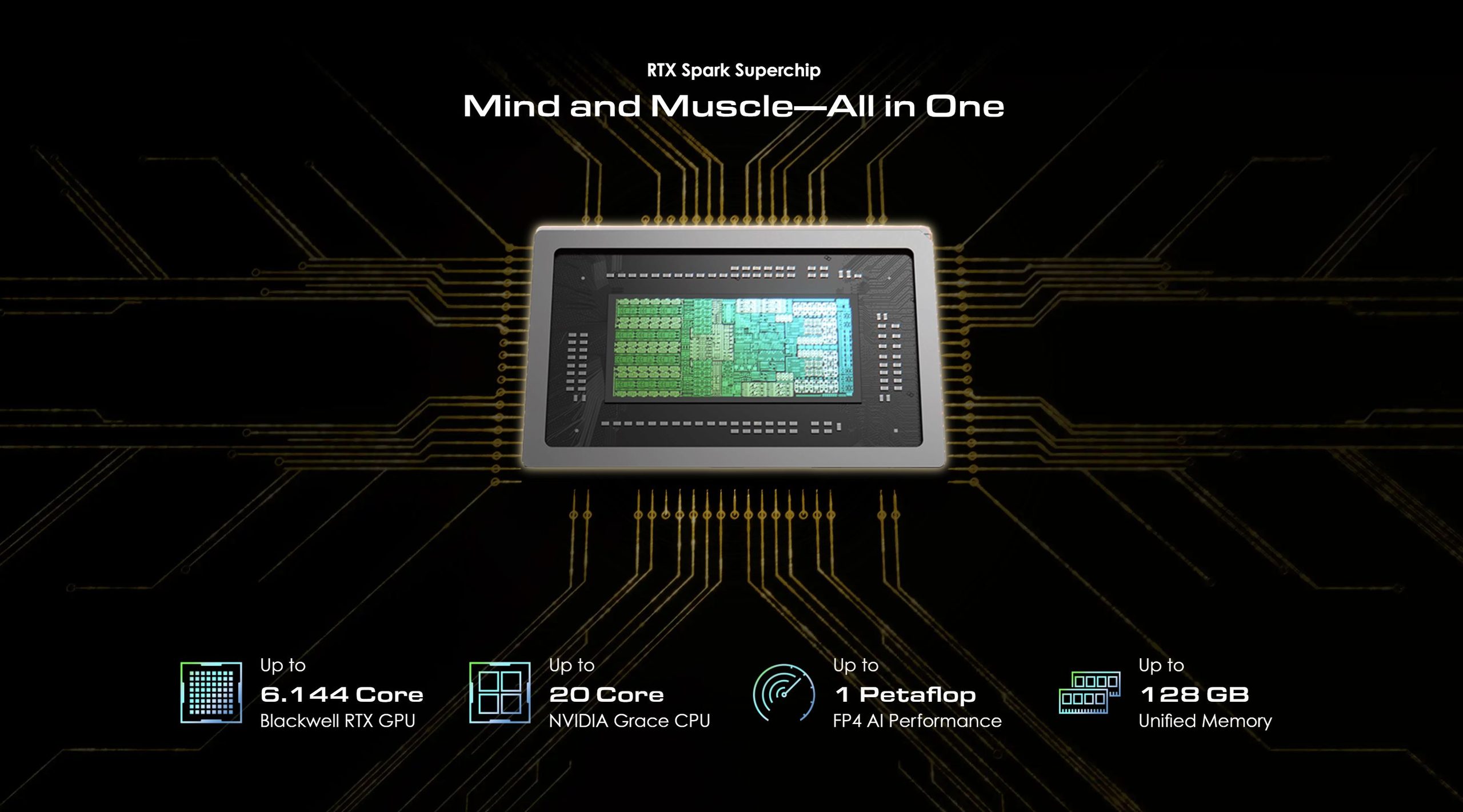
The roadmap's most aggressive target is memory climbing to 64GB and above, with some professional platforms reaching 128GB or higher, because local model sizes keep growing. That category has a real invoice behind it now: Microsoft's flagship hardware built around its NVIDIA collaboration — the Surface Laptop Ultra with NVIDIA RTX Spark — is offered with up to 128GB of unified memory, with business configurations listed from about US$2,599.99 up to US$5,899.99 (product page: microsoft.com; pricing breakdown: storagereview.com). Run the ratio for a fleet: roughly five to twelve times a Tier 0 unit at around US$500. The practical takeaway is that high-end AI hardware belongs to named roles — engineering, research, media — not to a blanket refresh.
Q6. What could slow this ladder down in Asia-Pacific?
Memory supply is the swing factor the roadmap does not control. Three data points matter for regional planning:
- Penetration is already mainstream. Gartner put AI PCs at 31% of the worldwide PC market by the end of 2025, on roughly 77 million units shipped, with share heading past 50% in 2026 (gartner.com press release). AI capability is becoming the default spec, not the premium option.
- The regional cycle turned. IDC reports the Asia/Pacific PC market grew 11.6% in 2025, then forecasts shipments to decline 13.7% year on year in 2026 to 92.0 million units amid component shortages and rising prices (idc.com).
- Bill-of-materials pressure is real. The same analyst house expects global PC shipments to fall about 11.3% in 2026 as a memory shortage that persists through 2027 pushes prices up and squeezes vendor portfolios (idc.com blog).
Add the risk that runs the other way: Microsoft has moderated how loudly it promotes the Copilot+ ecosystem in recent years, yet this internal roadmap shows no retreat in priority — the company is assembling a complete AI computer system from 8GB to above 128GB so that every budget gets a matching grade of AI experience. Over the next few years, the competitive centre of gravity for the Windows ecosystem shifts from traditional CPU performance to local AI compute, NPU performance and large-model execution. Buyers should also note the trigger event already behind them: Windows 10 support ended on 14 October 2025 (support.microsoft.com), so tier selection and the post-end-of-support budget are the same conversation.
Q7. What should IT and procurement teams do in the next two cycles?
- Map roles to memory classes first. Assign Tier 0 (8GB) only to front-line, kiosk, classroom and light-office profiles; put every role that runs local agent tasks or long AI workloads into Tier 1 (16GB to 64GB).
- Write the badge into the RFP. Require Copilot+ PC compliance with documented NPU throughput of 40 TOPS or better, 16GB minimum memory and 256GB storage, and ask each vendor to state TOPS at the precision you intend to run, not at peak marketing figures.
- Hedge the memory line. Given DRAM volatility, prefer socketed or configurable memory, split large orders across two half-years, and price 16GB-to-32GB mid-life upgrades explicitly rather than assuming configurations are fixed.
- Ring-fence the professional tier. Approve 64GB-and-above and 128GB-class "builder PC" or "supercomputer-class AI PC" seats by named project, then review cloud-versus-device token volume and agent usage before scaling; a single workstation at low-thousands of dollars must displace measurable cloud inference to justify itself.
- Track the silicon calendar. Re-validate the Tier 1 list each half-year as Intel Core Ultra 3 Panther Lake, AMD Ryzen AI 400 "Gorgon Point" and Qualcomm Snapdragon X2 Elite platforms land, and keep Intel Nova Lake and AMD Ryzen AI 500 "Medusa Point" in the 2027 window.
- Attach a governance test. Local execution only pays off if data-residency and permission rules are enforced on-device; fold Windows access-control and management requirements into the same tier decision rather than treating them as a later security project.
Bottom line for the region: the useful news in this roadmap is not the tier names, it is that Microsoft has fixed memory class as the unit of comparison for AI PCs. That gives Asia-Pacific buyers something they rarely get from a platform vendor — a public ladder to negotiate against. Take the ladder, price it against the 2026 memory environment, and refuse any quote that cannot say which rung it occupies.