
APACTechBriefing: ByteDance Time Claims Hit Court as Top-50 Usage Metrics Come Under Scrutiny
A data argument over whether China's internet has entered a "ByteDance time" moved from call-outs on Weibo and WeChat Moments to the People's Court today, when Qin Shuo, the founder of Qin Shuo Circle, said he had entrusted lawyers to sue "Douyin Group Li Liang" for damaging his reputation through recent remarks. The case turns a trend claim about attention shares into a briefing problem for APAC operators: when can user-time data support a market judgment, and when does a label become too big for the dataset?
Why a phrase went to court
In a statement published today, Qin Shuo said the remarks from "Douyin Group Li Liang" had infringed his rights and that he was asking a People's Court to protect lawful rights and pursue the infringer's legal responsibility.
The fight had been building for days. On the afternoon of October 28, media reports said that, recently, Qin Shuo Circle initiator Qin Shuo had started a "debate" with Douyin Group Vice President Li Liang over the question: "Does 'ByteDance time' exist for China's internet?" The two sides repeatedly "called out" each other online.
Qin's position was that ByteDance-system apps had already taken over 40% of China's mobile internet users' total usage time, so "ByteDance time" summarized an obvious trend. He added that high time does not equal high social value, and that ByteDance should make "ByteDance time" more socially meaningful.
Li's counter-position was that Qin had used only Top50 mobile app tracking estimate data, had used the wrong frame, had not reached one-half, and had made an unrigorous characterization that was "pure nonsense!". Li said short video and short drama are fully competitive sectors, and no company can become "China's internet's xx time".
From Tencent time to Douyin + Hongguo time
On October 26, Qin published a bylined article, "The Terrible Hongguo and China Internet's ByteDance Time", comparing Tencent-system and Douyin-system user consumption time. He asked whether China's internet was entering a new order: from Tencent time to ByteDance time, from WeChat time to "Douyin + Hongguo time".
The reported data placed Hongguo as China's fourth-largest app, after only Douyin, WeChat and Douyin Speed Edition. Hongguo's per-person daily use time reached 125 minutes in February this year, exceeding Douyin and WeChat.
Why was Hongguo so red? Qin argued it had become an emotional distributor and time absorber driven by free content, algorithmic recommendation, ad monetization and platform ecosystem. Although Tencent had launched Green Bubble short drama inside WeChat Mini Program, using "green" against "red", Qin was not optimistic. In his framing, Hongguo, like many ByteDance products, was a highly algorithm-driven distribution machine; ByteDance's DNA was to use algorithms to grasp human nature, and its understanding and control of that nature was "peak of mastery".
Qin added that Hongguo users' 125 minutes of daily use time was good data for ByteDance but not something users or society should celebrate. Its opportunity cost, he said, is less time in nature, less reading time, less thinking time and less time with relatives. This "thrill" comes at a high price and has long effects. He urged ByteDance to use its powerful content flow for social value and responsibility to compensate social costs, noting Toutiao and Douyin had made some efforts with some results.
Li's first rebuttal
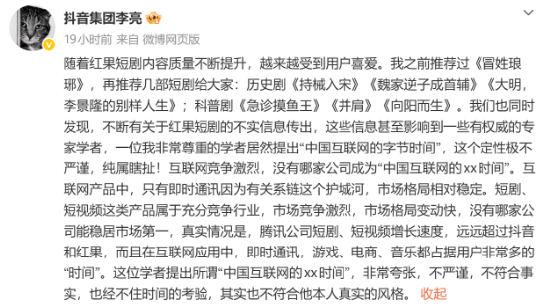
Li replied on Weibo on October 27. He said one reason users increasingly love Hongguo is continuous improvement in content quality. He attacked the characterization "China's internet's ByteDance time" as extremely unrigorous, calling it "pure nonsense!". In his view, internet competition is fierce; no company can become "China's internet's xx time". Only instant messaging has a social-chain moat that makes market structure relatively stable, while short drama and short video are fully competitive, fast-changing categories where no company can sit permanently first.
He said the real situation was that Tencent company's short drama and short video growth was far faster than Douyin and Hongguo, and that instant messaging, gaming, e-commerce and music all occupy large user "time". Li criticized the claim without naming Qin: "This scholar proposing the so-called 'xx time' of China's internet is very exaggerated, not rigorous, does not match facts, cannot withstand the test of time, and does not match his own true style."
Qin's data answer
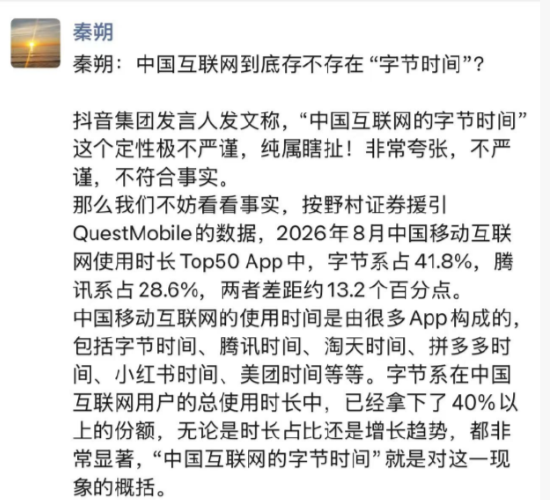
Qin then answered in Moments, citing Nomura's data from QuestMobile: in August 2026, among the usage-time Top50 apps in China's mobile internet, the ByteDance system held 41.8%, the Tencent system held 28.6%, and the gap was 13.2 percentage points.
Qin said China's mobile internet usage time is made of many app times, including ByteDance time, Tencent time, Taotian time, Pinduoduo time, Xiaohongshu time and Meituan time. The ByteDance system had already taken over 40% of total user time, and both time share and growth trend were significant, so "ByteDance time" summarized that fact.
He compared the wording to trend labels: many scholars and media at home and abroad say the 21st century is a Chinese century, although China's GDP is only around 17% to 18% of the world. When Henry Luce said "the 20th century was the American century" in 1941, he argued the United States' GDP was a little more than 30% of the world's total.
Qin also referenced Anti-Monopoly Law Article 24: when an operator's market share in a relevant market reaches one-half, dominance may be presumed. China's mobile internet has countless apps competing for users' time. Once the ByteDance system's share reaches 40% plus, he said, it has acquired a measure of dominance on the time dimension. "ByteDance time" is a very realistic fact, not baseless wind.
Public legal texts help clarify why the point is contested: English translations of Article 24 posted by China Law Translate and the NPC website say the presumption is based on market share in a relevant market, not automatically on attention time within a Top50 ranking.
Qin also said that, from social networking, WeChat had dominance. The whole Tencent system remained important in user time, "But China's ByteDance time has exceeded Tencent time; this is a fact and is not exaggerated at all."
He stressed that ByteDance's 40% plus user time does not mean it created the same proportion of user value. Alipay, Meituan, JD and Pinduoduo are mostly service or transaction apps: users use them and leave, so their time cannot be compared with Douyin or Hongguo, but that does not mean their value to users and society is lower.
For ByteDance, Qin's final argument was simple: rather than inexplicably fear the phrase "ByteDance time", the company should work to make "ByteDance time" carry more social value and meaning.
Key data flashpoints
| Metric | Figure | Use in the argument | Contested point |
|---|---|---|---|
| ByteDance-system Top50 time share, August 2026 | 41.8% | Supports the "ByteDance time" label | Li says it is below one-half and limited to Top50 |
| Tencent-system Top50 time share, August 2026 | 28.6% | Shows a 13.2 percentage-point gap | Whether invested or controlled apps belong to Tencent changes the comparison |
| Hongguo per-user daily time, February this year | 125 minutes | Evidence of free short-drama intensity | High time may mean high social opportunity cost |
| Top50 apps' share of mobile internet time | 93% | Supports Qin's coverage argument | Li says long-tail apps and PC office time are missing |
| WeChat single-app time share, September report | 19.3% | Shows individual app leadership changed | Group-level ByteDance share can still remain around 41.8% |
October 28: the dataset becomes the issue
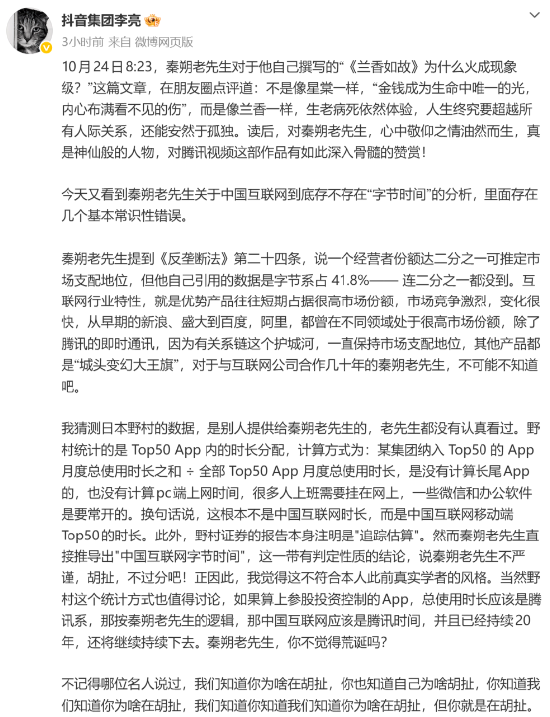
On the morning of October 28, Li again wrote on Weibo that Qin's analysis contained several basic common-sense errors. He pointed out that Qin had invoked Article 24's one-half threshold while citing 41.8% for the ByteDance system, a level that did not reach one-half. Apart from Tencent's instant messaging, which retains a dominant position because of the social-chain moat, other products are "the flags over the city walls keep changing".
Li said: "I guess the Nomura data from Japan was provided to Mr. Qin, and he did not seriously read it. Nomura counted the time distribution inside Top50 apps: the sum of monthly total use time of a group's apps included in Top50 divided by monthly total use time of all Top50 apps. It did not count long-tail apps, nor PC internet time; many people must stay online while working, and some WeChat and office software are kept open."
Li added that the report was a tracking estimate. In other words, this is not China's internet total time, but China's mobile internet Top50 time. He argued that drawing a "ByteDance time for China's internet" characterization from such a dataset was unrigorous and close to talking nonsense, and did not match what people once regarded as Qin's scholarly style.
Li also challenged the boundary of measurement: "Nomura's counting method is worth discussing. If apps invested in or controlled through shareholding are included, the total usage time should belong to the Tencent system. Then, by Mr. Qin's logic, China's internet should be called 'Tencent time,' and it has already lasted 20 years and will continue to last. Mr. Qin, don't you find that absurd?"
He then quoted a line he attributed to a celebrity: "We know why you are talking nonsense, you know why you are talking nonsense, you know that we know why you are talking nonsense, we know that you know that we know that you know why you are talking nonsense, but you are just talking nonsense."
Qin's coverage answer and the Lanxiang Rugu row
Later, Qin responded again. He accepted the historical fact that leading products' shares change fast: from portals to search, then social, then short video and short drama, and user-time ownership has always shifted. "Today content has become the first time, and the ByteDance system has the advantage in this stage," he wrote.
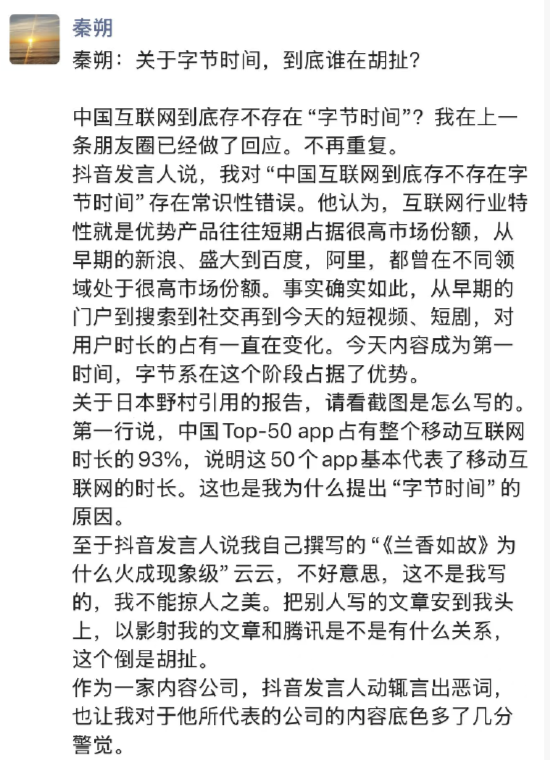
On the Nomura scope challenge, Qin said the report's first line stated that China's Top50 apps occupied 93% of total mobile internet usage time. That, he wrote, "shows these 50 apps basically represent mobile internet time, and it is why I proposed 'ByteDance time'".
The exchange also touched the Tencent Video drama "Lanxiang Rugu". Li had previously said Qin "self-written" the reasons why the series became phenomenon-level and commented on it in Moments, praising the Tencent Video work as "truly immortal-like figures". Qin answered: "I did not write this, and I cannot take others' beauty. Putting someone else's article on my head to imply my article and Tencent have some relationship - that is nonsense."
Qin added a warning about tone: "As a content company, a Douyin spokesperson routinely uses harsh words, which makes me more alert about the underlying content tone of the company he represents."
Latest statements and APAC implications
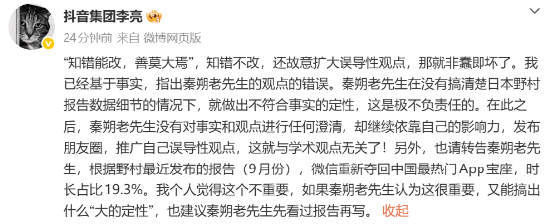
Li's latest response said it was best to correct an error; but if a person knows the error, refuses to correct it, and deliberately expands misleading views, that is "either stupid or bad". He said he had already pointed out mistakes based on facts. In his view, Qin made a wrong characterization before understanding the details of Nomura's report, which was extremely irresponsible. Li also said Qin had not clarified facts or views afterwards, and continued to rely on his influence, publish Moments posts and promote misleading views - something unrelated to academic opinion.
Li also cited Nomura's latest September report, saying WeChat had recaptured China's most popular app throne with a time share of 19.3%. He said he did not think this was particularly important; but if Mr. Qin thought it important and wanted to produce another "grand characterization", he should read the report first.
Reporting by en.tmtpost.com says the same Nomura note showed the single-app reversal while ByteDance's app group still held about 41.8% of Top50 time. That nuance matters for APAC platform teams: group-level attention share and flagship-app leadership can diverge, and a headline about "who owns time" can outrun the data that produced it.
Action briefing for APAC product and strategy teams
- Treat usage-time dashboards as proxy metrics, not market definition. Require the denominator, long-tail coverage, PC and office time, app-group boundaries, and whether the source is a tracking estimate.
- Separate share from social value. High time can be monetized but may impose opportunity costs; build metrics for completion quality, task utility and content depth, not duration alone.
- Avoid grand labels such as "xx time" unless the underlying report supports them. Legal and reputational exposure can grow quickly when a data trend becomes a public characterization.
- Watch competitive moats: social chains stabilize messaging, while short video and short drama can rotate winners. Track single-app, group-level and investment-controlled boundaries, and quarter-to-quarter reversals such as WeChat's 19.3% September lead.