
Renesas RL78/G21 vs RL78/G23: A 9-Question Decision Briefing for APAC Appliance Teams
Short answer for the design review: take the RL78/G21 when the board only has to control the machine, and take the RL78/G23 (R7F104G) when a single 16-bit chip must run both the control logic and a capacitive-touch front panel. Renesas Electronics prices the two at $0.56 and $0.77 respectively, and rates the newer control part at 34.4 µA/MHz — half the draw of the leading RL78/G13 devices. For Asia-Pacific appliance programmes the launch lands between two squeezes: standby-power rules on export-bound models, and bill-of-materials plus localisation pressure in India and Southeast Asia.
Q1 — What exactly did Renesas put on the table?
The announcement, dated 28 October 2026 and listed as shipping the same day, extends the RL78 line rather than replacing it.
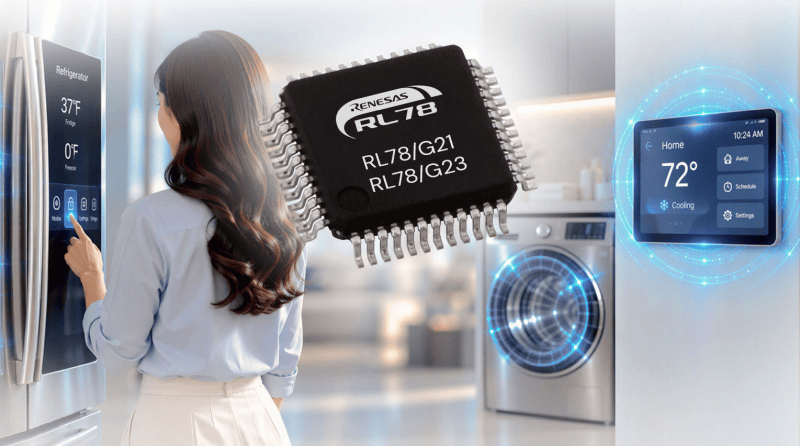
- A new control part: RL78/G21, a 16-bit microcontroller optimised for ultra-low-power system control in air conditioners, refrigerators, washing machines and microwave ovens.
- Reliability and expansion: ±4-kV HBM ESD tolerance for manufacturing, assembly and field handling, plus a UARTA interface that leaves room for extra sensors or a connectivity add-on.
- Memory and clock options: code flash of 128 KB or 256 KB, data flash of 4 KB, and a high-speed on-chip oscillator with ±1.0% accuracy.
- An HMI refresh: new RL78/G23 devices that lift capacitive-touch channels well past the levels of the existing R7F100G, reaching 24 in the 44-pin body and 25 in the 48-pin body under the R7F104G designation.
- An upgrade path: pin- and function-compatibility with RL78/G13 and RL78/G23, so most projects become re-layout and re-qualification rather than a new architecture.
Q2 — Which part should the product team pick?
Conclusion first: split by function count, not by product generation.
| Design goal | Right device | Why it wins | Watch-out |
|---|---|---|---|
| Standby-critical control board (inverter, compressor, sensor front end) | RL78/G21 | 34.4 µA/MHz plus 4 KB of data flash deletes an external memory | A busy touch panel still needs a second driver |
| Control plus a dense touch panel on one chip | RL78/G23 (R7F104G) | Folds user interface into the control MCU, cutting component count | Higher starting price at $0.77 |
| Refresh of a shipping RL78/G13 design | Either, per pin map | Pin- and function-compatible, so redesign stays minimal | EMC and safety paperwork still need retesting |
| Voice, graphics or full connectivity stack | Neither alone | Companion module or higher-tier family carries the load | Two supply chains to manage instead of one |
Q3 — Does 34.4 µA/MHz change compliance, or only cost?
Conclusion first: it is a power-rail and cost story, not a shortcut through an energy label. The European Commission's revised rules covering standby, off mode and networked standby in electrical appliances have applied since 9 May 2025, and national guidance such as the Netherlands' business.gov.nl lists the limit values taking effect from 9 May 2027 as no more than 0.5 W in standby and 0.3 W in off mode.
Run the arithmetic on a 3.3 V, 24 MHz control loop: 34.4 µA/MHz works out to roughly 0.83 mA, or about 2.7 mW on the control MCU itself; the figure implied for the RL78/G13, at roughly double, is about 5.4 mW. This is APACTechDigit's own calculation from the published specification, and it leads to two conclusions. The saving is genuine but small inside a 0.5 W appliance budget, so nobody should claim a label class on it alone. The real value is what the lower current enables — smaller power-supply circuitry, less battery capacity in interface-heavy designs and a cheaper total system, which is the benefit Renesas itself attaches to the number. For lines selling into China, where standby draw is measured under the national method standard GB/T 35758-2017, the headroom converts into one more feature — a display, a relay driver, a module — inside the same declared value.
Q4 — How risky is migration from an existing RL78/G13 board?
Conclusion first: low risk, provided the qualification calendar rather than the datasheet drives the schedule. Pin and function compatibility with RL78/G13 and RL78/G23 keeps layouts close to the original, while the on-chip oscillator at ±1.0% and the 4 KB data flash let designers remove a crystal and an EEPROM. Development support through Smart Configurator and fast prototyping boards shortens the time from code to first prototype, which is where small regional teams usually lose a quarter.
Q5 — What do 24 and 25 touch channels actually unlock?
Conclusion first: the channel count is a line-item saver because it removes a second processor. The prior RL78/G23 (R7F100G) offered 14 touch channels in the 44-pin package and 16 in the 48-pin package; the R7F104G moves the ceiling to 24 and 25, which covers hobs, combination ovens, washer-dryers and range hoods with multiple keys, sliders and a rotary knob on one device. Because Renesas keeps the touch peripheral common across the RL78, RX and RA families and pairs it with the QE for Capacitive Touch configuration tool, a panel design can move upward without a rewrite.
Risk note for APAC factories: capacitive sensing detunes when the enclosure, bezel thickness or ribbon length changes, so a higher channel count has to be validated on the final housing and on production-voltage rails, not only on an evaluation board.
Q6 — What should reliability and security reviewers flag?
Conclusion first: put the ESD rating and the safety library into supplier documents, not just into the engineering file. The ±4-kV HBM ESD tolerance targets handling damage during assembly and the field-return rate that follows it. Raji Mukhopadhyay, business division manager in the EP Mainstream MCU business division at Renesas, framed that tolerance as the key differentiator in the launch, alongside what appliance makers keep asking for: more intelligence, a better user experience and stronger safety without extra cost or energy consumption.
Both groups add flash read protection, a flash write-protect window, a unique chip ID and a customer ID — the standard defence against counterfeiting and cloning, which matters on high-volume Asian channels. A self-diagnostic library compliant with IEC 60730 is also listed, which is the line Japanese, Korean and EU safety reviewers ask for first.
Q7 — Where does the launch hit hardest across Asia-Pacific?
Conclusion first: the volume pull sits in South and Southeast Asia, the specification pull in Japan, Korea and export-oriented Chinese lines.
- Demand base: Mordor Intelligence values the Asia-Pacific major home appliance market at USD 262.48 billion in 2025 and USD 268.21 billion in 2026, with India alone moving from USD 33.34 billion to USD 35.17 billion over the same interval.
- Localisation: India's production-linked incentive scheme for white goods carries an outlay of INR 6,238 crore across 2021–2029 and re-opened its application window from 15 September to 14 October 2025, which puts component-qualification speed on the critical path.
- Capacity example: Mitsubishi Electric sized its Tamil Nadu room air-conditioner plant at an initial 300,000 outdoor units a year, with 650,000 compressors from December 2025 — the kind of ramp where a single-chip control and interface design cuts engineering cost per SKU.
- Export-facing lines face the standby and safety rules above, so ultra-low power plus IEC 60730 support reads as a sales requirement rather than an engineering preference.
Q8 — What will it cost, and where does the line stop short?
Both devices are available from Renesas Electronics, with starting prices of $0.56 for the RL78/G21 and $0.77 for the RL78/G23. The honest limits: the 128 KB and 256 KB code-flash ceiling excludes heavyweight connectivity stacks; no radio is listed on chip, so Matter or Wi-Fi products still need a companion module that the UARTA port can address; and 24 or 25 capacitive channels leave colour displays to a separate driver. Teams benchmarking against low-end 32-bit rivals should price the compatible upgrade path as the main discount, since redesign labour usually outweighs the unit price gap.
Q9 — Action plan for the next two quarters
- Set a per-board standby budget in watts and measure it the way GB/T 35758-2017 and the EU rules measure it before any part selection.
- Run one shipping RL78/G13 SKU through the compatible path and log the redesign hours; that number, not the datasheet, decides the next platform review.
- Score panel designs by channel count first — above 14 channels, compare a single-chip option against a two-chip option instead of defaulting to a UI driver.
- Add the ±4-kV HBM figure and the IEC 60730 self-test support to incoming-inspection and safety-file checklists for export models.
- Dual-source the companion connectivity module before the touch panel is frozen; in practice that component, not the MCU, is the scarce item.
FAQ: what engineering and procurement leads ask first
Is the RL78/G21 a straight replacement for the RL78/G13?
No. It is a lower-power addition to the RL78 family that remains pin- and function-compatible with RL78/G13 and RL78/G23, so existing designs can upgrade with minimal redesign while re-qualification still applies.
Can one chip really run control and the user interface?
Within limits, yes. The RL78/G23 combines system-control and interface functions in a single device, reaching 24 touch channels in the 44-pin version and 25 in the 48-pin version.
Which benchmark backs the low-power claim?
Renesas points to EEMBC's ULPMark-PeripheralProfile, in which earlier members of the family have posted leading results; the RL78/G22, for example, was registered at 330 on 1.8 V and 190 on 3.0 V on Renesas' own product page, as of 10 September 2025. Treat vendor-submitted benchmark entries as comparable within the same profile, not across profiles.
Do these parts handle Wi-Fi or Matter on their own?
No on-chip radio is listed. The UARTA interface is the documented expansion route, which in practice means pairing the MCU with a connectivity module.
Is the $0.21 price gap worth deciding on?
Rarely on its own. The cheaper comparison is one MCU, one power rail and one safety file against two of each, which is where the RL78/G23 case is usually made.
Reference sources
- Renesas launch announcement, Businesswire, 28 October 2026: https://www.businesswire.com/news/home/20261028688857/en/Renesas-Expands-RL78-Family-with-Ultra-Low-Power-16-Bit-RL78G21-MCU-Optimized-for-Smart-Appliance-System-Control
- European Commission energy news on revised standby-mode limits, 8 May 2025: https://energy.ec.europa.eu/news/eu-consumers-save-energy-new-limits-standby-modes-electrical-appliances-2025-05-08_en
- Netherlands business.gov.nl standby limit values effective from 9 May 2027: https://business.gov.nl/amendments/stricter-requirements-standby-energy-consumption-applicances/
- Mordor Intelligence, Asia-Pacific and India major home appliance market sizing: https://www.mordorintelligence.com/industry-reports/asia-pacific-home-appliance-market
- Mitsubishi Electric press release on the India room air-conditioner and compressor plant capacity: https://www.mitsubishielectric.com/en/pr/2023/0112/
- China national standard GB/T 35758-2017, measurement of standby power for household appliances: http://bzzx.spc.org.cn/guojia/47evzup.html
- EEMBC ULPMark benchmark description: https://www.eembc.org/ulpmark/