
APACTechBriefing Case File: Three Episodes Behind the RTX 5090 370% Premium, and What They Mean for Asia-Pacific GPU Sourcing
Hardware decision-makers in the region are not facing a single shocking percentage this quarter; they are facing a repeating mechanism. Tech Spot's newest survey of the GeForce RTX 50 range plots every model from launch to today, and the result reads like a case study with three distinct acts: a flagship that has escaped its own price sheet, a mid-range that follows component cost rather than marketing, and an entry tier that has quietly stopped being entry-level. Reconstructing those acts — trigger, price path, outcome — plus the component-market data behind them, produces something more useful than a headline: a sourcing playbook for IT, product and capital-equipment teams buying accelerator-equipped workstations across APAC.
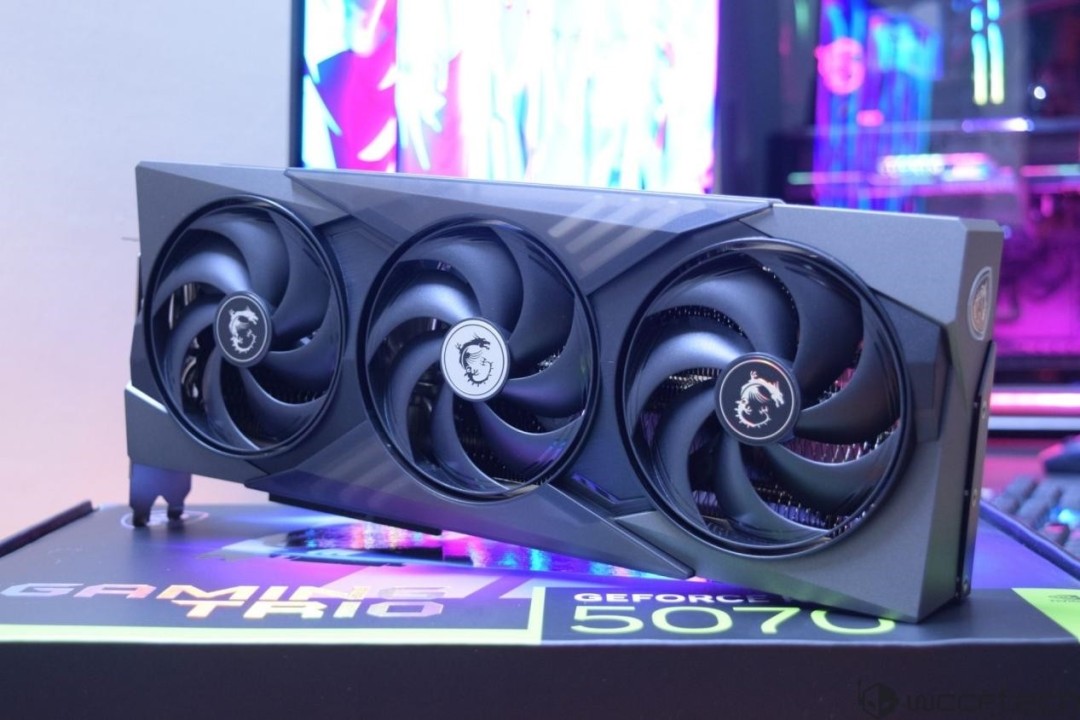
Episode 1 — The flagship that never traded at its own list price
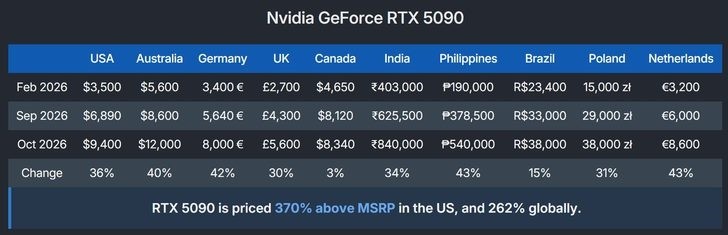
Outcome first: RTX 5090 is now quoted above 9000 US dollars in the United States, which the report converts to roughly 67,834 RMB. That is a 370% premium over the recommended retail price in the US market and about 262% above list on a global average — the steepest curve of any mainstream gaming GPU in recent memory.
The process matters more than the endpoint. Late last year, when the card touched 3000 US dollars (about 19,944 RMB), a large share of buyers decided to wait rather than pay; in hindsight, that was the last defensible reference price in the dataset. Between February and October this year the slope steepened sharply, and the acceleration is compressed into a single quarter: from September to October, the US average price of the card climbed 36% in one month, while Germany, Australia, the Philippines and the Netherlands each logged monthly gains above 40%. Circulation of unconfirmed reports that the card will be phased out progressively has added a scarcity layer on top of the cost layer, lifting quotes again in the most recent weeks.
Episode 2 — The premium slides down the stack, but not uniformly
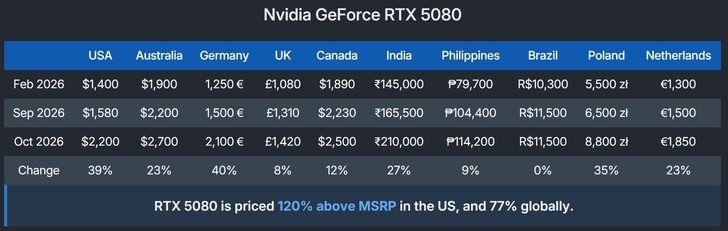
Directly beneath the flagship, RTX 5080 now runs 120% above list in the US and 77% above on the global average, with real transactions around 2200 US dollars (roughly 14,626 RMB). One tier further down, the 70 series behaves differently: RTX 5070 Ti and RTX 5070 carry US premiums of 67% and 64% respectively, yet in October most regions kept single-month movement inside 10%.
That divergence is the transferable insight for procurement. The top of the stack has become an allocation queue priced by scarcity; the middle is still priced by cost. Only the middle is planable, which is why budget owners who benchmark their next quote against the flagship are systematically over-anchoring their forecasts.
Episode 3 — Memory capacity is now the price tag
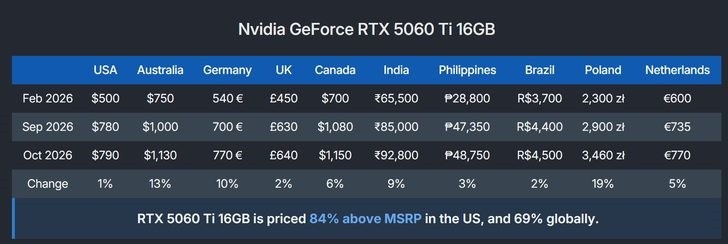
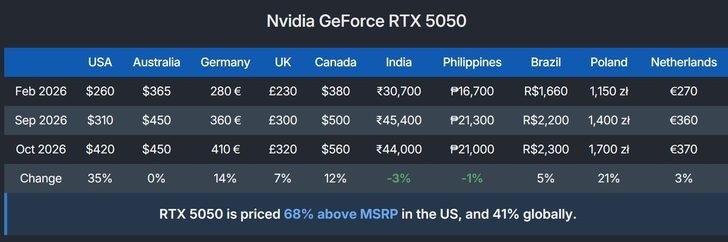
The clearest diagnostic in the whole survey is the RTX 5060 Ti split. The 16GB variant trades 84% above list in the US and is pushing past 800 US dollars (about 5,318 RMB), while the 8GB variant of the same processor rises 40% in the US and 24% globally. One tier below, RTX 5060 posts a 51% US premium and 40% globally. At the bottom of the range, RTX 5050 moved from 260 US dollars (about 1,728 RMB) to 420 US dollars (about 2,792 RMB) inside the year — 68% above list in the US, 41% globally — and can no longer be reliably bought under 400 US dollars despite remaining the cheapest 8GB card of the generation.
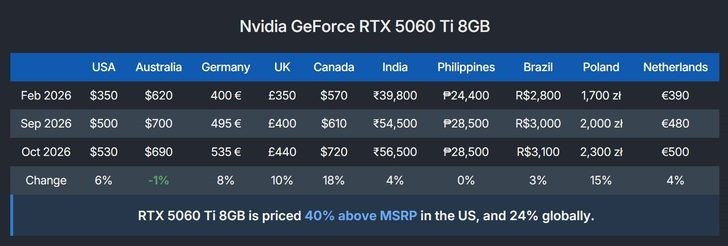
Read as a case, this is where the model of the market changed. When the scarce input is memory rather than silicon, two boards carrying the same GPU die separate in price by the size of their VRAM pool. The card long criticised for weak price-to-performance is now simply the lowest-cost ticket to 8GB of frame buffer, and because memory and PCB costs keep climbing, the report expects further increases rather than stabilisation.
What sits underneath: four external data points the price sheet does not show
- The escalation path is visible in the tracker's own history. Tech Spot runs the same multi-region price survey quarterly across ten markets; its Q1 2026 edition measured the entry RTX 5050 up only 9% on average across those regions. The same card carries a 68% US premium in the current cut (techspot.com), which tells you the whole cycle moved in roughly three quarters, not in one spike.
- Input costs were re-priced after the shipped cards were quoted. TrendForce's September 2026 outlook called for conventional DRAM contract prices to rise 10% to 15% quarter on quarter in the fourth quarter of 2026, following a 13% to 18% increase in Q3 (trendforce.com). Boards manufactured against earlier contract rounds still get repriced as those contracts roll.
- The pass-through started upstream, at board-partner level. Reporting from late July 2026 described notifications to add-in-board partners covering memory kits for both GDDR7 and older GDDR6 products (techpowerup.com) — meaning partner cost bases moved before any retail sticker did.
- The resale mechanism is a repeat, not a novelty. At launch, secondary-market sold listings for the same flagship already exceeded 6,000 US dollars (ign.com). Today's US quote sits half again higher on a tighter supply base, which is why the "wait and it normalises" play has now failed twice in the same product cycle.
Regional read — where APAC absorbs it differently
The Philippines is the only Asia-Pacific market named in Tech Spot's above-40% monthly cohort, and it matches the profile most regional buyers recognise: import-dependent distribution, shallow local inventory, and street prices set by landed cost rather than a manufacturer's sheet. Channel stress is showing up in volume, too. IDC expected Asia/Pacific traditional PC shipments to fall 13.7% year on year to 92.0 million units in 2026 after 11.6% growth in 2025 (idc.com), while Gartner forecast a 10.4% decline in worldwide PC shipments for the same year on memory costs alone (gartner.com). For buyers, the implication is asymmetric: deferred refresh cycles suppress demand, but they do not release supply, so regional prices are unlikely to converge back toward list while allocation persists.
Key numbers for the management brief
- 370% — US premium of RTX 5090 over list; 262% — the same card's global average premium.
- 9000 US dollars / about 67,834 RMB — current US quote; 3000 US dollars / about 19,944 RMB — the level late last year that already sent buyers to the sidelines.
- 36% — one-month rise in the US average from September to October; above 40% — monthly gains in Germany, Australia, the Philippines and the Netherlands.
- 120% / 77% — RTX 5080 US and global premiums; 2200 US dollars (about 14,626 RMB) street price.
- 67% / 64% — RTX 5070 Ti and RTX 5070 US premiums, with October monthly moves held inside 10% in most regions.
- 84% versus 40% — the 16GB and 8GB RTX 5060 Ti US premiums: a directly measurable memory tax. RTX 5060: 51% US, 40% global.
- 260 to 420 US dollars within 2026 for RTX 5050 (about 1,728 to 2,792 RMB), 68% US premium, 41% global, effectively unavailable under 400 US dollars.
- 40% to 120% — the band in which the entire RTX 50 range moved during 2026, with the flagship's 370% far ahead and no realistic return to list in sight.
Premium ladder and planning posture
| Model | US premium vs list | Global premium | Quote in the survey | Planning posture |
|---|---|---|---|---|
| RTX 5090 | 370% | 262% | above 9000 US dollars | Scarcity market; treat as allocation, not purchase |
| RTX 5080 | 120% | 77% | about 2200 US dollars | Cost-plus pricing; quote validity is short |
| RTX 5070 Ti / RTX 5070 | 67% / 64% | not separately reported | monthly moves inside 10% in October | The planable tier; best fit for roadmap budgeting |
| RTX 5060 Ti 16GB | 84% | not separately reported | approaching and exceeding 800 US dollars | Memory-size tax; downgrade spec where workload allows |
| RTX 5060 Ti 8GB | 40% | 24% | — | The hedge inside the same GPU family |
| RTX 5060 | 51% | 40% | — | Mainstream tier, still cost-driven |
| RTX 5050 | 68% | 41% | 420 US dollars, up from 260 | Entry tier no longer cheap; validate need before replacing |
Action list for the next two quarters
- Re-anchor budgets to the mid-range, not the flagship. Build forecasts from the 70 series and 60 series premium curves, which still track input cost and move under 10% month to month; treat flagship numbers as an allocation problem with a scarcity premium attached.
- Buy against memory requirement, not model name. The 44-point gap between the 16GB and 8GB RTX 5060 Ti in the US is a spec decision, not a vendor decision. Where a workload fits 8GB, specifying 16GB now costs roughly double the premium.
- Track contract rounds as a leading indicator. Quarterly DRAM contract price direction precedes street price by one to two shipping cycles; a quarter in which contract prices rise again should trigger early POs rather than waiting.
- Lock quote validity into purchase orders. With a 36% monthly move on the flagship, verbal pricing is worthless beyond days; require 7- to 14-day firm windows and cap escalation clauses.
- Extend, don't replace, in APAC channel-constrained markets. Where local distribution is thin, deferring a refresh by one cycle is cheaper than paying a landed-cost premium — but only if warranty and service coverage survive the delay.
- Price the secondary market as a fallback, not a bargain. Resale has repeatedly traded above the failed wait-and-see strategy at launch; treat used listings as a hedge with shortened remaining warranty and no allocation guarantee.
What could break the case's logic
Two variables would flip the conclusion. First, a genuine supply release in graphics memory would collapse the VRAM-size tax fastest, since it is the mechanism holding up the low end; forecasters currently see no meaningful relief while data-centre demand absorbs capacity. Second, an actual discontinuation of the flagship would confirm the scarcity reading rather than relieve it, pushing remaining inventory further from list. Until one of those happens, the operating assumption should be repricing, not rationing.
The briefing line
The takeaway for APAC is not that one card became unaffordable. It is that the pricing mechanism for the entire GeForce RTX 50 range has migrated from list price to input cost plus allocation — 40% to 120% across 2026 for everything except the flagship's 370% outlier. Teams that still budget against announced prices will read every quote as an anomaly; teams that budget against the memory cycle will find the mid-range still buys predictable capacity. That difference is now the whole planning exercise.