
Shopee, Taobao or TikTok Shop: Which 11.11 SG Playbook Wins Your Media Budget?
None of the three 11.11 SG campaigns is mainly a price fight. Shopee is buying cross-generational familiarity, Taobao is buying visibility its own app cannot generate, and TikTok Shop is buying livestream supply plus offline retail proof. For APAC brand, retail-media and growth teams, the decision is which of those assets the funnel is short of this quarter — not which voucher stack looks deepest.
Singapore supplies the arithmetic. The IAS 2026 Holiday Shopping Singapore report found seven in 10 consumers planning to do most or all holiday buying online, while 71% identify mobile as their primary shopping device. Regionally, Momentum Works put 2025 platform GMV across Southeast Asia at US$157.6 billion, up 22.8% year on year, with three platforms holding 98.8% of that pool. As Singles’ Day opens, the platforms are spending like media owners rather than discounters.
How big is the Singapore prize, and who already holds it?
Short answer: the region’s smallest high-value pool, and the most contested mindshare. Momentum Works figures cited by The Straits Times in April 2026 size Singapore’s platform e-commerce at roughly US$5.9 billion in 2025, with Shopee at 52%, Lazada at 36%, and Amazon and TikTok Shop near 6% each. That ranking explains the tactics: the leader defends with familiarity, the entrant from China buys reach, and the content newcomer buys proof.
Content commerce still punches above its share. DBS research expects Singapore’s social commerce market to reach US$3.17 billion in 2025, with live commerce contributing up to US$1.3 billion — which is why host training and offline formats now sit in the same budget line as vouchers.
What is Shopee buying: recall or retention?
Paid-for recall, then converted into repeat visits through delivery and loyalty perks.
Shopee revived one of the country’s most recognisable characters, with Gurmit Singh’s Phua Chu Kang — now marking his 30th year, and the platform’s first brand ambassador in Singapore back in 2020 — fronting the 11.11 commercial with an original jingle produced with a local audio studio.
Weiyi Tay, head of marketing at Shopee Singapore, framed the intent: “We hope the combination of the iconic character and the catchy tune brings generations together in a distinctly Singaporean moment that makes Shopee feel more familiar and, over time, builds greater affinity and trust in the brand.”
The continuity is deliberate: Germaine Tan and Avery Aloysius Yeo for 3.3, the Fandi family for 6.6, and Tasha Low and Yung Raja for 9.9. On top of that sits the “Biggest livestream party of the year”, stacking Ben Yeo, Lee Teng, Kim Chia, Bonnie Loo and Vivian Lai alongside creators Naomi Neo and Mongabong. Tay notes this year’s campaign runs longer than last year’s, with ‘Buy today, get today’ same-day delivery for eligible orders and an extra 3% cashback for ShopeeVIP members. The catch: familiarity depreciates fast, and cashback-led retention is rented, not owned.
What is Taobao buying: awareness or conversion?
Awareness, explicitly, and it is paying channel-level prices for it. More than 100 million yuan (US$14.9 million) stands behind Taobao’s Singapore 11.11 campaign, with physical advertising spend doubling year on year and the outlay split across consumer subsidies, shipping incentives and media.
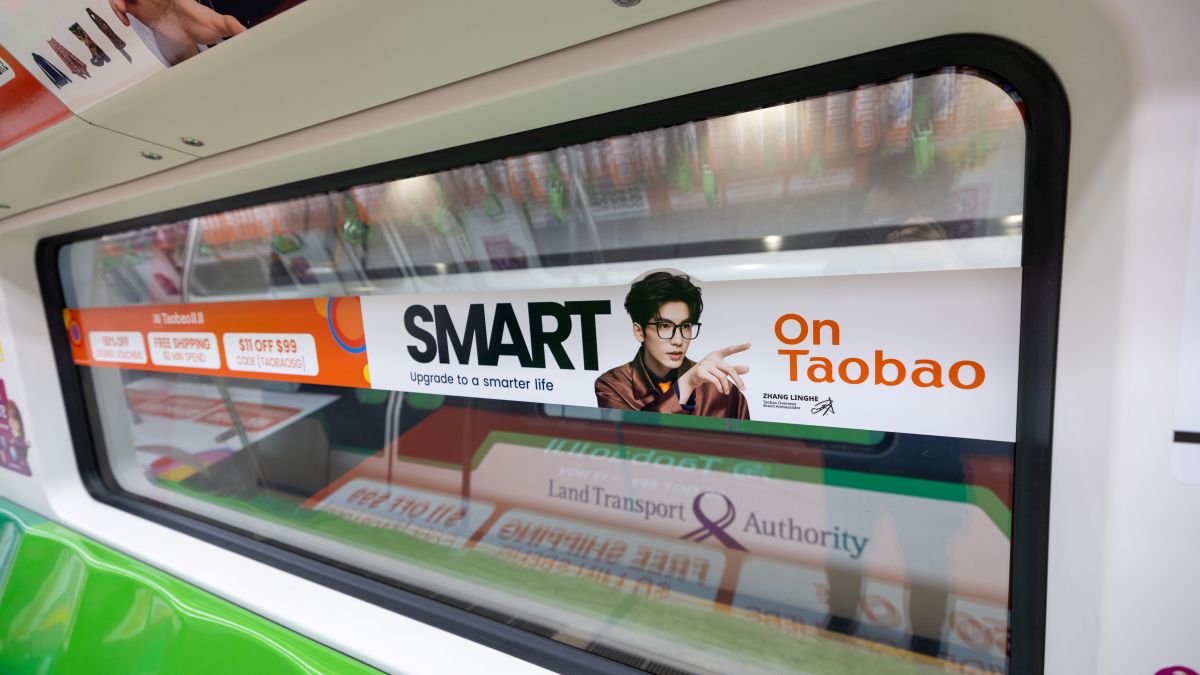
Buyers should size that against the medium itself: Market Research Singapore estimated 2025 Singapore out-of-home spend at about US$164 million (S$219 million), so a single quarter-end campaign of this scale takes a visible slice of available inventory that every other advertiser will want next quarter.
Chinese actor Zhang Linghe anchors the push, his image on themed train cabins across the North-South and East-West lines plus large-format sites islandwide, with QR codes linking those placements to a daily treasure hunt inside the app. The structure covers six shopping experiences spanning quality, taste, lifestyle, smart, trend and surprise. Cora Cai, Singapore country head at Taobao, told MARKETING-INTERACTIVE: “Through OOH, we want to communicate to more Singapore consumers that Taobao is a platform that helps you discover products for every kind of lifestyle.”
Because the reach is bought outside the funnel, the back end has to close the gap: PayNow payments, free shipping with no minimum spend, local returns and air express delivery from SG$1. In planning terms, those service fixes are the campaign; the billboard is only the door.
What is TikTok Shop buying: content reach or retail proof?
Retail proof, layered on an already large content base. Running from 30 October to 15 November, the 17-day “11.11 Mega LIVE Fest” pairs the platform with Joe's Outlets Mega Beauty Festival, described as Singapore’s first offline-to-online beauty event. Across two weekends at Singapore EXPO, more than 500 K-beauty, C-beauty and international prestige brands exhibited, and the first “Mega LIVE Beauty Showdown” put more than 100 local creators and celebrities against one another; the showdown achieved 1.8 times its target GMV. The Tech Show 2026 extends the same logic to consumer electronics.
The metrics disclosed at Singapore Summit 2026 explain the bet: LIVE viewership in Singapore grew 150% year on year, while LIVE GMV rose more than 1.7 times year on year. “One notable shift is the growing role of discovery in the shopping journey,” a TikTok spokesperson said, adding: “Alongside searching for products they’re already intending to buy, consumers are discovering products through short videos, creators, and LIVE sessions, where content can spark interest and inform purchase decisions.”
Talent, not traffic, is the constraint, so the platform funds it: LIVE Host Academy, launched in 2025, trains hosts in Singapore and gives sellers access to a certified pool. The same pipeline is meant to hold sellers on-platform through Black Friday Cyber Monday and the 12.12 Christmas Sale.
Head-to-head scorecard: which play fits your brief?
| Dimension | Shopee | Taobao | TikTok Shop |
|---|---|---|---|
| Asset purchased | Cross-generational recall | Off-app reach in commuter corridors | Host supply plus physical trial |
| Dominant cost line | Talent, jingle production, loyalty cost such as extra 3% cashback | Media buy and shipping subsidy | Event rights, creator fees, training |
| Attribution quality | Strong: in-app journeys plus same-day delivery signals | Weakest: QR-to-app handoff is the only bridge | Strong: session-level GMV, but against self-set targets |
| Best suited for | Mass FMCG, beauty and household brands defending repeat purchase | Cross-border assortment and lifestyle categories needing new demand | Brand launches, demos and impulse-priced bundles |
| Main failure mode | Nostalgia fatigue once the character cycle lengthens | Awareness without landed-cost clarity on delivery and returns | Event spike that decays once offline traffic ends |
Where each model breaks down
Discovery has a hard ceiling. Criteo’s “Spark of discovery 2026” found 60% of Singapore shoppers open to discovering something new, yet 62% still prefer sticking to a planned shopping list. Unplanned add-ons have to be small, credible and physically close to checkout, or the reach spend does not convert.
Cross-border adds a tax tail that platform marketing rarely shows. IRAS has applied GST to imported low-value goods since 1 January 2023 under the overseas vendor registration regime, at the prevailing 9% rate. Any promise built on free shipping with no minimum spend, or air express from SG$1, should be modelled on landed cost before it is matched in your own promotional pricing.
Measurement asymmetry is the quiet issue: platform-reported outcomes such as 1.8 times target GMV or 150% year on year viewership growth are not comparable across campaigns, and none is independently audited.
Action checklist for Q4 media planning
- Match asset to gap. If first-time awareness is the constraint, an out-of-home play with a QR handoff is the cheapest test; if conversion is the constraint, buy livestream slots and host capacity instead of billboards.
- Instrument the bridge. Require UTM-tagged QR paths, per-show GMV, search lift and app-open uplift before committing, so off-app spend is judged on app behaviour rather than impressions.
- Price the tail. Model GST, returns handling and delivery promise feasibility before you mirror a rival’s headline discount.
- Book capacity early. Themed train cabins, EXPO weekends and trained hosts are finite; the scarcity is inventory, not creative.
- Convert, do not capture. For CRM-heavy retailers, checkout-confidence tests beat lead-capture during festival weeks, per our Southeast Asia email budget scorecard.
- Plan the relay. Black Friday Cyber Monday and 12.12 follow within weeks, so hold creative and inventory for the 12.12 Christmas Sale instead of exhausting budget on 11.11.
FAQ: what APAC teams ask next
Is 11.11 in SG still about the lowest price?
Price still opens the funnel, but the differentiators disclosed this cycle are delivery speed, loyalty cashback, creator-led discovery and offline trial — not coupon depth alone.
Which campaign gives the cleanest performance read?
The in-app plays. Shopee’s livestream party and TikTok Shop’s LIVE sessions generate session-level data, while an out-of-home buy depends on QR scans into the app.
Should a cross-border seller copy the MRT-style push?
Only if fulfilment matches. The service fixes behind that campaign — PayNow, local returns, air express from SG$1 and free shipping — are what make reach usable; without them, the media spend only amplifies friction.
How much room is left for impulse?
Real but bounded: the Criteo split of 60% open to discovery against 62% who prefer a list is the practical ceiling on unplanned basket growth.
Sources referenced in this briefing
- The Straits Times: Singapore’s e-commerce platform market expands by 21%, led by Shopee
- DBS Business Class: Live Commerce — Retail’s Next Chapter
- IRAS: GST on imported Low-Value Goods
- Dataglass Labs: Southeast Asia seller market research 2026 (Momentum Works GMV data)
- Market Research Singapore: Singapore media spend and out-of-home outlook 2025