
Malaysia First in 2026: A Trade-Off Test of the Siemens–Swinburne Energy Training Node Model for Asia-Pacific Buyers
By Ethan Rivera · APACTechDigit (APACTechBriefing)
Same skills gap, very different buying routes. The short answer: a training node is worth real budget only where a Siemens installed base, a live grid-code workload and a university partner already exist — which is precisely why the first one lands in Malaysia. Where those three are missing, an OEM certification track or a utility-run academy delivers usable competence faster and at lower cost.
Siemens and Swinburne University of Technology are now taking their Australian energy and power systems partnership international under the Siemens Swinburne International Energy Transition Alliance for Industry Training and Innovation, extending the Siemens Swinburne Energy Transition Hub through a chain of nodes across Asia, starting with Malaysia by end of 2026. The 2026 target is stage one of a network, not a building programme — and that distinction changes how an APAC buyer should evaluate it.
What is actually being extended beyond Australia?
Everything routes back to Melbourne. The Alliance inherits the AU$5.2 million Hub in Melbourne, which integrates Siemens digital energy technology with Swinburne's research, teaching and technical expertise, and which opened in 2023. Since launch, hundreds of energy students, teachers and experts from Australia and elsewhere have completed training through the partnership.
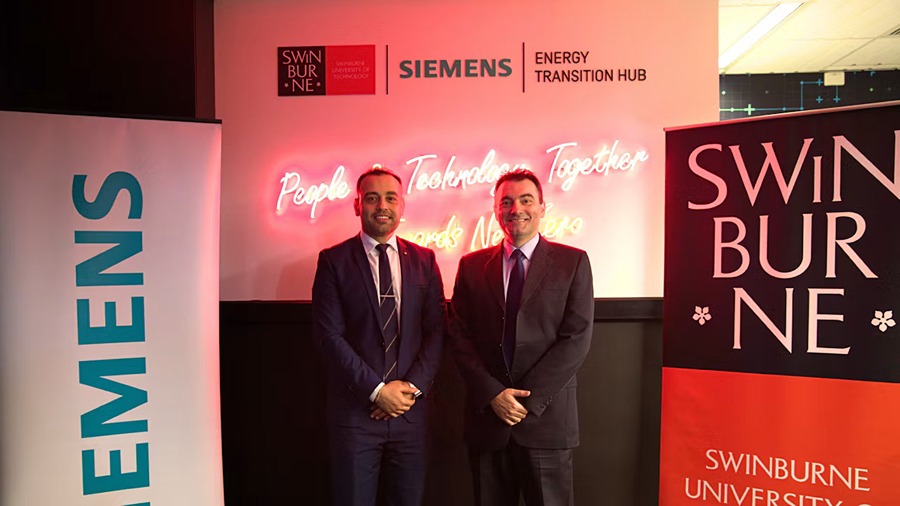
Inside the Alliance, energy-industry professionals are offered specialised training, advanced Siemens technology and practical expertise on modern power systems, renewable energy integration and the wider transition. Access is not limited to utility staff: the Hub is open to students, academia and industry, and it runs research and commercialisation work alongside training.
The architecture is deliberately not a copy of the Melbourne Hub. International nodes act as extensions, with programmes coordinated through the Australian facility and delivered together with local partner institutions. The stated purpose is industry capability, workforce skills gaps, and tighter academia–industry links rather than asset replication.
Why Malaysia, and what the siting order tells buyers
Node sequencing is a commercial signal. Malaysia offers the Alliance two things that other Asia markets ration: an installed base and a written transition schedule. Siemens has supported Tenaga Nasional Berhad's nationwide smart-meter rollout since 2014, according to the Siemens reference library, so metering, grid-edge data and distribution-automation skills already have a local user community to train into.
Policy pull is equally concrete. Malaysia's National Energy Transition Roadmap targets 31% renewable capacity by 2025, 40% by 2035 and 70% by 2050, with roughly 14 GW of solar by 2035 — work that needs protection engineers, forecasting analysts and grid-code reviewers at exactly the level a Hub extension can teach.
A second buyer class is arriving through the demand side. Regional data-centre demand could roughly quadruple by 2035, with Malaysia, Indonesia, Thailand and the Philippines named as the key growth markets in RMI's flexibility analysis. Demand-side retrofits travel the same path: our audit of Resorts World Sentosa's predictive cooling rollout shows how much of an Asia-Pacific efficiency programme still cannot be externally verified, which is a training problem as much as a technology one.
Malaysia vs Indonesia vs Vietnam: where the next node pays
| Market | Public capex / planning signal | Dominant grid workload | Node fit today (APACTechDigit analysis) | Watch-out |
|---|---|---|---|---|
| Malaysia | NETR: 40% renewable capacity by 2035, ~14 GW solar; smart-meter base since 2014 | Metering, distribution automation, integration studies | High — installed base plus English-language university intake | Data-centre load growth may outbid utility training budgets |
| Indonesia | RUPTL 2025–2034: 69.5 GW of additions, ~76% renewables and storage; 47,758 km of transmission and 107,950 MVA of new substation capacity | Transmission build-out, island-grid stability, smart-grid rollout | Medium-to-high volume, but a single state gatekeeper sets the agenda | Local-language delivery and long procurement cycles |
| Vietnam | ~US$18 billion transmission investment planned for 2026–2030, per a Watson Farley & Williams report | Curtailment relief, storage integration, reinforcement sequencing | Medium — capacity need outruns training supply | Planning rigidity and licensing delays flagged in the same analysis |
Capex rows are drawn from the public documents listed at the end of this briefing; the fit and watch-out columns are our own comparative assessment, not vendor claims.
Four ways to buy grid capability, compared
| Route | Who pays | Time to first competent cohort | Access to live Siemens tooling | Credential transfer in Asia | Best fit |
|---|---|---|---|---|---|
| Alliance node | Shared between employer and local partner institution | One to two teaching terms | Yes, via the Melbourne Hub and its research stack | University plus OEM backing, recognised across participating markets | Utilities and industrial energy teams that need credentialed staff, not seats |
| OEM certification | Vendor-led fees per person | Weeks to a few months | Only for that vendor's own equipment | Narrow, tied to one product line | Teams already running the certified kit |
| Utility in-house academy | Fully self-funded | One to two years to stand up | Whatever the utility already owns | Low outside the company | Large state utilities with their own control-room practice |
| Local university short course | Per-seat tuition | One term | Limited to lab simulators | Academic credit, weak industry signal | Students and fresh graduates |
What the Siemens and Swinburne side says it is selling
Peter Halliday, managing director of Siemens Australia and New Zealand, framed the move abroad as evidence that industry and academia can cooperate to bring Australian energy expertise to world markets. That wording matters regionally: it exports Australia's grid-reform scar tissue — negative pricing, inverter-dominated stability, distributed-resource orchestration — rather than a neutral textbook. Australia's household-battery and grid-balancing market is exactly where that experience was accumulated; our Virtual Power Plants in 8 Questions breakdown of what Asia-Pacific buyers should test in such contracts is a useful reference point for judging how transferable that know-how is.
Jose Moreira, head of the Grid Software business for Siemens in Asia Pacific, described the initiative as carrying enormous potential. Read commercially, the software seat is where the volume sits: grid software needs configuration, cybersecurity and operational skills that hardware training rarely certifies.
The research pipeline also travels. In 2026 Swinburne University of Technology and Siemens led the first Australian study on quantum-enhanced timing for grid resilience, an outgrowth of the Hub collaboration reported by the Siemens newsroom. A node that can route learners into live research carries credibility a standalone training centre cannot manufacture — and a node that inherits only courseware does not.
The shortage math behind this training market
- The IEA's World Energy Employment report published in December 2025 counts 76 million energy jobs in 2024, up more than 5 million, with the electricity sector alone at around 22.6 million workers.
- In an IEA survey of more than 400 energy companies in 2025, roughly 60% reported hiring difficulties caused by skills and labour shortages — the demand floor under any new training network.
- The IEA's 2026 workforce report on renewables and energy efficiency argues that skills gaps are a multi-stakeholder problem; an Alliance structured as OEM + university + local institution is that model in practice.
FAQ: what Asia-Pacific buyers ask first
When does the Malaysia node open?
It is planned for the end of 2026. No further node dates have been published, so treat 2026 as the only committed milestone in the public record.
Is a node a replica of the Melbourne Hub?
No. The Alliance explicitly runs on extensions coordinated through the Australian facility and delivered with local institutions; the AU$5.2 million Melbourne investment remains the centre of gravity.
Who can enrol, and in which language?
The Hub is accessible to students, academia and industry, but node intake rules and language of delivery will be set with each local partner institution. Confirm both before budgeting headcount.
How much training has the partnership already delivered?
Since the Hub launched in 2023, hundreds of energy students, teachers and experts from Australia and elsewhere have been trained — a cumulative figure, not an annual throughput.
Should a non-Malaysian buyer wait for a local node?
If your grid code, language of operation and utility procurement route differ materially from Malaysia's, wait, or buy Australia-based access now. If you only need vendor-neutral credentials, an in-house academy may still be cheaper per competent engineer.
Before you commit: a localization checklist
- Map your installed base against the node's anchor utility; a node built on metering depth will not teach you island-grid stability.
- Ask who signs the certificate, and whether it is portable to your regulator's competency register.
- Price travel and language: an Asia node is not automatically a local-language node.
- Tie the curriculum to your own workload — protection settings, inverter behaviour, metering data quality — not to "energy transition" as a topic.
- Verify whether the node inherits research access, such as the quantum timing work, or only packaged courseware.
- Reconcile the end of 2026 opening date with your training calendar before you announce a cohort.
Regional difference is the product here, not a footnote: the same Alliance will read as an opportunity in Kuala Lumpur, a procurement negotiation in Jakarta, and a capacity gap still two years away in Hanoi. Further information is available at siemens.com. Corrections and document requests: APACTechDigit editorial desk, contact@apactechdigit.com.
Sources and further reading
- IEA, World Energy Employment 2025 — executive summary: https://www.iea.org/reports/world-energy-employment-2025/executive-summary
- IEA, Ensuring a Skilled Renewable Energy and Energy Efficiency Workforce: https://www.iea.org/reports/ensuring-a-skilled-renewable-energy-and-energy-efficiency-workforce
- Ember, Solar and grid flexibility critical for Malaysia's future electricity: https://ember-energy.org/latest-insights/solar-and-grid-flexibility-critical-for-malaysia/
- RMI, The Importance of Data Center Flexibility in Southeast Asia: https://rmi.org/resources/the-importance-of-data-center-flexibility-in-southeast-asia/
- Hogan Lovells, Key takeaways from Indonesia's 2025–2034 RUPTL: https://www.hlc.com/en/publications/powering-indonesias-future-key-takeaways-from-the-20252034-ruptl
- Asian Power, US$18b grid investment crucial to Vietnam's energy future: https://asian-power.com/regulation/news/18b-grid-investment-crucial-driving-vietnams-energy-future-report-says
- Siemens reference library, Smart metering transformation for Tenaga Nasional Berhad: https://references.siemens.com/en/reference/smart-metering-malaysia
- Siemens newsroom, Swinburne and Siemens lead first Australian study on quantum timing: https://news.siemens.com/en-us/swinburne-quantum-timing/