
APACTechBriefing: TCL CSOT's Guangzhou G8.6 Printed OLED Line vs Vacuum Evaporation — What APAC Teams Should Decide
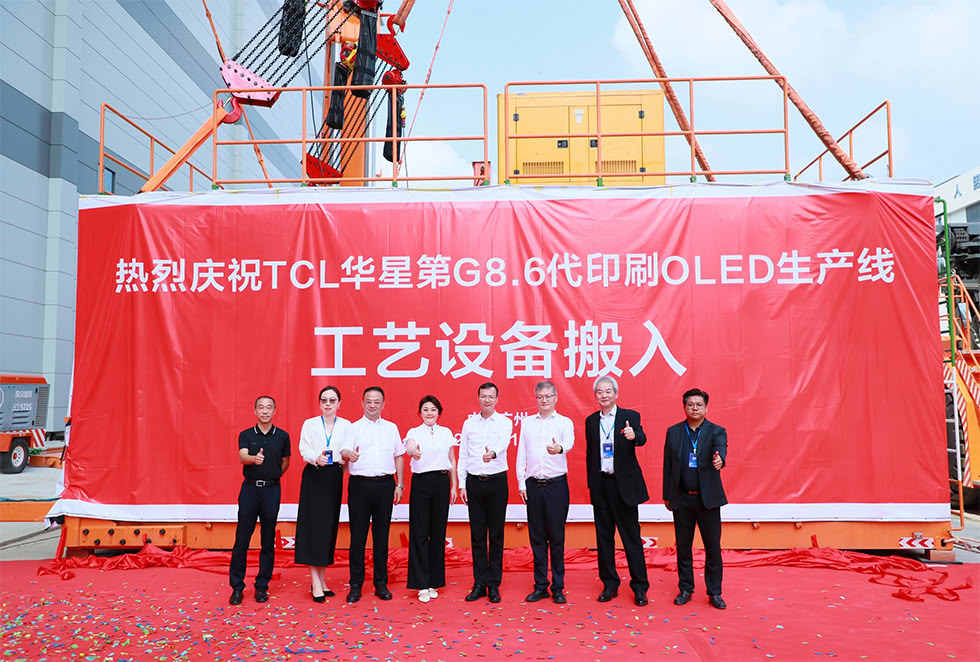
TCL CSOT's t8 equipment move-in does not prove printed OLED has won. It pushes a commitment of RMB 29.5 billion, or 295 hundred million yuan (USD 4.42 billion), on the Guangzhou G8.6 printed OLED line from construction into hardware debugging, after a September 2025 start, 226 days of main-plant framing and a mass-production target in the fourth quarter of 2027. For APAC buyers, the decisive question is process maturity, not headline capacity.
What changed at the Guangzhou 8.6-generation production line?
The practical signal is that manufacturing tools are now physically inside the plant. Guangzhou municipal government reporting says the shell reached structural completion on 8 May 2026 earlier than planned; Huangpu district government reporting says the t8 process-equipment move-in ceremony happened on 31 October 2026, with core equipment lifted to the L40 loading platform. The project therefore entered installation and debugging while retaining the company's published schedule.
The figures that matter for sourcing are less emotional. Public information ties the project to a RMB 29.5 billion, or 295 hundred million yuan, capital plan, a September 2025 construction start, 226 days to finish the main plant structure, and a design load of 22500 glass substrates per month. Each substrate measures 2290 mm × 2620 mm. Early output is directed toward tablets, laptops and monitors; flexible and foldable uses remain exploratory.
Printed OLED vs vacuum evaporation: what you gain, what you risk
The routes solve different cost problems. Vacuum thermal deposition vaporises organic material in a chamber and drives it through a fine metal mask. Inkjet printing turns the same class of material into ink and places it into defined pixel regions. TrendForce's note on mid-size display demand says the printed approach is designed to remove masks and vacuum chambers, improving material utilisation and lowering equipment investment.
| Decision factor | Printed OLED (t8) | Vacuum evaporation (rival IT OLED lines) | Read for APAC buyers |
|---|---|---|---|
| Process logic | On-demand deposition of emissive ink | Mask-based vapour deposition | Mask supply and chamber throughput remain bottlenecks for the incumbent route |
| Material use | Higher, because material is placed where pixels are required | Lower, because excess material is captured on masks and chamber walls | Material-heavy products gain most if printing yield holds |
| Equipment load | Fewer large vacuum chambers | Dense vacuum and mask infrastructure | Lower capital per unit could translate into faster price moves in mid-size panels |
| Size ceiling | Suited to large substrates such as the 8.6-generation format | Suited to formats already qualified with existing masks | Cutting economics from 2290 mm × 2620 mm will decide real panel cost |
| Proven risk | Scaling a newer process to high-gen volumes | Cost and supply concentration from mature tooling | Yield curves matter more than monthly substrate counts |
TCL CSOT frames the milestone as the latest stage of a long climb. Cao Weiran, general manager of the TCL CSOT printed OLED middle platform, says the 13-year journey began with a single drop of ink and experimental samples, passed through the Wuhan T12 5.5-generation line — described by the company as the first printed OLED line to reach production — and now arrives at tool installation on the Guangzhou 8.6-generation production line. In his account, the t8 move-in puts the programme in its final sprint toward mass manufacturing.
How does t8 compare with other 8.6-generation IT OLED plans?
Asia-Pacific display capital is chasing the same device classes, but not the same factory physics. TrendForce reporting on the high-generation IT OLED competition says BOE confirmed a Gen 8.6 OLED investment by the end of 2023 using fine metal mask evaporation and tandem stacking, while Samsung Display has pushed to lead the same segment. The contrast is useful: t8 bets that printing can rewrite the economics of mid-size OLED, while much of the competing 8.6-generation build-out depends on the proven evaporation path.
For panel purchasers, that creates a second negotiating axis. If printing reaches stable yield at 8.6-generation substrate size, cost pressure should appear first in monitors, laptops and tablets, where glass utilisation and panel area dominate price. If yield disappoints, evaporated supply keeps the advantage, and IT OLED pricing stays tied to existing capacity, mask economics and tool scarcity rather than to a new deposition method.
Which APAC teams should act now?
The line is not yet a shipping alternative, but its debugging phase changes planning assumptions for 2027 and 2028.
- PC and monitor product managers: treat the fourth quarter of 2027 date as a qualification target, not a guaranteed launch date; request panel-by-substrate yield data instead of relying on 22500 substrates per month.
- Sourcing leads: run dual-track comparisons of printed and evaporated mid-size OLED across lifetime, bezel design, power, warranty cost and repair rates, rather than claimed process advantages.
- Materials and equipment suppliers: track demand for inks, print heads, curing modules and inspection tools, because the bottleneck shifts from vacuum capacity to deposition uniformity once machines are installed.
- Regional channel teams: watch Chinese notebook and gaming-monitor refresh cycles first, then anticipate slower adoption by Japan and Korea brands as qualification and brand risk controls absorb the new panel option.
- Strategy and investment readers: score progress on commissioning, first qualified panels and yield on the 2290 mm × 2620 mm parent glass, not on topping-out or equipment ceremonies alone.
FAQ: questions APAC readers ask before sharing this briefing
Is this the first printed OLED line?
No. The Guangzhou project is presented as the first 8.6-generation printed OLED line. The earlier Wuhan T12 5.5-generation line is described by TCL CSOT as the first printed OLED line to reach production, so t8 is a scaling step, not an academic test.
What products benefit first?
The stated launch mix is tablets, laptops and monitors, because those panels align with mid-size OLED and large glass formats. Flexible and foldable products are mentioned as possible directions, but they are not the immediate volume market.
Will printing make OLED cheaper right away?
Not automatically. The theoretical advantages are real: less wasted material and fewer vacuum chambers can reduce unit cost. The commercial outcome depends on yield, inspection speed and material lifetime. Until those are proven at 8.6-generation volumes, evaporated panels remain the safer choice for products that cannot tolerate qualification delays.
What is the most important date to watch?
After the 31 October 2026 tool move-in, the next signals are commissioning progress and first qualified panels, because they determine whether the fourth quarter of 2027 mass-production plan remains realistic.
Bottom line
For APAC technology leaders, the t8 update matters less as a victory lap than as a comparison frame. Printed OLED offers a credible cost logic for mid-size IT panels, and the Guangzhou 8.6-generation production line has crossed into equipment phase with a monthly design load of 22500 substrates. The commercial verdict still depends on yield, not on capital announcements. Buyers should keep both routes live, while watching how quickly a 13-year R&D path can become repeatable shipments.