
Tesla's Emergency Drive Away Puts a Price Tag on Escape: An APAC Briefing on Interlock Risk, Cost and Liability
For Asia-Pacific decision-makers, the interesting part of Tesla's latest over-the-air release is not the drama. The company has converted a physical safety interlock — the mechanism that stops a car from moving while a live DC cable is seated in its charge port — into a software-authorised, customer-billed override. Escape speed is now bought with equipment life, a mandatory workshop visit and a repair ceiling that the manufacturer itself quantified. Below we break the mechanism down, cost it out, and mark exactly where it does and does not touch our own region.
The 30-second brief
- What shipped: Tesla published Emergency Drive Away (emergency drive-away) inside software update 2026.38.3, so a driver in genuine danger can select drive while the Supercharger cable is still plugged in.
- Where it works: Tesla's own Supercharger stalls only — V2, V3 and V4 hardware — with no support for third-party chargers or home wallboxes, according to owner-thread replies summarised by Electrek.
- Verified cost anchors from our base reporting: USD 539 for a post-activation charge-port inspection (about RMB 3595 in Kuai Technology's conversion), up to USD 25000 to repair a damaged stall, and total driver exposure topping RMB 170000 once fines are added.
- Benchmark added by this desk: Tesla's own Supercharger for Business configurator prices an eight-post V4 site at roughly USD 500,000 in hardware — about USD 62,500 per stall before installation, so the worst-case repair equals roughly 40% of a single post.
- Regional read: connector latching is handled differently under GB/T 20234 in China and the CCS2 electromagnetic actuator used across most APAC markets, so parity for drivers outside the US is a standards and insurance question, not a software toggle.
What the update actually changes at the charge port
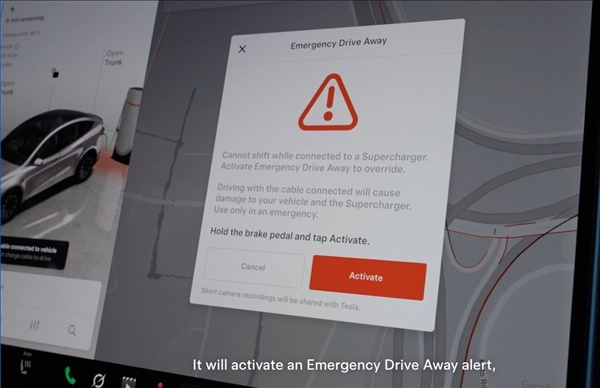
The default logic is unchanged: with a cable connected, the vehicle refuses to engage drive. If a driver tries anyway, the centre screen now shows a red warning reading "Gear cannot be selected while connected to a Supercharger; activate Emergency Drive Away to force release". Confirming it requires a foot on the brake pedal at the same moment the driver taps "Activate". Once triggered, the connector is torn out of the port, the car can roll away, and the vehicle pushes a short camera clip to Tesla as evidence that a real emergency was involved.
The bill: pricing an escape
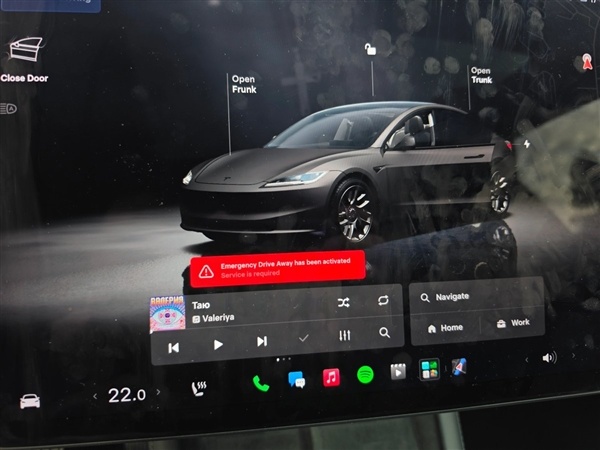
The cost structure is where this feature becomes a business story rather than a gadget. After activation the car keeps a red alert on screen and demands an after-sales inspection. User @Tutrifour posted on the X platform that a Tesla service centre charged USD 539 even though the car had not moved an inch — the visit covers a charge-port check and clearing the alert, a figure Kuai Technology converted to about RMB 3595. Charging still works normally in that state.
An actual drive-off is far more expensive. Tesla states that repairing a damaged Supercharger can run up to USD 25000, which the same Chinese trade coverage rendered as about 16.7 on the ten-thousand-yuan scale — roughly RMB 167,000 — and misuse may attract additional penalties, pushing the worst-case sum to RMB 170,000. Damage to the port and the connector depends on pulling force and angle; in severe cases the whole charge-port module must be replaced.
| Metric | Value (as reported) | Why it matters in APAC |
|---|---|---|
| Software release | 2026.38.3 | OTA-gated; feature not enabled on non-US stalls |
| Inspection after a false trigger | USD 539 / about RMB 3595 | Cash cost even with zero vehicle movement |
| Stall repair ceiling quoted by Tesla | USD 25000 / 16.7 (ten-thousand RMB) | Electrical, civil works and coolant cleanup in one bill |
| Driver exposure including penalties | RMB 170000 | Large enough to move insurance and site-policy debates |
| Hardware cost per V4 stall post (benchmark) | USD 62,500; USD 500,000 per 8-post site | Repair ceiling is roughly 40% of one post's hardware |
| EV share of global car sales, 2026 (IEA Global EV Outlook 2026) | about 29% | Site-safety features shift from niche to mainstream demand |
Why the lock exists — and why Tesla broke it
The interlock is not a quirk. Connector locking is a standards-level safety function: CCS inlets are fitted with an electromagnetic locking actuator, and the plug must be held seated before and throughout charging so that a live high-current circuit is never opened under load, which would produce an arc (Phoenix Contact's e-mobility technology guide; published connector-interlock safety-function documentation on tdcommons.org). Untangling a stuck connector normally means unlocking from the touchscreen or the handle button and, if that fails, pulling the mechanical release cable at the rear of the car. When a threat is outside the window, those seconds are the whole difference.
That is the scenario the update answers. The rollout followed an attack at a Supercharger in Twin Falls, Idaho, in August 2026, in which a gunman fired at people sitting inside charging vehicles that could not pull away — background reported by Electrek and CarBuzz. The engineering trade-off is explicit: a software unlock now sits on top of a hardware lock, buying an exit at the cost of equipment life.
Human error is already exposing the seam. A few days ago at an Austin Supercharger, a fatigued owner tapped through every confirmation prompt and drove off with the cable attached, producing the first recorded accidental trigger of the feature. Tesla's charging business director Max de Zegher said the company would improve the function quickly on user feedback, with false activation as the priority optimisation.
The accountability gap APAC readers should note
Tesla has not published an answer to who pays when a driver uses Emergency Drive Away in a genuine attack: owners asked directly in public threads and the company's account replied around the question, while confirming the feature works on V2, V3 and V4 stalls and not on home chargers (Electrek, 2 October 2026). Glycol cable coolant spills when a connector is torn out, which is why the site itself needs a mandatory service visit; the car needs one too, at a separate, unpublished price.
In most APAC markets charge-point ownership is split between an automaker, a third-party operator, a property owner and a retail partner. A software escape hatch that can destroy shared equipment with no contractual liability allocation is a governance problem long before it is an engineering one. Networks that open stalls to multiple brands — now common across Australia, Thailand and Korea — will have to choose between accepting a manufacturer-driven override, negotiating a cost-sharing clause, or pushing for regional latching rules that separate safely under load.
Where this lands in Asia-Pacific
Tonight the feature is a US-only capability, and the region it most affects is not the one that buys the most EVs. The IEA's Global EV Outlook 2026 expects electric cars to reach roughly 29% of global sales this year, with China accounting for more than half of world EV volume and Chinese-made imports now exceeding half of sales outside Europe and the United States. Tesla's own APAC footprint is dense enough to make an equivalent decision expensive: about 165 Supercharger sites in South Korea, 150 in Australia, 138 in Japan and 107 in Taiwan as of January 2025 (Tesla Supercharger network, Wikipedia), plus China's GB/T 20234 connectors, which use an automatic latch of their own.
Two more signals worth logging. First, the aftermarket already judged the gap: the breakaway adapter sold as EVject, priced around USD 299, saw renewed recommendation after the Idaho attack, and Tesla had sued its maker in 2024 — evidence that driver-side escape demand existed before the software. Second, the pressure is regional and rising: Tesla is adding 21 highway rest-area sites in South Korea under a national charging programme (Drive Tesla Canada, October 2026) and is building its largest Australian site with more than 25 V4 stalls, so whatever interlock policy is set today scales quickly across APAC footprints.
Action list for readers
- Drivers and fleet managers outside the US: treat the feature as US-only and plan the old way — release the port from the app or screen before leaving the seat, document the mechanical release route, and brief drivers on both.
- Fleet safety policy: classify the override as an emergency-only action with a mandatory post-incident report, because the alert demands an inspection and a false trigger costs roughly USD 539 per vehicle.
- Charge-point operators and property owners: add a drag-out damage clause to site agreements now; assume electrical, civil and coolant remediation, not just a cable swap, and size exposure against a per-stall hardware baseline of roughly USD 62,500.
- Product and compliance teams: log the two verification channels — camera clip plus telemetry — as a pattern for remote incident validation, and specify explicit remote-clearance logic so customers are not billed for a non-event.
- Investors and strategy readers: read this as evidence that automakers will trade infrastructure lifespan for occupant safety, an approach that will shape insurance pricing and standards lobbying in APAC over the next two to three charging hardware generations.
What we are watching
Three checkpoints should settle whether this is a one-market patch or a template. Watch whether Tesla makes the remote alert-clearing path real — if the two data channels confirm no movement, the inspection fee should disappear. Watch whether the liability question finally gets an answer, since owners have already asked publicly and none was given. And watch whether APAC regulators and operator consortia turn the Twin Falls episode into a latching requirement in their own standards work. Against a backdrop where EVs are expected to be about 29% of global car sales in 2026, the escape-first design logic is unlikely to stay confined to one country's Supercharger canopy.