
APACTechBriefing Data Watch: Thailand Moves EV Excise From 10% to 35% — the Numbers Behind the Three-Tier Grid
A 25-percentage-point tax step, one fixed effective date, and a 138% spike in monthly import value: this week's Thai electric-vehicle policy story is best read as a dataset, not a headline. What follows unpacks how many tiers the new grid actually has, the arithmetic that turns tax into sticker price, which operators the reform favours, and the numbers APAC decision-makers should keep on a watchlist through 2027. Every figure cited here comes from the Thai side's own disclosures or from public reporting, and where the fine print is still missing we flag it rather than guess.
One policy, three tiers: the localisation grid
Thailand did not settle on a flat rate. The reform sorts battery-electric vehicles into three tiers based on how much value is created inside the country: models built in Thailand with a high local-content share sit in the lowest band; vehicles assembled locally from imported parts by brands that have filed a production plan fall into the middle band; and fully imported units with no local manufacturing plan carry the top rate of 35%. The design is deliberately linear — the deeper the local footprint, the lighter the tax burden — which converts sourcing and plant decisions directly into tax outcomes.
| Tier | Qualifying position | Tax treatment | Planning implication |
|---|---|---|---|
| Lowest | Plant operating in Thailand, high share of locally produced parts | Bottom band of the three tiers | Cost advantage over imports widens automatically |
| Middle | Local assembly using imported components, production plan submitted | Intermediate rate | Only reachable with an assembly partner and a filed schedule |
| Highest | Completely built-up import, no local production plan | 35% | Price-led positioning largely evaporates |
The arithmetic at the showroom counter
Thailand's Ministry of Finance has walked through the example of a single imported electric vehicle listed at 1 million baht (roughly RMB 200,000). Under the old 10% excise rate, that car carried 100,000 baht in tax. Once the rate shifts to 35%, the retail price rises by at least 250,000 baht — about RMB 50,000 — an increase of more than a quarter. The point for buyers is that part of what looked like a bargain was never a low cost base but a low tax base; the point for brands shipping a narrow trim range is that a jump of this order cannot be absorbed quietly in margin.
Timeline: how quickly the grid became policy
- September 2026 — Thailand's EV policy committee endorsed the three-tier excise structure in principle, with the top band above the existing 10% and, in the finance minister's framing, at roughly 30%.
- October 2026 — the Ministry of Finance said it would table the package to cabinet within about two weeks and pointed to a 1 January 2027 start.
- 3 November 2026 — cabinet approved raising the excise tax on fully imported battery-electric and range-extended vehicles from 10% to 35%, effective 1 January 2027 (bangkokpost.com; nationthailand.com).
- Still open — public statements fix the top rate; the exact percentages for the two lower bands and the audit formula for local content have yet to be spelled out in the published legal text.
Why the lever is excise rather than tariffs
Under the ASEAN–China free trade agreement, import duties on part of the EV cargo already sit at zero, so Bangkok cannot simply lift a border tariff to close the gap between shipped-in and locally built cars. Excise duty is the instrument still within reach, and the same reform weights the local-content calculation toward high-technology components such as drive motors and battery packs rather than bodywork and bolt-up assembly. Two parallel mechanisms push in the same direction: under the Board of Investment's EV 3.5 package, participating brands must build two vehicles in Thailand for every one imported in 2026, with the ratio tightening to three for each import in 2027 (boi.go.th); and the rules on how far imported battery cells may count toward local value added keep narrowing, steering assemblers toward cell-level investment.
Who is protected, who is squeezed
For Chinese makers already on the ground, the grid reads as a tailwind. BYD's plant in Rayong is in operation — an assembly site that opened in 2024 with capacity reported near 150,000 units a year and a mandate to serve wider ASEAN markets (aseanbriefing.com). Changan Automobile has put its first overseas new-energy manufacturing base in Thailand, and Chery and GAC Aion are speeding up localisation as well. Vehicles built locally are untouched by the 35% import rate, so the cost gap over shipped-in rivals keeps widening. On the other side, brands still relying on pure imports face severe price pressure, and the middle band is available only to those able to line up assembly in time.
Import data shows a market that front-loaded
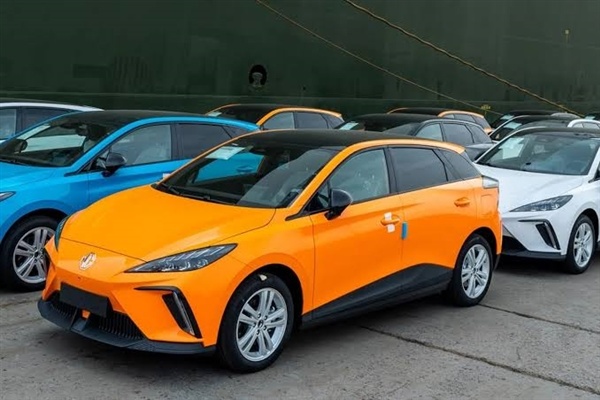
Trade figures released ahead of the cabinet vote explain the urgency. Thailand took in US$421 million of electric passenger vehicles in September 2026, up 138% year on year and 86% above the August level, with China supplying almost 99% of that value; the January–September total reached US$2.37 billion, 96% of it Chinese-sourced, according to Thai government data carried by bloomberg.com. The country's trade-policy office attributed the surge to genuine demand, the expansion of Chinese brands and, notably, shipments pulled forward before the new tax. That last driver is the number to watch: front-loading inflates 2026 volumes and can make the 2027 registration curve look far weaker than the underlying trend.
Macro stakes: why Bangkok moved now
The sector supplies roughly 10% of Thai GDP and employs some 850,000 people in vehicle and parts work (ilo.org), and the government has set a 30@30 goal — at least 30% of vehicle output to be zero-emission by 2030, around 725,000 cars (boi.go.th). At the same time the industry's own 2026 production target was trimmed from 1.5 million units to 1.45 million on soft exports (FTI, via thenationthailand.com). Read against that backdrop, the tax grid is an industrial-policy bet: convert EV appetite into plants and jobs instead of into deeper dependence on imported vehicles.
Five data points to keep on the watchlist
- The gazette text fixing rates for the two lower tiers and the local-content formula, especially the weighting for motors and cells.
- Monthly CBU import value against local registrations — the clearest signal that pull-forward is unwinding.
- Which import-only brands cross into the middle band by filing assembly plans before 1 January 2027.
- Price lists of the five best-selling fully imported models in the first quarter after the new rate takes hold.
- Battery, cell and e-motor plant announcements around the Rayong and Eastern Economic Corridor hubs.
Action recommendations for APAC readers
- Brand and country managers: rebuild landed cost for every completely imported SKU at 35% before setting 2027 volume allocations, and treat the middle tier as the only realistic hedge — test it against the 2:1 and 3:1 local-production obligations rather than assuming assembly equals relief.
- Sourcing and supply-chain leads: map each bill of materials against the tightening local-content definition, prioritising battery cells and drive units, and get supplier documentation audit-ready early.
- Pricing and product teams: do not push the whole increase onto one trim, in a market where lender scrutiny amid high household debt already limits volume (reuters.com); consider spec reduction or leasing and battery-as-a-service offers.
- Strategy and investors: evaluate Thai capacity as an ASEAN export platform question, not only a domestic-sales one, given the export mandate attached to local plants.
- All readers: confirm figures against Excise Department and Board of Investment publications before committing capital — the tier boundaries, not the headline rate, will decide returns.
Bottom line
Read as data, the message is blunt: value must be added inside Thailand to earn the right to compete on price. A move from 10% to 35% starting 1 January 2027 turns a sourcing ambiguity into a hard cost line, and any forecast built on 2026 import flows needs a front-loading correction. Brands that arrive with local content — cells, motors, real assembly — inherit a gap that no advertising budget can close, while pure importers are being asked to choose between margin, exit or a plant.