
iPhone Duo's Near-30% Foldable Share in 2027: What TrendForce's Forecast Changes for Asia-Pacific Roadmaps
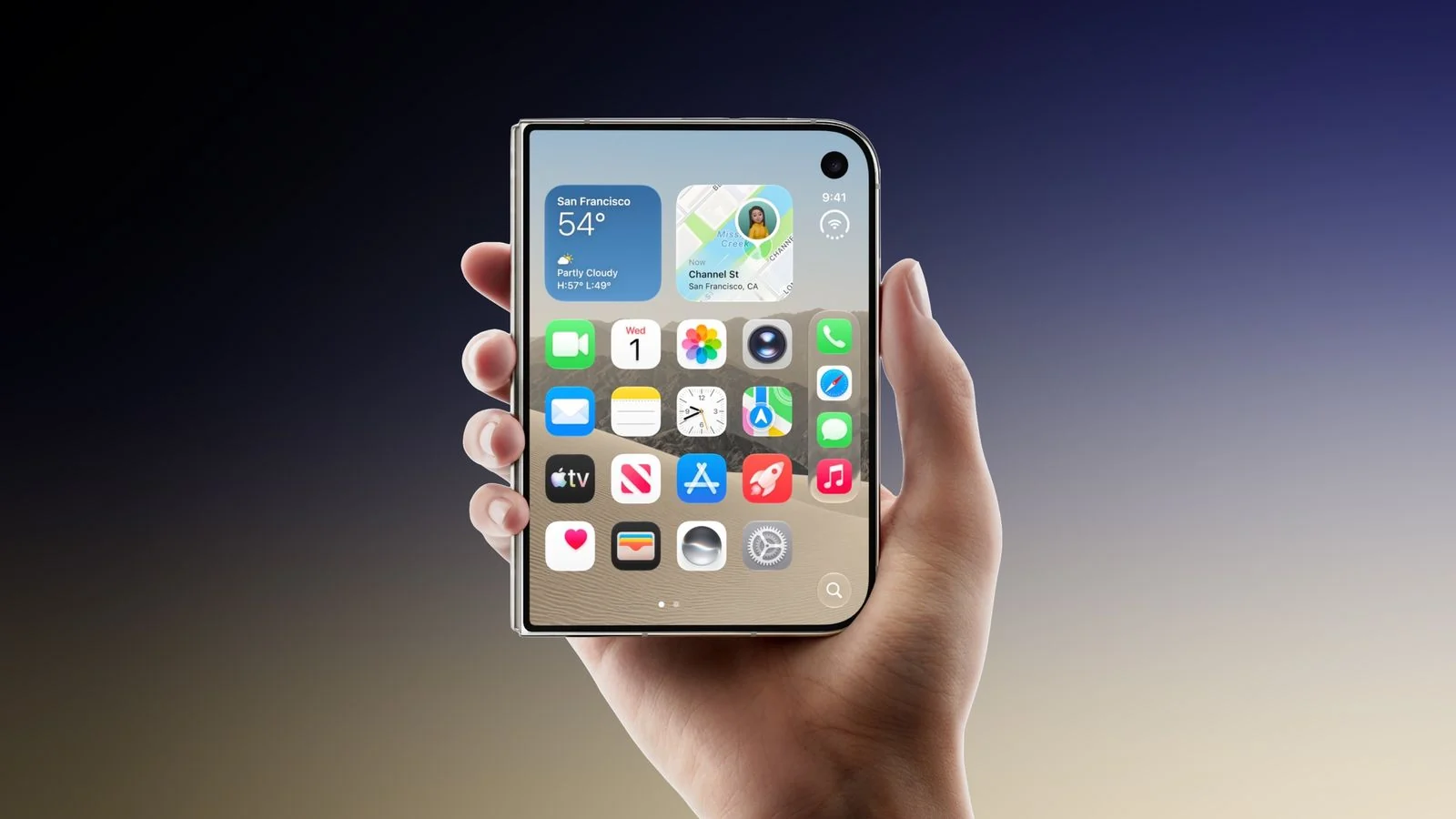
The foldable conversation has matured past hinges and crease depth. The question that actually moves budgets in this region is narrower: can one well-capitalised entrant convert a category growing at a fraction of a percent into a volume business? TrendForce's latest industry report attaches a figure to it — 29.8% of global foldable smartphone shipments in 2027 for the iPhone Duo, Apple's first folding handset — and the rest of the leaderboard rearranges around that single product. Read as a planning input rather than a headline, the forecast resets three things at once: vendor roadmaps, channel economics and the software effort required to sell a folding screen.
The numbers that reset the category
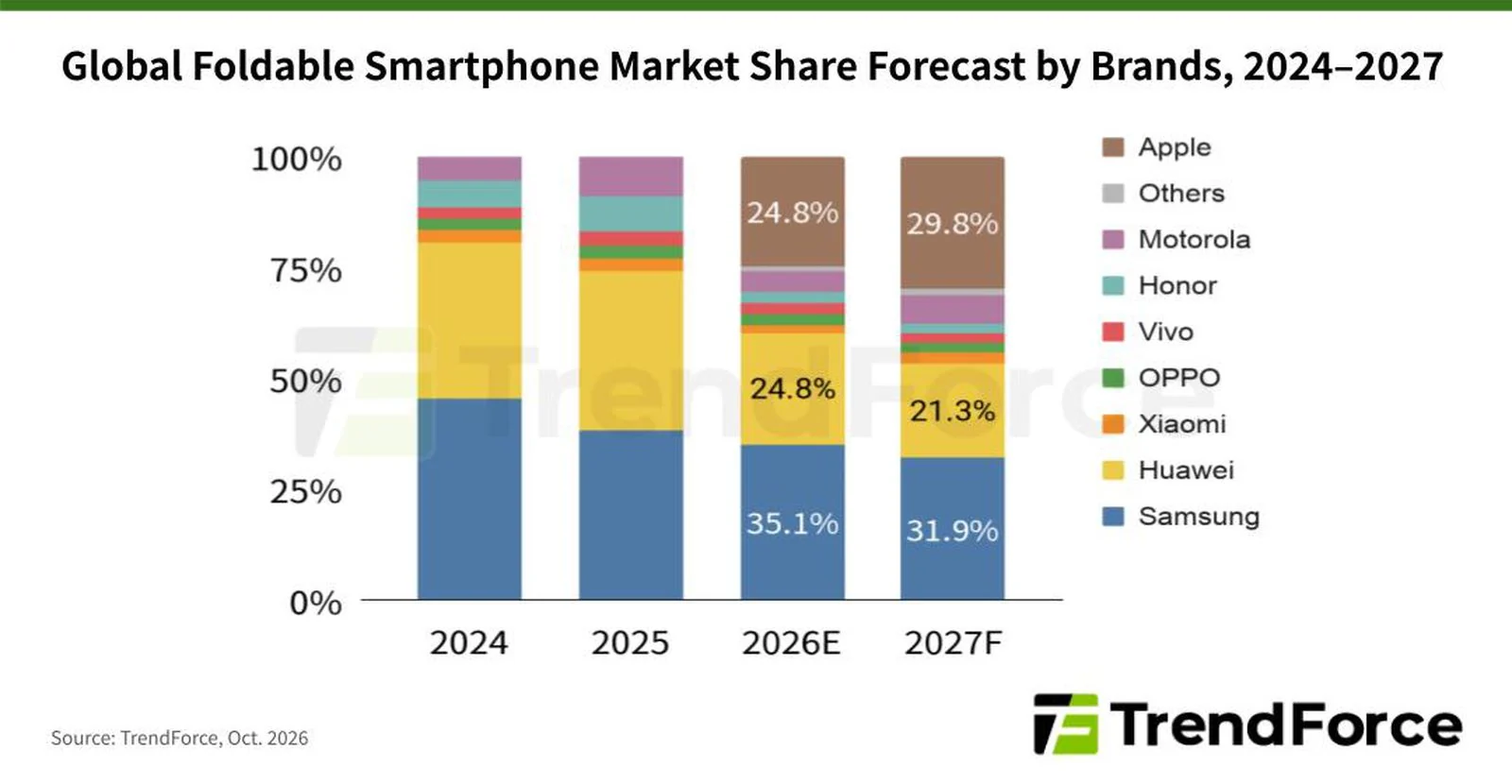
- Launch year: iPhone Duo shipments of around 5 million units before the end of 2026, equivalent to about 24.8% of the global foldable market — a first-year share no foldable vendor has previously reached.
- A flat base: total foldable smartphone shipments are forecast to grow just 0.5% in 2026, while some Android vendors' foldable volumes may fall by more than 20% year on year.
- The inflection: TrendForce expects the global foldable smartphone market to reach 23.5 million units in 2027, up 16.3%, with Apple's share climbing to 29.8%, close to 30%.
Why a stalled market moved
Demand, not supply, did most of the work. Apple has publicly characterised interest in the device as "extraordinarily strong", and within a short window of pre-orders opening, delivery dates in multiple markets slipped by weeks — Reuters reporting placed early estimates for some configurations in late January, while US carrier listings show the handset at a full retail price of $1,999.99 (att.com). Two constraints explain why the category looked stuck before that launch: repair-cost anxiety and a thin software payoff. TrendForce itself flagged in August 2026 that an inner-panel repair on Apple's foldable could exceed $1,155, nearly double the equivalent Galaxy Z Fold 8 bill. Tight allocation plus a high service-cost tail is exactly the profile that makes enterprise and channel buyers cautious.
Why two research houses read one launch so differently
TrendForce's unit-share view sits at the conservative end of the consensus. IDC's estimates are higher: roughly 7 million iPhone Duo units in 2026 and about 70% volume growth in 2027, which would hand Apple close to 40% of the foldable market (199it.com), alongside an earlier projection that first-year shipments could top 10 million units. IDC also frames the story in value rather than units, arguing Apple captures a disproportionate share of category revenue because of its price band. The practical read for planners is that the 2027 number is a range, not a point: allocate against TrendForce's 29.8%, stress-test the upside with IDC's roughly 40%, and treat first-quarter sell-through data — not pre-order queues — as the trigger for any volume commitment.
Where those 23.5 million units actually ship
Regional weighting is the second planning variable. Asia-Pacific is already the centre of gravity: Mordor Intelligence estimates the region accounted for about 54.9% of the global foldable market in 2026, with China the largest single pool. Entry pricing shows how unevenly a $1,999-class device lands: China pre-sale pricing has been reported from about 15,999 yuan (199it.com), a far larger share of median income in ASEAN or India than in Korea, Japan or Australia. Expect 2027 foldable growth to concentrate where carrier instalment plans, trade-in uplift and corporate refresh cycles absorb the ticket — and to disappoint where the category still depends on aspirational purchases.
The pivot from hardware form factor to software and ecosystem
TrendForce's core argument is that Apple's advantage lies in the integration of silicon, operating system and developer ecosystem, and that better app adaptation plus improving hardware reliability will let a folding screen deliver everyday value instead of novelty. The implication is a shift in competitive focus away from pure form-factor innovation towards productivity, multitasking capability and software experience. That shift is already visible in engineering practice rather than marketing: Google's adaptive-app documentation treats hinge- and fold-aware layouts, window size classes and multi-window continuity as baseline work, and it has been pushing developers to support ultra-wide folding canvases (developer.android.com). Meanwhile durability claims have moved up-market — flagship hinges are now advertised as tested for up to 500,000 folds (hihonor.com) — so the next differentiator is service economics and app quality, not whether the screen survives being opened.
Share ladder, 2026 to 2027
| Vendor | 2026 share | 2027 share | Rank | Planning watch-item |
|---|---|---|---|---|
| Samsung | 35.1% | 31.9% | First | Price ladder, accessory and service economics to defend the top slot |
| Apple (iPhone Duo) | 24.8% | 29.8% | Second | Allocation recovery, plus reported follow-ups such as Face ID and a telephoto camera (cls.cn) |
| Huawei | 24.8% | 21.3% | Third | Defence of the China premium segment against Apple's entry |
Apple's leap to second place comes at the expense of both incumbents, but the ranking is not really the point: a new player taking close to 30% of the category on one model line compresses the price umbrella every other vendor relies on.
Action list for APAC technology and digital leads
- Plan in a band, not a point. Model 2027 foldable mix at TrendForce's 29.8% Apple share with an IDC-leaning upside case, and tie re-order triggers to quarterly shipment data.
- Re-price total cost of ownership. Put an inner-panel repair in the USD 1,000-plus range into fleet and channel models; bundle extended warranty or insurance rather than absorbing breakage as an operating surprise.
- Move adaptive layout from backlog to roadmap. Any app sold to foldable owners should specify hinge-aware layouts, resize-safe components and multi-window behaviour in 2027 release trains.
- Sequence markets by financing depth. Prioritise Korea, Japan, Australia and China carrier-bundled volumes; stage ASEAN and India rollouts around instalment and trade-in eligibility.
- Re-open component terms. Hinge modules, ultra-thin flexible glass and yield assumptions are the choke points behind any 16.3% category growth.
- Watch the second product cycle. Reported additions on follow-up models are the signal that Apple intends to treat foldables as a standing line rather than a one-year event.
Trend judgement
If TrendForce's projection is validated, Apple will have captured close to 30% of the global foldable smartphone market within two years on the strength of its first folding model — a trajectory that ends the long assumption that the category belongs structurally to Samsung and Huawei. The durable effect is not the share transfer but the redefinition of what competes: silicon, developer ecosystems and multitasking value rather than hinge geometry. For Asia-Pacific, which already carries more than half of foldable demand, the takeaway is that 2027 is when those assumptions get tested, and the window to re-price, re-sequence and re-tool for that year sits in this budget cycle, not the next one.