
KLEON and SAMASTH: What Ubiqedge's Shared IIoT Stack Means for APAC Field Rollouts | APACTechBriefing
Ubiqedge has taken the integration layer out of industrial IoT by owning both ends of it: KLEON modular edge hardware at the machine, SAMASTH as the data and control layer above it. The number that matters to Asia-Pacific buyers is not the feature list but the clock — a new application in one to eight weeks, against nine to 18 months when the parts come from separate vendors.
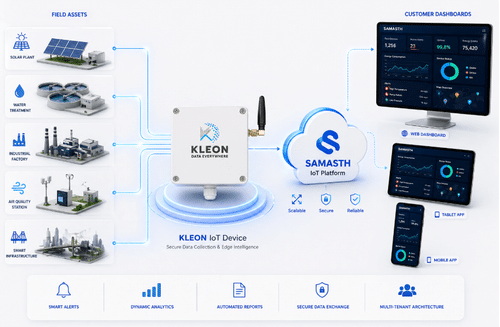 From edge hardware to cloud analytics: The KLEON and SAMASTH architecture.
Why a shared IIoT stack is a budget story, not a gadget story
Read the demand curve first, because it explains why a company founded in 2024 earns a briefing slot. Technavio's April 2026 assessment sizes the incremental industrial IoT opportunity at USD 232.78 billion across 2025 to 2030 at a 15.4% CAGR, with 38.9% of that growth attributed to Asia-Pacific. Mordor Intelligence puts the region's remote monitoring and control segment on a 7.95% CAGR to 2031, carried by automation spending in China, India and Southeast Asia. Those are third-party estimates rather than company figures, but the direction is the point: the next tranche of value in this region is brownfield — pulling data out of pumps, mixers, batching plants and tube wells that were never designed to speak Ethernet or Modbus TCP/IP.
Cost research says the same thing from the other side. A 2026 lifecycle-cost study in Computers & Industrial Engineering identifies integration cost as the primary driver in brownfield IIoT projects, and engineering guides list brownfield integration as the first reason such programmes stall. That line item is exactly what Ubiqedge is trying to delete.
What is actually being taken out of the bill of materials
Conclusion: the item removed is supplier coordination, not a component. A conventional build mixes gateways, sensors, communication hardware and software from different vendors, then spends weeks making them agree.
Ubiqedge answers with two in-house layers:
- KLEON — modular hardware in which the processor is swapped to fit the deployment, linking energy meters, PLCs, pumps, motors, controllers and environmental sensors. Field connectivity covers 4G, Wi-Fi, LoRa, Ethernet and the industrial buses Modbus RTU, Modbus TCP/IP and RS485.
- SAMASTH — dashboards, analytics, predictive analytics, alerts, reporting, remote device management, two-way control and firmware updates on the same data.
For an operations manager the practical difference is who owns a bad reading. In a multi-vendor build the sensor supplier blames the gateway and the gateway supplier blames the cloud. In a single-stack build one company owns the whole path — and one company can also fence it off.
Where the logic runs when the link drops
Conclusion: the edge/cloud split is the design choice that decides how this product behaves in Asia-Pacific conditions. KLEON stores data locally, processes information and executes control logic, while SAMASTH handles analytics, reporting, notifications and fleet management, so a job such as pump scheduling keeps running with no internet connection.
Why that is a regional question rather than a technical one:
- Rural India and irrigation schemes — one node per pump, patchy 4G, LoRa used to aggregate a cluster of wells; the control loop has to live on the device.
- Archipelago sites in Indonesia and the Philippines — the island link is the weak point, and crews expect messaging-app simplicity on the human side plus offline tolerance on the machine side.
- Japan and Korea plant floors — Ethernet and Modbus inside a managed LAN where data often cannot leave the premises; here the constraint is governance, not coverage.
Same stack, three different bottlenecks: coverage, culture or compliance. Which one you hit is set by the market, not by the datasheet.
What the one to eight weeks claim is actually worth
Ubiqedge states that its modular architecture can bring a new application to market in one to eight weeks, compared with nine to 18 months using off-the-shelf hardware or development from scratch. Two consequences for buyers.
Cost shape. A rollout needing two quarters dies in a capital calendar; one that fits inside a quarter gets funded from operating budget and can be abandoned cheaply. That moves the signature from a corporate IT committee to the plant manager.
Repeat-sale economics. Once integration is pre-solved, the second application should price closer to hardware plus licence than to a fresh engineering project. Public numbers suggest an early point on that curve: Inc42 reports the company clocked around ₹7 Cr in FY26 revenue, and Indian Startup News covered a ₹10 crore seed round led by Piper Serica in May 2026. The open question is not whether the clock works inside the building but whether it still holds once channel partners do the configuring.
Why India's field conditions come first
Ubiqedge reports more than 37,000 devices and assets deployed across India, live in solar monitoring, water management, air quality, railway infrastructure and ready-mix concrete. Groundwater is the loudest wedge: the company says the stack has digitised more than 23,000 borewells, its claimed strongest vertical.
Context from the World Bank's Independent Evaluation Group: over roughly five decades India's borewell count grew from 1 million to 20 million, making the country the world's largest groundwater user. A 2024 policy review on depletion (eacpm.gov.in) puts groundwater at about 62% of the country's irrigation and 85% of rural water supply. Millions of small, individually owned, remote pumps on subsidised power reward cheap nodes, offline logic and fast local servicing — the profile KLEON was cut to fit.
That fit does not travel unchanged. In Japan and Korea the installed base of controllers and SCADA belongs to the majors, procurement is measured in years, and feeding an existing DCS is a compliance exercise. Across much of Southeast Asia the decision unit is a distributor, and the winning motion is support responsiveness rather than a platform demo. We have argued on this site that in India adoption can turn distribution into a constraint on competition; the same logic applies to IIoT, where a stack that wins Indian node economics still has to earn a place in a Nagoya plant or a Surabaya workshop.
Layer by layer: what each market still has to prove
| Stack layer | What the case establishes | What changes by market |
|---|---|---|
| KLEON hardware | Modular processor; 4G, Wi-Fi, LoRa, Ethernet, Modbus RTU, Modbus TCP/IP, RS485 | Which interface is the default: LoRa in rural wells, Ethernet in a Japanese plant, 4G on Indonesian islands |
| SAMASTH software | Dashboards, alerts, reporting, remote management, firmware updates | Reporting formats, local language, data-residency rules |
| Edge/cloud split | Control logic runs offline | How much autonomy a site must show before an audit passes |
| Delivery clock | one to eight weeks against nine to 18 months | Procurement cycles can stretch a three-week build into a three-quarter deal |
| Channel | A platform that partners build applications on | Dealer economics and field service staffing, which do not transfer |
Action list before you commit to a shared stack
- Inventory the buses first: count how many assets already expose RS485 or Modbus RTU, because stack value rises with the messiness of your fleet.
- Run a seven-day link-loss test on one pilot node and confirm the control logic kept working.
- Price node and software separately, and ask in writing what the second application costs after the first.
- Contract the roadmap: who may change firmware, what happens at exit, and whether configuration data is portable.
- Demand one live reference site per claimed vertical instead of a total device count.
- Time your own proof of concept against the stated one to eight weeks and treat any overrun as a joint scoping lesson, not purely a vendor failure.
The lesson: hardware modularises, channels do not
The interesting part of the plan is the ambition to make KLEON and SAMASTH an infrastructure platform that Ubiqedge and its channel partners build new IIoT applications on. Platform economics pay off only when a partner can sell and service without the founder in the room, and in this region that is a staffing question, not an API question. Buyers should read the stack as a hard cost reduction on integration and a still-unproven promise on local delivery. It mirrors what we have pressed on semiconductor supply: what regional buyers need from suppliers is system co-engineering, and a stack owner can provide that without becoming everything to everyone.
Reader questions
Is KLEON just another gateway?
No. It is a family of modular edge devices where the processor and interface set are chosen per deployment, with SAMASTH handling the data and control above it.
How quickly can a new application ship?
The company's own figures put it at one to eight weeks versus nine to 18 months for conventional assembly, so the claim should be tested on your site before it is treated as a plan.
Where is it deployed today?
More than 37,000 devices and assets across India, spanning solar, water, air quality, railway infrastructure and ready-mix concrete, with borewell telemetry as the largest single wedge.
What is the main risk for an Asia-Pacific buyer?
Single-supplier dependency across hardware, firmware and cloud, in markets where after-sales staffing rather than specifications decides uptime.
Reference sources
- Ubiqedge, company note on the ₹10 crore seed round and borewell telemetry — https://www.ubiqedge.com/blogs/undefined/Ubiqedge-Secures-10-Crore-seed-Funding/
- Inc42, profile of the KLEON and SAMASTH stack and FY26 revenue — https://inc42.com/startups/how-ubiqedge-is-giving-old-industrial-machines-an-aiot-upgrade/
- Indian Startup News, seed funding led by Piper Serica — https://indianstartupnews.com/funding/aiot-startup-ubiqedge-raises-rs-10-crore-in-seed-funding-led-by-piper-serica-11785818
- Technavio, Industrial IoT market forecast 2026–2030 — https://www.technavio.com/report/industrial-internet-of-things-market-industry-analysis
- Mordor Intelligence, Remote Monitoring and Control market — https://www.mordorintelligence.com/industry-reports/remote-monitoring-and-control-market
- World Bank Independent Evaluation Group, groundwater depletion in India — https://ieg.worldbankgroup.org/blog/addressing-groundwater-depletion-lessons-india-worlds-largest-user-groundwater
- Bocchetta et al., planning and lifecycle cost model for industrial IoT — https://www.sciencedirect.com/science/article/pii/S0360835226005401
By Nina Roberts · APACTechBriefing · APACTechDigit. Corrections and field tips: contact@apactechdigit.com