
APACTechDigit Briefing: Volkswagen Dual-Track Tech — NXP S32K5 vs China VEGA
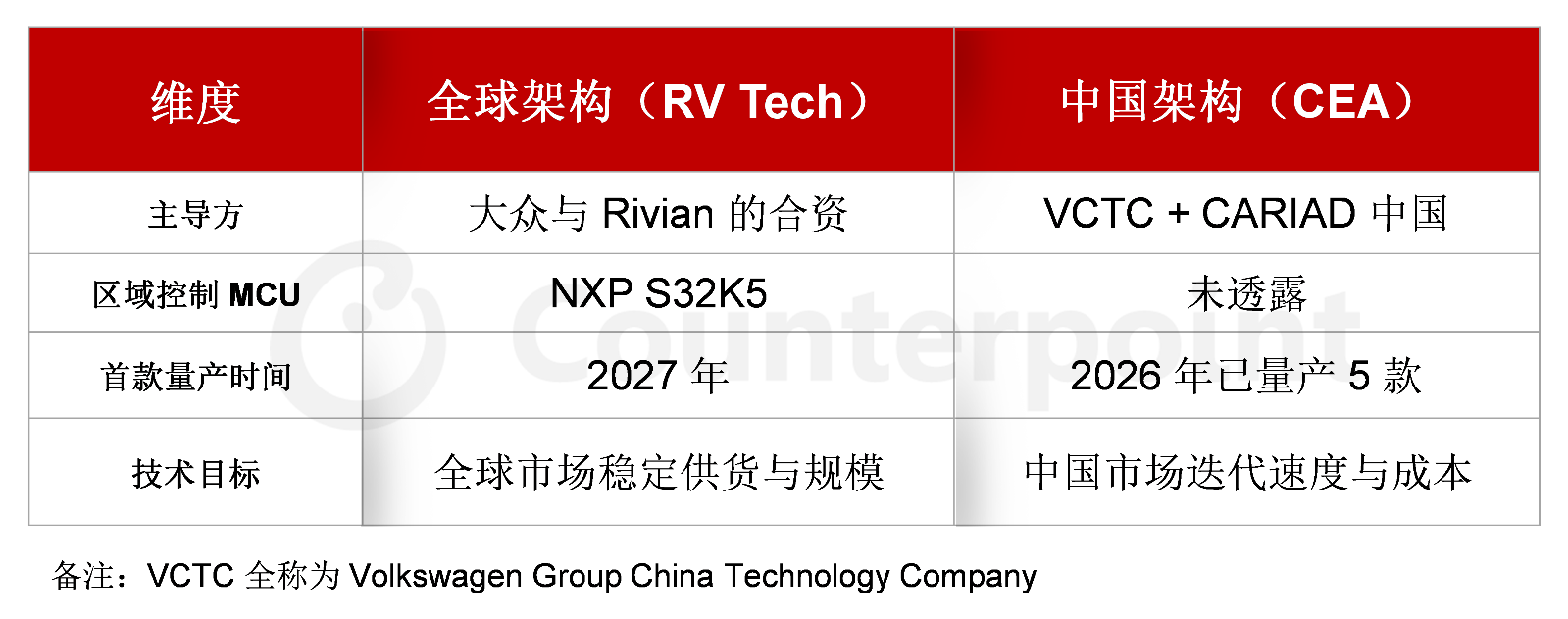
For APAC technology managers, Volkswagen's latest semiconductor and software announcements read like a control test: can one automaker run a global standard architecture and a China-specific development stack without duplicating cost, risk and decision overhead? On October 26, Volkswagen and NXP announced a strategic partnership centred on S32K5 microcontrollers as the regional-control building block for future vehicles; two days later, Volkswagen held its first Tech Day in China and unveiled VEGA, a locally developed stack spanning three areas: vehicle platforms, electronic/electrical architecture and ADAS. The company is running two systems at once, and the briefing question is where global scale wins and where China speed becomes the only workable model.
Counterpoint Research frames the two moves as a reallocation of technical decision rights. The global track seeks scale, stability and supplier standardisation; the China track prioritises rapid product iteration and local market adaptation. The cost is not trivial: parallel verification, software maintenance and supply-chain management will likely remain expensive until Volkswagen chooses which system becomes dominant. The commercial context raises urgency. Automotive News reported Volkswagen Group third-quarter deliveries fell 14%, while China sales declined 39%. Bloomberg also reported that the VEGA software stack is designed for updates every three months, with a larger overhaul planned for 2027.
Track 1: NXP S32K5 as the global zonal-control baseline
The NXP deal is about common architecture. S32K5 is intended to serve as a core component in Volkswagen's next-generation zonal architecture, across multiple brands and vehicle lines, with the first related model planned for 2027. NXP's product materials describe the family as supporting scalable zonal architectures and extending the S32K3 line with higher performance, larger memory and stronger vehicle-network communication at low power. For APAC component buyers, the practical issue is not whether software-defined vehicles are coming, but whether regional-control hardware can be standardised across markets without weakening safety validation.
Track 2: VEGA, CEA and the C-Brain speed experiment
The China track changes the operating model. VEGA packages China-developed platform work with CEA as the electronic/electrical architecture layer. CEA is not a fully independent invention: in April 2024, Volkswagen and XPeng Motors signed an E/E architecture cooperation framework to jointly develop technology based on XPeng's latest EEA 3.0 architecture. Volkswagen states that CEA was developed by Volkswagen (China) Technology Co., Ltd. (VCTC), CARIAD China and XPeng. Counterpoint Research says the result combines XPeng architecture know-how with Volkswagen functional-safety and validation methods, then localises engineering through Volkswagen China.
Efficiency data explain why the China stack is being treated as a management pilot. Volkswagen disclosed that C-Brain, an AI toolchain built around CEA, cut software-function testing from 3 days to 2 to 3 hours and reduced software-problem diagnosis from 2 weeks to 20 minutes. Counterpoint Research cautions that these figures are not a full proxy for company-wide R&D productivity. The more important shift is authority: China teams are gaining architecture-definition rights, not merely running localisation tasks.
Track 3: three ADAS chip routes and the CARIZON bet
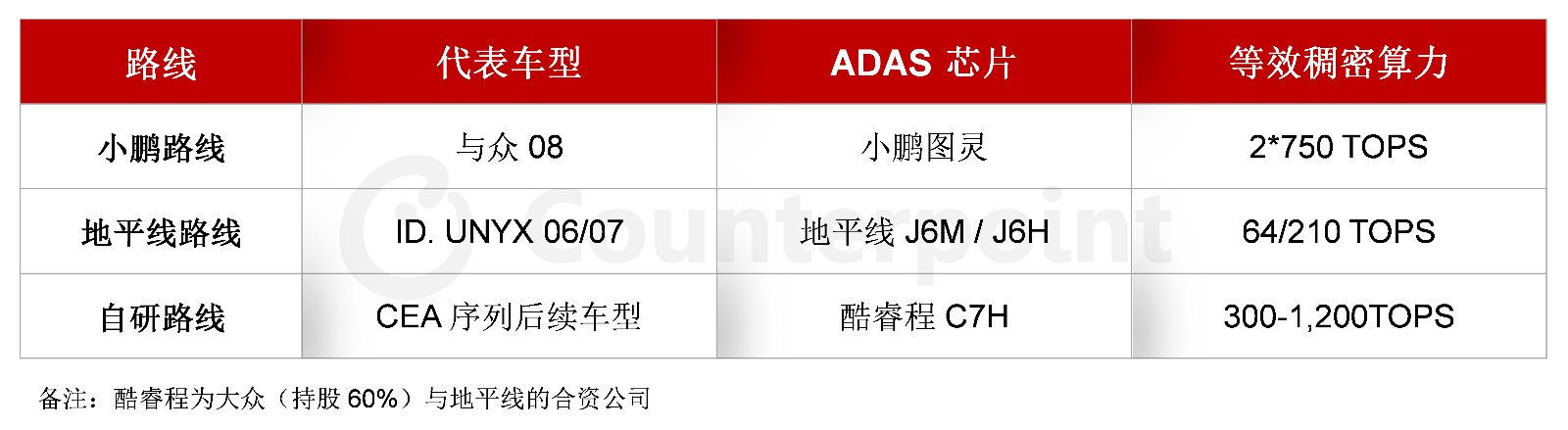
Volkswagen has three ADAS chip routes in China, according to Counterpoint Research. One involves CARIZON, the CARIAD and Horizon joint venture. The team is developing a C7H system-on-chip codenamed Nash Architecture, with mass production targeted for 2028. Counterpoint Research emphasises that C7H is not a direct Horizon IP-licensed part; Horizon is positioned as a JV shareholder, AI foundation-model provider and chip supply-chain partner. The route may reduce dependence on external chip suppliers, but it also places more qualification, tooling, safety validation and version-management work inside Volkswagen's own China system.
Commercial fit: L3 timing, CMP exports and APAC use cases
Volkswagen said it plans L3 autonomous-driving readiness in 2027, but Counterpoint Research warns that readiness is not commercial availability. Road-test permits, functional-safety approval and consumer market access are separate gates; the firm expects L3 for individual users in China may not arrive before 2029. The export plan adds another APAC dimension: Volkswagen wants to use the CMP platform with CEA in South America, Africa and Southeast Asia, betting that Chinese development cycles can lower cost and improve responsiveness.
Under the older model, Germany-based Volkswagen teams set the architecture and China adapted it. The new split asks whether China can originate core choices for global markets while Germany retains certification, brand governance and long-term platform discipline. The open question is which track wins if costs rise faster than iteration gains.
Comparison table: where each track helps
| Decision dimension | Global NXP S32K5 track | China VEGA/CEA track | Best-fit scenario |
|---|---|---|---|
| Architecture goal | Unified regional-control hardware across brands and markets | Faster integration of platform, E/E and ADAS for local users | Global fleet standardisation versus China market responsiveness |
| Speed signal | Validation-led; first related model planned for 2027 | C-Brain compresses tests from 3 days to 2 to 3 hours | Software-defined vehicle rollouts needing frequent updates |
| Supply-chain impact | Strengthens a named semiconductor partner and long-term sourcing base | Keeps CEA chip supplier disclosure open; CARIZON adds in-house option | APAC sourcing teams should watch dual supplier exposure |
| Advanced driving risk | Global architecture may support L3 readiness messaging in 2027 | China regulatory gates may delay consumer L3 to 2029 | Do not treat technical readiness as market launch |
Action list for APAC technology and product leaders
- Track 2027 S32K5 vehicle milestones and regional-control supplier disclosures; ask how MCU selection affects cross-market reuse, software maintenance and certification.
- Benchmark C-Brain metrics (3 days to 2 to 3 hours, 2 weeks to 20 minutes) against internal test cycles before copying AI test-toolchain investments.
- Treat VEGA as a China speed case, not a global replacement; separate roadmaps for L3 consumer availability, with 2029 as the earliest planning horizon cited by Counterpoint Research.
- For emerging-market programmes, evaluate CMP and CEA localisation in South America, Africa and Southeast Asia, but require validation-cost estimates for parallel two-system maintenance.
- Monitor EEA 4.0 in 2026 and the CEA 1.0 upgrade gap; architecture version drift could become a supplier-management risk for APAC partners.
APACTechBriefing takeaway: Volkswagen's dual-track plan is a supply-chain and governance experiment, not merely a chip roadmap. For APAC buyers, the value is in the comparison itself — NXP S32K5 gives evidence of global consistency, while VEGA, CEA and C-Brain show how quickly China-based engineering can compress validation. The decision rule is simple: choose the global track when scale and certification dominate; choose the China track when feature velocity and local integration dominate; price both if the company must keep two systems alive through 2027, 2028 and 2029.