
Case Review: Two Unattended AI Automations That Failed Real Customers — and the Governance Playbook for APAC Transformation Teams
Unattended AI automation turns efficiency into annoyance whenever a workflow optimised for internal throughput ships without three controls: a named owner, a working human exit, and a containment boundary that keeps experiment-stage code away from live customers. That is the shared root cause in the two martech incidents reviewed here.
Every idiom for a runaway unattended system applies: the lights are on but nobody is home, the engine is running but nobody is driving, the wheel is spinning but the hamster is gone. The Wi-Fi’s on, but there’s no Internet.
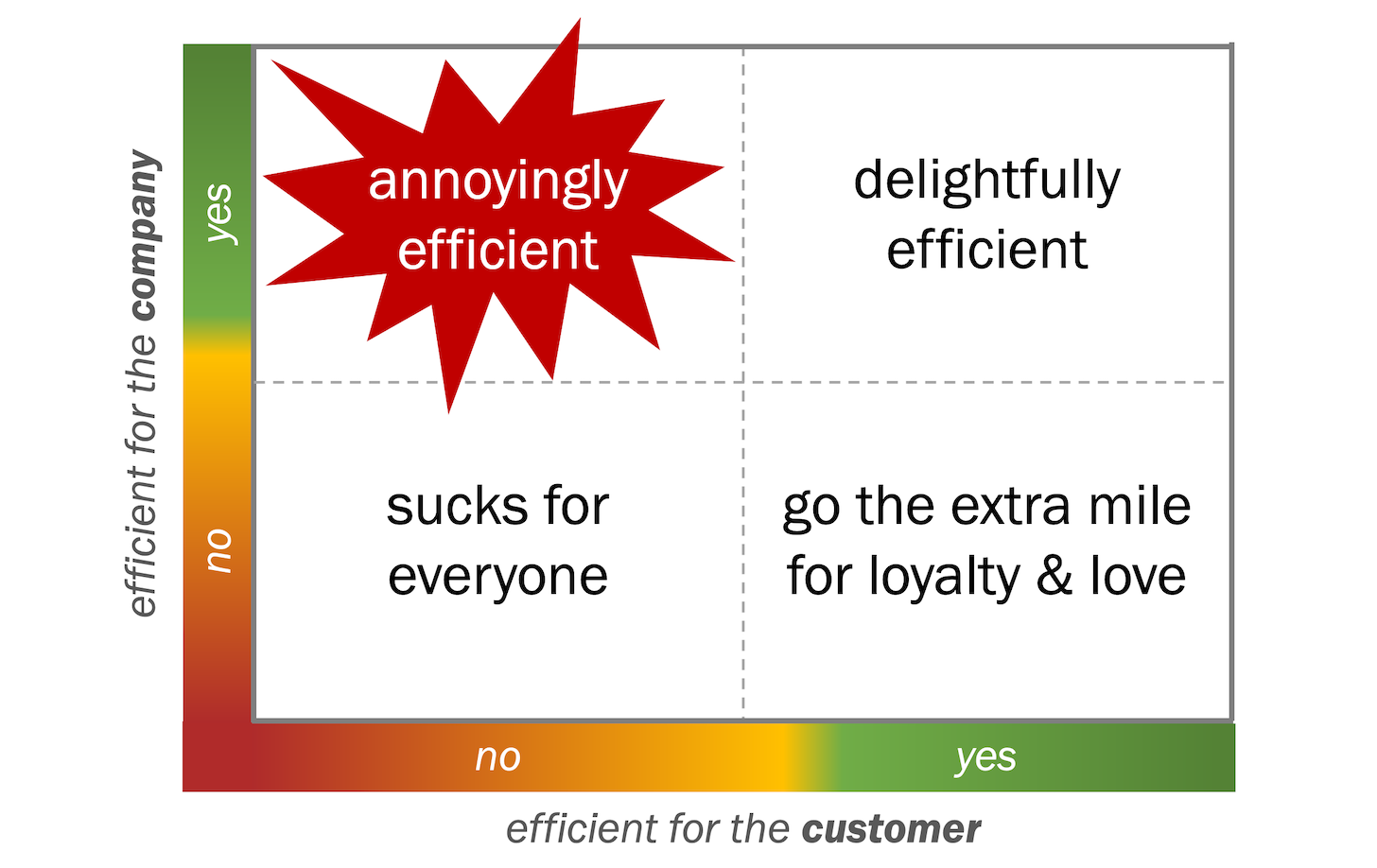
Over the past weeks, a longtime martech practitioner recorded AI automation incidents at two separate martech companies — once as a paying customer of one vendor, once as a would-be prospect for the other. Both landed in the same cell of the matrix he drew: the annoyingly efficient upper-left quadrant of the 2×2 below. Efficient for the company. Abrasive for the person on the other end of the thread.
APACTechDigit revisits these incidents as a governance case review rather than a vendor complaint. Neither company is named, because the pattern is ordinary rather than exceptional — and because the irony that both firms sell marketing technology is exactly why transformation leaders should care. If the teams that build these systems cannot see them misfire, their customers' own teams rarely can either.
What happened in the two cases, step by step
Case one: the support path that goes nowhere
The first incident concerns a subscription product whose onboarding drip had been running for weeks on a sensible cadence, with genuinely useful content, sent from a shared onboarding address rather than a real person's mailbox. Then last week a billing question came up. Every contact pointer in the app, the FAQ and the account screens led back to that same onboarding inbox, so that is where the question was sent.
No answer arrived — not even an automated acknowledgement of receipt. Not a big deal at first. He waits a day, then sends a polite follow-up. Nothing. A couple of days later the onboarding address delivers another cheerful onboarding tip. He writes a third time, restates the billing question and volunteers that perhaps this belongs to a different address. Still nothing. He goes hunting through help docs and account screens for an instruction he might have missed; every path still points to the same dead inbox. Out of options and with other work on fire, he abandons the attempt — and while the account of it was being written, yet another onboarding email landed, oblivious to three prior attempts to engage.
Diagnosis from outside the stack can only be probabilistic. It looks like automated routing: multiple teams sharing one inbox with rules that dispatch incoming mail to the right place, and the dispatch is broken. Maybe a bug in the routing logic. Maybe the destination queue is unmanned. Maybe an LLM interpreting intent errors out silently. Maybe a retrieval lookup against the account record fails and nothing catches the exception. Whatever the cause, a paying subscriber's billing question — one of the highest-stakes intents in any subscription business — was absorbed by an unattended system with no acknowledgement, no service-level alarm and no escalation path.
Case two: personalised opening, then institutional amnesia
The second incident starts with a report download offered through a classic demand-generation form. Within a couple of minutes of submitting it, an email from a named rep arrives, and it is a masterclass in production-quality generative AI personalisation: the opening paragraph is crafted around the nature of his work on chiefmartec, it raises an AI concern genuinely relevant to him, and it closes with a question that sounds real. No "Hello, $FIRST-NAME" template. The only tell is speed — no human could research and draft that fast, and a fast, accurate reply is not a bad thing to admire.
He replies, complimenting the response time with a wink that he knows how it was done, explaining his interest and self-disqualifying as a prospect, assuming the note will reach the actual rep. There is no reply. Survivable, but odd: the original email was conversational, and in comparable exchanges with reps at other martech vendors, replies almost always come — threads that later turn into useful connections. The funnel is perennially oversimplified.
Then, a couple hours later, a second message arrives from the same rep, formatted completely differently: an old-school "Hello, $FIRST-NAME" opener, a reference to something unrelated to what was downloaded, and calendar slots for a demo. A total non sequitur to the exchange that had just happened. Read the way a martech person would read it: the contact had been swept into an automated sales sequence.
A week later a third message follows in that same automated format — a generous offer for something largely irrelevant, this time with "$COMPANY-NAME" merged into the first paragraph, and the company inserted is most definitely not his.
The reconstruction on offer: an AI SDR agent wrote the first message; the rep never saw it, and never saw the reply, which the AI SDR intercepted and did not know how to handle, so the contact was enrolled in a sequence with no memory of the earlier exchange; meanwhile a data enrichment service attached fields that were flat-out wrong. Two products, a weak integration at best, and compounding errors accumulating along the journey.
Which failure modes transfer to your own stack?
| Failure mode | Observable symptom | Likely cause | Business cost | Control |
|---|---|---|---|---|
| Silent routing failure | Question sent to the only address advertised gets no reply; unrelated nurture mail keeps coming | Shared-inbox rules broken or routed to an unmanned queue; uncaught LLM/retrieval errors | Revenue-risk intent unanswered; churn risk plus re-worked ticket later | Mandatory acknowledgement receipt, one documented address per intent, unanswered-message alarm at 24 hours |
| Intercepted reply | A prospect answers a personalised note and hears nothing back | AI SDR has no fallback when intent falls outside its scope | A warm, self-qualified conversation is discarded | Named-rep peek window on replies; any inbound question forces a human notification |
| Sequence amnesia | Follow-up contradicts the conversation that just happened | Two systems with a weak integration and no shared memory | Contradictory messaging; credibility damage | Treat conversation state as a first-class object in the orchestration layer |
| Field contamination | $COMPANY-NAME merges the wrong value into a "personalised" paragraph | Enrichment writes unverified attributes; the sequence never validates them | Personalisation becomes proof of sloppiness | Confidence thresholds and field-accuracy sampling before merge |
| Laboratory leak | Demo-grade automation running inside live customer journeys | No boundary between experimentation and revenue-protecting systems | Unbounded blast radius | Containment rules and a change freeze on production-facing flows |
Are these model problems or process problems?
Both incidents failed at integration seams, not at inference quality: the first outbound message was excellent, the routing and the state management were absent. That asymmetry matches the wider evidence base. Gartner's 25 June 2025 prediction that over 40% of agentic AI projects will be cancelled by the end of 2027 attributes cancellations to escalating costs, unclear business value and inadequate risk controls — organisational causes, not algorithmic ones. MIT NANDA's study The GenAI Divide: State of AI in Business 2025, reported by Fortune on 18 August 2025, found that around 95% of enterprise generative AI pilots delivered no measurable financial return, blaming workflow integration and learning gaps rather than model capability.
The operational conclusion is blunt. AI and automation can be efficient for customers as much as for the company when they address what the customer actually needs, but they will never be right 100% of the time, and the edge cases are infinite. The difficulty is not producing the correct answer; it is deciding what the system does when there is no correct answer.
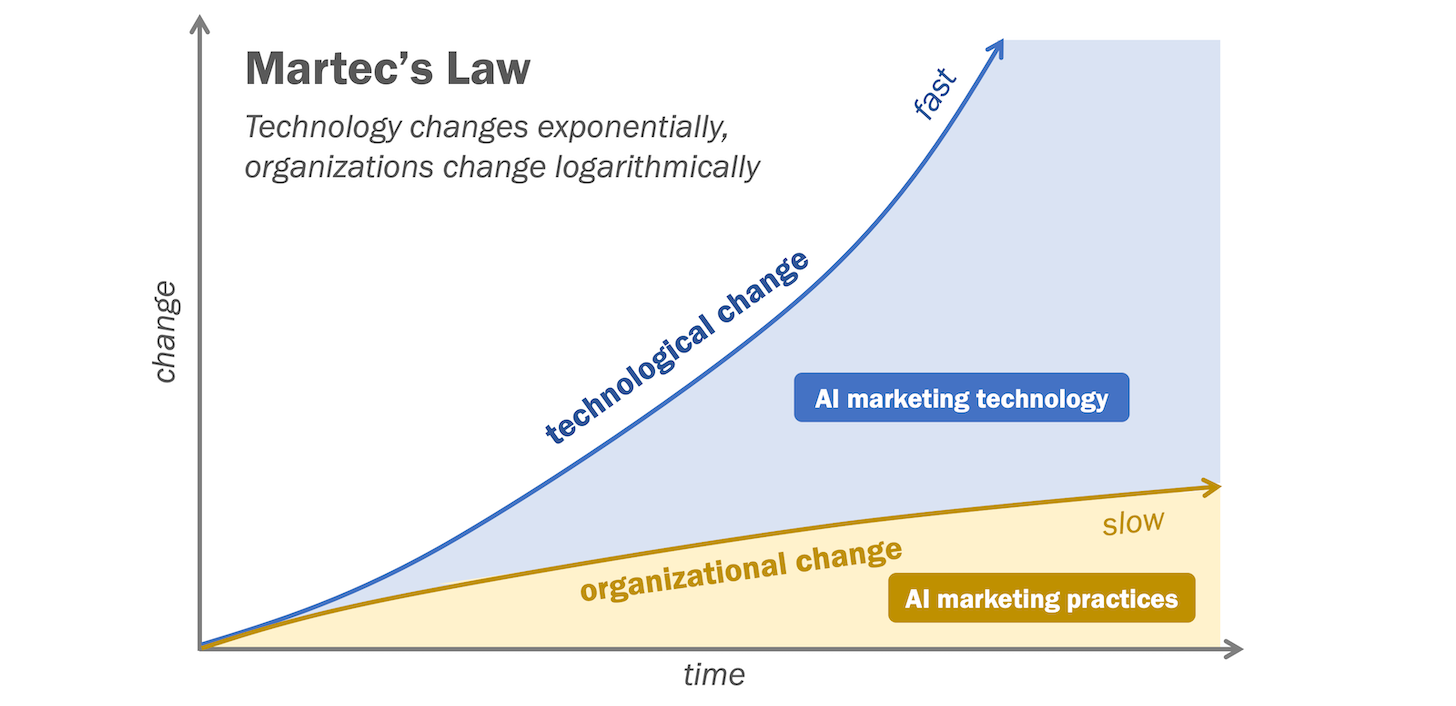
The practitioner's long-standing shorthand for this gap is Martec’s Law: technology changes quickly, but organisations change slowly, and it has held across his 17 years of covering marketing technology. The corollary is the one that hurts — teams chronically underestimate the people and process changes that fast-moving technology demands.
Two Asia-Pacific specifics sharpen the risk. First, adoption intensity is wildly uneven inside the region: BCG's regional study published on 30 October 2025 reported AI adoption around 92% in India against roughly 51% in Japan, so an identical unattended workflow can meet customers with completely different tolerance for automation by market. Second, for APAC vendors selling into Europe, documented human oversight is no longer a best-practice opinion: general-purpose AI model and governance obligations under the EU AI Act have applied since 2 August 2025 (European Commission), which makes inspection records and accountable owners part of the compliance evidence trail rather than internal housekeeping.
How do you pilot unattended automation without alienating customers?
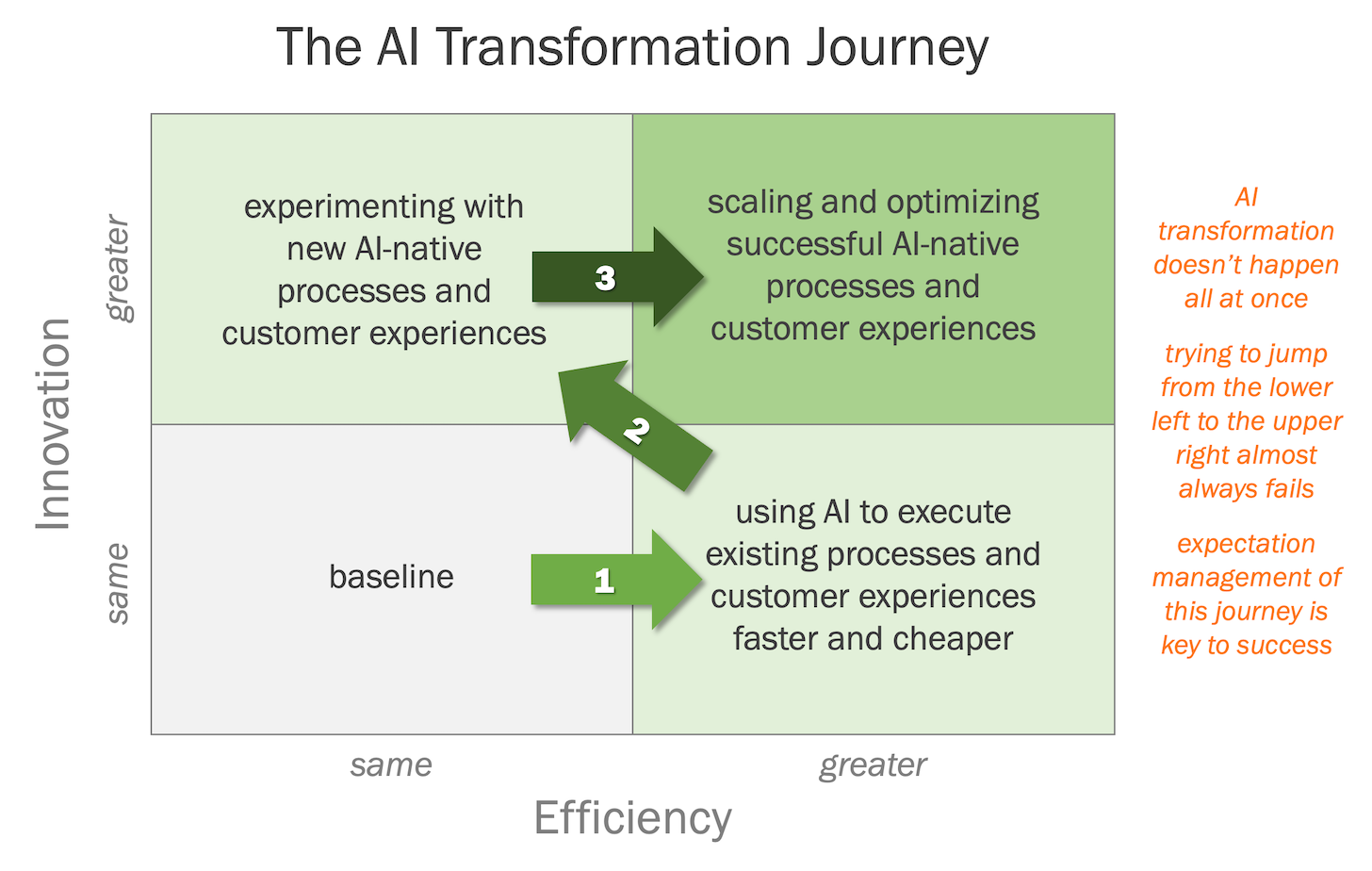
The recommended ethos in the original case account is go-slow-to-go-fast, explicitly against the move-fast-and-break-things reflex created by vague but urgent top-down AI edicts. That is not an argument for low intensity — this is a high-gear period for everyone involved — but a refusal to skip stages of the journey, because the foundation is what makes the next stage reliably faster.
- Classify and register the automation. Label each one as revenue-protecting production or experiment, give it a named owner, and put it in an agent inventory — the baseline control Microsoft's Cloud Adoption Framework prescribes for governing AI agents across an organisation.
- Contain the first release. Narrow audience, one market and one language, capped volume. Move fast on pilots, but keep the perimeter tight.
- Guarantee a human exit. One advertised route per intent (billing is not onboarding), a visible path to a real person, and a test send that proves the path actually connects.
- Instrument acknowledgement. Every inbound message gets a receipt with a reply window; alarm on anything unanswered at 24 hours. This single control would have caught case one on day two instead of week three.
- Keep a human in the loop. Even post-hoc review of what the agent did is enough at first. Reps can use inbox rules to cut noise, but should peek at any reply that contains a question — it is their name and their reputation on the envelope.
- Run secret-shopper journeys. Staff can start it, but an external reviewer with fresh eyes and no patience for internal politics is better. B2B is harder here, because the enrichment industry converges hard on one identity, with varying accuracy.
- Inspect on a calendar, like an elevator. Re-validate routing rules and data definitions, content and branding, and the contexts before and after the automation fires. Timestamp and sign each inspection; pair a repeatable test harness with human judgement.
- Gate the scale-up. Widen only when field accuracy, handoff latency and post-handoff satisfaction clear thresholds. Chasing ghosts and wrangling tech debt in production gums up everything downstream.
Which metrics prove customers tolerate the automation, not just that it is cheap?
| Metric | What it measures | Why dashboards mislead without it |
|---|---|---|
| Deflection rate | Share of contacts handled without a human | It measures volume diverted, not problems solved; a flattering number can hide case-one-style silence |
| Containment rate | Whether the customer needed further help afterwards | Outcome-based, so it separates "answered" from "resolved" — a distinction contact-centre guidance from RASA emphasises |
| Handoff latency and step count | Time and steps from "I want a person" to a live agent | Exposes the friction customers feel most and automation dashboards ignore |
| Post-handoff satisfaction | How the customer feels after escalation, including the context they had to repeat | Catches the cost of a broken transfer instead of celebrating the transfer rate |
| Personalisation field accuracy | Share of merged company, name and account fields verified against a source of truth | Prevents the "$COMPANY-NAME" embarrassment before it reaches an inbox |
| Unanswered messages past SLA | Inbound messages with no acknowledgement or human response within 24 hours | The early-warning signal for routing failures and unmanned queues |
What misconceptions make unattended automation expensive?
- "A high automation rate proves the transformation is working." Efficiency for the company and value for the customer are different axes; the upper-left quadrant of the matrix is where projects look green while customers get angry.
- "The agent replied, so the customer was served." Case two proves the opposite: fluent, fast replies can be followed by silence, contradiction and wrong data.
- "Trim the headcount and the automation will absorb the work." Unhandled exceptions do not disappear; they queue up behind whoever is left.
- "One platform means one shared conversation history." These incidents were two products stitched together; state did not travel between them.
- "A polished demo is a production-ready system." The original account leans on Frans Riemersma's framing of the real split: a martech stack serves two missions. One side is the steady, reliable factory. The other side is the laboratory where new and adapted use cases get tested. Manage them differently, and be wary of lab leaks.
What should CIOs do in the next 90 days?
The following is APACTechDigit's analysis built on the case evidence above, not a claim from the original account.
- Days 1–30: inventory every live automation and agent, assign an owner per entry, document which intents each one serves and which address it advertises, and switch on acknowledgement receipts.
- Days 31–60: run two secret-shopper journeys per critical path (one internal, one external); baseline handoff latency, post-handoff satisfaction and field accuracy; fix routing gaps and enrichment sources.
- Days 61–90: publish an inspection calendar with timestamped sign-off, set explicit scale gates tied to the metrics table above, re-box or retire experiments that leaked into production, and add human-oversight evidence clauses to vendor contracts for EU-facing journeys.
Frequently asked questions
Why did a paying customer's billing question get no reply at all?
Because the only advertised contact route was a shared onboarding inbox whose routing rules were broken, unmanned or erroring silently. The system kept executing its nurture job while failing its support job, and nothing alarmed on an unanswered message. The fix is acknowledgement receipts plus an unanswered-message SLA alarm, not a smarter model.
Should companies stop using AI SDRs and automated sequences?
No. The personalised opening in case two was genuinely good and arrived fast, which is the value the technology is supposed to deliver. The damage came from an agent that could not escalate an out-of-scope reply, a sequence with no memory of the conversation, and unverified enrichment fields. Fix the handoff and the data, and keep the speed.
What is the cheapest control to implement first?
An agent inventory with a named owner per automation. It costs process, not licences, and it makes every later control — inspection cadence, sign-off, rollback, compliance evidence — possible to run at all.
What replaces deflection rate as the headline number?
A pair: containment rate for resolution quality, and handoff latency plus post-handoff satisfaction for the escalation experience. Deflection alone rewards suppression of contact, which is precisely the behaviour that produces annoyed customers.
Where is the product opportunity in this?
Both cases point at the same unserved market: governance and monitoring for automation that is already running. Building an automation or deploying an AI agent gets easier every day; keeping them aligned is where operational discipline earns its keep, since without it the estate behaves like herding cats. Orchestration in the AI age of marketing therefore means knowing what is running, what it decided, who owns it and who is accountable when it decides wrongly — and that is where Asia-Pacific platform teams and vendors can differentiate rather than merely add another agent to the catalogue.
Sources and further reading
- Gartner, "Gartner Predicts Over 40% of Agentic AI Projects Will Be Canceled by End of 2027", 25 June 2025 — https://www.gartner.com/en/newsroom/press-releases/2025-06-25-gartner-predicts-over-40-percent-of-agentic-ai-projects-will-be-canceled-by-end-of-2027
- Fortune on MIT NANDA, "MIT report: 95% of generative AI pilots at companies are failing", 18 August 2025 — https://fortune.com/2025-08-18/mit-report-95-percent-generative-ai-pilots-at-companies-failing-cfo/
- BCG, "Asia Pacific Leads the World in AI Adoption", 30 October 2025 — https://www.bcg.com/press/30october2025-asia-pacific-leads-ai-adoption
- European Commission, AI Act implementation timeline (general-purpose AI and governance obligations applicable from 2 August 2025) — https://digital-strategy.ec.europa.eu/en/policies/regulatory-framework-ai
- Microsoft Cloud Adoption Framework, "Govern and secure AI agents" — https://learn.microsoft.com/en-us/azure/cloud-adoption-framework/ai-agents/governance-security-across-organization
- RASA, "AI Agent Performance Metrics: Contact Center KPIs You Must Track" (deflection vs containment) — https://rasa.com/blog/measure-ai-agent-performance-in-the-contact-center
Prepared by the APACTechDigit DigitalDX desk. For governance-template requests or case contributions, contact the editorial team at contact@apactechdigit.com.