
Southeast Asia AI Adoption Playbook: Six Steps, Five Traps and the Governance Checklist for APAC Operators
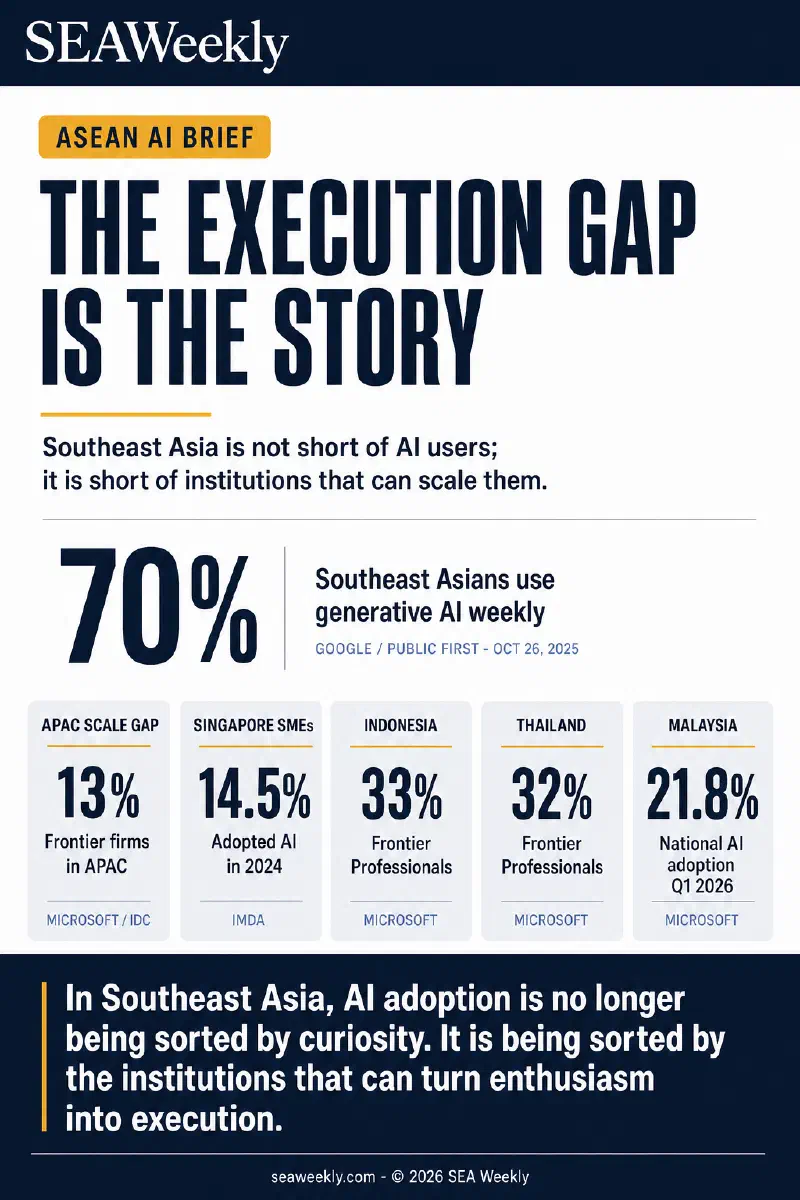
AI adoption in Southeast Asia is no longer held back by appetite. Google's October 2025 note put weekly generative AI use at 70% of the region's population and sized the prize at US$270 billion. What holds firms back is the operating layer: workflow redesign, data foundations, native-language reliability and one named executive owner. Below is the sequence, the checklists and the traps we see repeated across Singapore, Indonesia, Thailand, Malaysia, the Philippines and Vietnam.
You can always tell where a rollout has stalled. It is never the licence count. It is the Monday meeting at which nobody can name the process the tool was supposed to change. IMDA's AI for Enterprise Impact Playbook makes exactly that point through its Grain case: product-build time down 80% and administrative workload down 20%, but only after leadership, workforce training, data governance and daily operating habits were run as one stack instead of four unrelated projects.

Is user demand still the bottleneck?
No. Demand is the most settled variable in the region's AI story, and any operator who treats it as the hard part is solving last year's problem.
- Google's October 2025 note, “Turning AI momentum in Southeast Asia into tremendous economic growth.”, reported 70% of people in the region using generative AI weekly, with a US$270 billion upside if that use converts into output rather than novelty.
- Microsoft's April 2025 APAC Work Trend Index, released as “APAC emerges as global AI frontrunner: Region’s businesses lead worldwide intelligent agent adoption.”, found 53% of APAC leaders already using AI agents to fully automate workstreams or processes — the highest share of any region — while 52% of employees treat AI as a thought partner rather than a command box.
- The worker layer is deeper still. Microsoft's June 30 update, “Microsoft’s Work Trend Index 2026: 33% of Indonesian Workers are at the Forefront of AI Adoption.”, counted 33% of Indonesian workers as Frontier Professionals against a 16% global average; the August 4 Thailand read put 32% of that workforce in the same band, the August 10 Philippines release put 25% there, and Malaysia sits at 24%.
- Optimism is not fragile either. Tech Wire Asia's April 16 read of Stanford's 2026 AI Index, published as “Southeast Asia leads the world in AI optimism. Its governance frameworks are nowhere near ready.”, found more than 80% of respondents in Malaysia, Thailand, Indonesia and Singapore expecting AI to change their lives within three to five years, with reported generative AI adoption of 61% in Singapore against 28.3% in the US.
Our July 11 brief on AI adoption in ASEAN trade finance said the same thing from the buyer's chair: uptake runs fastest where a concrete job already exists and the surrounding system is dense enough to absorb the tool.
Independent survey work closes the loop. The McKinsey–EDB–Tech in Asia study of roughly 330 companies across six Southeast Asian economies found 46% of respondents already past pilots and into scaling, against a 35% global figure. Read that carefully: it is a headline about breadth, not depth. The same work flags pricing and ease of use as the gating factor for micro and small businesses, which is where most of the region's employment actually sits.
So the open question is not whether anyone will touch the software. It is which organisations reach what vendors call mature adoption — the state that gets described in keynotes and costed in almost none.
What actually stops a rollout: five friction points
Short answer: management systems, not models. Each of the five below shows up in a different country dataset but behaves the same way in the P&L.
- Redesign lags deployment. Microsoft Singapore's April 29 essay, “Fast AI adoption is not enough; Singapore must care about redesigning work.”, put only 13% of organisations in Singapore and across Asia-Pacific in the frontier-firm category, against 31% in North America. Enterprise uptake of agentic AI locally was already 37%, roughly in line with global peers, yet concentrated in a handful of functions rather than the operational core.
- Leadership alignment is the missing input. Microsoft's June 23 note, “Microsoft’s 2026 Work Trend Index: Malaysian workforce is ready for AI and organizations must keep pace.”, recorded 24% Frontier Professionals and 69% of employees producing work they could not have created a year earlier — but only 32% saying leadership is clearly and consistently aligned on AI.
- Rewards still pay for stability. The August 4 Thailand release, “Microsoft Unveils Work Trend Index 2026, Guiding Thai Organizations Toward ‘Owned Intelligence’ For AI-Era Growth.”, counted 32% advanced users and 89% who use AI output as a starting point for their own ideas, while only one-third of leaders actively reward experimentation and 60% of employees feel safer using AI to support old routines. Microsoft calls the deadlock the Transformation Paradox: buy the new tool, protect the old process.
- The management layer outweighs individual will. The Philippines dataset, “Filipino Workers Outpace Global Peers in AI-Driven Reinvention, New Microsoft Work Trend Index Reveals.” (August 10), shows 25% Frontier Professionals, 77% producing work they could not have produced a year ago and 65% ranking critical thinking as the most important human skill. The uncomfortable part sits in the management column: organisational factors such as culture, manager support and talent practices carry more than twice the impact of individual mindset and behaviour alone.
- Policy already concedes that usage is not readiness. IMDA's March 2 factsheet on the National AI Impact Programme, “National AI Impact Programme: Empowering Enterprises and Workers to Transform with AI.”, recorded Singapore SME adoption rising from 4.2% in 2023 to 14.5% in 2024 and non-SME adoption from 44% to 62.5%. The response was not a press release about success. It was a target of supporting 10,000 enterprises over three years and making 100,000 workers AI Bilingual.
Bain's regional tracking adds a structural caveat for anyone planning one rollout across many markets. Its e-Conomy SEA work, published on October 21, 2026, estimates that enterprise workloads account for 45% to 60% of AI usage only in Singapore and Malaysia, with total per-capita use in Singapore already close to half the US level. Elsewhere in the region the enterprise layer is still thin, so a single operating model will not travel unchanged.
Language, mobile and modality: engineering requirements, not marketing
Adoption accelerates when the interface matches behaviour that already exists. Google's July 14 report, “How Gemini is speaking the language of Southeast Asia.”, said active Gemini users in the region more than doubled in a year, with Nearly 70% of prompts submitted in native languages — led by Vietnam at 89%, Thailand at 87% and Indonesia at 84%. Almost three in four requests come from mobile devices, more than 40% use voice, photos or video, and roughly 40% ask the model to generate something new rather than retrieve information.
Treat those as test cases rather than trivia:
- Build a prompt set in the working languages on your floor — Bahasa, Thai, Vietnamese — and score answers on business terminology, not fluency.
- Run one task end-to-end on a phone before approving a desktop workflow.
- Test multimodal input on your own artefacts: photographed forms, voice notes from a shop floor, a screenshot of a supplier invoice.
- Reject any vendor who can only demonstrate in English on a curated script.
Google's framing in the same report is worth borrowing: adoption happens when technology feels native, not translated. A model that cannot hold Thai nuance or Bahasa prompts consistently stays a curiosity; one that can drops the friction of thinking inside somebody else's interface.
The six-step path from pilot to production
Sequencing beats tool selection. IMDA's own playbook, described in the May 21 release “New Playbook Charts a Clear AI Transformation Path for Local Enterprises.”, is built as a three-step process that begins with a readiness diagnosis — a useful reminder that the first purchase in an AI programme is usually an assessment, not a licence.
- Step 1 — Diagnose before you buy. Write down which process is losing money, who owns it and what a win costs. If you cannot answer in one page, the programme is a hobby.
- Step 2 — Choose one workflow and one number. Cycle time, exception rate or cost per transaction. One metric per workflow, reviewed monthly by a named owner.
- Step 3 — Fix the data layer before the model layer. FPT Digital's April 7 summit write-up, “Reshaping Vietnam’s Retai”, argued AI can lift customer lifetime value by 20-30%, double conversion rates, halve the sales cycle and cut decision time by 40-60% — but only on top of a deep enough data foundation. The proof was Long Chau Pharmacy: a Data Lakehouse built in 2023, AI layered into logistics and warehousing, and a 50% reduction in manual workload.
- Step 4 — Buy the missing middle while public money is on the table. MDEC's July 2025 announcement of “RM2.9 Million in Strategic Grants to Advance AI and Industrial Digitalisation.” states the objective plainly: commercialise local AI products rather than import them. Under MDAG-AI, eligible companies can claim up to 70% of total project costs, capped at RM2 million.
- Step 5 — Build a capability pipeline, not a champion. Microsoft's March 12 note “Creating the Enablers for Indonesia’s AI Future.” tied adoption to hard enablers: a US$1.7 billion cloud and AI investment commitment, an estimated US$2.5 billion of new economic value tied to the Indonesia Central region, 106,295 projected jobs, 704,342 people already skilled and elevAIte Indonesia's target of one million AI-skilled people by 2025 — with 92% of Indonesian knowledge workers already using generative AI at work. On the literacy layer, AI Ready ASEAN has equipped more than 800,000 young people, educators and parents, while Gemini Academy has trained more than 290,000 teachers across Indonesia, Malaysia, Thailand, Vietnam and the Philippines.
- Step 6 — Wire governance and capacity before the auditors arrive. The regional baseline exists: the Expanded ASEAN Guide on AI Governance and Ethics for generative AI, issued in January 2025 by the ASEAN Working Group on AI Governance alongside the 2024 guide, sets shared principles. It is voluntary, so firm-level controls remain the operator's job. Capacity is now part of the same conversation. Tech Wire Asia's February 25 report, “Singtel building Southeast Asia’s AI power grid through Johor.”, described a physical race around Singapore, Johor and Batam: Nxera's DC Tuas added 58MW of AI-ready capacity with more than 90% pre-committed, and regional operational plus pipeline capacity is expected to exceed 400MW in the mid-term.
In-country infrastructure changes procurement maths directly. Microsoft's May 21 piece, “From pilots to impact: Malaysia enters next phase of AI-driven transformation.”, said the Malaysia West cloud region had made more than 190 services generally available locally, and that national AI adoption rose to 21.8% in Q1 2026 from 19.7% in H2 2025. The April 24 partnership note, “Malaysia deepens national AI partnership with Microsoft, expanding whole-of-nation skilling across educators, enterprises, and communities.”, added the workforce side under Elevate Malaysia: 80,000 learners reached in the pilot phase, on top of 800,000 Malaysians previously trained through AIForMYFuture. Singapore is building the same middle through policy coordination — NAIIP as a translation layer between adoption and redesign, plus the May 20 national partnership described in “Accelerating AI impact in Singapore.”
Common traps, and the counter-move
| Trap | What it looks like on the ground | Counter-move |
|---|---|---|
| Procurement-first adoption | Licences approved, no process owner named | Make organisational support a budget line: culture, manager backing and talent practices carry more than twice the weight of individual mindset |
| Pilot hoarding | A dozen proofs of concept, none in production | Cap the portfolio at three workflows and set a kill date before the first sprint |
| Translated experience | English demo wins the board, local staff abandon the tool | Score native-language prompts before signing; Nearly 70% of regional prompts are already non-English |
| Training as an event | One town hall, no deliberate practice | Copy the policy model: cohort targets like the 100,000 workers IMDA wants to make AI Bilingual |
| Infrastructure as background noise | Residency, latency and capacity assumed solved | Confirm in-country service availability and data residency; local regions are what shorten pilot-to-production cycles |
Where each market should start
| Market | Signal in the data | First move |
|---|---|---|
| Singapore | 61% reported generative AI adoption; 37% agentic uptake; 13% frontier firms | Redesign two core workflows and plug into the National AI Impact Programme |
| Malaysia | 21.8% national adoption in Q1 2026; 69% producing new work; 32% leadership alignment | Convert MDAG-AI grant support into a board-approved roadmap with one owner |
| Indonesia | 92% knowledge-worker usage; 33% Frontier Professionals | Stand up enterprise architecture and governance to match workforce readiness |
| Thailand | 32% advanced users; 89% building on AI output; only one-third of leaders reward experimentation | Change the incentive before changing the toolchain |
| Philippines | 25% Frontier Professionals; 77% producing new work; 65% ranking critical thinking first | Equip line managers, since management factors outweigh individual mindset |
| Vietnam | 89% native-language prompts; Long Chau Pharmacy cut manual workload 50% | Deepen the data foundation, then scale AI into operations |
Organisational guarantees: the ownership grid
Nothing above works without four named humans and one reviewed file:
- Executive owner — one accountable director, not a steering committee; the Malaysia data shows willingness without alignment stalls at 32%.
- Workflow owner — the person whose cost line moves, and whose KPI changes with it.
- Data owner — the role that makes lakehouse-grade inputs possible, the Long Chau Pharmacy precondition.
- Risk and vendor governance — the reviewer who checks counterparty filings and contract terms before signature, the same vendor metadata gap we documented for APAC buyers in the Apple country tax file case.
- Reviewed file — a one-page operating model per workflow: decision rights, escalation path, exception handling, refresh date.
Compute readiness follows the same rule as equipment readiness elsewhere in the region: capacity on order is not capability on the floor, which is the lesson we drew when EUV orders set the delivery date and fab readiness set the yield clock.
Frequently asked questions
Do we have an adoption problem or an execution problem?
Execution. Weekly generative AI use is already at 70% across the region's population, yet only 13% of Singapore and Asia-Pacific organisations qualify as frontier firms. The gap between those two numbers is your project plan.
Should small and mid-sized firms wait for cheaper tools?
Waiting is the wrong frame; sequencing is the right one. Singapore SME adoption still moved from 4.2% in 2023 to 14.5% in 2024, so entry is possible. The regional survey work points to low-cost entry options, local-currency billing and usage-based pricing as what actually unlocks smaller firms — ask vendors for those three terms in writing.
Is governance a phase-two item?
No, and the region's framework layer is still voluntary rather than enforced — the point Tech Wire Asia pressed in April 2026. Put logging, approval and escalation on one page before the first production workflow goes live, then review it quarterly alongside the metric you picked in Step 2.
Which market moves fastest once enablers line up?
Indonesia on capability volume — US$1.7 billion committed, 704,342 people already skilled, one million targeted by 2025 — and Vietnam on operational depth, where data foundations turned AI into a 50% cut in manual workload rather than a board slide.
The roadmap we hand boards on day one
Days 0–90. Diagnose, pick one workflow, name the four owners, score native-language prompts, and set a kill date for every existing pilot.
Months 4–9. Fix the data layer for that workflow; claim the grant or support available in your market (MDAG-AI, NAIIP, elevAIte Indonesia); publish a one-page operating model per workflow.
Months 10–18. Extend to a second and third workflow, move budget from tooling to manager capability, and let the metric — not the usage dashboard — decide whether the programme scales.
Southeast Asia is not short of people willing to use AI. It is short of organisations that can make that willingness survive contact with policy, workflow, language and accountability. Whoever builds that machinery compounds the demand curve; everyone else keeps buying licences.
Written by Ethan Jenkins, IndustryReports, APACTechDigit. Corrections and reader questions: contact@apactechdigit.com.
References
- Google (October 26, 2025). “Turning AI momentum in Southeast Asia into tremendous economic growth.” https://blog.google/company-news/inside-google/around-the-globe/google-asia/turning-ai-momentum-in-southeast-asia-into-tremendous-economic-growth/ (Accessed August 16, 2026)
- Google (July 14, 2026). “How Gemini is speaking the language of Southeast Asia.” https://blog.google/innovation-and-ai/products/gemini-app/gemini-southeast-asia-report-2026/ (Accessed August 16, 2026)
- Google (May 20, 2026). “Accelerating AI impact in Singapore.” https://blog.google/company-news/inside-google/around-the-globe/google-asia/singapore-government-partnership/ (Accessed August 16, 2026)
- IMDA (March 2, 2026). “National AI Impact Programme: Empowering Enterprises and Workers to Transform with AI.” https://www.imda.gov.sg/resources/press-releases-factsheets-and-speeches/factsheets/2026/national-ai-impact-programme (Accessed August 16, 2026)
- IMDA (May 21, 2026). “New Playbook Charts a Clear AI Transformation Path for Local Enterprises.” https://www.imda.gov.sg/resources/press-releases-factsheets-and-speeches/new-playbook-charts-a-clear-ai-transformation-path-for-local-enterprises (Accessed August 16, 2026)
- Microsoft Source Asia (April 30, 2025). “APAC emerges as global AI frontrunner: Region’s businesses lead worldwide intelligent agent adoption.” (Accessed August 16, 2026)
- Microsoft Source Asia (March 12, 2025). “Creating the Enablers for Indonesia’s AI Future.” (Accessed August 16, 2026)
- Microsoft Source Asia (April 29, 2026). “Fast AI adoption is not enough; Singapore must care about redesigning work.” (Accessed August 16, 2026)
- Microsoft Source Asia (April 24, 2026). “Malaysia deepens national AI partnership with Microsoft, expanding whole-of-nation skilling across educators, enterprises, and communities.” (Accessed August 16, 2026)
- Microsoft Source Asia (May 21, 2026). “From pilots to impact: Malaysia enters next phase of AI-driven transformation.” (Accessed August 16, 2026)
- Microsoft Source Asia (June 23, 2026). “Microsoft’s 2026 Work Trend Index: Malaysian workforce is ready for AI and organizations must keep pace.” (Accessed August 16, 2026)
- Microsoft Source Asia (June 30, 2026). “Microsoft’s Work Trend Index 2026: 33% of Indonesian Workers are at the Forefront of AI Adoption.” (Accessed August 16, 2026)
- Microsoft Source Asia (August 4, 2026). “Microsoft Unveils Work Trend Index 2026, Guiding Thai Organizations Toward ‘Owned Intelligence’ For AI-Era Growth.” (Accessed August 16, 2026)
- Microsoft Source Asia (August 10, 2026). “Filipino Workers Outpace Global Peers in AI-Driven Reinvention, New Microsoft Work Trend Index Reveals.” (Accessed August 16, 2026)
- MDEC (July 8, 2025). “RM2.9 Million in Strategic Grants to Advance AI and Industrial Digitalisation.”
- Tech Wire Asia (February 25, 2026). “Singtel building Southeast Asia’s AI power grid through Johor.” https://techwireasia.com/2026/02/singtel-sovereign-ai-infrastructure-southeast-asia-johor/ (Accessed August 16, 2026)
- Tech Wire Asia (April 16, 2026). “Southeast Asia leads the world in AI optimism. Its governance frameworks are nowhere near ready.” https://techwireasia.com/2026/04/southeast-asia-leads-the-world-in-ai-optimism-its-governance-frameworks-are-nowhere-near-ready/ (Accessed August 16, 2026)
- FPT Digital (April 7, 2026). “Reshaping Vietnam’s Retai”
- McKinsey, EDB and Tech in Asia. “AI in Southeast Asia: An era of opportunity” — https://www.edb.gov.sg/news-and-insights/new-mckinsey-edb-tech-in-asia-report-ai-adoption-in-southeast-asia-is-outpacing-the-global-average (regional scaling figures: 46% versus 35% globally)
- Bain & Company (October 21, 2026). e-Conomy SEA — https://www.bain.com/insights/e-conomy-sea-2026/ (enterprise workload share of AI usage)
- ASEAN Secretariat (January 2025). Expanded ASEAN Guide on AI Governance and Ethics – Generative AI — https://asean.org/wp-content/uploads/2025/01/Expanded-ASEAN-Guide-on-AI-Governance-and-Ethics-Generative-AI.pdf