
APACTechDigit VC Case File: How Investors Now Underwrite Optical Interconnects After the Salience Labs $125 Million Round
Optical interconnect has stopped being a physics pitch and become an underwriting exercise. The short answer: money in this category now prices three things — proven foundry manufacturability, ownership of a scarce control point in the photonics stack, and a credible strategic exit inside the next 24 months. That verdict is reconstructed here from four live deals, each with its own capital structure, milestone clock and exit logic.
By Lynn Zhou · APACTechDigit Venture Capital desk. Format: case retrospective — what happened, what the capital bought, and which lessons transfer to the next deal on your screen.
This week’s report of the $115 billion Marvell-Lumentum deal, the Salience Labs Series B of $125 million, and Voyant Photonics’ chip-scale OCS engine arrive in the same news cycle, and that coincidence is the story. Venture and strategic capital no longer treats silicon photonics as insurance against copper’s power wall; it treats it as a market to be captured before the control points are all taken.
What actually changed between the OFC conference and this week?
Conclusion first: the bottleneck moved out of the lab and into capacity, packaging and M&A pipelines. That relocation is what re-priced the asset class.
Just two years ago, a workshop panel convened on the sidelines of the OFC conference in San Diego asked a far softer question — whether AI would become the killer application for silicon photonics at all. The panel report was explicit about why nobody could answer it: “It was clear from the presentations that we are at a potential turning point for silicon photonics. But there were still challenges in terms of scaling, energy efficiency, packaging, ecosystem, and tools like EDA and third-party IP, as well as materials.”
At that time, those unknowns were precisely the reason cheques stayed small: no fund could model a gross margin on a technology with no proven assembly path. The framing today is inverted. Over the past year the sector moved from describing integrated silicon photonics as an emerging alternative to copper to recognising optical interconnects as a viable physical backbone for scaling next-generation AI infrastructure, and foundry economics now favour high-volume manufacturability and scaling rather than bespoke device fabrication.
Case 1 — Salience Labs: what does an oversubscribed $125 million Series B actually underwrite?
The short read: investors did not buy an optical switching demo, they bought a manufacturing plan. Salience Labs closed a $125 million Series B to accelerate deployment of its optical circuit switching (OCS) technology, and its backers include Applied Ventures, AMD Ventures, and Intel Capital.
Two process details matter for anyone screening deals in this layer. According to tech.eu’s report on the close (2026-10-14), the round was oversubscribed and led by Bullhound Capital, whose principal Callum Stewart joined the board; new money also came from SBI Group, Hudson River Trading and British Business Bank. A board seat for the lead plus participation from chip-company venture arms and a trading firm is a different cap-table signature from a typical deep-tech Series B — it signals that the round was sized for factory ramp, not for another tape-out.
Vaysh Kewada, CEO and co-founder of Salience Labs, explains the timing in terms any investment committee would recognise. The company reduces normal supply chain friction because its architecture is deliberately built on foundry processes able to support volume production, and because it aligned with co-packaged optics (CPO) manufacturing strategies early on. She points to 2027 as a critical inflection year for volume production and deployment of the company’s OCS technology.
In remarks to EE Times, Kewada said: “We’ve taken the approach of developing out an optical circuit switch that’s optical end-to-end so we’re never transforming the payload or the data into the electrical domain. The second differentiating standpoint is that we’ve chosen to take a fully integrated on-chip approach. And we’ve overcome the loss aspect of integrating optics onto the chip through the development of our own amplifiers that are also integrated on chip.”
Reusable lesson: treat “which fab, which substrate, which test flow” as the first diligence question, and treat on-chip amplification and packaging choices as the technical moat evidence rather than the pitch deck headline.
Case 2 — Ayar Labs: how a Series E ladder gets built in two steps
The pattern here is a staged valuation ladder rather than one large round. Woodside Capital Partners’ deal log records that Ayar Labs closed a $650 million Series E at a $5.0 billion valuation. Reporting dated 2026-09-10 by Reuters and dealroom adds the mechanics: a $500 million tranche announced in March 2026, led by Neuberger Berman, was extended by roughly $150 million in September with data-center equipment maker Wiwynn joining the cap table, lifting the total raised inside one calendar year to $650 million.
For early-stage observers the transferable point is the hedge built into the investor list. When CPU, GPU and ASIC camps all sit on the same cap table, the round is partly financing the company and partly insuring the buyer against picking the wrong accelerator architecture. Photonics.com’s coverage of the March tranche put the starting valuation near $3.75 billion before the September extension — evidence that the category reprices on customer commitments, not on the optical physics.
Case 3 — Voyant Photonics: can a startup enter the same race on a fraction of the balance sheet?
In the same week that Salience Labs announced its funding round, Voyant Photonics said it is developing a chip-scale OCS engine for AI data center networks, offering customers a compact optical switching building block to be integrated into next-generation data center switching platforms. Voyant is not starting from scratch: it has already developed a high-density silicon photonics switch matrix that routes light for its FMCW LiDAR systems, using discrete, solid-state optical paths rather than moving mirrors or continuous analog beam steering, and is adapting that architecture because a data center OCS implementation shares the same fundamental structure. The company plans to offer its OCS technology as an engine that optical networking companies can incorporate into their own platforms.
The capital comparison is where the VC story sits. Public filings and industry databases tracked by optics.org (2022-01-03) show a $15.4 million Series A led by UP.Partners, following a $4.3 million early round in 2019 backed by Contour Venture Partners, LDV Capital and DARPA; Tracxn’s profile puts cumulative funding at roughly $23 million across four rounds. On APACTechDigit’s own arithmetic, one Salience Labs round is therefore about five times Voyant Photonics’ entire disclosed war chest.
That gap is not a verdict on the technology. It is a warning about cash curves: an OCS engine sold into other vendors’ switch platforms is a lower-capex route to market, but hyperscaler qualification cycles are long, and the volume node that Vaysh Kewada dates to 2027 will be capitalised the same way for both approaches. Founders choosing the reuse strategy should plan for a bridge between design-win and high-volume manufacturing.
Case 4 — the exit side: how founders should read the $115 billion Marvell-Lumentum deal
Exit economics, not product economics, is what turned this category into a land grab. The reported structure is instructive: according to coverage by The Paper and Sohu Finance on 2026-11-02 and 2026-11-03, Marvell agreed to acquire Lumentum in an all-stock transaction in which each Lumentum common share converts into 4.5 Marvell shares, implying an enterprise value of about $115 billion, roughly $1,132 per share; the companies framed the combined addressable market at about $550 billion, and Marvell chief executive Matt Murphy described the shift to optical interconnect as a once-a-generation opportunity. Note the currency: acquirers are paying in appreciating equity, with Lumentum shares reportedly up around 128% year-to-date before the announcement.
This context helps explain why Marvell is interested in bringing Momentum into its already strong connectivity portfolio — and why the same logic pulled $3.54 billion out for Celestial AI.
Woodside Capital Partners put the sequencing in its report published last month, titled “The Interconnect Imperative—Why AI Is Forcing the Semiconductor Industry to Go Global”: “In the space of fifteen months, Marvell paid $3.54 billion for Celestial AI; Nvidia put $2 billion each into Coherent and Lumentum—and then $3.2 billion more into Corning; Ayar Labs closed a $650 million Series E at a $5.0 billion valuation; and Credo, Molex, GlobalFoundries, Ciena, AMD, and FormFactor each bought their way into a different layer of the stack.” The report, hosted by the firm at woodsidecap.com and produced with Yole Group, adds the investment conclusion that VCs are now underwriting directly: “Our view is that this is a land grab for control points—lasers, optical engines, chiplets, packaging, test, and foundry capacity—and that it will not run forever. Each deal removes a control point from the board and raises the scarcity premium on what remains; but as the gaps fill, urgency will decline. For founders, the window for premium strategic exits is open now. For acquirers, the cost of waiting is compounding.”
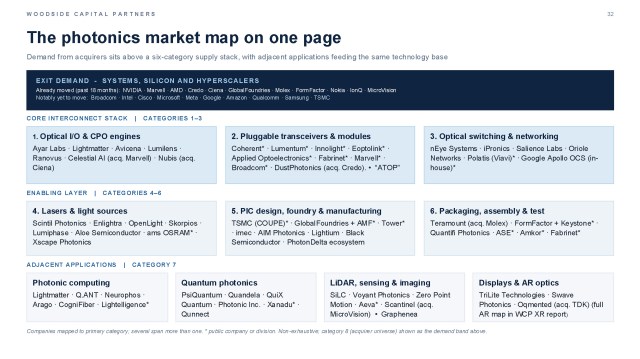
Image: the Woodside Capital photonics market map sets acquirer demand from systems, silicon and hyperscaler companies above a six-category supply stack of core interconnect and enabling technologies, with adjacent applications drawing on the same technology base. Companies are mapped to their primary category, public companies or divisions are marked with an asterisk, and the map is non-exhaustive. Courtesy of Woodside Capital Partners.
Side by side: what each deal type tells a venture investor
| Case | Round or structure | What the capital actually buys | Exit logic | Signal for the next deal you screen |
|---|---|---|---|---|
| Salience Labs | $125 million Series B, oversubscribed, led by Bullhound Capital with AMD Ventures, Intel Capital and Applied Ventures on the list | Factory ramp and deployment toward the 2027 volume node | Strategic acquirer needing switch-layer optics | Foundry-native architecture now commands round size |
| Ayar Labs | $650 million Series E at a $5.0 billion valuation, staged across 2026 | Production capacity plus architecture insurance from chip strategics | Late-stage markup before any IPO window | Valuation ladders follow customer commitments, not demos |
| Voyant Photonics | Chip-scale OCS engine; cumulative disclosed funding around $23 million | Reuse of an existing LiDAR switch matrix at low incremental capex | Sell the engine into other vendors’ platforms, or be absorbed by one | Capital efficiency is an asset only if the runway reaches the volume node |
| Marvell-Lumentum | $115 billion all-stock deal at 4.5 Marvell shares per Lumentum share | Portfolio completeness across lasers, modules and connectivity silicon | The exit template for the whole category | Acquirers pay in equity while their own shares re-rate |
| Lumilens (new-company comparable) | Over $700 million Series C at a $5.51 billion valuation, more than $900 million raised since a 2024 start | Own process flow plus high-volume manufacturing expansion, already shipping to a hyperscaler under a multi-billion-dollar agreement | Customer-locked scale-up optics before consolidation | Category now funds companies at Series C sizes once reserved for software |
Where the money goes next: three underwriting rules drawn from these cases
Rule one — ask for manufacturability evidence before asking for bandwidth numbers. Coverage assembled by Eastmoney and Caijing.com on 2026-10-28 describes China’s optical interconnect funding rising about 69.2% year-to-date, with investors’ core screening criteria shifting to supply-chain qualification and volume-production capability, and several Shanghai startups closing multiple rounds within months of incorporation. For APAC investors this is the practical transfer: the diligence checklist is converging across regions even as the architectures differ.
Rule two — count control points, not pitch decks. Cignal AI’s Optical Component Startup Tracker maps close to 70 venture-backed companies in the segments reshaping AI infrastructure, while its 1Q26 optical components report logged record quarterly component revenue of $7.7 billion. Roughly 70 startups chasing six scarce layers is a consolidation statistic, not a greenfield statistic; underwrite the probability that a given company occupies one of those layers exclusively.
Rule three — treat 2027 as a funding gate, not a roadmap slide. Woodside Capital’s own wording is that urgency declines as the gaps fill. If a portfolio company’s volume deployment slips past the inflection year, the scarcity premium that made the strategic-exit case may already be gone, so size reserves and follow-on triggers against that date rather than against product milestones.
Common misconceptions that cost investors money in photonics
- “A bigger round means a safer company.” Round size in this category tracks how expensive volume manufacturing is, not how close commercial risk is to zero. Compare the $125 million Salience Labs Series B with the roughly $23 million cumulative funding disclosed for Voyant Photonics: both face the same 2027 qualification clock.
- “Optics simply replaces copper link by link.” The investable surface is the seam between the two — packaging, test, lasers, foundry capacity — which is exactly what the Woodside Capital Partners control-point list enumerates.
- “A chip-strategic investor validates the technology roadmap.” Applied Ventures, AMD Ventures and Intel Capital appearing together is closer to a hedge across competing interconnect architectures than to an endorsement of a single one.
- “An exit at $115 billion sets the comp for everyone.” That number belongs to a listed component supplier being folded into a connectivity portfolio, not to seed or Series A optics assets; treat it as an upper bound on category strategic appetite rather than a valuation anchor.
Action advice for founders, angels and early-stage funds
Founders: build the data room around manufacturability — fab partner, pass-line yield, packaging and test plan, and the date at which a hyperscaler or switch vendor can qualify you. Anchor your own narrative to the 2027 volume node and show what a bridge round covers if that date moves by two quarters.
Angels and seed funds: the arbitrage is upstream and left on the stack. Passive components, alignment and test, laser integration and EDA-style photonic design tooling are the layers where sub-scale deals still exist, while optical-engine and switch companies are already priced for capacity.
Early-stage VC: reserve for the gap between design-win and volume production, insist on an exit thesis in the term sheet — which acquirer buys which layer and on what timeline — and re-underwrite the scarcity premium at every follow-on. Lumilens chief executive Ankur Singla framed the demand thesis in a line now widely repeated in investor decks, reported by Zhiding and Zhongcaiwang on 2026-08-06: the constraint has moved from how many accelerators you can buy to how many you can connect.
FAQ: what venture readers ask about the optical interconnect funding cycle
Is this an infrastructure bubble or a genuine supply shortage?
The evidence on both sides is measurable. Cignal AI logged record optical component revenue of $7.7 billion in 1Q26 and roughly 70 venture-backed startups in its tracker, so demand is real and the deal supply is crowded. The bubble risk is concentrated in the middle of the stack, where multiple companies pitch the same optical engine layer against a finite list of acquirers.
Why do chip companies invest rather than simply acquire?
Because investing buys optionality at a known price. Nvidia put $2 billion each into Coherent and Lumentum before adding $3.2 billion more into Corning, keeping several supply routes open while any single architecture is still contested. Applied Ventures, AMD Ventures and Intel Capital follow the same logic inside startup rounds.
What is the realistic window for a premium strategic exit?
Woodside Capital Partners answers it directly: the window is open now, but each deal removes a control point from the board, and urgency will decline as the gaps fill. On APACTechDigit’s reading, the operative deadline is one volume-production cycle ahead of the company’s own 2027 inflection assumption.
Should a founder raise a mega-round as early as possible?
Only if the cash converts into capacity the acquirer cannot build in-house. Salience Labs raised $125 million against a foundry-native plan with CPO alignment locked in early on; Voyant Photonics is betting that reusing an existing switch matrix lets it reach the same market on a fraction of that capital. The right question is which scarce asset the money buys.
Read next from APACTechDigit Venture Capital
This case file will be updated when the next three data points land: whether any 2026 vintage Series B in optics converts into volume shipments before the 2027 inflection, whether the all-stock structure of the Marvell-Lumentum deal becomes the template for follow-on photonics M&A, and how quickly the roughly 70 venture-backed component startups consolidate. The variable that decides returns in this category is not optical performance. It is who still needs to buy a control point.
Sources and further reading
- Woodside Capital Partners, “The Interconnect Imperative — Why AI is forcing the semiconductor industry to go optical” (with Yole Group), published 2026-10-11 — https://woodsidecap.com/the-interconnect-imperative-why-ai-is-forcing-the-semiconductor-industry-to-go-optical/
- tech.eu, “Salience Labs secures $125M to scale photonic chips for AI data centres”, 2026-10-14 — https://tech.eu/2026/10/14/salience-labs-secures-125m-to-scale-photonic-chips-for-ai-data-centres/
- Salience Labs, funding announcement — https://www.saliencelabs.ai/salience-labs-125-million-series-b-funding/
- Reuters, “Ayar Labs, backed by chip giants, extends funding round by $150 million”, 2026-09-10 — https://www.reuters.com/world/asia-pacific/ayar-labs-backed-by-chip-giants-extends-funding-round-by-150-million-2026-09-10/
- optics.org, “Voyant Photonics raises $15.4M in Series A funding”, 2022-01-03 — https://optics.org/news/voyant-photonics-raises-15.4m-in-series-a-funding
- Cignal AI, Optical Component Startup Tracker (2026-07-13) and 1Q26 optical components data — https://cignal.ai/2026/07/optical-component-startup-tracker/
- FinSMEs, “Lumilens Raises Over $700M in Series C Funding”, 2026-08-06 — https://www.finsmes.com/2026/08/lumilens-raises-over-700m-in-series-c-funding.html
- The Paper, coverage of the all-stock Marvell-Lumentum structure, 2026-11-03 — https://m.thepaper.cn/newsDetail_forward_34390507
- Eastmoney / Caijing.com, China optical interconnect funding and VC strategy split, 2026-10-28 — https://stock.caijing.com.cn/20261029/5190572.shtml